Farewell to Interest Rate Dependency: Circle Heavily Invests in Arc and Hyperliquid, Ushering in the First Year of Vertical Integration?
TechFlow Selected TechFlow Selected
Farewell to Interest Rate Dependency: Circle Heavily Invests in Arc and Hyperliquid, Ushering in the First Year of Vertical Integration?
Circle is transitioning from a simple interest-income business to a platform-based business driven by traffic and transaction fees.
 Navigating Web3 tides with focused insights
By Ekko An & Ryan Yoon, Tiger Research
Translated by AididiaoJP, Foresight News
Executive Summary
Marked by its Q1 FY2026 financial results, Circle is accelerating its transformation—from a pure stablecoin issuer into a comprehensive infrastructure operator for the digital asset industry. Its forward-looking business strategy rests on three core pillars:
- Maximizing USDC profitability and circulation: Interest income from reserves originates both from external platforms and Circle’s own infrastructure. The share of USDC usage on Circle’s proprietary channels (CPN) has increased significantly, driving RLDC profitability to a record high of 41.4% this quarter. To expand issuance volume, Circle has forged a deep partnership with DEX platform Hyperliquid.
- Launching its native L1 blockchain, “Arc,” to diversify revenue: Currently, 94% of Circle’s revenue still comes from reserve interest income. Once Arc scales its platform and begins generating platform fee revenue, it will fundamentally reduce Circle’s overreliance on reserve interest.
- Seizing leadership in AI-native payments via Agent Stack: Circle is establishing standards for autonomous micro-payments between AI agents. Commercialization is targeted for 2028—aligned with Arc’s infrastructure rollout and the effective date of the GENIUS Act.
Overall, Circle is expanding USDC issuance aggressively through strategic platforms like Hyperliquid while simultaneously pursuing vertical integration across its native L1 (Arc), payment network (CPN), and AI-native nano-payment layer (Agent Stack). Crucially, growth in USDC circulation and diversified infrastructure development reinforce each other in a virtuous cycle.
Through this path, Circle is transitioning from an interest-driven business model to a platform-driven one powered by traffic and transaction fees.
Q1 FY2026 Review: Improved Profitability
1. Revenue Growth and Margin Expansion, with Higher Proprietary Platform Share Strengthening Earnings Quality
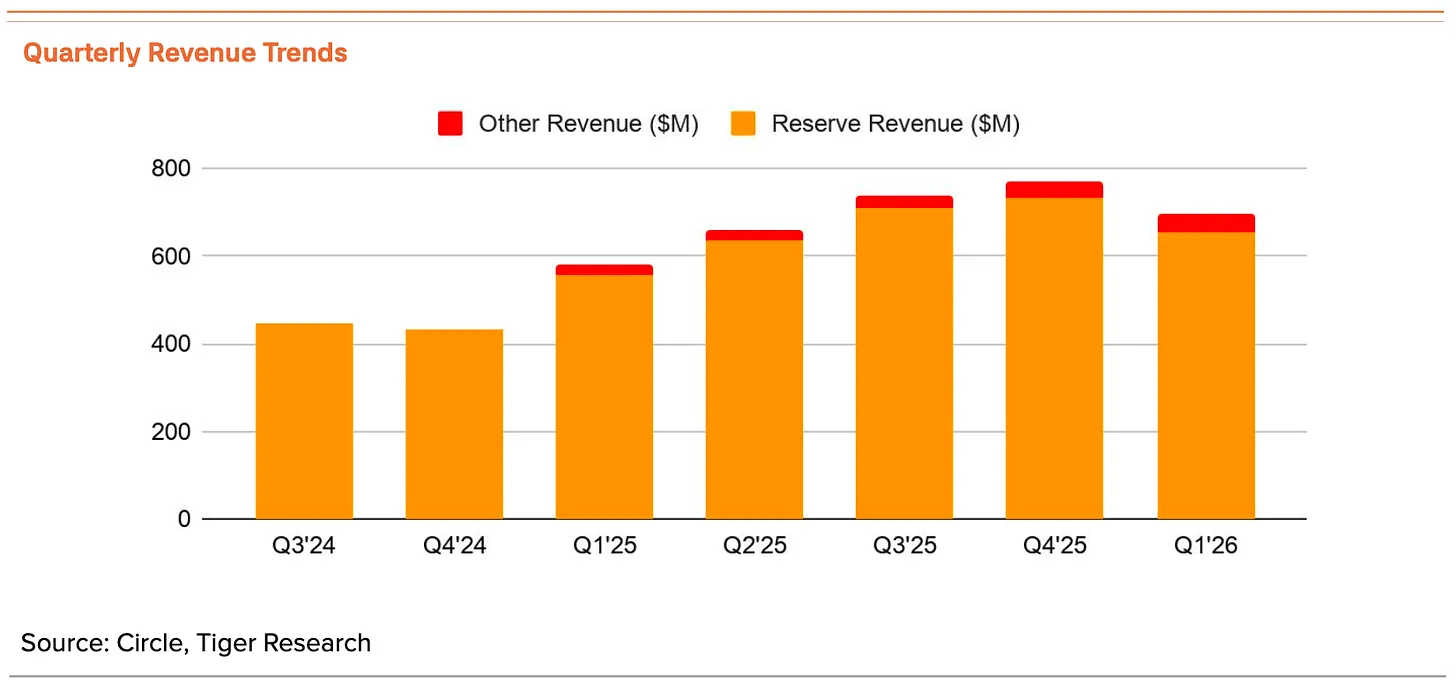
Q1 FY2026 revenue reached $694 million (+20% YoY), with adjusted EBITDA at $151 million (+24% YoY) and an adjusted EBITDA margin of 53%, reflecting improved profitability. However, 94% of Circle’s total revenue remains dependent on reserve interest income.
Reserve yield declined by 31 basis points sequentially (from 3.81% to 3.50%), exerting clear pressure on revenue. Nonetheless, RLDC profitability has risen for three consecutive quarters, reaching a new all-time high of 41.4%. Even with interest-sensitive revenue dominating, Circle has successfully enhanced underlying earnings quality.
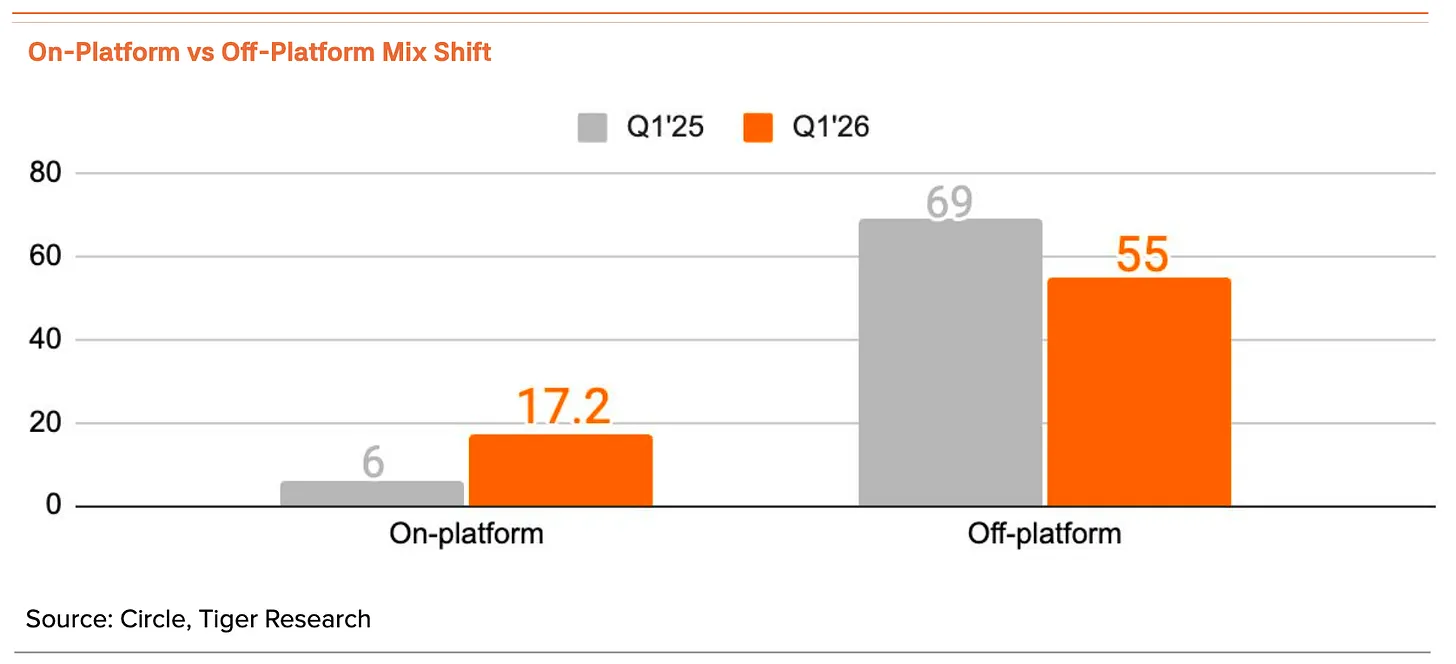
The key driver is the substantial increase in USDC usage on Circle’s proprietary platforms. The proprietary platform share surged from 6% last quarter to 17.2% this quarter (+1,149 bps YoY), while the external platform share dropped to 55%.
This shift stems from successful institutional onboarding onto the Circle Payments Network (CPN). Institutional members grew by 36% quarter-on-quarter to 136, and annualized total payment volume (TPV) expanded to ~$8.3 billion (+17% QoQ).
The phased rollout of CPN’s payment product suite underpins this trend:
- Fiat Payments (launched Q2 2025): Supports cross-border inbound and outbound payments in local currencies across 50+ countries.
- Stablecoin Payments (launched Q3 2025): Enables direct payments and settlements using compliant stablecoins (USDC, EURC) in 180+ countries.
- Custodial Payments (launched Q2/Q4 2026): Circle provides licenses, custody, compliance, and USDC liquidity support via a single-integration API. Partners only handle fiat—no need to manage digital asset custody, operations, or regulatory obligations.
This structural shift is critical for long-term earnings quality: revenue attribution differs sharply depending on where deposits reside. Balances held on external platforms like Coinbase require revenue sharing with partners, whereas balances on Circle’s proprietary platforms—including Circle Mint and CPN—are 100% retained by Circle.
In other words, higher proprietary platform share directly reduces partner-sharing costs—and thereby lifts RLDC profitability. At any given revenue level, Circle’s actual earnings power is meaningfully stronger.
Notably, CPN’s own transaction fee revenue has yet to meaningfully contribute. As CFO Jeremy Fox-Geen stated on the prior earnings call, network expansion—not monetization—is the current priority. CPN currently functions more as a conduit for routing funds onto Circle’s proprietary platforms than as a direct revenue channel. As a strategic measure to mitigate external revenue-sharing pressure, Q1 results confirm this approach is working.
2. Underlying Net Income Decline Hidden Beneath Top-Line Growth
However, contrasting the top-line growth and margin improvement is a notable divergence in underlying profitability—warranting attention. Q1 net income stood at ~$55 million, down 15% YoY.
The primary drivers are post-IPO equity-based compensation expenses and a sharp increase in R&D investment ahead of Arc’s infrastructure launch. Adjusted metrics—excluding one-time and non-cash items—remain robust, but the net income trajectory merits continued monitoring.
Circle’s Path Toward Full Vertical Integration
1. USDC: Reinforcing the Core, Scaling Issuance
Q1 reserve interest income totaled $653 million, representing 94% of total revenue. With such heavy concentration in reserve interest, revenue growth must rely on expanding USDC issuance.
USDC’s current circulating supply stands at ~$77 billion. Circle’s fundamental growth question is: How much higher can this ceiling be pushed? USDT’s early explosive growth was fueled by Binance’s first-mover advantage in listing it as a primary trading pair.
Circle aims to replicate that strategy on DEX platform Hyperliquid. A telling example is Coinbase’s recent acquisition of Hyperliquid’s native stablecoin USDH: rather than retaining USDH as Hyperliquid’s native trading pair, Hyperliquid sold it and registered USDC as its official trading pair instead.
Hyperliquid’s deposit growth directly translates into USDC issuance. Its TVL doubled from $2 billion in Q1 2025 to $4 billion in Q1 2026, peaking at $6 billion. Because Hyperliquid uses USDC as its base deposit asset, platform growth directly drives incremental USDC issuance. Forward-looking circulation scenarios based on this dynamic are as follows:
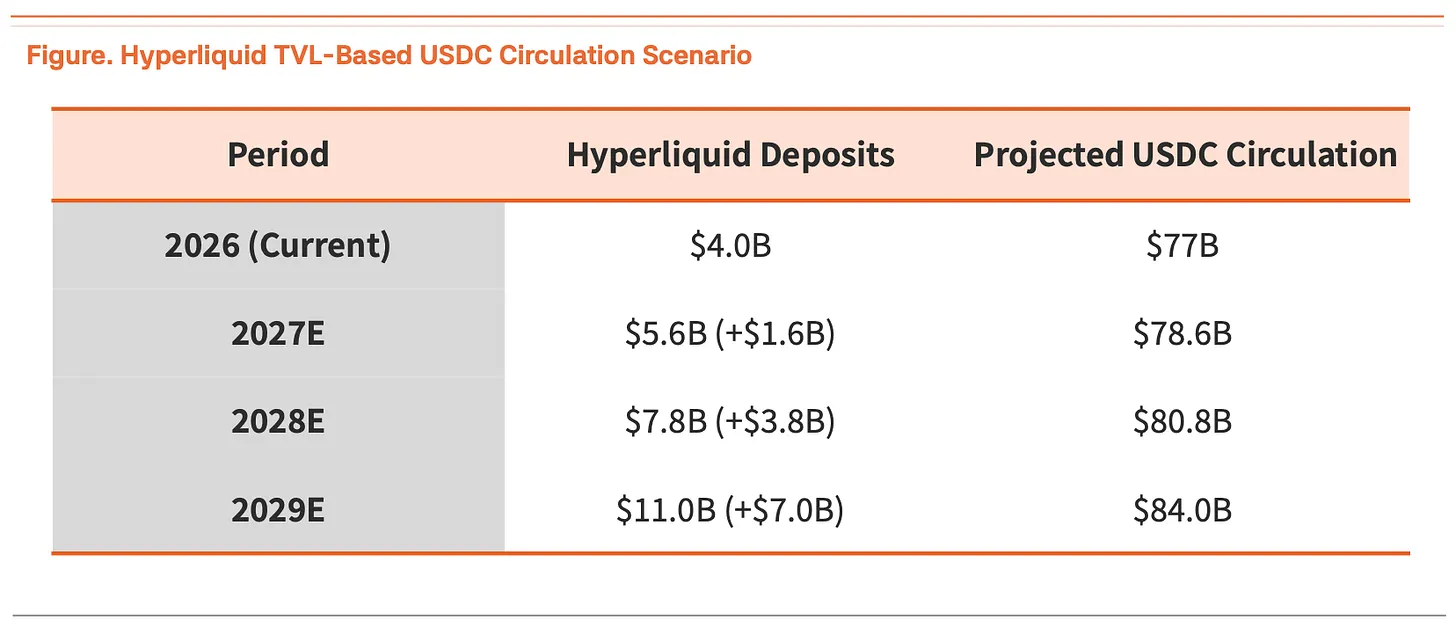
According to scenario modeling, Hyperliquid alone could lift USDC’s total circulating supply from $77 billion today to $84 billion within three years—a contribution exceeding 10% of total circulation and establishing it as a major issuance channel.
Though Circle must cede 90% of reserve interest to the platform, short-term profitability is modestly diluted. Yet given Hyperliquid’s daily trading volume of ~$11 billion and its 17% share of the DEX derivatives market, this trade-off approaches an acceptable strategic investment.
If Hyperliquid subsequently launches derivatives products built on USDC, this virtuous cycle would strengthen further. For Circle—whose priority remains circulation growth over near-term margins—even partial profit-sharing makes Hyperliquid a strategically indispensable battleground.
2. Arc: How Circle Breaks Free from Rate Dependency
As noted earlier, Circle’s revenue is highly concentrated in reserve interest, exposing it structurally to rate cuts. Arc remains in testnet phase and has not yet generated visible revenue. Yet backed by ~$222 million in recent institutional funding, Arc has become the cornerstone infrastructure designed to sever Circle’s dependence on interest rates at a foundational level.
Arc’s primary target is the global cross-border payments market. According to the World Bank’s Remittance Prices Worldwide (RPW) Issue 54 report, the global average remittance cost is 6.36%, with bank transfers costing as much as 14.99%. High costs stem from SWIFT’s multi-layered intermediation, opaque FX spreads, and weekend settlement delays.
To address inefficiencies in traditional finance rails, Circle plans to generate platform revenue atop Arc. Infrastructure fee revenue—designed to reduce rate dependency—rests on two pillars:
- Circle Payments Network (CPN): Onboards global institutions and enterprises onto Arc for cross-border payments and settlements, charging per-transaction processing fees. Q1 institutional fund inflows serve as seed capital for full-scale transaction revenue upon Arc mainnet launch.
- On-chain FX Engine (StableFX): Enables on-chain stablecoin exchange, replacing traditional FX’s high intermediary spreads. Smart contracts charge a pre-set fee from each transacting currency upon execution.
StableFX employs an RFQ (Request-for-Quote) model—not SWIFT’s fixed-cost structure. Market makers bid in real time to offer optimal wholesale spreads. Large-value transfers settle 24/7—free of SWIFT’s fixed fees and slippage.
More CPN traffic and higher StableFX volumes on Arc translate directly into greater infrastructure and fee revenue. This completes Circle’s non-interest-based revenue architecture.
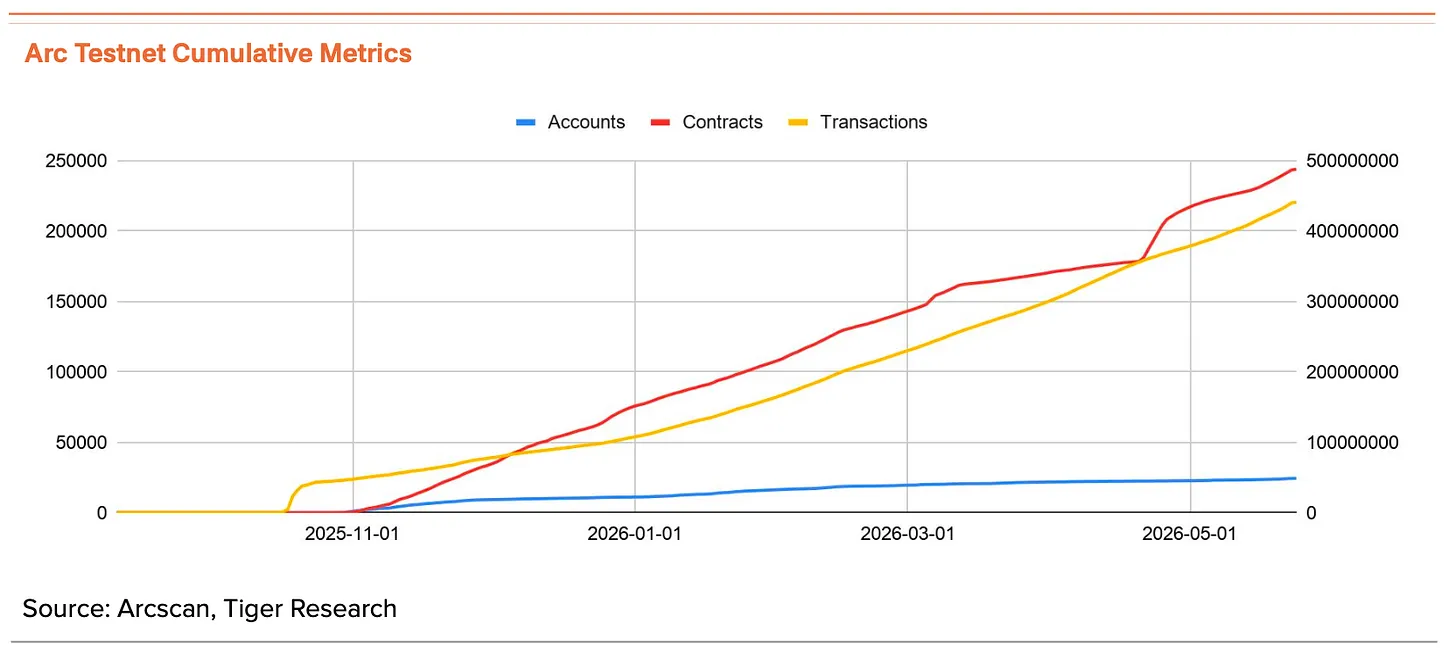
This transition is already validated in testnet and among participating enterprises. Per Arcscan data, the public testnet has processed ~430 million cumulative transactions, with 3.26 million transactions in the past 24 hours. Over 100 global institutions are engaged—including BlackRock, HSBC, Visa, and AWS.
Beyond traditional finance, blockchain-based prediction market Polymarket has also joined the ecosystem.
This goes beyond functional or platform pilots. Arc is attracting real enterprises and driving real transactional traffic. If Arc performs as planned, Circle will pivot from USDC reserve interest revenue to infrastructure operations revenue. Arc is the first decisive step toward untethering Circle’s revenue model from interest rates.
Per the roadmap, the Arc mainnet is scheduled to launch this summer. Meaningful Arc revenue is expected to emerge gradually after mainnet activation.
3. Agent Stack: The Blueprint for Autonomous AI Payments
The “agent economy”—where AI agents replace humans in decision-making and transactions—is rapidly approaching. Global tech giants including Google and OpenAI have begun actively deploying such autonomous systems.
The bottleneck lies in payment infrastructure. Fees generated by AI agent API calls are priced in sub-cent microamounts—far below what traditional payment systems can process efficiently. Routing such micro-payments through credit card networks incurs fees exceeding principal, resulting in net losses per transaction. Agent payments are structurally incompatible with existing card networks.
Circle precisely targets this gap with its “Circle Agent Stack,” using USDC as the settlement asset and providing a full toolkit for building supporting infrastructure:
- Agent Wallets: Enable AI agents to autonomously hold and send USDC within human-defined parameters (e.g., spending limits).
- Agent Marketplace: A store where AI agents acquire API services and settle per-call.
- Agent Nanopayments: Enables gas-free, instant USDC settlement down to ~$0.000001.
- Circle CLI: A command-line interface for wallet creation and agent connectivity.
- Circle Skills: Modules enabling AI agents to directly operate Circle’s full financial product suite.
Revenue from this domain remains unmaterialized. Market adoption and revenue recognition are expected to follow this phased roadmap:
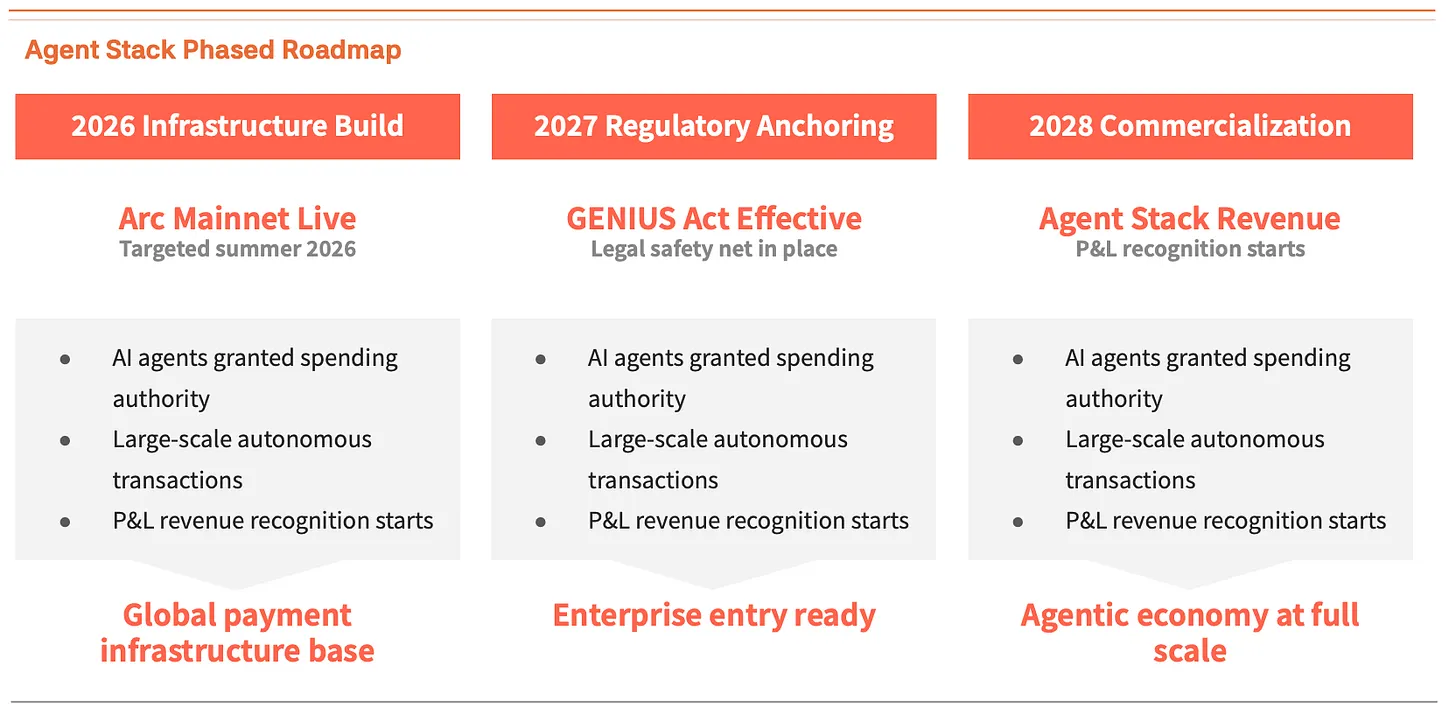
- 2026 (Infrastructure Phase): Build a robust, scalable technical foundation for nano-payment processing. Arc mainnet activation this summer will enable partners to integrate Circle CLI and financial modules.
- 2027 (Regulatory Anchoring Phase): The GENIUS Act takes effect, establishing an institutional safety net for enterprise onboarding. With legal clarity around stablecoin securities exemptions and the requirement for 100% safe asset backing, even conservative corporate legal teams can adopt and test USDC payment systems internally—risk-free.
- 2028 (Commercialization & Monetization Phase): Technical infrastructure and regulatory legitimacy fully align. The agent economy achieves full commercialization. Enterprises grant AI agents real spending authority, triggering massive transaction volumes—and Agent Stack’s impact will appear clearly on financial statements.
Thus, before traffic-driven revenue arrives en masse in 2028, Agent Stack will likely manifest as an “expectation premium” in Circle’s stock price—reflecting future market leadership value rather than current revenue generation.
Join TechFlow official community to stay tuned
Telegram:https://t.me/TechFlowDaily
X (Twitter):https://x.com/TechFlowPost
X (Twitter) EN:https://x.com/BlockFlow_News
 @tiger_research