








Perpetual Protocol: The Next Level of Decentralized Derivatives Trading
TechFlow Selected TechFlow Selected
Perpetual Protocol: The Next Level of Decentralized Derivatives Trading
Perpetual Protocol is a DeFi project whose primary goal is to create the best, most accessible, and most secure decentralized derivatives exchange for perpetual futures.
 Navigating Web3 tides with focused insights
Author: jakub
Translation: Alex, TechFlow
So what exactly is Perpetual Protocol? What improvements does its recently launched version 2 offer? How does it utilize Uniswap V3? And what lies ahead for Perpetual?
Introduction
Perpetual Protocol is a DeFi project primarily aimed at creating the best, most accessible, and secure decentralized derivatives exchange for perpetual futures.
Founded in 2019 by a small team of startup founders and software engineers, the project was initially named "Strike" before pivoting to perpetual futures and rebranding in the summer of 2020.
The first version of the protocol launched in December 2020 on the xDai network. Version 2 of the protocol, named Curie after the renowned scientist and Nobel laureate Marie Curie, went live on Optimism on November 31, 2021.

The design of Perpetual Protocol, as we will explain later, is particularly interesting because it embraces the DeFi "money legos" philosophy—both building on existing DeFi projects and serving as a foundational component for future protocols.
Perpetual Protocol is one of the key DeFi projects focused on derivatives. Before diving into its architecture, let’s first understand the primary derivative product it offers—perpetual futures.
Perpetual Futures
Perpetual futures are among the most popular trading instruments in the cryptocurrency space. Originally offered by well-known centralized platforms such as Bitmex, Binance, or Bybit, they are now making their way into DeFi.
Like other derivatives, perpetual futures allow exposure to the price of a specific financial instrument without holding the underlying asset. This can serve multiple purposes, including price speculation, hedging, or arbitrage.
Unlike standard futures contracts, perpetual futures do not expire and have no settlement date, allowing them to be held and traded indefinitely.
The absence of a settlement date benefits traders significantly, eliminating the need to manage multiple contracts with different expiration dates. In traditional futures, the settlement date plays a crucial role in aligning the futures price with the actual spot price of the underlying asset as expiry approaches.
To ensure that perpetual contract prices do not diverge excessively from their underlying assets, perpetuals use a funding rate mechanism. Funding rates are paid periodically and incentivize one side of the market—either long (bullish) or short (bearish) position holders.
Typically, when the perpetual contract price exceeds the spot price, the funding rate turns positive, and longs pay shorts. Conversely, when the perpetual price falls below the spot price, shorts pay longs.
This mechanism helps align the price of a perpetual contract with that of its underlying asset. In addition to funding rates, price speculators and arbitrageurs also help prevent significant price discrepancies across different derivative or spot exchanges.
Perpetual futures also provide a straightforward method to short a particular asset, enabling market participants to profit from a decline in its price over time.
They also facilitate easy access to leverage, allowing traders to control larger positions than would otherwise be possible with the same capital. While useful in certain scenarios, this can also be highly risky, as undercollateralized positions may face liquidation when the market moves against them.
Generally, derivatives markets contribute to price discovery for various assets by providing a venue where all market participants can easily trade, often involving large orders. For some financial instruments, the derivatives market can even become the primary source of price discovery.
Perpetual Protocol
Perpetual Protocol enables trading of perpetual contracts on major cryptocurrencies like Bitcoin and Ethereum, with plans to add many more assets in the future.
Unlike centralized exchanges offering similar products, Perpetual Protocol does not custody user funds, ensuring users retain full control over their assets. Moreover, it allows users to trade in a permissionless and fully transparent manner.
Currently, Perpetual uses USDC stablecoin as its primary collateral, though this may expand to include other collateral types in the future.
Using USDC across the platform also means all trades settle in USDC. For example, if a user speculates on Ether's price and doubles their capital, they will receive additional USDC in their account upon closing the position.
Version 1 of the protocol was initially deployed on Ethereum Layer 1 but encountered slow execution and high transaction fees. As a result, it was launched on xDai at the end of 2020.
Version 2
Version 2 iterates on the original design and introduces a new model for managing positions and executing trades, leveraging Uniswap V3 and its concentrated liquidity feature.
At the core of Perpetual Protocol's design is the Clearinghouse smart contract. The Clearinghouse mints and burns virtual tokens called v-tokens, which represent user-held positions within the system.
When a user deposits USDC into the exchange, the Clearinghouse contract mints v-tokens using the maximum available leverage. This does not mean users must use maximum leverage when opening a position; rather, it gives them the option to do so by issuing the maximum number of tokens, which they may or may not fully utilize.
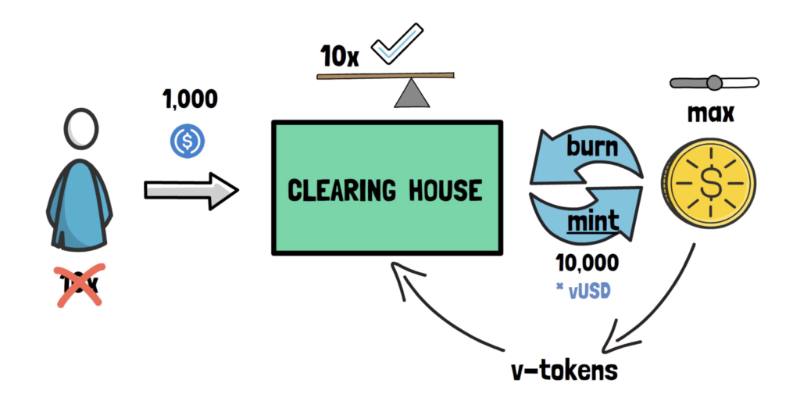
For instance, if a user deposits 1,000 USDC, the protocol issues 10,000 v-tokens—in this case, vUSD.
To open a specific position, users select the desired product and use v-tokens to enter the trade.
For example, if a user wants to go long on BTC, they instruct the Clearinghouse to swap their vUSD tokens for vBTC. The protocol then executes this trade via the Uniswap V3 vUSD-vBTC pool.
As mentioned earlier, depending on the chosen leverage ratio, users may use only part or all of their vUSD tokens.
When a user decides to close their BTC position, they can swap their vBTC tokens back to vUSD, realizing profits or losses based on Bitcoin’s price movement since opening the position.
In addition to traders, the Clearinghouse contract is also used by makers.
In Perpetual, makers are market participants who provide liquidity to perpetual futures markets. By doing so, they earn trading fees whenever trades occur in the pools they support. Makers can also use leverage when providing liquidity.
Due to Uniswap V3’s design, providing liquidity is more complex than on other AMMs. Specifically, makers must choose a price range within which to provide liquidity and only earn fees from trades that occur within that range.
Similar to traders, makers interact with the perpetual futures exchange using USDC. When a maker chooses to provide liquidity for a given asset, they deposit USDC into the Clearinghouse contract, which then mints the appropriate vTokens and automatically adds liquidity to the selected Uniswap V3 pool.
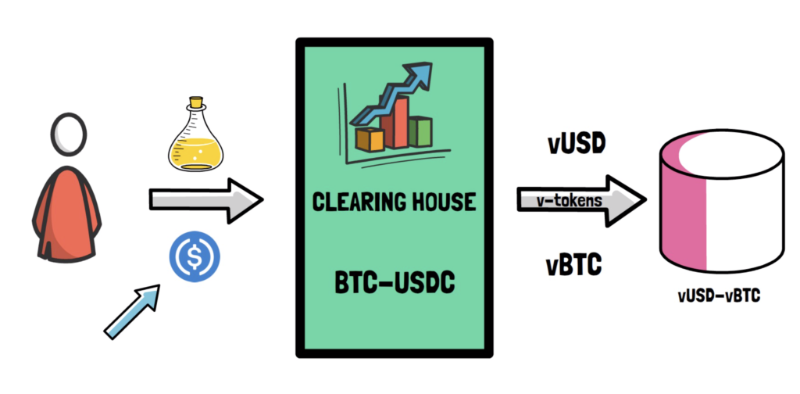
For example, if a maker decides to provide liquidity in the BTC-USDC market, their USDC will be used to mint the correct ratio of vUSD and vBTC, which are then added to the vUSD-vBTC Uniswap V3 pool.
Since makers are exposed to price movements of the underlying tokens in the liquidity pool, they are subject to impermanent loss and must carefully select their liquidity range, ideally employing a sustainable strategy.
To simplify liquidity provision on Uniswap V3, Perpetual has partnered with protocols such as Popsicle Finance and Visor.
Interestingly, Perpetual Protocol builds directly on top of Uniswap V3, fully embracing the aforementioned "money legos" philosophy in a permissionless manner.
On margin models, Perpetual Protocol uses cross-margining, meaning user funds are pooled together and used as collateral across all their positions.
This simplifies collateral management, as users don’t need to add or remove margin for each individual position. However, it requires caution, as a single losing position could impact others and potentially trigger liquidations. Users can alternatively use isolated margining by creating separate wallets for each position.
Layer 2
Version 2 of the protocol has just launched on Optimism—an optimistic rollup Layer 2 scaling solution for Ethereum.

Launching on a rollup enables Perpetual Protocol to scale, achieving low transaction fees and high throughput—critical factors for operating a successful perpetual futures exchange. As these solutions mature and become even more cost-effective, the advantages of rollups should become increasingly evident over time.
Version 1 will remain active on xDai. If Uniswap V3 launches on xDai, V2 could also be deployed there.
Perpetual also plans to launch on Arbitrum in the near future.
The rollout of Perpetual V2 is ongoing. During the full V2 deployment, the protocol intends to introduce additional features such as limit and stop-loss orders, staking, multi-collateral support, liquidity mining, and even permissionless market creation.
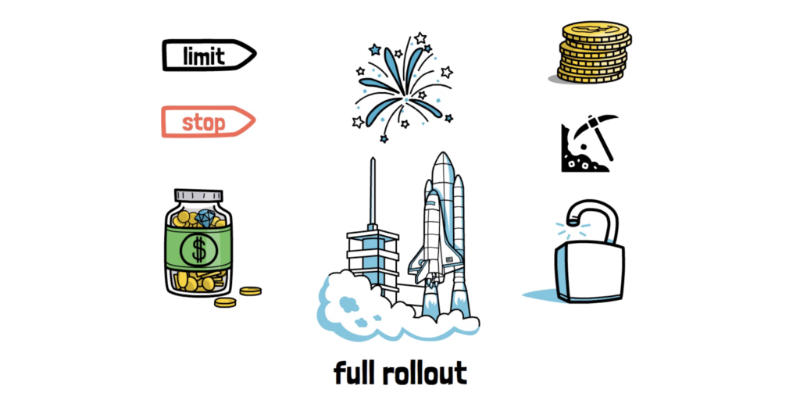
Regarding the latter, anyone will be able to create a perpetual market for any asset, provided price information is available via Uniswap V3 TWAP or Chainlink oracles—both supported in V2.
Furthermore, in future updates, the protocol will expand beyond cryptocurrencies to include markets such as forex, commodities, and stocks.
Conclusion
Perpetual Protocol is undoubtedly one of the most compelling projects in the DeFi derivatives space.
It appears the team has learned valuable lessons from the first version and introduced a refined, improved design that should make perpetual trading more sustainable and appealing to both traders and liquidity providers.
Perpetual Protocol exemplifies how projects can greatly benefit from launching directly on Ethereum Layer 2 solutions like Optimism or Arbitrum.
It suggests that a new class of protocols may be better off launching directly on Layer 2, bypassing Layer 1 deployment altogether. We look forward to seeing other protocols adopt this approach and explore possibilities previously constrained by Ethereum’s Layer 1 limitations.
TechFlow is a deep-content platform focusing on alternative asset investment. Follow our official account for more insights, and add WeChat TechFlow01 to join the TechFlow community and participate in discussions.

Join TechFlow official community to stay tuned
Telegram:https://t.me/TechFlowDaily
X (Twitter):https://x.com/TechFlowPost
X (Twitter) EN:https://x.com/BlockFlow_News






