Up to nearly 4x surge, the pump story behind Story Protocol
TechFlow Selected TechFlow Selected
Up to nearly 4x surge, the pump story behind Story Protocol
Buybacks + DAT companies drove the price increase, and the trend of intellectual property securitization in the financial industry is worth noting.
 Navigating Web3 tides with focused insights
By: Eric, Foresight News
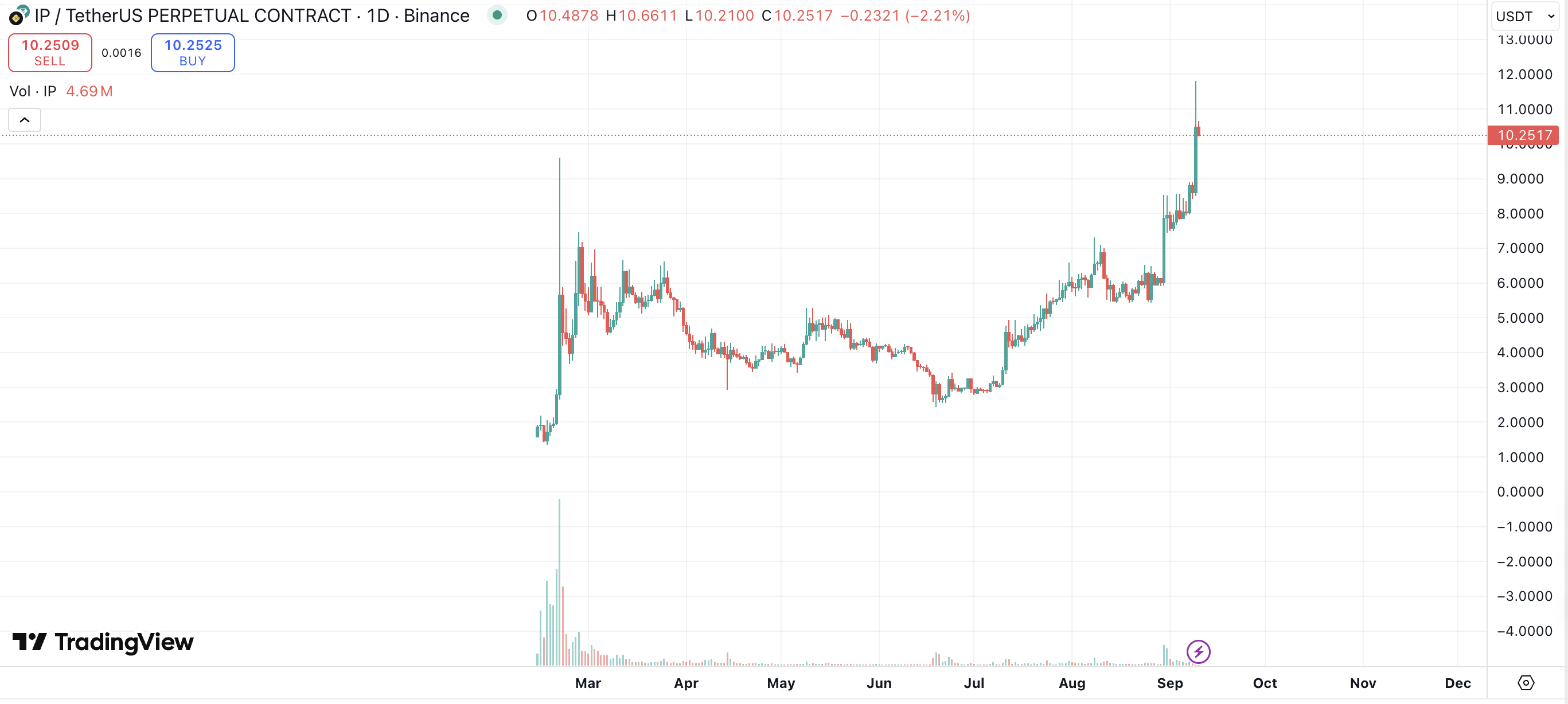
On September 9 (Beijing time), the Story Protocol token surged nearly 40% within a single day, briefly reaching close to $12—about 8 times higher than its initial exchange listing price of $1.35 and nearly 4 times higher than its mid-June low of around $2.40. However, compared to recent "meme coins" that have skyrocketed multiple-fold in just days, IP (its token) has seen a relatively moderate rise.
With this rally, Story Protocol’s FDV has surpassed $10 billion. According to CoinMarketCap data, IP currently ranks 40th by circulating market cap, ahead of APT (Aptos) and MYX—which recently surged—but behind ETC (Ethereum Classic) and ONDO.
Story Protocol is a protocol focused on intellectual property (IP) assetization and one of the few projects that a16z has heavily backed over the past two to three years.
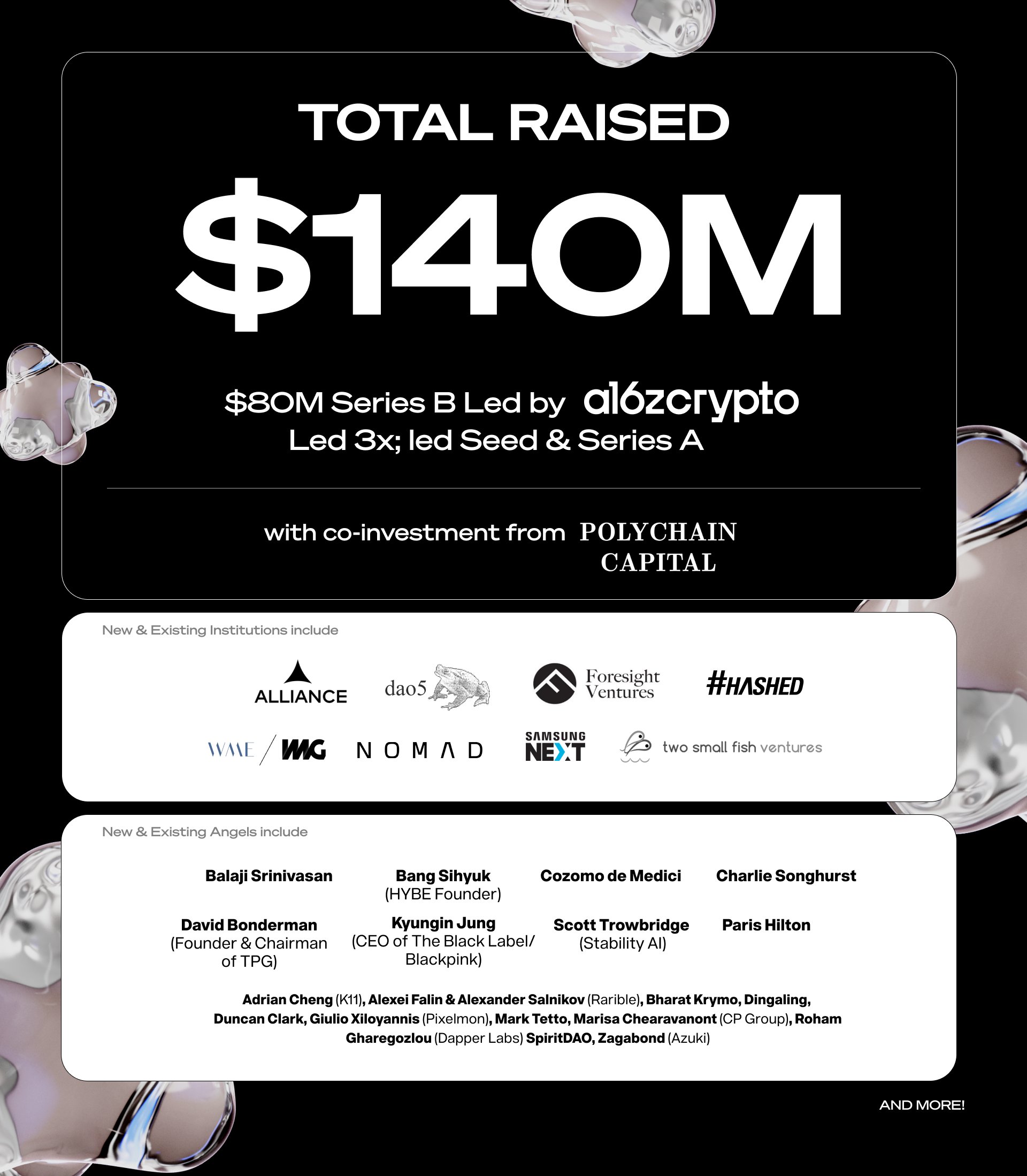
Two years ago on September 6, Story Protocol announced a $29 million funding round led by a16z crypto. Combined with a $29.3 million raise completed in May of the same year, its total funding reached over $54 million at the time. Nearly a year later, in August 2024, Story Protocol announced an $80 million Series B round, again led by a16z Crypto. According to TechCrunch citing sources, the post-money valuation for the Series B reached $2.25 billion. Foresight Ventures also participated in both rounds.
Story Protocol aims to build a vast ecosystem around "on-chain IP," and both the ecosystem and its projects have attracted strong investor interest. In late June this year, Story Protocol and OKX Ventures jointly announced a $10 million fund to support early-stage teams working at the intersection of intellectual property and artificial intelligence. In July, Poseidon—an AI-powered decentralized data layer project built on Story Protocol—secured a $15 million seed round led by a16z.
Earlier, at the end of last year, Sekai—a generative AI storytelling platform based on Story Protocol—announced a $3.1 million seed round led by Hashed, with participation from a16z CSX.
Sources familiar with the matter told the author that some members of Story Protocol were introduced via a16z, transitioning from the ZKsync team to Story. It appears a16z helps accelerate growth for new ventures by assigning executives from more mature portfolio companies to lead emerging ones.
Turning back to the IP token itself, after its official launch in February, IP went through a rollercoaster ride, bottoming out during Bitcoin’s correction following its May peak, before steadily climbing upward since then.
The uptrend began with the previously mentioned joint ecosystem fund announcement with OKX Ventures. In July, Grayscale updated its “Assets Under Review” and “Current Holdings” lists, adding Story Protocol’s token IP into consideration. At the end of July, Grayscale officially launched the Grayscale Story Trust, bringing real buying pressure as positive catalyst.
Subsequently, the launch of DAT and the Story IP buyback program pushed market sentiment to a peak. One month ago, Nasdaq-listed Heritage Distilling announced a $220 million PIPE financing ($100 million in cash and $120 million in IP tokens) to establish a $360 million reserve fund focused on IP. Lead investors included the Story Foundation and a16z crypto. Heritage will allocate $82 million in proceeds to purchase IP tokens from the Story Foundation at a fixed price of $3.40. The Story Foundation will use the $82 million from token sales to strategically repurchase IP tokens on the open market within 90 days after closing (August 15 to November 16).
About two weeks after the initial announcement, Heritage Distilling secured another $223.8 million private placement round co-led by Story Foundation and a16z crypto, further advancing its reserve initiative. On the very day IP surged 40%, Heritage Distilling officially unveiled its strategic reserve holding Story-native token IP.
The genuine buying demand from DAT and Grayscale funds has been the biggest driver behind this rally. Yet, unlike many tokens that decline steadily after launch, IP has held strength because this sector genuinely represents one of the opportunities gaining attention in finance.
Prior to this, the Story ecosystem has seen several valuable projects emerge, primarily in AI and music IP assetization. The AI angle needs little explanation; while the "Web3 + AI" narrative still awaits broader market validation, tokenizing AI algorithms’ IP and collaborating with AI projects to empower creators on related platforms remains a promising direction.
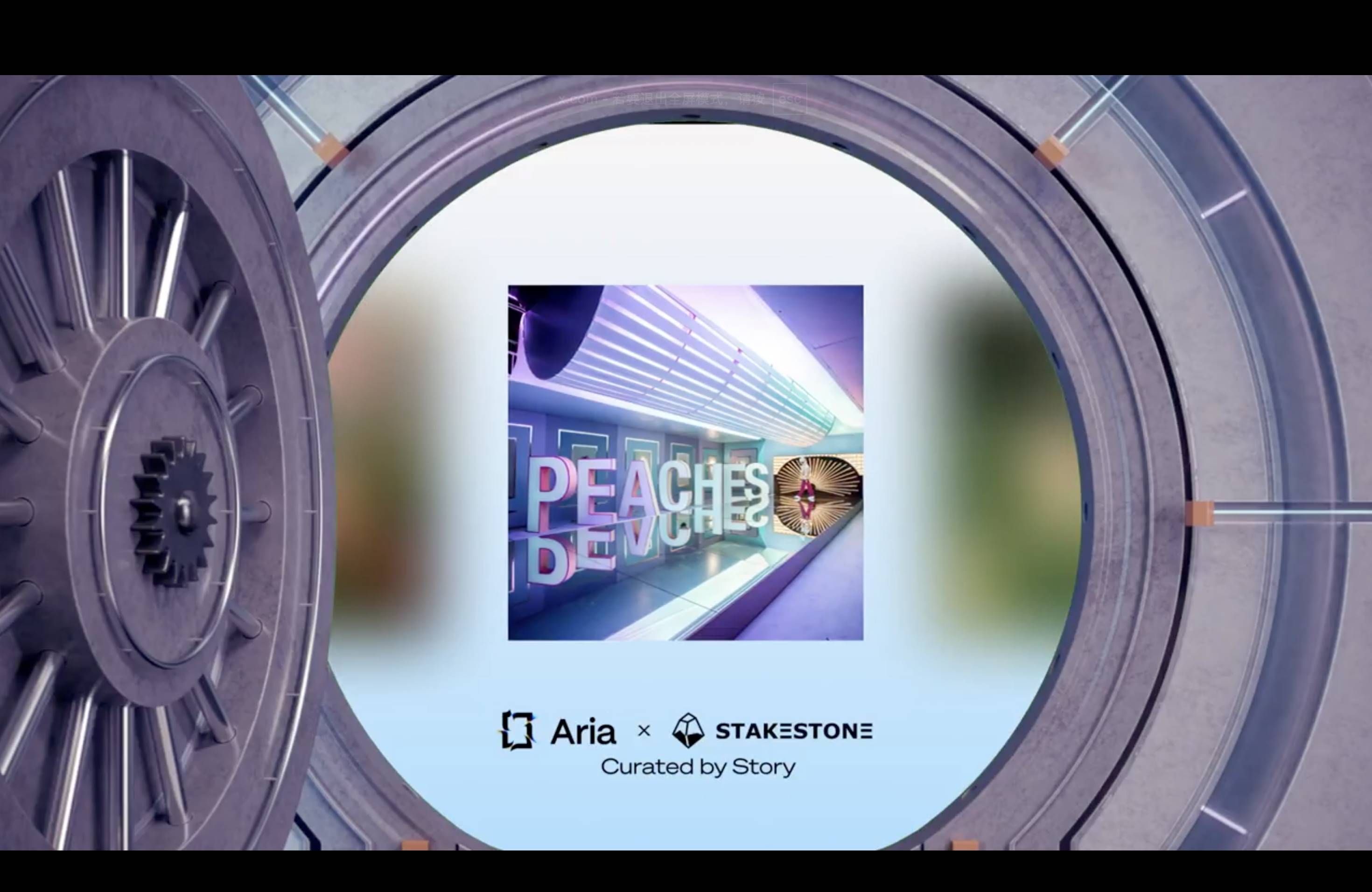
In music IP assetization, progress has been even more concrete. Earlier this year, Aria—an IP RWA protocol built on Story—launched its first RWAIP asset: Justin Bieber’s single “Peaches,” with a total deposit cap of $7 million. By depositing funds, users gain partial rights as producers, managers, and copyright holders of the track. The asset achieved full-chain liquidity via StakeStone.
Following this, Aria set its sights on music copyrights from other major artists, including South Korean groups BLACKPINK and BigBang, as well as Western pop stars Katy Perry and Maroon 5. Story previously announced it would host the Origin Summit during Korea Blockchain Week, with attendees including the CEO of HYPE (BTS’s agency), the CEO of The Black Label (home to BLACKPINK & BIGBANG members), SM Entertainment’s CAO, and SK Networks’ CEO. Story’s founder had previously hinted at upcoming partnership announcements, making the end-of-month event particularly noteworthy.
Over the past two to three years, music asset securitization has gained momentum on Wall Street. In an article titled “Sweeter Than Corporate Bonds? Music Asset Securitization Booms on Wall Street”, Alpha Research指出 that investors such as Blackstone, Carlyle Group, and the Michigan State Pension Fund have already raised at least $4.4 billion this year through debt financing backed by song copyrights. According to the Financial Times, debt financing backed by music rights in 2025 has already exceeded 2024’s $3.3 billion. In 2021, transaction volume was only $300 million, and there were no recorded deals at all in 2020.
Intellectual property securitization—and even tokenization—is a highly promising field, especially as high-quality assets become increasingly scarce. At a time when RWA tokenization is rapidly advancing, and with Nasdaq applying to the SEC for approval to trade tokenized stocks, more tokenized high-quality assets are expected to enter public secondary markets.
Join TechFlow official community to stay tuned
Telegram:https://t.me/TechFlowDaily
X (Twitter):https://x.com/TechFlowPost
X (Twitter) EN:https://x.com/BlockFlow_News
 Foresight News