After DeFi and NFT, DAO will become the third main player on the crypto stage
TechFlow Selected TechFlow Selected
After DeFi and NFT, DAO will become the third main player on the crypto stage
The DAO governance model has achieved initial success in crypto-native communities and will continue to thrive—now is the perfect time to join this revolutionary wave.
 Navigating Web3 tides with focused insights
Author: Yasmine Karimi, Analyst at Nansen
Translation: Perry Wang
First decentralized finance (DeFi), then non-fungible tokens (NFTs), now decentralized autonomous organizations (DAOs).
If you're reading this, it means you’re gaining awareness of this trend very early. We believe that today’s 169 DAOs (data from DeepDAO) are merely a drop in the ocean of what's coming next in crypto. These DAOs are pioneering revolutionary governance models with the potential to replace all forms of enterprises, governments, and human organizations.
What is a DAO?
DAO stands for Decentralized Autonomous Organization—a crypto-native collective formed around a shared purpose, often (but not always) pooling funds toward specific goals or missions.
Use cases for DAOs are endless and continuously evolving. They range from purely social platforms—like token-gated Discord servers (e.g., Friends With Benefits, recently backed by a16z)—to investment-driven platforms like MetaCartel. PleasrDAO offers another fascinating example—an amalgamation of a social DAO and an art-collecting DAO that acquires culturally significant digital artworks over time. Below is a landscape map of the DAO ecosystem in 2021.
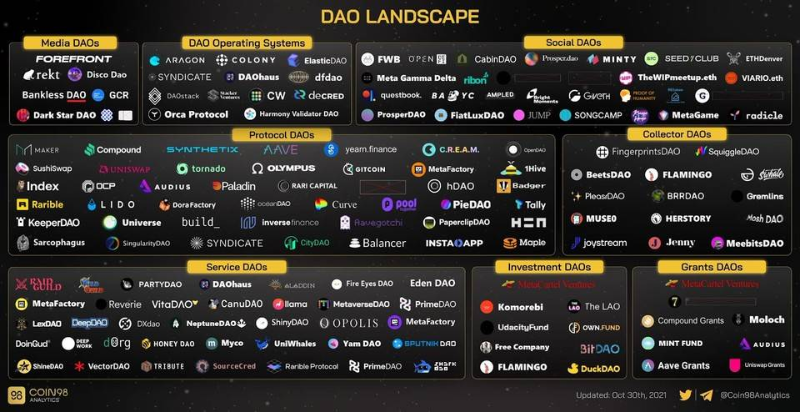 2021 DAO Landscape, Source: Coin98
Given their diverse use cases and the rapid emergence of new DAOs, market participants and observers still struggle to grasp the true significance of DAOs.
Therefore, we see a need to clarify the fundamentals of DAOs, illustrate how they differ from traditional organizations, and offer guidance on engaging with this revolutionary wave.
Understanding DAO Governance
The simplest way to explain a DAO is by unpacking its acronym. First, DAOs are autonomous, meaning they are organizations run by smart contracts. These smart contracts are lines of self-executing code agreed upon by the DAO’s initial developers and stored immutably on the blockchain. They allow the organization to maintain itself when faced with hiring decisions, reward distributions, and other bureaucratic or critical organizational issues.
Second, unlike traditional organizations where decisions are made by a CEO or executive team, DAO decisions are made collectively. Members who hold one or a predetermined number of the DAO’s native tokens can propose changes to the smart contract, initiatives, or investment ideas and vote on them—the exact process varying across different DAOs—to drive the DAO forward. Notably, eligibility criteria, economic rights, and governance rights vary significantly across DAOs.
Membership in a DAO stems from ownership of its native token. The minimum required number varies per DAO. Individuals may purchase tokens during or after the token launch, receive them as contributions, or earn them through participation—again depending on the specific DAO. While DAOs are often known for being open to all, smaller DAOs typically have higher permission barriers than larger protocol-based DAOs. In such cases, simply holding tokens may not suffice—written applications and invitations from existing members are also required.
Once joined, holding a DAO’s native token unlocks various benefits—from voting rights to profit-sharing from the organization’s earnings. Typically, in large protocol DAOs operating as financial service platforms (such as multi-chain platform BitDAO or lending platform Compound), member benefits include voting rights on matters related to fees and distributions. When token supply is capped and demand rises, members also benefit from overall token appreciation. In some cases, governance tokens confer greater voting power but lack intrinsic monetary value—for instance, GHST, the native token of AaveGotchi.
In smaller DAOs (under 500 members), membership usually implies active work for the DAO. Beyond voting rights, members may receive tokens, token yields, predetermined shares of treasury funds, and/or cryptocurrencies (like Ether, Dai, or Cash) in exchange for contributions. This is especially true for investment-focused DAOs (e.g., The LAO, MetaCartel) and collector DAOs (e.g., PleasrDAO). Some DAOs, like MetaCartel, even require ongoing participation in management duties, due diligence, proposal submissions, and voting on investments to retain membership.
Once a member, voting rights are granted—but the specifics vary widely between DAOs. Minimum voting requirements might include holding at least one native token, reaching a threshold amount, or owning a percentage of total supply (e.g., Nouns DAO requires 1% of total supply). After proposals are submitted, members vote, and quorum thresholds for approval vary—examples include 10%, 20%, or even 50% participation requirements (as seen in The LAO).
How Does the DAO Model Transform Human Organizations?
This is a revolutionary model that brings about a paradigm shift in human organizations through two defining characteristics.
First, internet users are, for the first time in history, able to collectively create and exchange value within a trustless environment—namely, the blockchain. Blockchain technology first empowered DeFi, then NFTs, and is now creating a collaborative workspace for groups. Blockchain eliminates the need for third parties in financial transactions, as all rules and transactions are recorded on-chain. This means DAOs operate independently of government institutions because the blockchain acts as the trusted intermediary.
Second, unlike other organizational forms, DAOs feature stronger incentive mechanisms. Members are incentivized by voting rights, which may influence fee distributions and rewards, and by sharing in profits via tokens, buybacks, or cryptocurrencies. Since the advent of traditional Web2 platforms, most user-created value has been captured by platforms (specifically their founders/CEOs). In the new framework built by DAOs, members can share in that value. The exact mechanism depends on each DAO’s unique economic and voting structure. Overall, this alignment of incentives is believed to motivate members to contribute their best efforts, making the organization more efficient.
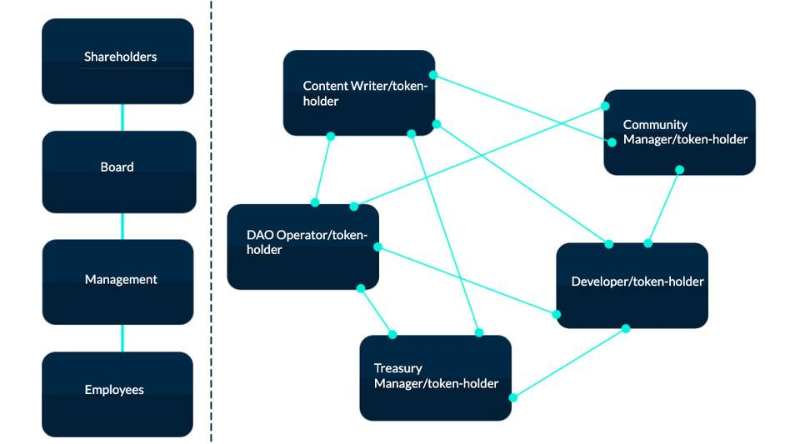 Simplified illustration of corporate relationships in traditional organizations vs. DAOs
Limitations of the DAO Model
However, the very features that make DAOs fundamentally superior to traditional organizations can also be sources of vulnerabilities. The blockchain technology they rely on makes them trustless and transparent, but also means their code is accessible to everyone—including potential hackers. A prime example is when hackers exploited a bug in the code to execute a high-profile attack.
Likewise, the fact that DAOs cannot be shut down by authorities or governments due to their reliance on blockchain as a third party may increasingly attract regulatory scrutiny.
Additionally, DAOs often lack professional vertical specialization, leading to long decision-making times. Nevertheless, we are seeing the emergence of delegation and proxy voting mechanisms in DAOs, which could enhance governance efficiency. More broadly, DAO structures will diversify, incorporating representatives, sub-teams, and specialized leadership roles.
In practice, the DAO model has inherent limitations and isn't suitable for every type of organization. While we don’t know how extensively DAOs will disrupt all forms of human coordination, one thing is certain—we’ll see more DAOs emerge, and quickly.
Joining This Revolutionary Wave
You now understand the basic mechanics of DAOs and are eager to explore this emerging trend. You might be wondering: How can I get involved?
The quickest answer is to join a DAO by acquiring its native token. Depending on the DAO, you may need to purchase one or more tokens during or after the token launch, while some DAOs distribute tokens to active contributors. However, some DAOs will succeed while others may underperform. Therefore, it’s crucial to conduct due diligence on the project and member quality, and analyze how value is created and captured within the DAO before participating. Although DAOs are still relatively new and mature evaluation metrics don’t yet exist, below we outline key factors that determine membership quality and DAO value.
Key Factors Driving DAO Value
Effective Incentive Mechanisms
Understanding how members are rewarded for their contributions within a DAO is crucial. Typically, governance rights, contribution rewards, or profit shares incentivize members to actively participate and work for the DAO, enhancing organizational efficiency.
Another way to view this: as a DAO becomes more successful, the secondary market value of its token increases. Greater success attracts more market participants interested in benefiting from the DAO’s creative outputs, monetary gains, or treasury voting rights. As more people engage, the token appreciates further. Rising token value motivates members to contribute more, reinforcing DAO success and driving token value upward in a positive feedback loop.
Thus, in the long term, DAOs with aligned incentives for contributors are likely to outperform others. The more members are rewarded for their work, the higher the DAO’s overall value will rise.
High Voting Participation Rate
A DAO’s value is driven not only by individual member work but also by active participation in governance, which enables adaptation and growth. Holding voting rights doesn’t guarantee members will vote. You can assess the level of engagement by reviewing voter turnout across all submitted proposals. This data is available on DeepDAO.
This metric carries more weight in smaller DAOs. As shown in the chart below, larger DAOs generally have lower voting participation rates. The reason is that most are large protocol DAOs where collective decision-making is currently limited to peripheral issues.
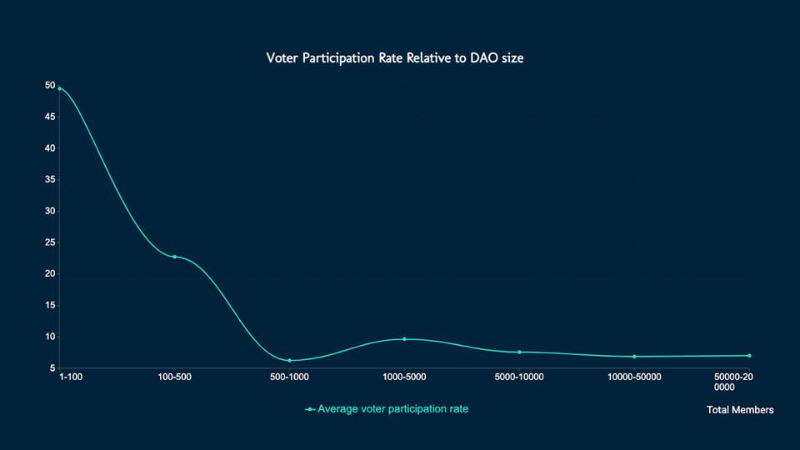 Voter Participation Rate vs. DAO Size
While this shows overall participation, you can focus on addresses receiving the most tokens from the treasury to identify top contributors. This reveals which members are most rewarded for their efforts.
 Top wallet balances in FWB
You might also want to check whether prominent figures in the DAO space appear among these wallets. If so, it signals that the DAO has attracted attention from domain experts. Consider the following names:
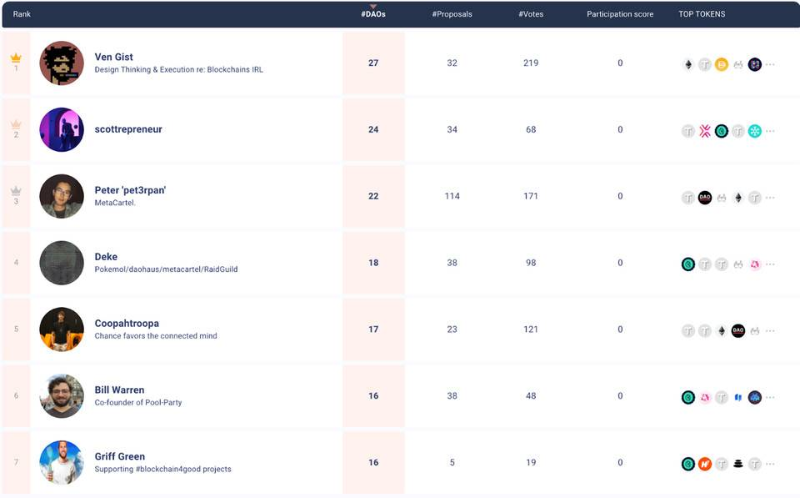 Top 7 well-known contributors in the DAO space
Consistent Project Delivery
If a DAO has strong incentives and active contributors, it should consistently deliver projects and initiatives. Steady progress across multiple initiatives is a good indicator of collective engagement, execution capability, and long-term value appreciation potential.
PleasrDAO is a perfect example. Since purchasing the Uniswap V3 NFT in March last year, the DAO has acquired and fractionalized the Doge Meme NFT, bought a CD from the iconic Wu-Tang Clan, and even hosted an exclusive event in New York for its members.
Consistent delivery drives token appreciation, increases motivation to join, enhances member interaction, and feeds back into continued effective execution.
Conclusion
In summary, DAOs mark the beginning of a new chapter in crypto history. While we don’t yet know how deeply DAOs will disrupt all forms of human organization, their governance model has already proven highly successful within crypto-native communities. DAOs should surpass traditional organizations by enabling internet users to collectively create and exchange value in a trustworthy environment, while rewarding them for the value they generate. Although this new governance model inherently faces challenges like vulnerability to attacks, it will continue to thrive. Today there are only 169 DAOs. One day there may be tens of thousands. Now is the perfect time for you and me to join this revolutionary wave and participate in one—or several—DAOs. These are still early experiments, yet they are already making crypto history, and perhaps rewriting human history.
Join TechFlow official community to stay tuned
Telegram:https://t.me/TechFlowDaily
X (Twitter):https://x.com/TechFlowPost
X (Twitter) EN:https://x.com/BlockFlow_News