








VC practitioner: How can retail investors smartly invest in cryptocurrency?
TechFlow Selected TechFlow Selected
VC practitioner: How can retail investors smartly invest in cryptocurrency?
Follow trend investing, but get in early before the trend ends; become a user of the product; talking to crypto developers helps; stay confident, concentrate your position, and hold on.
 Navigating Web3 tides with focused insights
Author: Sangyoon
Translation: Alex Zhang
You might wonder if my advice applies since I'm a venture capitalist, meaning I get early access. Let me tell you what's behind the shiny VC facade. I’m a crypto specialist—this is how I’ve made most of my money.
Finding these opportunities has little to do with venture capital, because your investment horizon is 5–10 years.
I’ll review some of my wins and losses and summarize key lessons at the end.
1 + 1 = 3
First, collaborating with a friend deeply immersed in crypto is extremely helpful. 1 + 1 = 3.
This space evolves so rapidly that you need a partner to cover the landscape and spot the best opportunities.
I use “we” because, so far, my successes have only been possible with a partner who brings good ideas.
Invest Early in Trends
Follow trend investing, but enter early—before the trend ends. You’ll see countless cryptocurrencies, but only those aligned with major trends will ride the wave upward—even if they don’t ultimately win. Non-winning projects may gain 2.5x, while winners can surge 100x, as Matic did in early 2021. Heads I win, tails I still win.
In December 2020, we sensed the next bull market was approaching and documented key industry trends such as derivative protocols, stablecoins, Layer 1s, Layer 2s, oracles, DEXs, and lending. Within these sectors, we scoured for small-cap projects with market caps between $10 million and $300 million.
All this requires work, so be prepared to roll up your sleeves. Becoming a user of these protocols is the single best way to narrow down potential winners.
Case 1: Apeswap
In January 2021, we tried Binance Smart Chain (BSC), a newly launched Layer 1 competitor to Ethereum. It was amazing. Compared to Ethereum’s minutes-long transactions and fees over $30 per tx, BSC offered instant execution at low cost. Ignore that it’s less decentralized than Ethereum—practically speaking, it enabled yield farming (which often requires many transactions) without spending thousands on gas fees.
We believed this ecosystem would grow significantly and wanted to find the next big winner. Soon after positioning ourselves, the following happened:
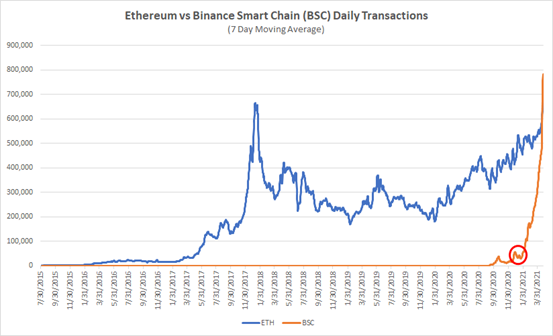
The red circle shows our position on Binance Smart Chain
Pancakeswap is the largest decentralized exchange on BSC. We expected a second-place player to emerge, just like Uniswap (#1) and Sushiswap (#2) coexist on Ethereum. But there were too many competitors, and they all looked similar. For example:

Dozens of DEX forks
After Pancakeswap, nearly dozens of companies competed to become the next major DEX on BSC. We dove into Telegram channels, spoke with developers, and even reviewed some code. We discovered that Goose Finance, then the #2 ranked player, was routing trades back to Pancakeswap—meaning their token had no fundamental value. Yet clueless influencers were pumping and hyping Goose Finance’s price.
On the other hand, Apeswap had a legitimate team capable of quickly rolling out updates. Their community was stronger than any other DEX. This was a real powerhouse team. But amid an ocean of DEXs, it was still tiny—with a $15M market cap versus Goose’s $100–200M. We knew Apeswap could go to zero, but we bet big anyway because, if our research was right, it would soon dominate among swap platforms. The result:
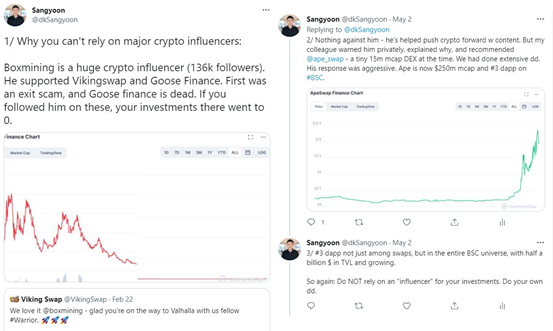
We also hedged well. With APES token yields at 200–300% annually, we had plenty of hedges. In fact, the token initially dropped 70%, but thanks to yield farming, my position still gained 50%. At its peak, the investment returned 10x within two months.
Following the recent crypto crash, Bitcoin fell from $60K to $30K, and Apeswap declined significantly too. But net returns remain substantial because we entered early, and yields in April were still above 100%. Dozens of other swap projects delivered zero returns.
Apeswap remains among the top 2–3 DEXs on BSC. I believe that as long as the team continues releasing innovative features, it will rise sharply in the next bull market.
Position Sizing
It’s worth highlighting the importance of concentrated capital. If your position is small, a 10x return doesn’t matter much. This seems obvious, but I didn’t truly grasp it until real money and real consequences were involved.
Suppose you invest $100K and it grows to $1M, while your friend invests $300K and it becomes $3M. The initial $200K difference quickly turns into a $2M gap. It’s hard to fathom how big a $2M difference really is.
So think about it this way: If I now deposited $100K into your bank account, what would you do? $2M is 20 times that amount. From the earlier example, your friend now has profits enabling them to buy a Tesla Model Y, a Porsche Panamera, a $1M one-bedroom home in the Bay Area, pay off $200K in student debt (common in the U.S.), and still have over $1M left. All of this stems from an initial $200K difference in position size.
The impact of position sizing on multi-bagger investments is far greater than the effect of achieving 30%+ returns in stock investing.
If you want meaningful position size, you need conviction.
To build conviction, you need deep research.
Case 2: Polygon (Matic)
This was a Layer 2 project on our shortlist in December 2020, with a $100M market cap. Unfortunately, we decided to wait because we weren’t sure who would emerge as the winner. Over the next few months, it went on to deliver a 100x return. Fortunately, when we saw the whitepaper finalized, we jumped back in halfway through.
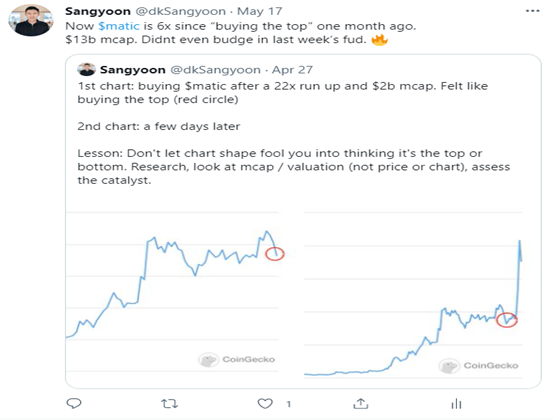
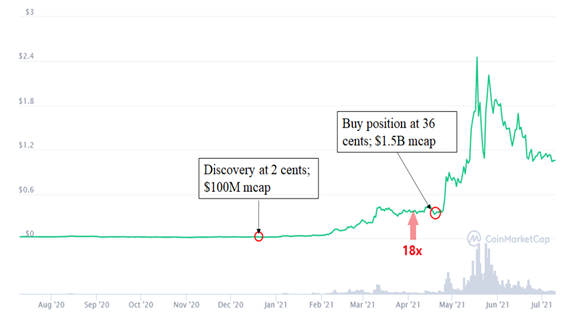
Matic Token Chart
As seen in the chart above, we entered after missing 18x growth—an entry that felt like buying at the top, which is extremely difficult. But you must separate past price action from future fundamentals.
What prompted us to enter despite delays was that every crypto project I spoke with planned to run on Polygon’s Layer 2. Developers are closest to the action, so talking to them provides valuable insights. Even though the price had already risen 18x from my initial consideration, I still pulled the trigger because I believed mainstream adoption hadn't caught up yet. It quickly delivered another 6x (though sadly, we missed the full 100x).
Doing foundational research on specific landscapes is also valuable. For instance, in the Layer 2 space, there are optimistic rollups, zk-rollups, etc. I’ll write more on this later, as it goes beyond the scope here.
That’s enough for now. In part two of this article (forthcoming), I’ll discuss two major mistakes.
Summary:
Lesson 1: Follow trend investing, but enter early—before the trend ends
Lesson 2: Become a user of the product
-
You only become a true user if you’re genuinely interested in crypto. To develop genuine interest, you need to understand why it represents a bigger opportunity than the internet—as my boss Tim Draper once said.
Lesson 3: Have conviction, concentrate your position, and hold
-
Without a sizable position, a 10x return is meaningless. To hold large positions, you need confidence derived from research.
-
For assets like Bitcoin and Ethereum—highly likely to maintain market share over 5–10 years—simply holding for years generates massive gains. Most people try to time the market and end up missing the big moves.
Lesson 4: Talking to crypto developers helps
-
They are closest to what’s actually happening in the industry.
-
This will be detailed further in part two.
Exiting
A brief note on exiting positions. If you exit and realize half the profit compared to selling at the peak, you’ve done well. Selling everything at the absolute top is impossible. A staggered exit is a solid strategy. I don’t have a clear framework for sensing market tops—it’s mostly experience-based. It’s always an educated guess.
Another option is to buy high-quality crypto assets and hold long-term. As an old friend and crypto fund manager told me: “Timing is hard. We tell our limited partners that if they invest with us, they’re going long on crypto regardless of the cycle. If you 100x and then drop 90%, you still 10x.” He does have a public trading desk and occasionally shorts tokens, but most of the time they’re long-term holders. His firm manages billions, so this approach clearly works for them.
Original: “How To Intelligently Invest in Crypto as a Retail Investor (from a VC)”
Join TechFlow official community to stay tuned
Telegram:https://t.me/TechFlowDaily
X (Twitter):https://x.com/TechFlowPost
X (Twitter) EN:https://x.com/BlockFlow_News






