
a16z Partner: Why Web3 Matters?
TechFlow Selected TechFlow Selected
a16z Partner: Why Web3 Matters?
Web3 addresses the core problem of centralized networks, where value accumulates within a single company that ultimately ends up opposing its own users and partners.
 Navigating Web3 tides with focused insights
By Chris Dixon
TechFlow Note: Venture capital today is highly competitive—not only does it require investing in great projects, but also writing compelling essays to promote specific sectors or startups. In this regard, a16z stands out as the true master. From "software eating the world" to championing Web3 in the blockchain era, a16z consistently captures the minds of entrepreneurs ahead of the curve. This article, “Why Web3 Matters,” offers a high-level synthesis, contrasting value capture in Web 1 and Web 2, and elevating Web3 and crypto to a theoretical pinnacle—truly impressive.
Original:
Web 1 (roughly 1990–2005) was about open protocols that were decentralized and community-governed, with most of the value accruing to the edges of the network—users and builders.
Web 2 (roughly 2005–2020) was about siloed, centralized services run by corporations. Most of the value was captured by a small number of companies such as Google, Apple, Amazon, and Facebook.
We are now at the dawn of the Web3 era, which combines the decentralization and community governance ethos of Web 1 with the advanced, modern functionality of Web 2.
Web3 is an internet owned by the builders and users, coordinated via tokens.
Why does Web3 matter?
First, let’s examine the problems with centralized platforms.
Centralized platforms follow a predictable life cycle. Initially, they do everything they can to recruit users and third-party complements such as creators, developers, and businesses.
They do this to strengthen their network effects. As the platform moves up the S-curve of adoption, its power over users and third parties steadily increases.
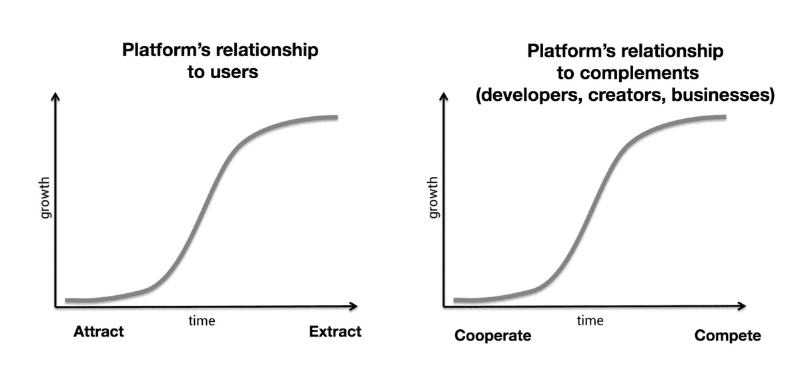
When they reach the top of the S-curve, their relationship with network participants shifts from positive-sum to zero-sum. To continue growing, they must extract data from users and compete with former partners.
Famous examples include Microsoft vs. Netscape, Google vs. Yelp, Facebook vs. Zynga, Twitter vs. its third-party clients, and Epic vs. Apple.
For third parties, the shift from cooperation to competition feels like a bait-and-switch. Over time, the best entrepreneurs, developers, and investors have learned not to build on centralized platforms—a trend that has stifled innovation.
Now let’s turn to Web3. In Web3, ownership and control are decentralized. Users and builders can own pieces of internet services through tokens, both non-fungible (NFTs) and fungible.
Tokens give users property rights—the ability to own a piece of the internet.
NFTs give users the ability to own digital objects—art, photos, code, music, text, in-game items, certificates, governance rights, access passes, and whatever else people dream up next.
NFTs exist on blockchains like Ethereum. Ethereum is a decentralized global computer, owned and operated by its users.
Blockchains are special computers accessible to anyone, yet owned by no one.
Ethereum is powered by a fungible token, ETH, which incentivizes the physical computers supporting the system. ETH is also the native currency for transactions within the system, such as buying NFTs.
There are many ways for users to obtain both fungible and non-fungible tokens. You can buy them, but you can also earn them.
Uniswap retroactively airdropped 15% of its governance tokens to early users of the protocol. Community grants like these are becoming common in Web3, serving as a way to build goodwill and incentivize adoption.
You can also earn tokens through creative and entrepreneurial activities. For example, people currently earn around $100 million worth of ETH daily by selling NFTs.
Tokens align network participants around a shared goal—the growth of the network and the appreciation of the token.
This solves the core problem of centralized networks, where value accumulates within a single company that eventually turns against its own users and partners.
Before Web3, users and builders had to choose between the limited functionality of Web1 or the corporatized, centralized model of Web2.
Web3 offers a new path, combining the best aspects of previous eras. We are still in the early days of this movement—an excellent time to get involved.
Join TechFlow official community to stay tuned
Telegram:https://t.me/TechFlowDaily
X (Twitter):https://x.com/TechFlowPost
X (Twitter) EN:https://x.com/BlockFlow_News
 a16z
a16z