








Zicen: Why has EOS been languishing for so long? Uncovering the truth from overlooked data
TechFlow Selected TechFlow Selected
Zicen: Why has EOS been languishing for so long? Uncovering the truth from overlooked data
So, having already waited three years, why shouldn't I keep waiting?
 Navigating Web3 tides with focused insights
The unbearable burden we've long ignored: Why has EOS remained depressed for so long?
Regarding Block.one, there will likely be a new development announced soon. For now, I'll say no more—just follow the official website for updates. Today, I want to share some data points that I've never spoken about before but have been consistently overlooked by everyone.
1) This data comes from SlowMist: in 2020, Ethereum DApps suffered 33 hacking incidents, resulting in losses exceeding $360 million—about 0.7% of its market cap. EOS DApps experienced 117 hacks with losses over $28 million—representing 1.4% of its market cap. These represent additional sell pressure. On top of EOS's annual inflation rate of 1%, it actually bears an extra 1.4% in constant sell-off pressure.
2) Plustoken (data as of July 2019) held approximately 200,000 BTC, 789,000 ETH, and 26.31 million EOS (worth around $110 million USDT at the time). Since July 2019, newly mined supply amounts to roughly 702,000 BTC (3.7% of circulating supply), 6.48 million ETH (5.7%), and 14.6 million newly produced EOS (1.4%).
This means the additional selling pressure from Plustoken accounts for 28.5% of BTC’s new supply, 12.2% of ETH’s—but a staggering 180% for EOS.
3) The total funds within the EOS ecosystem (as of April 2020) amounted to about 19.36 million EOS. From April 2020 to present, only 5.83 million new EOS tokens have been generated. The extra sell pressure imposed by this project compared to normal issuance is an alarming 332%.
Combined, over the past two years, EOS has endured actual selling pressure exceeding six times its new token issuance. Compared to BTC and ETH, which require far less buying demand to maintain secondary market prices, EOS has continuously borne an unbearable burden that everyone else has ignored.
In a prolonged bear market, such sustained sell pressure is devastating. But when the bull market arrives, these pressures will vanish like paper-thin barriers easily pierced. Stay calm. Wait for the wind. The first key moment: December 2020.
1. Fundamentals are sound, all is peaceful
Let me repeat what I’ve always said: “Bitcoin represents the fundamental baseline of the entire digital currency industry and will lead the way. Ethereum is the foundation of the public blockchain sector and follows next. Everything else—including EOS—must wait.” Don’t accuse me of chasing trends, abandoning ship, or denying facts. My analysis on market trends remains correct.
My continued prediction: Bitcoin will consolidate through the remainder of 2020 before challenging its previous high near $20,000.
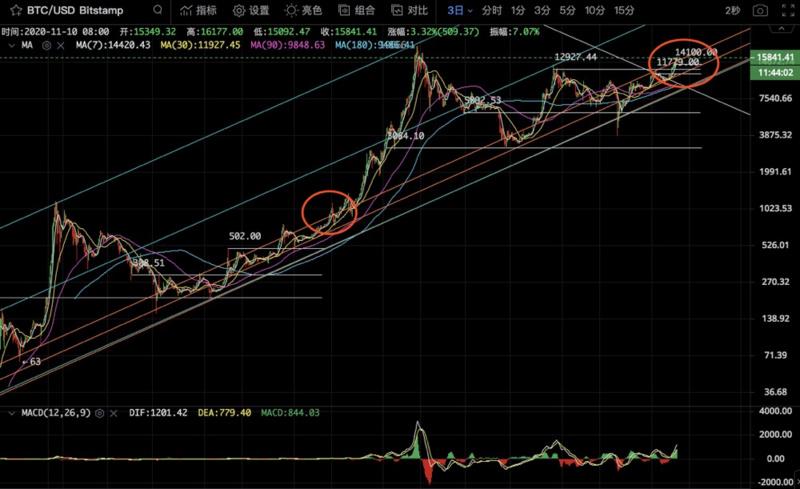
As for Ethereum, backed by Eth 2.0 staking expectations, Grayscale’s accumulation, and DeFi’s ability to lock liquidity, it will also continue to strengthen.
With both the broader cryptocurrency industry and the public blockchain sector showing strong fundamentals, we’re heading into a phase where everything rises together—the very moment EOS finally hits rock bottom. A breakout above previous highs marks the start of a bull market. And real bull markets aren't defined by single stars shining alone—they’re chaotic seas where every player gets their turn. Remember this phrase. I said it in November 2016. I’m saying it again in November 2020:
“When the tide surges, it will eventually flood every lowland.”
2. Back to EOS—the story’s protagonist
In the last cycle—the Blockchain 1.0 era—all narratives belonged solely to the concept of “global money,” to Bitcoin-as-gold and Litecoin-as-silver. So Ethereum, just two years post-mainnet launch back then, looked like this: dismal, hopeless, dismissed as “worthless in the long run.” Sound familiar when you look at today’s EOS? At that time, ETH was even worse off than EOS is now.
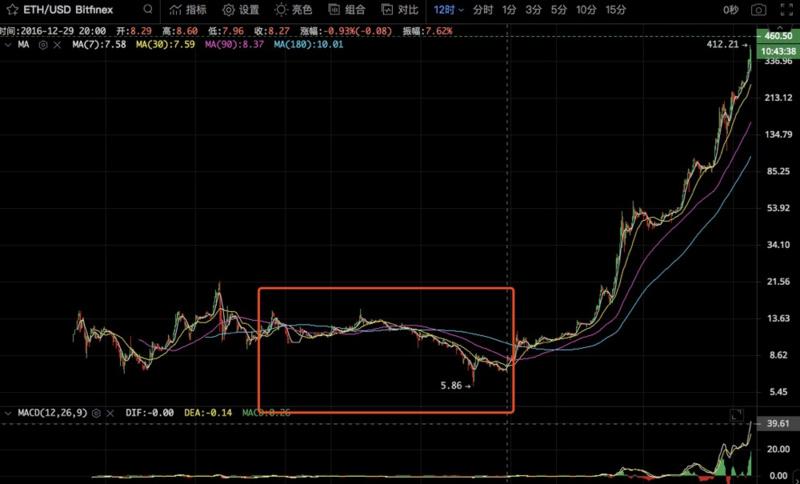
This time, the Blockchain 2.0 narrative belongs to both global money and smart contracts. As a result, BTC and ETH have become the brightest stars. Now, it's EOS’s turn to endure the despair—a project also more than two years past mainnet launch, stuck in a downward spiral, still struggling at the bottom.
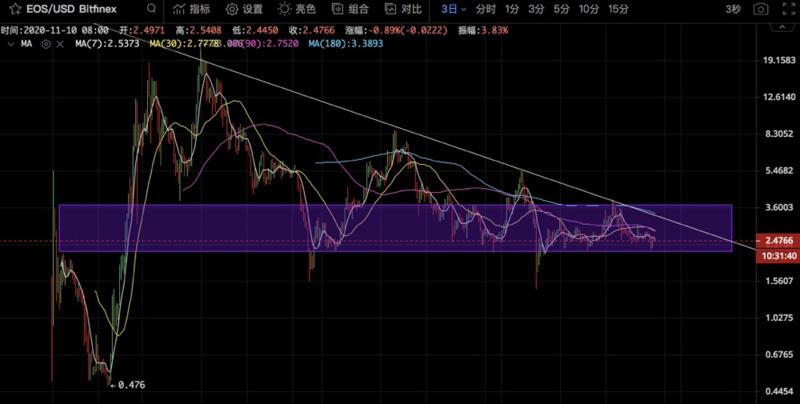
During the past two years of bear market, the tensions between Block.one and the community—and particularly with China—can ultimately be summarized as follows:
Block.one has never been able, nor ever willing, to act exactly as we expected or believed they should.
At its core, this stems from regulatory pressure and strong legal advice. Yet from another perspective, actions by traditional whales like Grayscale signal a crucial insight: in the upcoming bull cycle, compliance and regulation will play increasingly central roles. In my view, while compliance may have restrained progress during the bear market, in the next upcycle, compliance, high performance, large-scale commercialization, and enterprise-grade applications will become exactly the competitive edge needed to break through the crowded public blockchain landscape.
3. What truly makes me believe it's worth waiting: bias
Even without significant moves from Block.one, the EOS ecosystem has visibly flourished. Right now, EOS offers the smoothest, most convenient, lowest-cost DApp (DeFi) user experience—a fact most people haven’t experienced firsthand because they’ve never tried it. It hosts the most active third-party developer ecosystem outside Ethereum, along with the highest level of community engagement. From Pizza, quietly building for two years, to DFS, we can clearly see the resilience and persistent refinement capability of EOS-based projects. Yet on the other side of the scale, we face the strongest prejudice in the entire industry. Criticizing EOS has become politically correct. Despite having solid infrastructure, developers, users, and momentum, nearly everyone approaches EOS with arrogance, distorting information, dismissing positive developments, and magnifying negatives. Just like this image:

So after three long years of waiting—what reason do I have not to keep going?
Join TechFlow official community to stay tuned
Telegram:https://t.me/TechFlowDaily
X (Twitter):https://x.com/TechFlowPost
X (Twitter) EN:https://x.com/BlockFlow_News






