
Future Prices Trick Oracle, Ostium Drained of $24 Million in Five Minutes
TechFlow Selected TechFlow Selected
Future Prices Trick Oracle, Ostium Drained of $24 Million in Five Minutes
Ostium has not yet published the final loss assessment and post-incident report, leaving significant questions regarding the abuse of signer permissions.
 Navigating Web3 tides with focused insights
Author: CryptoSlate
Compiled by: TechFlow
TechFlow Editor's Note: This is not a missing signature, but an authorized signer submitting price data "from the future." When validation passes but the data itself is toxic, where is the moat for DeFi protocols? Ostium has yet to publish final loss calculations and a post-mortem report, leaving huge questions about signer privilege abuse.
On-chain perpetual trading platform Ostium stated that a five-minute security incident resulted in losses to its public liquidity vault. Security firms estimate the exploit scale reached up to $24 million.
Co-founder Kaledora Kiernan-Linn confirmed that the issue occurred between 14:18 and 14:23 UTC on July 15, affecting the public Ostium Liquidity Provider (OLP) vault. She stated that the team discovered the issue within minutes and coordinated to pause trading within an hour. The statement did not provide exact total losses, root cause, or a final post-mortem report.
Security firms stated that the core of the incident was authorized data, not missing signatures. Blockaid and Cyvers indicated that a registered PriceUpKeep forwarder submitted an authorized oracle report with a future date, creating false trading profits.
SlowMist stated that authorized signers provided manipulated data with valid signatures for repeated profitable trades. These descriptions remain third-party findings, pending confirmation from Ostium's post-mortem report.
Cryptographic authentication can confirm that the report was signed by an allowed key. However, price reasonableness, timestamp freshness, and settlement security require separate control measures.
The OstiumVerifier code linked from Ostium's security documentation recovers the ECDSA signer and checks whether the signer is authorized, but this verification function does not enforce price reasonableness tests or timestamp boundaries.
The code does not appear to indicate which implementation version was active during the incident, or whether separate contracts applied these checks. Any timestamp, replay, price deviation, or multi-source protection measures must operate elsewhere in the execution path.
Even If Stock Prices Remain Unchanged, Tokenized Stocks as Collateral Can Fail
Ostium's protocol documentation states that the OLP vault holds trader collateral and pays winning trades instantly on-chain. If false profits are accepted for settlement, vault liquidity pays for these payouts.
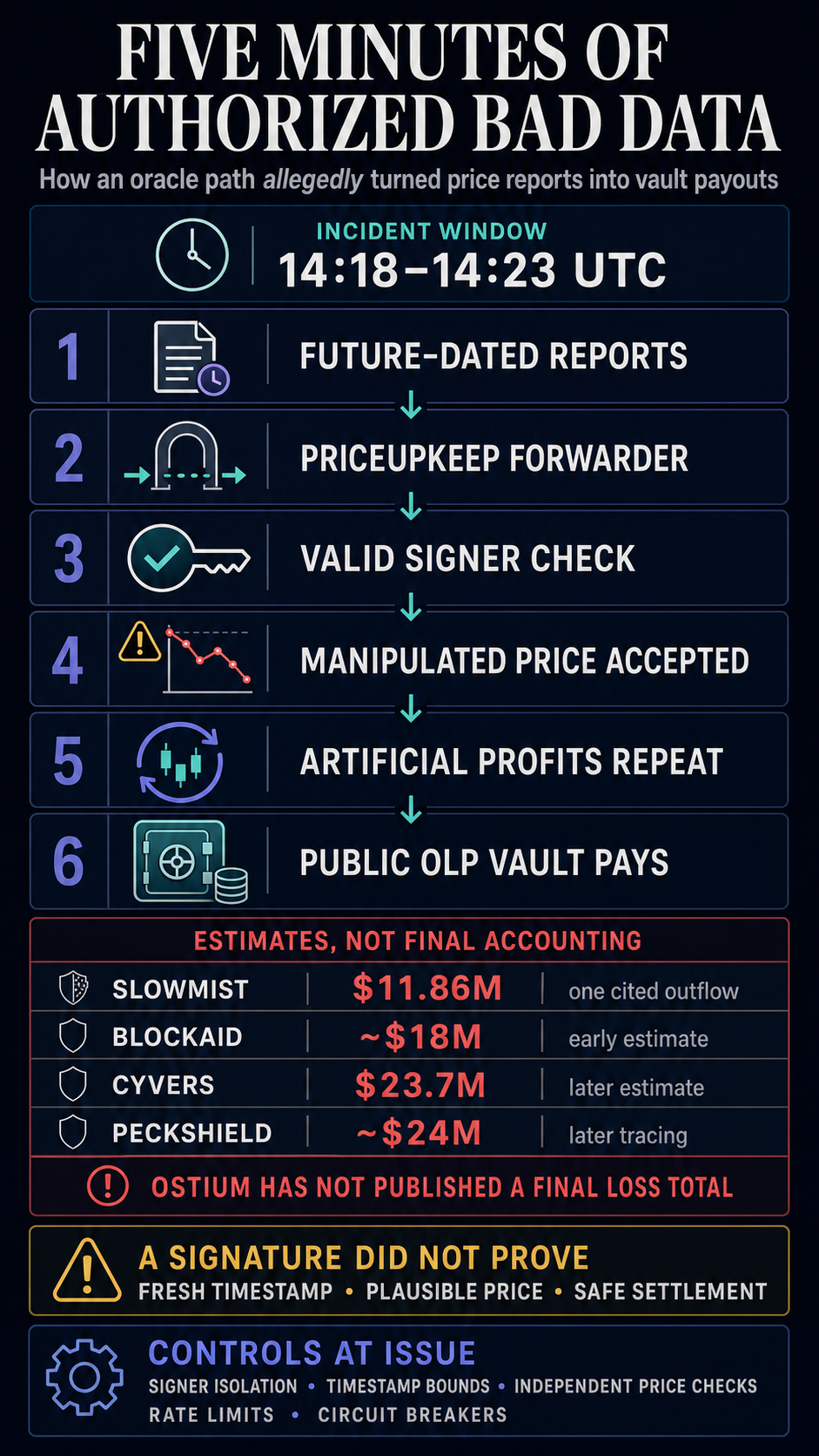
Public estimates continued to rise as tracking progressed. Blockaid believed payouts approached $18 million, Cyvers estimated $23.7 million, and PeckShield later described approximately $24 million being drained.
SlowMist's lower figure of $11.86 million appears to track a visible vault outflow of 11,862,444.782 USDC in the transactions it cited.
New SummerFi DeFi Vulnerability Shows AI Automation Now Overrides Smart Contract Risks
PeckShield stated that the extracted USDC was swapped for 12,080 ETH, and as of its update, 10,540 ETH had entered Tornado Cash. Kiernan-Linn stated that Ostium is cooperating with law enforcement, SEAL 911, and third-party security experts.
This mechanism distinguishes Ostium from a similar issue with the Hedera lending protocol Bonzo Lend four days prior. Bonzo's incident report stated that its verifier accepted a proof without a valid signature. In the Ostium case, security firms claim the report passed through the authorized signer path: authentication succeeded, but the data was allegedly insecure.
How Zero-Signature Oracles Unlocked $9 Million from Hedera DeFi Lending Protocol Bonzo Lend
Ostium still needs to confirm whether signer keys were compromised, whether authorized operators acted maliciously, or whether other privileged paths were abused.
Its remediation measures will be judged by whether signer isolation, strict timestamp boundaries, independent price checks, rate limiting, and circuit breaker mechanisms can prevent a trusted path from turning a few minutes of bad data into another vault payout.
Join TechFlow official community to stay tuned
Telegram:https://t.me/TechFlowDaily
X (Twitter):https://x.com/TechFlowPost
X (Twitter) EN:https://x.com/BlockFlow_News
 @CryptoSlate