The Evolution of Oracles (1): From Data Bridges to Intelligent Trust Layers
TechFlow Selected TechFlow Selected
The Evolution of Oracles (1): From Data Bridges to Intelligent Trust Layers
Oracles are both a connection and a contamination; both a breakthrough and the starting point of crisis.
 Navigating Web3 tides with focused insights
Author: 0xhhh
I. Introduction: The Blind Spot of Trust
Blockchain is a revolution about trust, but its trust is closed.
It believes in math, not the world.
Early blockchain was like a logician: it trusted reasoning, but rejected perception.
Bitcoin trusts hashes, not people; Ethereum trusts code, not inputs.
So when a contract wants to ask, "What is the price of ETH?", it falls silent.
This is not a technical flaw, but a philosophical boundary.
The certainty of blockchain comes from its separation from the external world.
The source of trust is isolation.
But without connection, there is no meaning.
Human history of building trust systems is the continuous process of making the "system" see "reality" again.
The oracle is the first hand reaching out from this crack.
It is both connection and contamination;
both breakthrough and the starting point of crisis.
II. Phase One: Cracks in the Cave (2015–2018)
Background: Isolated Islands of Smart Contracts
In 2015, Ethereum brought "code is law" into the world.
But laws require evidence, and there is no "external fact" on the blockchain.
A contract for weather-based payouts cannot know whether it rained today;
a synthetic asset tracking stock prices cannot see Nasdaq.
Smart contracts became prisoners in Plato's cave, staring only at shadows on the chain.
The purity of blockchain also became its constraint.
Problem: How to "See" Without Being Contaminated
How can blockchain perceive the external world without being corrupted by it?
Trusting external data means introducing subjectivity and centralization—precisely what blockchain aims to eliminate.
Thus, "trusted input" became the first paradox of decentralized trust systems.
Technical Evolution
-
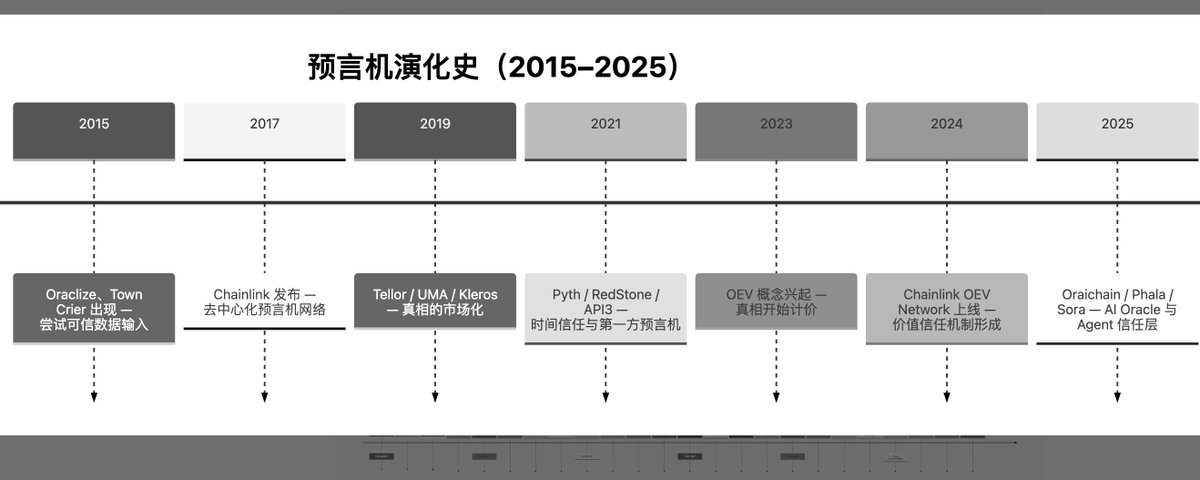
Oraclize (Provable): Used TLSNotary to prove data originated from specific sources.
-
Town Crier (Cornell): Leveraged Intel SGX trusted execution environments for secure data retrieval.
-
Chainlink (2017): Introduced decentralized oracle networks, where nodes stake LINK, aggregate data, and form weighted consensus.
The First Breath of Trust
Blockchain made trust logical; oracles made trust tangible.
Machines learned to "believe" for the first time, and humans began defining truth through algorithms.
III. Phase Two: The Market for Truth (2019–2021)
Background: DeFi’s Trust Famine
DeFi's explosion made price feeds the system's lifeline.
Liquidations, derivatives, stablecoins, synthetic assets—all depend on external prices.
But one price manipulation could trigger a chain reaction.
Truth became an arbitrageable resource.
Technical Evolution
-
Tellor (TRB): Uses staking and dispute mechanisms to generate truth through game dynamics.
-
UMA (Optimistic Oracle): Assumes truth by default, unless challenged.
-
Kleros (PNK): Decentralized juries resolve factual disputes.
-
Band Protocol / DIA: Introduced API-layer compromises balancing speed and credibility.
The Era of Trust as Game Theory
Tellor turns truth into a game-theoretic equilibrium,
UMA turns truth into a default state,
Kleros turns truth into a social contract.
Trust is no longer a whitelist—it's the outcome of games.
Truth was "marketized" for the first time.
IV. Phase Three: The War Over Time (2021–2023)
Background: The Latency Crisis of Truth
In the era of high-frequency trading and liquidations, delay equals risk.
When truth arrives slower than lies, the system punishes truth.
Technical Evolution
-
Pyth Network (PYTH): Exchanges directly sign price quotes—sources become nodes.
-
RedStone (RED): Pull-based price feeds, verified upon execution.
-
API3: First-party oracles—data providers sign and publish their own data.
-
Band Protocol: Implemented cross-chain data layer on Cosmos.
When Time Becomes the Shape of Truth
Trust shifts from "correctness" to "timeliness".
Oracles become "arbiters of time".
Latency becomes a new dimension of trust.
🔹 Trust Begins to Have a Price: The Rise of OEV (2023–2024)
OEV (Oracle Extractable Value)
— The arbitrage spread between truth and time.
The moment a price updates is not just an information event, but a value event.
The order of truth dissemination begins to determine wealth distribution.
The question is no longer "Is it true?" but "Who profits from the truth?"
Technical and Mechanism Evolution
-
Chainlink OEV Network (2024): Creates an OEV auction market, allowing bidding for priority updates.
-
Pyth / SEDA: Use timestamped signatures and random committees to suppress internal arbitrage.
-
RedStone Pull Model: Naturally eliminates time gaps, leaving no arbitrage window.
Truth Begins to Be Priced
OEV gives trust economic weight.
We used to debate "who is telling the truth",
now we must debate "who benefits from the truth".
Trust expands from fact verification to value governance.
V. Phase Four: Collision of Intelligence and Privacy (2023–2025)
Background: AI Enters the Trust System
AI models can assess markets and analyze news, but their "truthfulness" is unverifiable.
When machines begin judging truth, how do we judge the machines?
Technical Evolution
-
Oraichain (ORAI): Verifiable AI inference (Proof of Execution).
-
Phala / iExec: Use TEE trusted hardware to generate remote proofs.
-
SEDA / Supra / Entangle: Integrate AI verification with cross-chain synchronization.
Verifying Reason
When we demand machines prove their own rationality,
oracles shift from "verifying the world" to "verifying intelligence".
Trust extends to the judgment layer.
VI. Phase Five: Rebuilding Trust in the Agent Era (2025 →)
Background: The Rise of AI Agents
AI agents now possess economic agency.
They sign contracts, negotiate cooperation, execute trades.
But algorithms have no morality—only inputs.
When agents trade with each other, who ensures they perceive the same world?
Technical Evolution
-
Sora Oracle (SORA): AI Oracle + payment protocol + prediction market, forming a self-calibrating cognitive system.
-
Flux / OptionRoom: Embed prediction markets for factual validation.
-
Orochi Network: Builds machine identity systems enabling traceable judgments.
Rethinking Trust
When agents become societal actors,
humans shift from "bearers of trust" to "designers of trust".
Trust between machines is not emotion, but protocol.
Oracles evolve from data interfaces into civilizational infrastructure.
VII. Epilogue: From Data Bridge to Intelligent Trust Layer
Ten Years of Evolution: Every Oracle Upgrade
originates from a crisis of trust—and opens new frontiers.
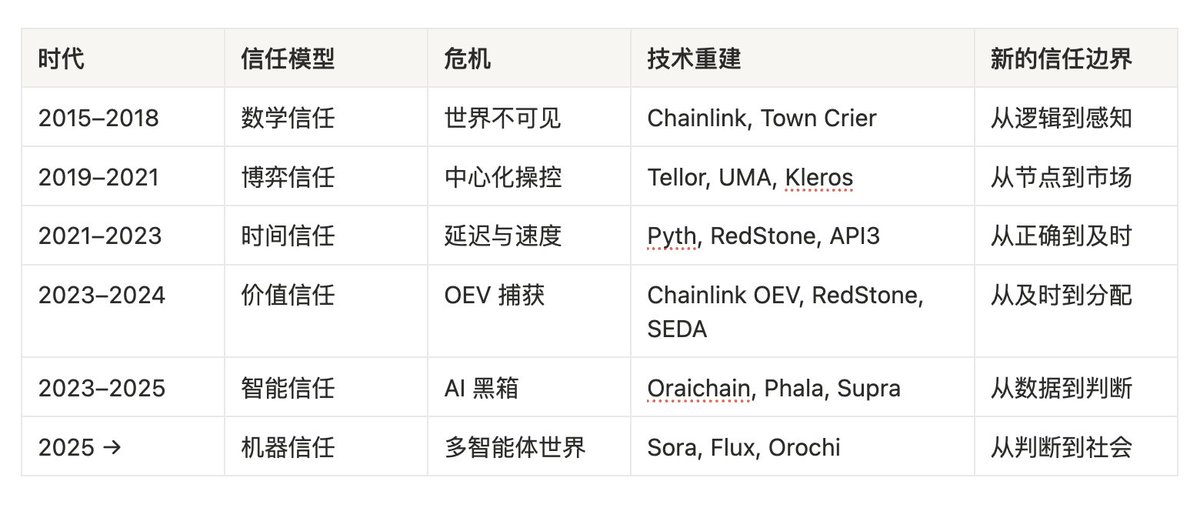
Blockchain makes trust computable; Oracles make reality computable; AI Oracles make intelligence computable.
Oracles are no longer just bridges,
but the trust layer of intelligent civilization.
Final Thoughts
If blockchain is the memory layer of civilization, then oracles are its sensory layer.
We are teaching machines something unprecedented:
how to perceive honestly.
When the intelligent society truly arrives, oracles will not merely transmit data—but forms of truth.
Join TechFlow official community to stay tuned
Telegram:https://t.me/TechFlowDaily
X (Twitter):https://x.com/TechFlowPost
X (Twitter) EN:https://x.com/BlockFlow_News
 @hhh69251498