Will Claude suspend accounts and verify IDs? Facial recognition relates to an incident from two months ago; “handing data over to the police” is a misinterpretation.
TechFlow Selected TechFlow Selected
Will Claude suspend accounts and verify IDs? Facial recognition relates to an incident from two months ago; “handing data over to the police” is a misinterpretation.
The genuine substantive increment is that the data flow of Agent tasks has been formally incorporated into policy for the first time.
 Navigating Web3 tides with focused insights
Author: Claude, TechFlow
TechFlow Introduction: Anthropic’s updated privacy policy takes effect on July 8. Chinese social media widely interpreted it as a major shift toward “real-name registration + facial verification” and “opening user data to law enforcement.” However, a line-by-line comparison with the original text reveals most sensational claims are unfounded: identity verification is an existing mechanism launched in April; the alleged “lowered threshold for law enforcement disclosure” finds no basis in either the new or old versions of the policy. The only substantive addition is the first explicit inclusion of data flows related to Agent tasks.

On June 8, Anthropic announced an update to its privacy policy, effective July 8 for all individual users of Claude—Free, Pro, and Max tiers. Following the announcement, Chinese tech and community platforms rapidly disseminated interpretations centered on two main points:
- Claude will introduce real-name registration and facial verification;
- The new policy lowers the threshold for disclosing user data to law enforcement, signaling the “end of the anonymous era for large language models.”
However, a detailed comparison of the new policy text, the previous version (dated September 28, 2025), and Anthropic’s official update summary shows that most conclusions in this narrative misrepresent the actual policy.
Misconception #1: Real-name and facial verification are not new—they’ve been in place since April
Labeling identity verification as a “sudden new policy” effective July 8 is the most widespread error in current reporting.
In fact, Anthropic introduced identity verification on the Claude platform as early as April 14, 2026. The next day, its official Help Center published a dedicated “Identity verification” policy page.
According to contemporaneous reports from V2EX, East Money, and 36Kr, users triggered for verification were required to submit government-issued physical identification documents (e.g., passports, driver’s licenses, or national ID cards) via Persona—a third-party compliance service—and complete live facial biometric verification via camera. East Money’s Wealth Channel documented at the time that verification was typically triggered for users subscribed to the highest-tier Max plan, those engaging in high-frequency usage, or accounts flagged by risk-control systems as potentially anomalous—including cases where developers were mistakenly banned due to AI misjudgment.
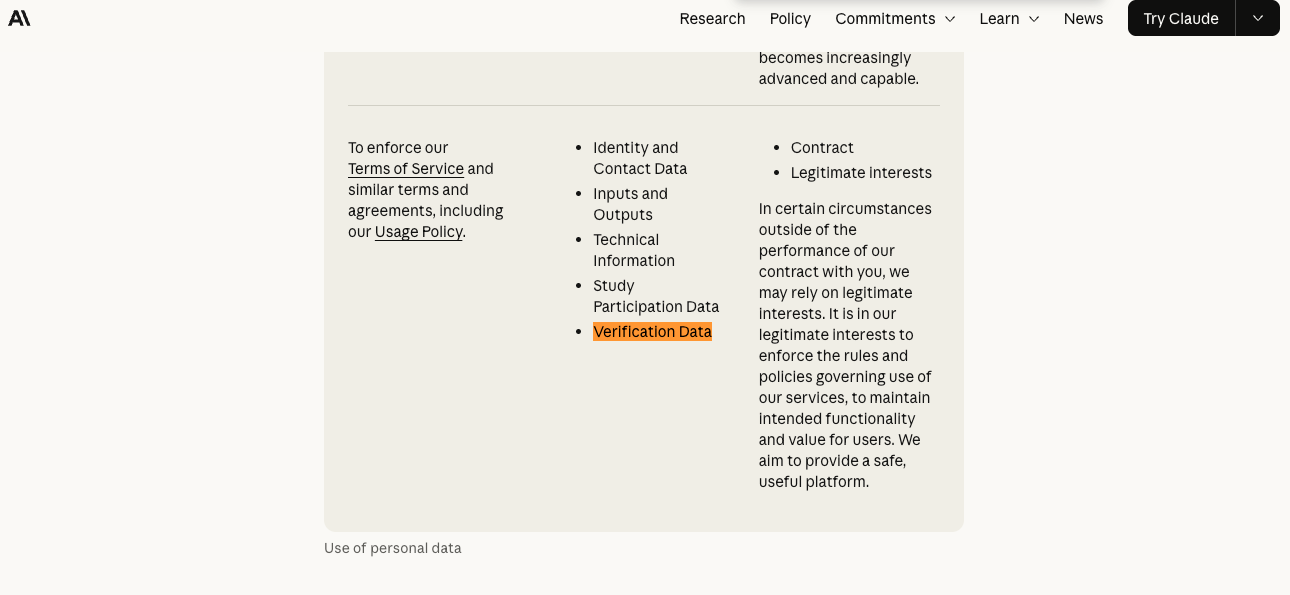
In other words, the question of “whether to submit your ID” has already been in effect for two months—and had already sparked backlash among developers. The July 8 privacy policy update does not introduce this verification mechanism; rather, it formally incorporates into the policy text the data collection practices associated with the already-operational verification system. A newly added section titled “Verification Data” explicitly lists the categories of information collected:
Images of government-issued IDs and associated identifiers (e.g., ID numbers, birth dates), photos or videos of the user’s face, facial geometry templates (classified as biometric data in certain jurisdictions), and the verification result itself.
Mistaking “policy documentation” for “sudden implementation” completely distorts the timeline.
Misconception #2: “Opening user data to law enforcement” is unsupported—the old and new clauses show no substantive tightening
The most impactful—and most urgently needing correction—is the claim that “the new policy lowers the threshold for disclosing user data to law enforcement.” Some Chinese translations claimed the prior version permitted disclosure only when “legally mandated,” whereas the new version allegedly allows disclosure whenever Anthropic holds a “good-faith belief.”
This framing has no basis in the actual policy text—not even in Claude’s own analysis.
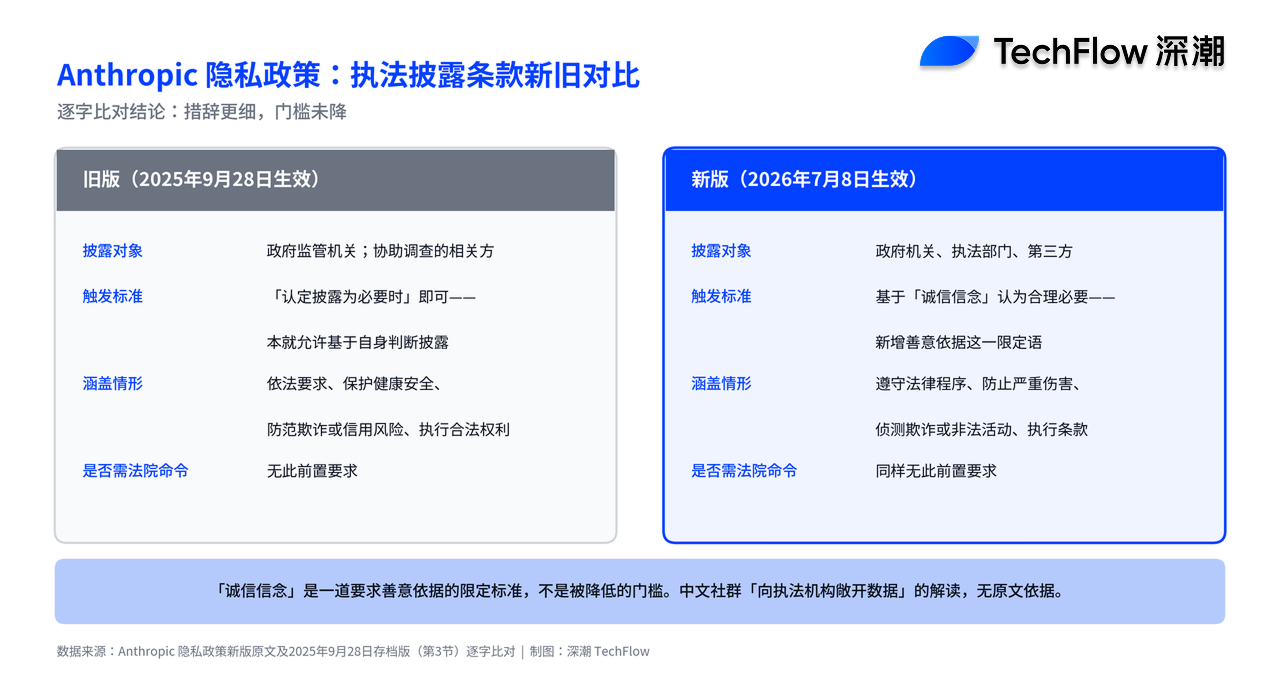
The new Section 3 states: Anthropic may share data with government agencies, law enforcement, or third parties when, based on available information, it holds a “good-faith belief” that such disclosure is reasonably necessary for one of four purposes:
Complying with applicable laws, regulations, or legal processes (including responding to enforceable government requests); preventing serious harm to persons or property; detecting, preventing, or investigating fraud or illegal activity; or enforcing its Terms or protecting Anthropic’s rights—or those of its users and others.
The critical question is how the prior version (dated September 28, 2025) reads. Its Section 3 similarly permits disclosure “when Anthropic determines it is necessary to protect your or others’ health or safety, prevent fraud or credit risks, enforce legal rights, etc.”—and explicitly includes “disclosure to governmental regulatory authorities as required by law… or to assist investigations.” In other words, the prior version never limited disclosure solely to cases of “legal mandate”; it always granted Anthropic discretion to disclose based on its own judgment.
A word-for-word comparison concludes:
The new version rewrites this clause more structurally—explicitly naming “law enforcement,” adding the qualifier “good-faith belief,” and enumerating the four scenarios clearly. Legally speaking, “good-faith belief” imposes a standard requiring honest, reasonable judgment—not a lowered threshold. More precise wording does not equate to looser restrictions. Anthropic’s official update summary characterizes this change simply as “clarifying when data may be shared with third parties.”
Another counterpoint helps calibrate this misconception.
In August 2025, the U.S. District Court for the Northern District of California ruled in the copyright lawsuit filed by Universal Music Group and other publishers against Anthropic that Anthropic need not provide user personal information to the plaintiffs. As reported by Intellectual Property Economy citing Bloomberg, the judge held that linking chat content to specific users lacked sufficient justification and would “unduly compromise third-party privacy interests.” In that case, Anthropic stood firmly on the side of refusing to hand over user data—demonstrating that the operation of “good-faith belief” standards in practice is far more nuanced than the oversimplified phrase “opening data to law enforcement.”
Regarding the specific claim that “biometric data is not stored on Anthropic servers but processed by Persona”—this appears only in some Chinese media reports. No corresponding statement exists in the new policy text, and it cannot be verified from primary sources; treat it as unconfirmed.
What the policy actually changed: First-time formalization of data flows for Agent tasks
Stripping away the exaggerations, the sole substantive addition in the new policy is the explicit codification of data flows when Claude executes multi-step tasks or connects to third-party applications—precisely the area left almost entirely uncovered in the prior version.
New language added to Sections 1 and 3 specifies: When users connect to third-party services—or instruct Claude to perform tasks on their behalf (e.g., reading files, sending messages, retrieving information)—Claude transmits the user’s input, output, and instructions directly to those third-party services, which process the data under their own privacy policies. Claude also retrieves content from those services, and such retrieved content becomes part of the user’s subsequent input. Some integrations retain access permissions until the user manually disconnects.
This fills a crucial compliance gap for Agent-oriented product design. When the prior privacy policy was drafted, Claude functioned primarily as a single-turn Q&A tool. The new version addresses a fundamentally new question: How does data flow between the user, Anthropic, and third parties when AI performs cross-application operations on the user’s behalf? The policy further notes that as Agent tasks grow more complex, verification requirements may expand accordingly. For power users heavily reliant on connectors and Claude Code workflows, this provision matters more than “whether to submit your ID”: your data footprint expands in tandem with Claude’s growing agency.
Beyond Agent-related data flows and verification data, the new policy adds a dedicated section on “Research Participation Data” (data collected when users participate in Anthropic surveys or interviews) and refines the legal basis for marketing recommendations and data processing. In its update summary, Anthropic reaffirms three unchanged commitments: it does not sell user data; Claude remains ad-free; and users retain full control over whether their conversations are used to train models.
Placing this update in context, it resembles a compliance “catch-up”—aligning policy text with existing product capabilities—rather than an active tightening of user privacy protections.
The high engagement in Chinese communities partly stems from conflating April’s pre-existing news, standard industry clauses, and genuinely new provisions. For ordinary users, the real account-suspension risk arises from violating usage policies or being flagged as anomalous by risk-control systems—a condition that existed since April and has not worsened with this update. As for concerns that “chat logs will be handed over to police at will,” both the policy text and the California court ruling clearly show such fears are significantly overstated.
Note: This article was authored by Claude itself—making it more authoritative than secondary media reports.
References:
Anthropic’s New Privacy Policy:
Join TechFlow official community to stay tuned
Telegram:https://t.me/TechFlowDaily
X (Twitter):https://x.com/TechFlowPost
X (Twitter) EN:https://x.com/BlockFlow_News
 深潮TechFlow