Decentralized AI 2026 Landscape: Why Blockchain Is the Inescapable “Cure” for AI
TechFlow Selected TechFlow Selected
Decentralized AI 2026 Landscape: Why Blockchain Is the Inescapable “Cure” for AI
From DeFi to Privacy-Preserving Verification: Decentralized AI Is Reshaping Every Layer of the Intelligent Economy.
 Navigating Web3 tides with focused insights
Author: Pink Brains
Translation & Editing: AididiaoJP, Foresight News
Decentralized AI exists because centralized AI faces structural bottlenecks—bottlenecks that cannot be resolved by capital or code alone:
- Scarce and expensive compute resources
- Excessive concentration of control
- Unverifiable model outputs
- Increasing difficulty in acquiring training data
Scarce and expensive compute resources
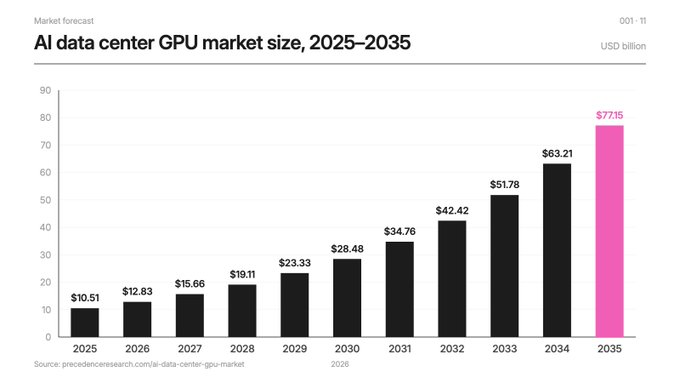
GPU infrastructure is projected to grow from $10 billion in 2025 to $77 billion by 2035. Data center GPUs have been sold out for several consecutive months. The decentralized compute market is expected to expand from $9 billion in 2024 to $22 billion by 2035 (per Research and Markets data). This figure holds only if you believe the shortage is structural—not cyclical—and we do.
Excessive concentration of control
ChatGPT, Gemini, Grok, and Claude are all owned and operated by a handful of private companies. Current AI policy assumes only a few entities capable of aggregating massive compute resources can train powerful systems. Once this assumption is broken, the landscape of who can build frontier intelligence will shift entirely.
Unverifiable outputs
When models make decisions, users cannot verify whether the correct model was run, whether computations were executed correctly, or whether sensitive data was leaked. This may be tolerable for chatbots—but becomes wholly unacceptable when AI handles loans, healthcare, or autonomously manages real-time wallets.
Increasing difficulty in acquiring training data, due to privacy concerns and regulation
A centralized crawler hosted in a single AWS region quickly hits rate limits, geo-blocks, or poisoned caches. As a16z noted in its 2026 outlook, privacy is becoming “crypto’s most important moat.”
AI needs blockchain—to make intelligence open, verifiable, and economically accessible.
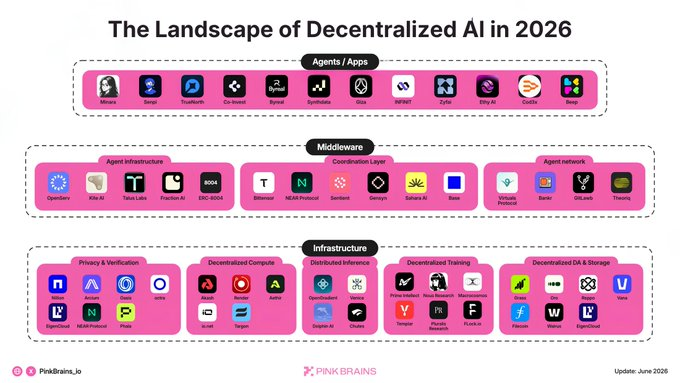
Decentralized AI Tech Stack Map
- Application & Services Layer: AI agents can do many things, but two dominant use cases in crypto today are Agentic Finance and Agentic Payments.
- Middleware Layer: Coordination layers—from frameworks for building and identifying agents, agent marketplaces, to orchestration layers.
- Infrastructure Layer: Foundational AI resources—privacy & verification, compute, inference, training, data, and storage.
Application & Services Layer
Agentic Finance translates natural-language prompts into on-chain actions.
@gizatechxyz’s ARMA agent has processed over $4.6 billion in agentic transaction volume across selected lending markets—running block-by-block, non-custodially, on EigenLayer’s AVS framework.
@Infinit_Labs operates a cluster of over 20 specialized agents, translating intents like “earn $1,000/month with 1 BTC” into one-click strategies across Ethereum, Solana, and Base.
@coinvestai by Liquid embeds real-time execution directly into ChatGPT and Claude, enabling trading across 500+ markets via the Model Context Protocol.
@minara integrates Hyperliquid and recently joined Lighter. It runs full “analyze → decide → execute” trading loops via the DMind model and 50+ integrations.
@Cod3xOrg: A network of lightweight AI agents that translate intent into on-chain transaction construction and execution.
@Zyfai_: A self-hosted DeFAI agent automating and optimizing yield farming—continuously rebalancing capital across protocols to chase risk-adjusted APY, fully hands-off.
In prediction markets, @SynthdataCo—a Bittensor subnet—operates a decentralized predictive financial intelligence network. Miners compete to model short-term price uncertainty. It already powers real-time data for products like Kalshi’s Mode AI Quant in crypto markets.
Agentic Payments: Machines Paying Machines
Just as the internet became the communication layer for the digital economy, blockchains and stablecoins are becoming the settlement layer for agentic payments.
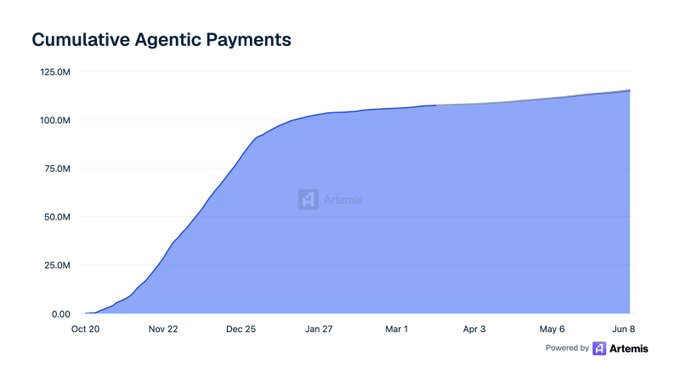
As of May 2026, x402 has processed over 173 million transactions on Base and Solana. The x402 Foundation includes Google, Visa, AWS, Circle, Anthropic, Stripe, and Cloudflare. Stripe began using it in February 2026; AWS launched native AgentCore Payments.
Buyer and seller activity is rising—most transactions relate to real-time, pay-as-you-go usage: API calls, AI inference services, agentic commerce, and similar workloads. The initial hype cycle has cooled—but underlying traction is accelerating.
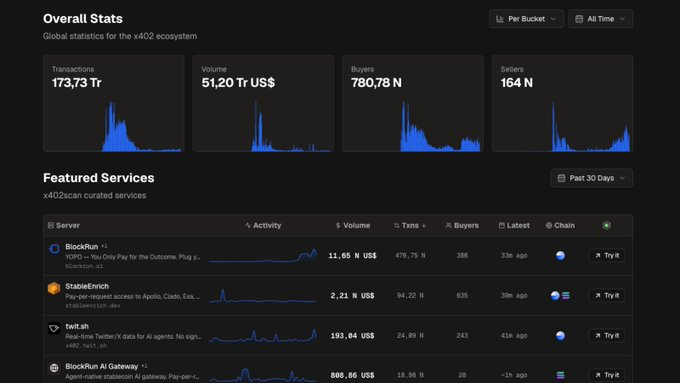
Meanwhile, Stripe and Tempo’s Machine Payments Protocol is emerging as a second track—recording over 411,900 transactions and 9,600 buyers since launch.
Together, these networks signal a broadening shift toward machine-to-machine commerce—where software agents transact autonomously at machine speed.
Middleware Layer
As agent count grows, the core challenge becomes coordination: How do agents discover each other, prove identity, and transact without human involvement?
This trust gap is the bottleneck. The estimated size of agentic commerce could reach $1.5–5 trillion by 2030—but adoption is constrained by one key fact: Most users let AI do research, but few let AI actually buy.
Today’s systems still rely on API keys; almost no system treats agents as entities with identity.
@GoKiteAI is building a dedicated L1 where identity and payments are native primitives. ERC-8004 is an Ethereum standard granting agents portable on-chain identity and reputation—transferable across chains.
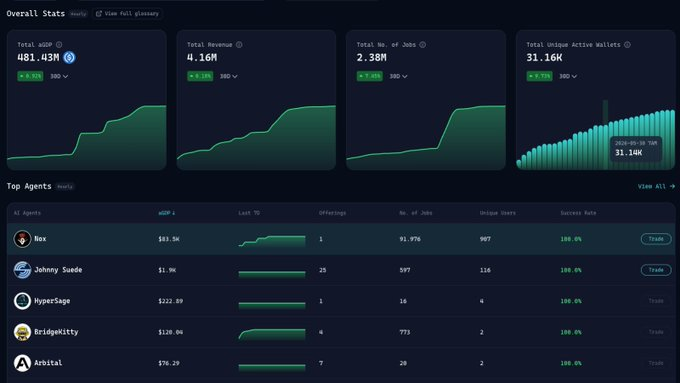
In markets, @virtuals_io serves as the operating system for the Base-based agent economy. By June 2026, it had processed over 2.38 million agent tasks, generating nearly $480 million in “Agent GDP.”
But the crown jewel here is Bittensor. It’s a network of specialized subnets—each a micro-economy where miners run AI models, validators score outputs, and TAO emissions flow to those producing the most useful work. Three mechanisms make it economically serious:
- The December 2025 halving cuts daily TAO issuance from 7,200 to 3,600—aligning with a hard cap of 21 million.
- The dTAO upgrade gives each subnet its own Alpha token and AMM pool—markets determine emissions.
- The Taoflow upgrade (launched November 2025) allocates emissions purely by net staking flow. A subnet that unstakes more than it stakes risks dropping to zero. It’s deliberately Darwinian.
The network now hosts over 128 active subnets. The top three compute subnets reportedly achieved combined $20 million ARR within three months post-monetization. Darwinism is the product.
Other projects focus on building purpose-built AI blockchains—or delivering tools, frameworks, and incentives needed for community-owned AI ecosystems.
@NEARProtocol: An invisible coordination layer combining settlement, identity, privacy, TEE, MPC, and PII protection—built for autonomous agents.
@base—the main base for the “agent economy.” Base MCP enables AI tools like Claude, ChatGPT, and Cursor to execute on-chain actions—including swaps, transfers, and DeFi interactions—on platforms like Uniswap, Morpho, and Avantis, via prompt.
@SentientAGI: Its GRID ecosystem connects agents, models, data, and compute—routing queries to specialized participants for optimal results.
@gensynai: Verifiable ML execution—coordinating distributed hardware for training and inference while ensuring work trustworthiness—$AI coordinates the network.
@SaharaAI unifies data, models, agents, and rewards within a single AI-native ecosystem.
Infrastructure Layer
Infrastructure is AI’s skeleton—the raw compute, inference, training, data, and privacy primitives everything above depends on. It’s the most capital-intensive layer in the decentralized AI stack.
Decentralized Compute
@akashnet runs a reverse-auction marketplace where providers bid to win your workloads. New leases grew 27% quarter-on-quarter in Q1 2026, reaching over 43,500—marking its third consecutive quarter of growth. Its AkashML inference service processed nearly 120 billion tokens in April—at prices 60–85% cheaper than mainstream cloud.
@rendernetwork reported 428% year-over-year usage growth.
@ionet aggregates over 130,000 GPUs from 130+ countries on Solana.
@AethirCloud is among the few truly revenue-generating projects: reporting ~$166 million ARR (Q3 2025), delivering over 1.5 billion compute hours.
Distributed & Verifiable Inference
Inference accounts for over 70% of AI operational costs. Goldman Sachs forecasts agentic AI will drive token consumption up 24x by 2030—reaching 120 trillion tokens per month.
The decentralized answer: make inference cheap, private, and verifiable.
@AskVenice serves over 2 million users daily with >50 billion tokens via private, censorship-resistant models—its moat is its models.
@OpenGradient has processed over 2 million verifiable inferences, generating 500,000+ zkML proofs.
@chutes_ai lets developers deploy and scale AI models via simple APIs—backed by GPU miners—with costs up to 85% cheaper than AWS. Platform revenue automatically converts to token demand via staking mechanisms.
@dphnAI—a decentralized AI inference network. Notably, Dolphin developed the censorship-resistant model used by Venice AI—and dedicates 100% of network revenue to token buybacks.
Decentralized Training
Training is the hardest—and highest-impact—problem: it determines whether frontier models must be built exclusively inside labs of three or four corporations.
@PrimeIntellect’s INTELLECT-1 (10B parameters) was the first globally distributed training run; INTELLECT-2 (32B parameters) was the first distributed RL run.
@tplr_ai successfully trained Covenant-72B across 70+ distributed nodes—processing ~1.1 trillion tokens and cutting communication costs by 146x.
@NousResearch: Its Psyche network enables fault-tolerant distributed training; Hermes 4.3 is the first Hermes model trained on decentralized infrastructure—not centralized clusters.
@MacrocosmosAI’s IOTA subnet (SN9) performs decentralized LLM pretraining and “train-at-home”; its Data Universe subnet (SN13) handles the data layer. DiLoCo-series low-communication algorithms let GPUs scattered globally collaborate without ultra-high-speed intra-data-center networks.
Decentralized Data Availability & Storage
As AI workloads scale, both are becoming bottlenecks. Frontier models consume massive volumes of fresh data, while storage demand has surged so sharply that major HDD suppliers report capacity sold out years in advance.
Economics are compelling. Decentralized storage can cost 60–80% less than traditional cloud providers—networks like @Filecoin offer storage under $1/TB/month, versus ~$30/TB/month for centralized alternatives.
@grass pays 2.5 million nodes across 190 countries for idle bandwidth—enabling AI labs to scrape live web data.
@WalrusProtocol—built by @Mysten_Labs—is a fast-rising challenger for decentralized storage and data availability—using 2D erasure coding to efficiently store large “blobs,” increasingly positioned as the persistent memory layer for AI agents.
@eigencloud: A verifiable cloud platform built around data availability, verifiable computation, and dispute resolution—secured by restaked ETH. Its thesis: enable AI agents to run with cryptographic guarantees—making actions provable, auditable, and enforceable.
@vana—an EVM L1 where Data DAOs and Data Liquidity Pools transform personal data into tokenized, tradable assets.
@reppo and @oroagents build high-quality, trusted datasets for AI training through incentivized competitions.
Privacy & Verification Layer
Ordinary AI users cannot verify whether their data was processed privately, whether computations executed correctly, or even whether the claimed model was used.
In 2026, privacy and verification are becoming prerequisites—not add-ons—for AI.
@nillion—the “blind computer”—uses MPC and its own Nil Message Compute to perform computations on encrypted data without decryption. Use cases include private AI inference, encrypted databases, and private RAG (letting AI query proprietary knowledge bases without leakage).
@Arcium: A decentralized confidential computing network on Solana. Use cases include Umbra (shielded transfers / private yields) and confidential AI training on sensitive datasets.
@OasisProtocol: A privacy-first L1 using ROFL (Runtime Offchain Logic)—a TEE-based framework for running verifiable, privacy-preserving off-chain computation—ideal for AI agents, model training, or oracles.
@octra: A privacy-first L1 natively supporting FHE, using its proprietary HFHE (Hypergraph FHE) scheme—designed for parallel encrypted computation and throughput.
@eigencloud: A verification-heavy player built atop EigenLayer’s restaking security. EigenAI (a verifiable LLM inference API compatible with OpenAI’s, for open-source models—where prompts and responses are provably untampered) and EigenCompute (for verifiable off-chain execution of agent logic).
@PhalaNetwork. Cloud GPUs are powerful—but not private; Phala makes workloads provably shielded—even from Phala itself. Its flagship product, Phala Cloud GPU TEE, deploys open-source models onto hardware—offering an OpenAI-compatible API where every inference carries an encrypted proof.
Where Decentralized AI Is Headed: 2026–2027
AI demand is growing faster than infrastructure can keep up—and AI agents are becoming the dominant growth engine—on-chain rails are ready.
Compute is transforming into an asset class—and on-chain markets are becoming its financial layer. Institutional participants are shifting from experimentation to infrastructure investment.
Tokenomics are emerging as decentralized AI’s structural advantage in coordinating capital, compute, and data. Opportunities are expanding beyond AI into robotics, autonomous machines, and physical AI.
Conclusion
Decentralized AI is growing across major stack layers—infrastructure, middleware, and applications—evidenced by compute revenue, expanding agent economies, and large-scale distributed training.
Yet the field remains early. Revenue often lags token incentives; adoption remains uneven. While overall AI investment surges, decentralized AI still commands only a small slice of venture capital. Token-driven networks can be powerful advantages—but only if value capture is designed correctly.
Nonetheless, the emergence of projects like Bittensor, NEAR, Virtuals, Base, and Venice signals that decentralized AI is evolving—from speculative narrative to a new paradigm for coordinating compute, data, capital, and intelligence.
Join TechFlow official community to stay tuned
Telegram:https://t.me/TechFlowDaily
X (Twitter):https://x.com/TechFlowPost
X (Twitter) EN:https://x.com/BlockFlow_News
 @PinkBrains_io