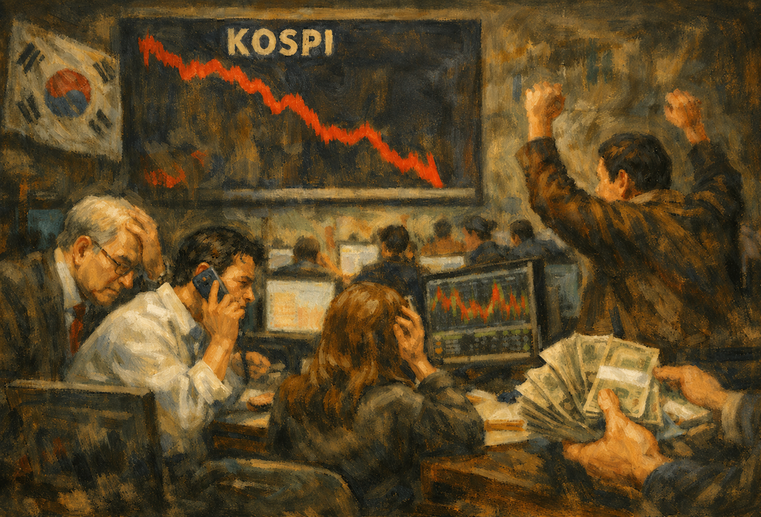
April 28 Market Recap: S&P 500 and Nasdaq Hit All-Time Highs; Oil Surpasses $107; Bitcoin Retreats After Reaching 12-Week High
TechFlow Selected TechFlow Selected
April 28 Market Recap: S&P 500 and Nasdaq Hit All-Time Highs; Oil Surpasses $107; Bitcoin Retreats After Reaching 12-Week High
The main event has begun—this week will determine the quality of the rebound.
 Navigating Web3 tides with focused insights
Author: TechFlow
U.S. Equities: Walking a Tightrope at All-Time Highs—Earnings Week Countdown Begins
On Monday, Wall Street’s bulls took another step along a tightrope.
The S&P 500 rose 0.12% to close at 7,173.91—a new all-time high. The Nasdaq Composite also gained 0.20%, closing at 24,887.10, another record high. Meanwhile, the Dow Jones Industrial Average fell 62.92 points (–0.13%) to 49,167.79—the seesaw between tech and industrial stocks flipped once again on Monday.
This divergence—rising S&P 500 and Nasdaq alongside a falling Dow—has persisted for several days. The logic is straightforward: the powerful AI and semiconductor narrative continues lifting heavyweight tech stocks, while real-economy companies in the Dow—consumer goods, industrials, and restaurants—are being gradually eroded by $107-per-barrel oil prices and weakening consumer confidence.
Two key drivers powered Monday’s action:
Nvidia surged another 4%, rebounding near $208—just days after hitting a new all-time high last Friday. The market now treats this stock as a real-time sentiment barometer for AI investment. Alphabet rose 1.8%, and Micron jumped 5.6%, with the semiconductor sector continuing to absorb capital inflows.
On the other side, Apple fell 1.3%, McDonald’s dropped 3%, and Domino’s Pizza plunged 10%. The pizza chain reported same-store sales growth of just 0.9% for Q1—far below the expected 2.7%—and lowered its full-year 2026 outlook to low single-digit growth. When soaring oil prices inflate food delivery costs and consumers’ wallets tighten, the pricing logic for that pizza begins to unravel.
One figure worth highlighting: Since the start of this month, the S&P 500 has risen over 9%, the Nasdaq over 15%, and the SOX Semiconductor Index has rallied more than 50% from its March lows—extending its winning streak to 18 consecutive trading days, with its RSI overbought indicator nearing 85.
This is a technical overheating signal no one can ignore. Markets can climb further into overbought territory—but any negative news could trigger a correction faster than the rally itself.
And that negative news may arrive this week.
This Week’s Most Critical Countdown: MAG4 + Fed—Collision on Wednesday
Wednesday, April 29, marks the densest single day of this earnings season so far: Alphabet, Meta, Microsoft, and Amazon will all release their Q1 results after market close. On the same day, the Federal Reserve will announce its interest-rate decision—reportedly the final meeting under current Chair Jerome Powell.
Each of these four companies has already risen over 10% this month, with massive AI-driven capital expenditures receiving strong pre-approval from investors. Yet last week’s earnings reports from ServiceNow and IBM remain fresh cautionary tales: even beats can become catalysts for shorting—if forward guidance disappoints.
Dan Ives of Wedbush has gone public with his view, expecting “good news to continue, with the AI revolution accelerating full-throttle.”
But Thursday, April 30, brings Apple and Amazon’s earnings; Japan’s central bank meets Wednesday; and the European Central Bank meets Thursday. With three major central banks plus the MAG7, any misstep by one triggers tremors across the rest.
This is the pivotal window that could determine whether this rally has run its course.
Oil: A Fragile Ceasefire Shell—$107 Hides Cracks Beneath
Brent crude broke above $107 per barrel on Monday; WTI rose into the $95–$97 range. In just one week, WTI has surged over 13% from $89.
The cause is simple on the surface—ceasefire—but deeply rooted in stalemate.
On Monday, Axios cited U.S. officials and informed sources reporting that Iran, via Pakistan, proposed a new plan to the U.S.: reopen the Strait of Hormuz and halt attacks on vessels in exchange for the U.S. lifting its naval blockade and delaying nuclear negotiations. At first glance, it sounds like progress—but on Saturday, Trump announced the cancellation of Witkoff’s and Jared Kushner’s planned trip to Pakistan, writing on Truth Social: “Too much time wasted—just pick up the phone.”
That sentence left diplomats speechless. When negotiators won’t even board planes, proposals remain ink on paper. The Strait of Hormuz remains effectively closed; tankers still detour around the Cape of Good Hope; Asia suffers an estimated daily supply loss of roughly 5 million barrels.
A detail complicating market sentiment further: Iran previously suggested it would levy “tolls” on ships transiting the Strait of Hormuz, payable in stablecoins or Bitcoin—at about $1 per barrel. Chainalysis, a blockchain analytics firm, disclosed this week that on-chain activity linked to Iran’s Islamic Revolutionary Guard Corps (IRGC) exceeded $3 billion in 2025—predominantly in stablecoins. The “cryptographic tollbooth” at Hormuz is shifting from conspiracy theory to documented reality.
Gold: $4,730—Chasing Inflation, But Lagging Behind
Gold closed Monday in the $4,730–$4,750 range—rising modestly alongside oil but lagging significantly.
The driving logic remains a contradictory transmission chain: higher oil → rising inflation expectations → stronger dollar → downward pressure on gold. Yet persistent war risk → sustained safe-haven demand supports gold. These opposing forces largely offset each other, leaving gold tracing a slow, sideways climb.
The “establish a new framework to tackle inflation” comment made by Fed Chair nominee Warsh during his confirmation hearing remains unresolved. If the Fed holds rates steady this week but strikes a hawkish tone, gold faces near-term pressure. Conversely, if Powell’s farewell appearance carries dovish undertones, gold may have room to catch up.
Cryptocurrencies: $79,488 Within Reach—Then It Reversed
In early Monday European trading hours, Bitcoin briefly spiked to $79,488—the highest level in 12 weeks—and came within breath of the psychological $80,000 threshold.
Then Brent crude broke above $107—and Bitcoin reversed.
By the close of U.S. equities trading Monday, Bitcoin had slipped to the $76,600–$77,900 range, down ~1.5% over 24 hours; Ethereum fell ~3%; XRP and Solana each declined ~3%. The CoinDesk 20 Index (a broad-market crypto benchmark) dropped ~2%. Total global crypto market capitalization stood near $2.68 trillion; the Fear & Greed Index remained below 46—in neutral-to-fear territory.
In its Monday report, Bitfinex analysts highlighted a critical structural signal: short-term holders concentrated profit-taking between $78,000 and $79,000 during this rally—partially offsetting persistent buying from ETFs and strategic investors. In other words: institutions bought, but short-term longs sold. These countervailing forces stalled Bitcoin at the $80K gate.
Data cited by Bloomberg shows that initial news of Iran’s Hormuz proposal did lift Bitcoin from the $75,000 zone toward $79,488—but the subsequent oil rebound erased that optimism. Bitcoin’s price has effectively become a real-time barometer of Middle East peace talks.
Today’s Summary: The Main Event Begins—This Week Decides the Rally’s Quality
On April 27, both the S&P 500 and Nasdaq hit new highs—but U.S. equities are walking a razor-thin wire:
U.S. Equities: S&P 500 closed at 7,173.91 (+0.12%), Nasdaq at 24,887.10 (+0.20%)—both records. Tech and semiconductors led gains; consumer stocks lagged. Domino’s 10% plunge epitomizes how high oil prices are squeezing real-economy consumption. The Nasdaq is up over 15% this month; the SOX Semiconductor Index has risen for 18 straight days—clear signs of technical overbought conditions.
Oil: Brent breached $107/barrel; WTI rose to $95–$97, up over 13% weekly. Iran proposed reopening the Strait of Hormuz, but substantive negotiations remain stalled—Trump canceled the U.S. diplomatic delegation’s trip to Pakistan.
Cryptocurrencies: Bitcoin touched a 12-week high of $79,488 early Monday, then retreated to ~$77,000 amid rising oil prices, falling 1.5% on the day. Each failed attempt to breach $80,000 depletes bullish momentum.
This week, markets focus on one question: Can Wednesday’s MAG4 earnings withstand expectations?
Alphabet, Meta, Microsoft, and Amazon have each risen over 10% this month—pricing in continued AI-driven explosive growth. If guidance from any of these four falls short—or if capex growth disappoints—Wednesday’s after-hours session could mark a painful end to this rally. If all four beat expectations, the market may climb further.
One small but significant signal not to overlook: China’s National Development and Reform Commission (NDRC) ordered Meta this week to unwind its $2 billion acquisition of Singapore-based AI startup Manus. Geopolitical fragmentation in AI competition is expanding—from chip export controls to capital transaction restrictions.
This week promises to be far more eventful than last.
Join TechFlow official community to stay tuned
Telegram:https://t.me/TechFlowDaily
X (Twitter):https://x.com/TechFlowPost
X (Twitter) EN:https://x.com/BlockFlow_News
 深潮TechFlow