Interop roadmap "accelerated": After Fusaka upgrade, Ethereum interoperability may take a crucial leap
TechFlow Selected TechFlow Selected
Interop roadmap "accelerated": After Fusaka upgrade, Ethereum interoperability may take a crucial leap
Without real-time ZK, it's difficult to have truly usable Interop UX.
 Navigating Web3 tides with focused insights
Author: imToken
In previous articles of the Interop series, we separately explored OIF (intent frameworks) and EIL (interoperability layers), which address intent standardization across chains (enabling the network to understand what you want to do) and execution channel issues (allowing funds to move in a standardized way).
However, achieving a perfect "single-chain experience" still involves trade-offs between speed and trust. After all, current cross-chain interoperability either requires enduring slowness (e.g., Optimistic Rollups requiring a 7-day challenge period before finality) or sacrificing decentralization (relying on multisig bridge trust assumptions).
To break this "impossible trinity," a foundational capability bridging Ethereum's interoperability roadmap—Acceleration and Finalisation—is essential: real-time proofs enabled by ZK technology (see further reading: Ethereum Interop Roadmap: How to Unlock the Last Mile for Mass Adoption).
The recently activated Fusaka upgrade includes an unassuming EIP-7825, which has quietly removed the biggest engineering barrier toward this endgame.
1. The Underestimated EIP-7825 Behind the Fusaka Upgrade
On December 4, Ethereum’s Fusaka upgrade officially activated on mainnet. Unlike the high-profile Dencun upgrade, market attention was largely focused on blob scaling and PeerDAS, celebrating further reductions in L2 data costs.
Yet beyond the noise, there lies a subtle proposal—EIP-7825—that clears the largest obstacle for Ethereum to achieve L1 zkEVM and real-time proving, arguably laying quiet groundwork for the ultimate realization of Interop.
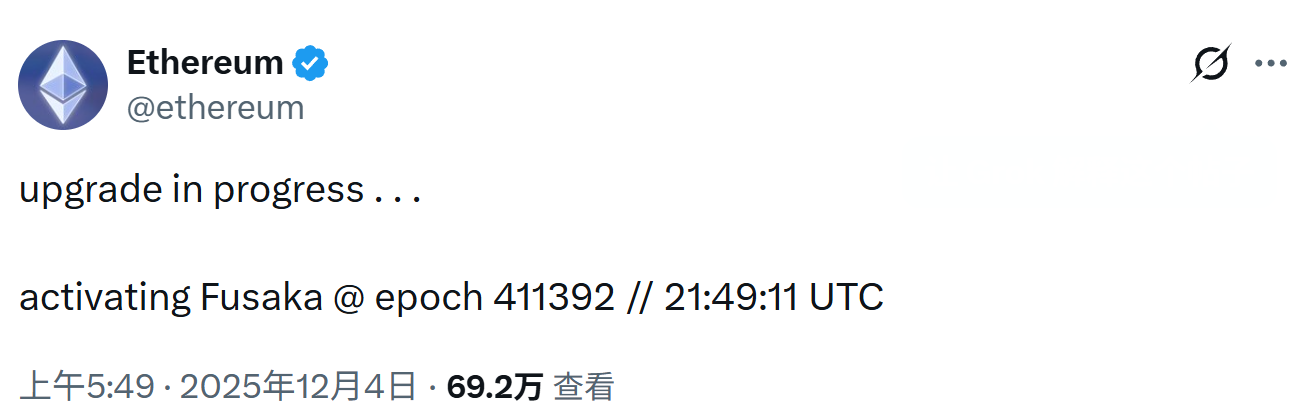
During this Fusaka upgrade, nearly all attention centered on scalability: an 8x increase in blob capacity, combined with PeerDAS random sampling verification, rendering DA (data availability) cost narratives obsolete.
Indeed, cheaper L2s are welcome, but for Ethereum’s long-term ZK roadmap, EIP-7825 is the true game-changer, as it sets a per-transaction gas limit (approximately 16.78 million gas) on Ethereum.
As widely known, Ethereum's block gas limit has already been raised to 60 million. In theory, if someone pays a sufficiently high gas price, they could submit a super-complex "mega-transaction" consuming the entire 60 million gas block capacity, thereby clogging the whole block.
This was previously allowed, but EIP-7825 introduces a new restriction: regardless of block size, no single transaction can exceed 16.78 million gas.
Why impose such a limit? This change has no impact on regular user transfers, but for ZK Provers (proof generators), it makes all the difference—and is deeply tied to how ZK systems generate proofs.
For example, prior to EIP-7825, if a block contained a 60 million gas “mega-transaction,” the ZK Prover would have to execute this extremely complex transaction sequentially—with no possibility of splitting or parallel processing. It’s like a single-lane highway where one extremely slow-moving truck blocks all smaller vehicles behind it.
This effectively sentenced “real-time proving” to death—because proof generation time becomes completely unpredictable, potentially taking dozens of minutes or longer.
With EIP-7825, even if future block capacities expand to 100 million gas, every transaction is capped at 16.78 million gas, turning each block into predictable, bounded, and parallelizable "small task units." This transforms Ethereum’s proof generation from a difficult "logical problem" into a purely scalable "computational resource problem (Money Problem)":
As long as sufficient parallel computing power is available, these split tasks can be processed simultaneously within seconds, enabling ZK proof generation even for massive blocks.
As Brevis co-founder and CEO Michael put it, EIP-7825 is the most underestimated upgrade on the path to future ZK and 100x Ethereum scaling. It makes “real-time proving” shift from “theoretically impossible” to “engineerable and schedulable.” As long as we solve the computational challenge via parallelization, even 200 million gas blocks could achieve second-level proof generation. This isn’t just a breakthrough for ZK technology—it’s the physical foundation enabling Ethereum’s Interoperability Layer (EIL) to achieve sub-second cross-chain settlement.
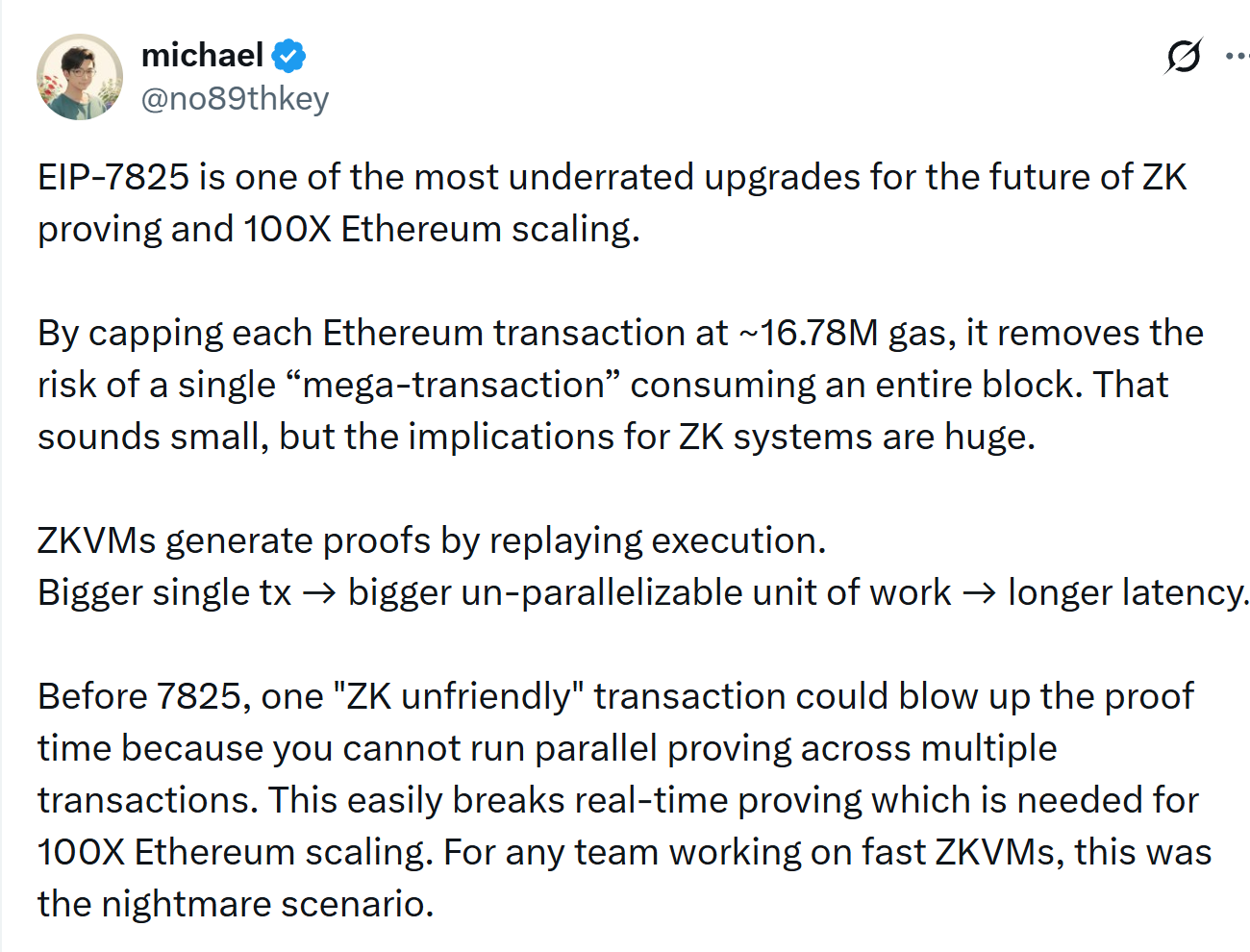
So while this upgrade may seem minor, it represents a significant leap forward for the ZK roadmap and Ethereum’s scalability future in 2026.
2. L1 zkEVM: The Trust Anchor of Ethereum Interoperability
While EIP-7825 paves the physical path (parallelizability) for real-time proving by limiting per-transaction size, this is only one side of the coin. The other question is: how will Ethereum’s mainnet itself leverage this capability?
This leads us to the hardest-core narrative in Ethereum’s roadmap—L1 zkEVM.
For a long time, zkEVM has been seen as the "holy grail" of Ethereum scaling, not only because it solves performance bottlenecks, but also because it redefines blockchain trust mechanisms—the core idea being to give Ethereum’s mainnet the ability to generate and verify ZK proofs.
In other words, every Ethereum block execution in the future could produce a verifiable mathematical proof, allowing other nodes (especially light nodes and L2s) to confirm correctness without re-executing computations. If ZK proof generation is built directly into Ethereum’s protocol layer (L1), proposers (Proposers) would package each block along with a ZK proof, and validators would no longer need to replay transactions—only verify the tiny mathematical proof.
What does this mean for interoperability?
In the context of Interop, the significance of L1 zkEVM goes far beyond scaling. It serves as the "trust anchor" for all L2s. If Ethereum L1 can generate proofs in real time, all L2s can read L1’s final state instantly and trustlessly, leading to two qualitative shifts:
-
Elimination of challenge periods: Cross-chain confirmation times shrink from “7 days (OP mechanism)” to “seconds (ZK mechanism)”;
-
Decentralized interconnection: Cross-chain interactions no longer require trusting third-party multisig bridges, but instead rely on Ethereum mainnet’s mathematical truth;
This is exactly the physical foundation required for the EIL (Interoperability Layer) discussed in our previous article to function properly—without real-time finality (Finality) on L1, L2 interoperability will forever remain under the shadow of “latency.”
The goal is clear (L1 zkEVM), the physical constraint is lifted (EIP-7825)—but what about implementation tools?
This brings us to a subtle evolution occurring in the ZK tech stack: the shift from zkEVM to zkVM.
3. Fusaka & EIP-7825: Unleashing the Interoperability Roadmap
If EIP-7825 provides a "parallelizable hardware environment" for ZK by limiting per-transaction size, then the evolution of the ZK tech stack aims to find a "more efficient software architecture." While this may sound confusing, the distinction is significant and reflects two phases in ZK development (see further reading: The Dawn of the ZK Roadmap: Is Ethereum’s Endgame Accelerating?).
The first phase is naturally zkEVM, representing the compatibility-oriented or evolutionary approach.
The logic here is to meticulously emulate every instruction of the Ethereum EVM, allowing developers to deploy Solidity code directly and minimizing migration costs and barriers.
In short, zkEVM’s biggest advantage is its compatibility with existing Ethereum applications, greatly reducing the workload for Ethereum ecosystem developers who can reuse most existing infrastructure and tools (including execution clients, block explorers, debuggers, etc.).
However, precisely because the EVM was not originally designed with ZK-friendliness in mind, this compatibility imposes ceilings on proof efficiency—resulting in significantly slower proof times—and carries heavy historical baggage.
In contrast, zkVM represents the radical revolutionary faction—building a virtual machine inherently friendly to ZK proofs (e.g., based on RISC-V or WASM) to accelerate proof generation and improve execution speed and performance.
But it comes at the cost of losing compatibility with many EVM features and existing tools (such as low-level debuggers). Nevertheless, a clear trend is emerging: more and more L2 projects are shedding legacy constraints to aggressively optimize proof speed and cost, exploring architectures based on zkVM.
So why is the Fusaka upgrade the key enabler?
Before EIP-7825, both zkEVM and zkVM faced exponentially increasing proof generation times when encountering mega-transactions on Ethereum due to inability to split tasks.
Now, EIP-7825 forcibly breaks transactions into predictable small units. With a parallelizable environment established, highly efficient architectures like zkVM can unleash their full potential. Even complex Ethereum blocks, when processed through zkVM with parallel computing power, can achieve real-time proving.
What does this mean for interoperability? The combination of zkVM adoption and EIP-7825 means proof generation costs will drop dramatically. When generating a cross-chain proof becomes nearly free and fast as sending an email, traditional "cross-chain bridges" will vanish entirely, replaced by underlying universal messaging protocols.
Final Thoughts
As repeatedly emphasized in earlier Interop series articles, the ultimate goal of Interop is no longer merely about asset "bridging" or confined to the concept of "asset bridges." Instead, it encompasses a comprehensive system-level capability, including cross-chain data communication, cross-chain logic execution, cross-chain user experience, cross-chain security, and consensus.
From this perspective, Interop can be understood as a universal language among future Ethereum ecosystem protocols. Its significance lies not only in transferring value but also in sharing logic. Within this framework, ZK ensures execution correctness and supports real-time state verification, making cross-domain calls both "dare to act" and "able to act." One could even say, without real-time ZK, truly usable Interop UX is hardly achievable.
Thus, as EIP-7825 quietly activates within the Fusaka upgrade and L1 zkEVM gradually becomes reality, we are drawing infinitely closer to that endgame: execution, settlement, and proving fully abstracted in the background, with users completely unaware of chains throughout their experience.
This is the Interop endgame we all look forward to.
Join TechFlow official community to stay tuned
Telegram:https://t.me/TechFlowDaily
X (Twitter):https://x.com/TechFlowPost
X (Twitter) EN:https://x.com/BlockFlow_News
 @imTokenOfficial