The End of Ethereum's Isolation: How EIL Reconstructs Fragmented L2 into a "Supercomputer"?
TechFlow Selected TechFlow Selected
The End of Ethereum's Isolation: How EIL Reconstructs Fragmented L2 into a "Supercomputer"?
EIL is the latest solution provided by Ethereum's account abstraction team and is central to the "acceleration" phase of the interoperability roadmap.
 Navigating Web3 tides with focused insights
Author: imToken
In the previous article of the Interop series, we introduced the Open Intents Framework (OIF), a universal language that allows users to express intentions such as "I want to buy an NFT cross-chain," which can then be understood by solvers across the network. (Further reading: When 'Intent' Becomes Standard: How OIF Ends Cross-Chain Fragmentation and Returns Web3 to User Intuition?)
But merely "understanding" is not enough—it must also be "executed." After all, once your intent is expressed, how does your fund securely move from Base to Arbitrum? How does the destination chain verify that your signature is valid? Who pays the gas fee on the target chain?
This leads us to the core of the "Acceleration" phase in Ethereum's interoperability roadmap—the Ethereum Interoperability Layer (EIL). At the recent Devconnect, the EF Account Abstraction team officially brought EIL into the spotlight.
In simple terms, EIL has an extremely ambitious goal: to make the user experience across all L2s feel as if they are operating on a single chain—without requiring hard forks or changes to Ethereum’s underlying consensus.
1. What Exactly Is EIL?
The key to understanding EIL lies in not being misled by the term "Layer," because EIL is neither a new blockchain nor a traditional cross-chain bridge.
At its core, it is a set of standards and a framework that combines "account abstraction (ERC-4337)" with "cross-chain message passing" to create a virtual unified execution environment.
In today’s Ethereum ecosystem, each L2 operates as an isolated island. For example, your account (EOA) on Optimism and your account on Arbitrum may have the same address, but their states are completely separated:
-
Your signature on Chain A cannot be directly verified on Chain B.
-
Your assets on Chain A are invisible to Chain B.
EIL aims to break this isolation through two key components:
-
Smart Accounts Based on ERC-4337: Leveraging account abstraction to decouple account logic from keys; using the Paymaster mechanism to resolve gas shortages on the target chain; and using Key Manager for multi-chain state synchronization.
-
Trust-Minimized Messaging Layer: Establishing a standard allowing UserOps (user operation objects) to be bundled and securely transmitted to another chain via official Rollup bridges or light client proofs.
To illustrate, traditional cross-chain interactions resemble international travel—you need to exchange currency (transfer assets), obtain a visa (re-authorize), and follow local traffic rules (buy gas on the target chain). In contrast, cross-chain interaction under EIL is more like using a Visa card:
No matter where you are, a single swipe (signature) triggers the underlying banking network (EIL) to automatically handle exchange rates, settlements, and verification—making borders imperceptible.
The EIL proposal put forward by the Ethereum Foundation’s account abstraction team envisions a future where users can complete cross-chain transactions with just one signature, without relying on centralized relayers or introducing new trust assumptions, initiating actions directly from wallets and settling seamlessly across different L2s.

This represents a closer realization of the ultimate form of "account abstraction." Compared to today’s high-barrier, fragmented operations, this experience will help users automatically create accounts, manage private keys, and handle complex cross-chain transactions.
Especially with native account abstraction (AA), all accounts become smart accounts, freeing users from worrying about gas fees (or even being aware of gas at all), allowing them to focus purely on on-chain experiences and asset management.
2. The Paradigm Shift from "Cross-Chain" to "Chain Abstraction"
If EIL is fully implemented, it could very well bridge the "last mile" toward mass Web3 adoption. It marks a shift in the Ethereum ecosystem—from multi-chain competition to chain abstraction and integration—offering solutions to the most painful problems faced by users and developers alike.
First, for users, it enables a true "single-chain experience."
In short, under the EIL framework, users no longer need to manually switch networks. For instance, your funds are on Base, but you want to play a game on Arbitrum. You simply click "Start" in the game, a signature prompt appears in your wallet, you sign, and the game begins.
Behind the scenes, EIL automatically packages your UserOp from Base, transmits it via the messaging layer to Arbitrum, and a Paymaster covers the gas and entry fees. To you, it feels as smooth as playing the game directly on Base.
Second, from a security standpoint, it eliminates the single point of failure inherent in multisig bridges.
Traditional cross-chain bridges often rely on external validators (multisig groups). If these validators are compromised, billions of dollars in assets are at risk. EIL emphasizes "trust minimization," preferring to use the inherent security of L2s (such as storage proofs) to verify cross-chain messages rather than depending on third-party trust. This means as long as Ethereum mainnet remains secure, cross-chain interactions remain relatively secure.
Finally, for developers, it provides a unified account standard. Currently, if a DApp wants to support multiple chains, developers must maintain multiple logic branches. With EIL, developers can assume users have a universal cross-chain account, writing interfaces solely against the ERC-4337 standard, thereby natively supporting all-chain users without needing to know where their funds actually reside.
Yet achieving this vision faces a major engineering challenge: How can hundreds of millions of existing EOA users also benefit from this experience? (Further reading: From EOA to Account Abstraction: Will the Next Leap in Web3 Happen at the 'Account System' Level?)
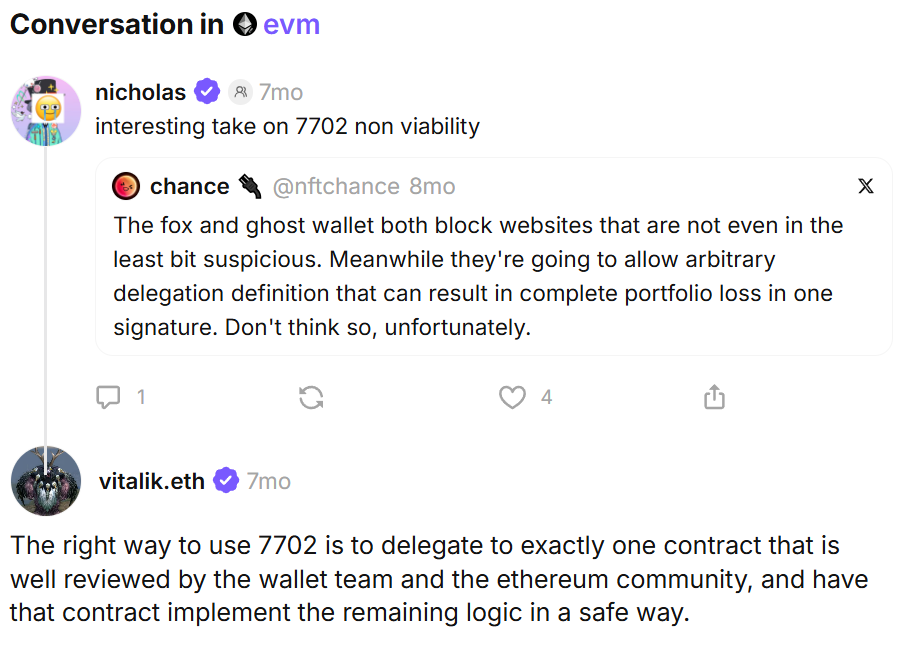
After all, migrating from EOA to AA requires users to transfer assets to a new address—an inconvenient process. This brings us to Vitalik Buterin’s earlier EIP-7702 proposal, which cleverly resolves the compatibility deadlock among three prior proposals (EIP-4337, EIP-3074, EIP-5003), doing something remarkable: allowing existing EOA accounts to temporarily transform into smart contract accounts during transactions.
This proposal means you don’t need to register a new wallet or transfer assets from your current imToken wallet to a new AA address. Instead, via EIP-7702, your old account can temporarily gain smart contract capabilities (such as batch approvals, gas sponsorship, atomic cross-chain operations), reverting back to a fully compatible EOA after the transaction concludes.
3. EIL Implementation and the Future
Unlike OIF, which emerged from community-driven, bottom-up collaboration, EIL carries stronger official backing, being an engineering initiative led by the EF Account Abstraction team (the creators of ERC-4337).
Currently, progress is unfolding along three key dimensions:
-
Multichain Expansion of ERC-4337: The community is exploring ways to extend the structure of ERC-4337’s UserOp to include cross-chain information such as target chain IDs—this is the first step toward giving smart accounts "long-range vision";
-
Synergy with ERC-7702: As EIP-7702 (granting EOA accounts smart account capabilities) advances, ordinary EOA users will be able to seamlessly join the EIL network, significantly lowering the barrier to entry;
-
Standardized Messaging Interfaces: Similar to how OIF addressed intent standardization in our previous article, EIL is driving standardization of底层 message transmission. Projects like Optimism’s Superchain, Polygon’s AggLayer, and ZKsync’s Elastic Chain are exploring interoperability within their own ecosystems, while EIL aims to further unify these heterogeneous systems into a universally compatible messaging layer.
Even more interestingly, EIL’s ambition extends beyond mere "connectivity"—it is also adding another foundational capability: privacy.
If EIP-7702 and AA solve "accessibility," then Kohaku, the privacy framework unveiled by Vitalik at Devconnect, could become the next critical piece of EIL—echoing another core principle from the "Declaration of Trustlessness": censorship resistance.
At Devconnect, Vitalik stated plainly, “Privacy is freedom,” and emphasized that Ethereum is on a path toward privacy enhancement, aiming to deliver real-world privacy and security. To this end, the Ethereum Foundation has assembled a privacy team of 47 researchers, engineers, and cryptographers dedicated to making privacy a "first-class citizen" on Ethereum.
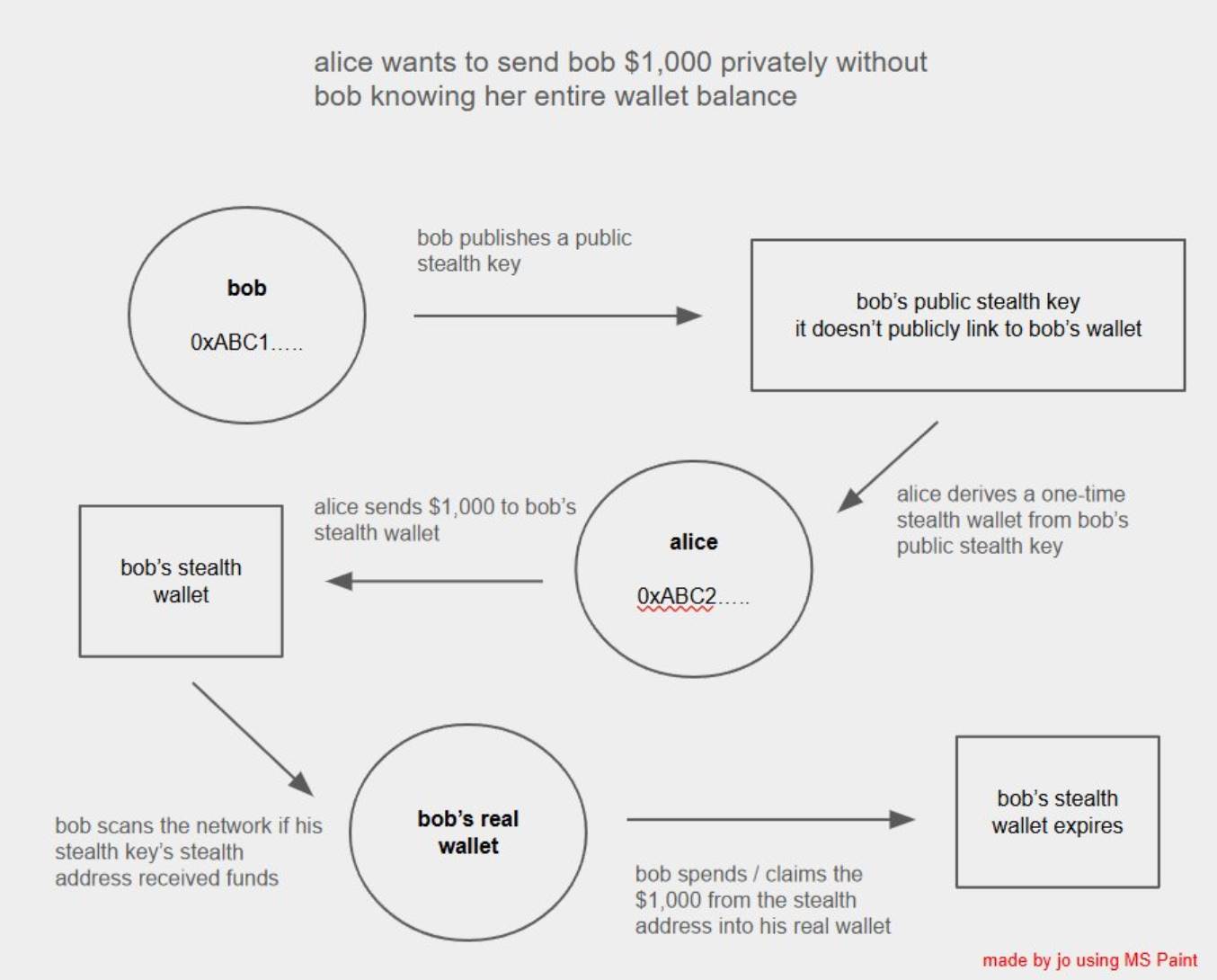
This means future privacy protection will no longer be an optional plugin, but a fundamental capability as natural as sending a transaction. Materializing this vision is the Kohaku framework—which essentially uses your public key to generate a temporary stealth address, enabling private operations without revealing links to your primary wallet.
Under this design, future AA accounts will not only be asset management tools but also privacy shields.
By integrating protocols like Railgun and Privacy Pools, AA accounts will allow users to protect transaction privacy while compliantly providing "proof of clean funds," enabling anyone to prove their funds are not illicit without exposing specific spending trails.
Now, we can clearly see the full picture of Ethereum’s interoperability roadmap:
-
OIF (Intent Framework): Enables the application layer to "understand" user needs;
-
EIL (Interoperability Layer): Paves the infrastructure layer for seamless execution.
This may also be the clear signal the Ethereum Foundation wishes to convey: Ethereum should not be a loose collection of L2s, but rather one vast, unified supercomputer.
In the future, when EIL is fully realized, we may no longer need to explain to new users what L2s or cross-chain bridges are. At that point, you’ll only see assets—without barriers between chains.
Join TechFlow official community to stay tuned
Telegram:https://t.me/TechFlowDaily
X (Twitter):https://x.com/TechFlowPost
X (Twitter) EN:https://x.com/BlockFlow_News
 @imTokenOfficial