Space Recap|Rising Inflation vs Market Bets on Rate Cuts: How to Maintain a Cautious Crypto Asset Allocation Amid Macroeconomic Volatility?
TechFlow Selected TechFlow Selected
Space Recap|Rising Inflation vs Market Bets on Rate Cuts: How to Maintain a Cautious Crypto Asset Allocation Amid Macroeconomic Volatility?
Facing macroeconomic fluctuations, the TRON ecosystem offers a "balanced offensive and defensive" asset allocation model through stablecoin settlements, interest-bearing assets, and innovative services.
 Navigating Web3 tides with focused insights
While traditional markets are still debating the "conflicting signals" between inflation data and rate cut expectations, the crypto world has already become a battleground for extreme emotional and financial tension. On one side, persistent inflation data casts a shadow over monetary policy; on the other, the market continues to bet that the Fed will begin a rate-cutting cycle in the coming months.
This "expectation mismatch" is shrouding the crypto market in a fog of information. For retail investors, the split macro narrative makes direction hard to discern. To address this, this edition of SunFlash invites several veteran KOLs for an in-depth roundtable discussion on the topic: "Inflation rebound vs. rate cut bets: Can misaligned expectations become the next catalyst for crypto?" The goal is to peel back the surface of macro trends, analyze the market psychology and capital logic behind the "expectation mismatch," and explore how ordinary users can interpret signals, manage risk, and find more stable footing amid volatility during this highly uncertain period.
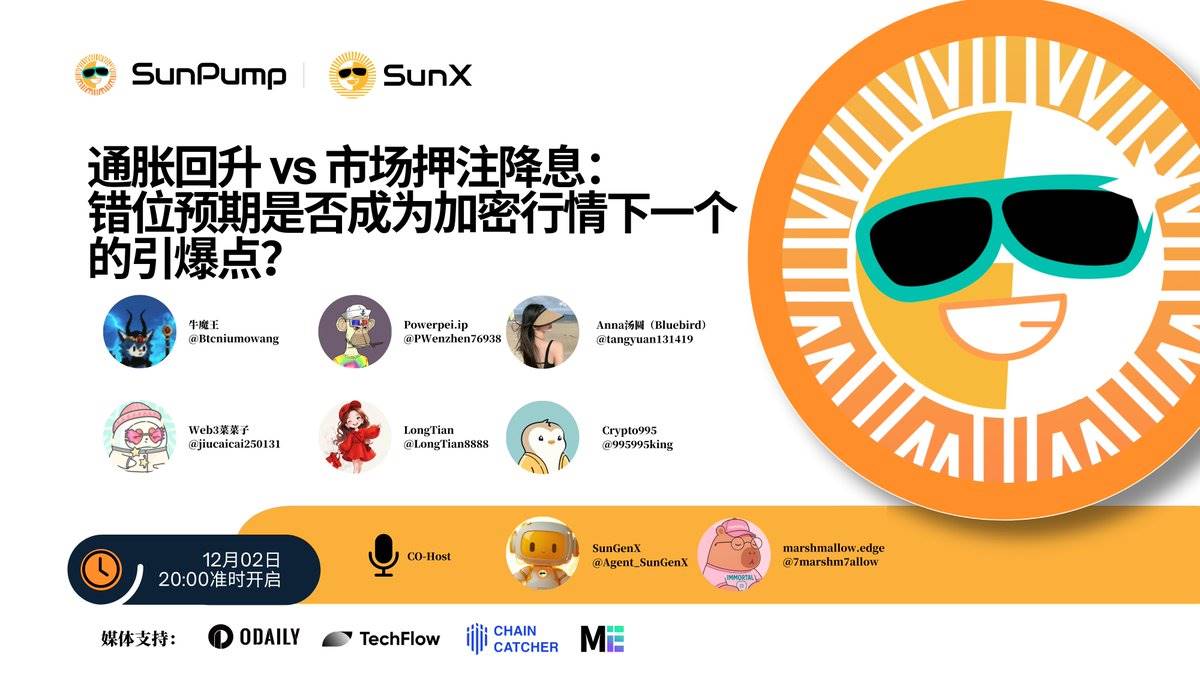
Inflation Rebound vs. Rate Cut Bets: The Game Behind the Mismatched Expectations
Regarding the significant "mismatch" between current macro data and market expectations, guests generally agree this is not a simple market misjudgment, but rather a forward-looking game based on future liquidity expectations.
Niuniu Wang likens this phenomenon to the market passing through a "speed bump." He points out that the core issue is the widespread belief that the high-interest-rate "tap" cannot remain shut forever, otherwise it would trigger globally unsustainable systemic risks. Therefore, capital isn't focused on minor fluctuations in CPI figures, but on the certainty of liquidity gates opening within the next six months. This very mismatch creates an ideal environment for major players to oscillate prices, shake out weak hands, and position themselves.
Anna Tangyuan clarifies the rationality of this "contradiction" from a time perspective. She emphasizes that markets trade the future, while inflation data reflects the past. The current inflation rebound is seen largely as a short-term phenomenon, while the market has already observed signs of economic stress such as weakening employment and high financing costs, leading to early bets on central banks eventually turning dovish.
On the flip side, however, when rate cut expectations are already priced in, any failure or delay in those expectations could become the spark that ignites risk. Guests unanimously believe that if rate cut expectations fail to materialize or are delayed, the crypto market may face not just a regular correction, but a severe storm triggered by a liquidity reversal and leveraged liquidations.
Niuniu Wang vividly compares the current market to a group of people waiting hungrily for a meal—should the Fed "flip the table," the reversal in market sentiment would be extremely violent. The most dangerous aspect is not the macro situation itself, but the amplifier effect of high leverage. Once expectations shift, panic could drive leveraged positions to flee en masse, with cascading liquidations fueling a sharp, "pinning" style crash. Web3 Caicaizi predicts the worst-case scenario: if the Fed turns hawkish or even restarts rate hikes, global liquidity could tighten abruptly, potentially reenacting systemic panics like "312" or "519."
How to Maintain a Cautious Crypto Asset Allocation Amid Macro Volatility?
Faced with this high-volatility "misalignment" environment, how can ordinary users avoid risks without completely missing potential opportunities? The guests' strategies center on "defense and counterattack" and "timing control." powerpei.ip summarizes the approach as "maintain stability, seize opportunities." He views Bitcoin and Ethereum as essential "ballast stones" and core assets that must be firmly held, ensuring one's foundational presence in the industry. At the same time, assets with strong narratives—such as AI, RWA, and privacy—serve as supplementary components to capture cutting-edge opportunities, enhancing the overall resilience of the strategy.
Under this strategic framework, selecting assets that combine the stable foundation of "staying grounded" with the growth potential of "seizing opportunities" has become a practical consideration for many investors. The TRON ecosystem in crypto exhibits a clear two-tier structure, whose core is building a financial network that balances stability with growth potential. This characteristic aligns perfectly with investors’ current need for a "defense and counterattack" strategy amid macro uncertainty.
Its most fundamental "ballast" business is serving as the core settlement layer for global stablecoins, especially USDT. According to Presto Research, a blockchain research firm, TRON has become a primary global stablecoin settlement network, processing transactions worth $6–8 billion annually—a classic infrastructure role with high certainty and strong network effects. This means that regardless of market conditions, global demand for stablecoin transfers and settlements continuously injects real, high-frequency liquidity into this network. TRON’s total account count exceeding 350 million and cumulative transaction volume surpassing 12.2 billion serve as solid proof of its status as a key financial infrastructure.
Above this robust settlement network lies a rich decentralized finance (DeFi) yield ecosystem, which acts as its "opportunity-seeking" yield amplifier. Stablecoins held by users (e.g., USDT) are not idle—they can be transformed into income-generating assets through lending protocols, liquidity mining, and other channels on the TRON chain, earning approximately 8% annualized yield or higher in risk-free returns. Meanwhile, its native token TRX not only offers around 7% annual yield through basic staking, but can achieve greater return elasticity through advanced strategies like liquid staking and DeFi portfolio combinations. This ability to convert base assets into continuous cash flow presents a highly attractive option for investors seeking "stable grounding" amid macro turbulence.
Looking ahead, the TRON ecosystem is expanding its business boundaries through innovation, reaching into broader traditional finance realms—representing its long-term "opportunity-seeking" growth narrative. For example, at the frontier of AI and blockchain convergence, TRON has undergone a brand upgrade with AINFT, building a decentralized AI new economy ecosystem. In the decentralized finance (DeFi) space, its core platform SUN.io integrates AI-powered tools like SunAgent, which uses intelligent strategies to help users automate trading, manage assets, and optimize returns, embedding AI decision-making into actual on-chain financial operations. Additionally, targeting the highly popular Meme coin sector, the TRON ecosystem has launched SunPump, a platform dedicated to fair launches and creation of Meme coins, further lowering the barrier to creation and participation through its one-click token launch tool SunGenX, opening a new growth curve driven jointly by technological innovation and community culture.
Overall, the TRON ecosystem has built a business matrix spanning underlying settlement ("stability"), mid-layer yield generation ("balanced offense and defense"), and frontier innovation ("opportunity"). Under the tightening expectation of "delayed rate cuts," its essential stablecoin settlement function and defensive DeFi yield assets become more prominent. Under the easing expectation of "rate cuts implemented," its native tokens and innovative ventures may exhibit stronger price elasticity. This very business structure provides a multi-layered, dynamically adjustable strategic option for navigating macro uncertainty.
As illustrated by the analysis of the TRON ecosystem, a cyclical-resilient allocation model often features a multi-layered business matrix capable of adapting to different macro scenarios. The key lies in ensuring that no matter how conditions change, parts of the portfolio continue generating value and capturing demand, while others retain the flexibility to respond and act opportunistically. Ultimately, finding a way out of the macro maze may depend precisely on building such intrinsically resilient assets and ecosystems, rather than merely guessing whether the next door will open or close.
Join TechFlow official community to stay tuned
Telegram:https://t.me/TechFlowDaily
X (Twitter):https://x.com/TechFlowPost
X (Twitter) EN:https://x.com/BlockFlow_News