How to trade U.S. stocks with 100x leverage contracts?
TechFlow Selected TechFlow Selected
How to trade U.S. stocks with 100x leverage contracts?
Perpetual contracts on U.S. stocks, the next key investment focus for smart money.
 Navigating Web3 tides with focused insights
Author: Jaleel Jia Liu,律动
Money always flows to where there is more money, and liquidity forever chases deeper liquidity.
Bitcoin’s market cap stands at $1.7 trillion, while the total market capitalization of U.S. equities exceeds $50 trillion. Tech giants like Apple, Microsoft, and NVIDIA each have valuations that dwarf half of the entire cryptocurrency market.
An increasing number of savvy crypto participants seem to have quietly reached a consensus: trading stocks may truly outperform trading crypto.
The U.S. stock market is deeply intertwined with the global economy, geopolitics, and technological innovation, making its volatility and narrative richness far exceed those of any single cryptocurrency. This level of global attention is something meme coins and altcoins can never match.
Major Perp DEXs in the crypto industry—such as Hyperliquid, Trade.xyz, Ostium, and Lighter—have already launched perpetual contracts for U.S. stocks.
And when combined with on-chain perpetual contracts—a financial instrument long familiar in the crypto market—the U.S. stock market becomes even more exciting and attractive.
After all, in traditional finance, ordinary individuals face numerous barriers when trying to trade U.S. stocks: opening overseas brokerage accounts, enduring lengthy approval processes, limited trading hours, and leverage caps of only 2x or at most 4x.
But now, the rules of the game are being rewritten. Perpetual contracts are merging with the U.S. stock market in an unstoppable way. And perhaps U.S. equity perpetuals represent the next key investment frontier for smart money.
This article will deeply analyze the core mechanisms of three platforms—Trade.xyz, Ostium, and Lighter—and compare their differences in trading experience, risk control, and data performance.
Which DEX Offers More Stocks and Higher Leverage?
We first look at the most basic concerns for traders: supported stock types, available leverage multiples, and fee structures.
trade.xyz
trade.xyz is the first perpetual DEX deployed on the Hyperliquid HIP-3 protocol and currently the largest perpetual DEX on HIP-3, launching in October 2025. Its biggest innovation is enabling 24/7/365 round-the-clock U.S. stock trading, focusing on U.S. equity indices (XYZ100) and individual stock perpetuals. Currently in growth mode, it offers trading fee discounts ≥90%, with actual taker fees around just 0.009%.
The team remains relatively mysterious, primarily consisting of members from the Hyperunit team (@hyperunit), operating anonymously or discreetly without disclosing detailed founder information. There are community rumors suggesting the Hyperunit team originated from Hyperliquid. No external funding has been raised yet, and it's a Pre-TGE project. Related reading: "2 Billion USD Trading Volume in 10 Days: Hyperliquid’s Next Hit Product."
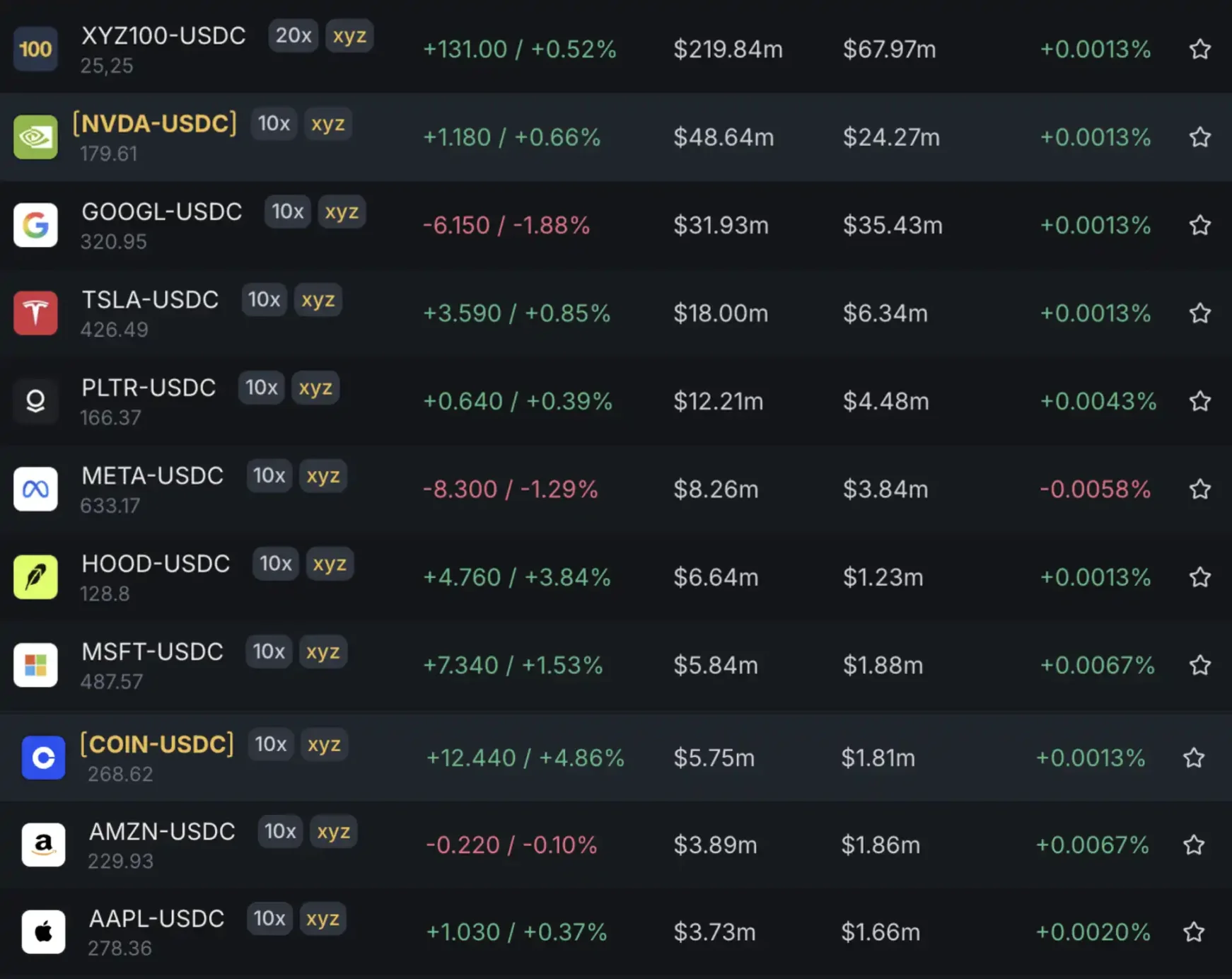
As shown in the image, trade.xyz currently supports 11 U.S. equity assets. Most stocks offer up to 10x leverage, while the index product XYZ100 (tracking Nasdaq) allows up to 20x leverage. The trading model used is CLOB.
The fee structure is also quite favorable overall: under current growth mode, fee discounts are ≥90%, resulting in actual fees: takers ≤0.009% (about 9 cents per $1,000), makers ≤0.003%.
Lighter
Lighter is a perpetual trading platform built on a custom ZK-rollup on Ethereum, officially launching in early 2025, known for zero transaction fees and provable fairness. The platform uses zero-knowledge proofs to verify all order matching and liquidation processes. It rolled out U.S. stock trading functionality on November 26.
Founder Vladimir Novakovski has a strong background—an immigrant from Russia, gold medalist in U.S. Math and Physics Olympiads, joined Citadel as a trader after graduating from Harvard at age 18, with 15 years of fintech experience. He previously co-founded AI social platform Lunchclub (raised $30 million). In November 2025, Lighter completed a $68 million Series B round at a $1.5 billion valuation, led by Founders Fund (Peter Thiel) and Ribbit Capital, with participation from top-tier firms including a16z crypto, Lightspeed, and Coatue.
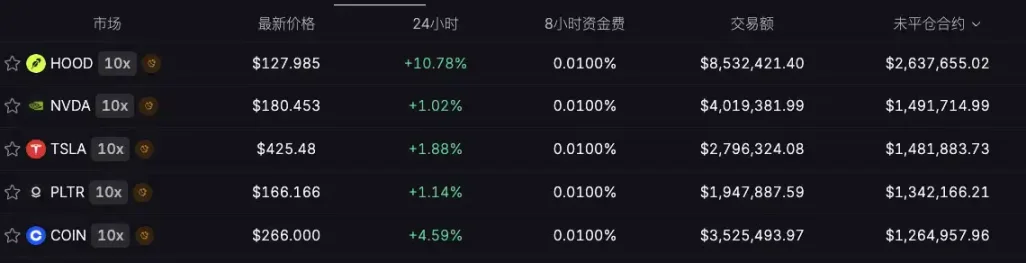
As shown in the image, Lighter supports five U.S. equity assets, all offering uniform 10x leverage. The trading model used is also CLOB.
Regarding fees for U.S. stock trading, Lighter maintains its biggest selling point: 0 fees. Retail takers and makers both pay 0%. For high-frequency traders and professional market makers, fees are set at 0.002% for makers and 0.02% for takers. Additionally, Lighter calculates funding rates hourly, capped at ±0.5%, based on premium TWAP.
Ostium
Ostium is an open-source decentralized perpetual futures exchange built on Arbitrum, focused on real-world asset (RWA) trading, including U.S. stocks, indices, commodities, and forex. Key features include up to 200x leverage.
Ostium Labs was founded in 2022 by former Bridgewater Associates employees, two Harvard classmates. On October 6, 2023, it completed a $3.5 million seed round led by General Catalyst and LocalGlobe, with participation from notable institutions such as Balaji Srinivasan, Susquehanna International Group (SIG), and GSR. Currently in Pre-TGE stage, it runs a points system rewarding active users.
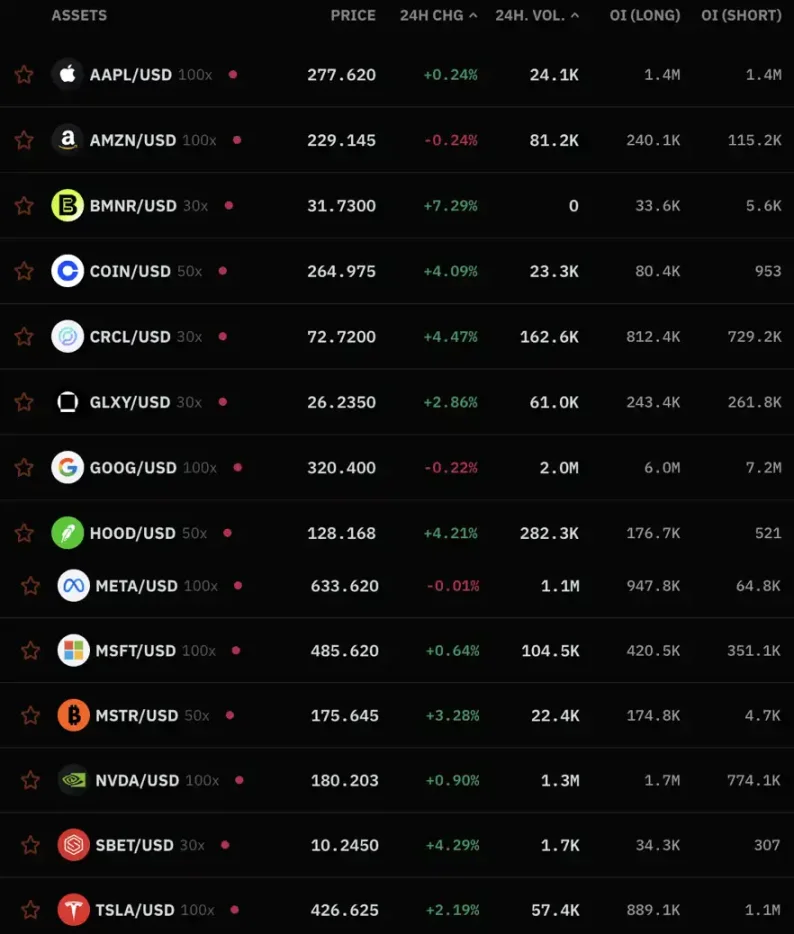
As shown in the image, Ostium offers the widest variety of U.S. stocks, currently supporting 13 U.S. equity assets. Its leverage levels are aggressive and vary depending on asset liquidity and trading volume. Major tech stocks such as Apple, Amazon, Meta, Microsoft, NVIDIA, and Tesla support up to 100x leverage. Crypto-related stocks like Coinbase, Robinhood, MicroStrategy, SBET, and Circle support 30–50x leverage.
Different from the CLOB models of the previous two, Ostium adopts an Arbitrum AMM pool-to-pool trading model.
In terms of fee structure, there is a fixed 0.05% opening fee, with no closing fee; oracle fees are charged at $0.10 per transaction, potentially refundable upon closure depending on trade type—see fee rules for details. There's also a rollover fee similar to funding rates, calculated via block-by-block compounding and holding cost, with asymmetric long/short rates.
How Do You Trade U.S. Stocks When Wall Street Is Closed?
After comparing the underlying assets, leverage, and fees across the three platforms, another critical factor determines the difference in "trading experience": U.S. stocks don't trade 24 hours a day, but on-chain perpetual contracts do.
So how do oracles continue functioning when external prices halt, and how do platforms handle trading during market downtime? Each platform takes a completely different approach.
trade.xyz
For trade.xyz, its handling method can be summarized as "by asset, by time segment."
The index product (e.g., XYZ100 tracking Nasdaq) does not directly rely on U.S. spot prices but instead uses CME's NQ futures—which trade nearly 23 hours a day, providing a more continuous price source. trade.xyz applies a cost-of-carry model to reverse-engineer the futures price into a corresponding "spot index price," allowing the index contract to maintain near-continuous price updates.
However, individual stocks are more complicated. Unlike futures, they lack almost-continuous liquidity. Therefore, trade.xyz primarily relies on Pyth's price feeds to cover pre-market, post-market, and overnight extended periods.
Only when there is absolutely no external data input—such as during the one-hour daily futures break or the 48-hour weekend pause—does the system switch to trade.xyz’s internal pricing mechanism: using an exponentially weighted moving average (EMA) with an eight-hour time constant based on the on-chain order book to smooth prices, adjusting impact spreads according to bid-ask depth so prices still reflect on-chain supply and demand even without external data. Once external data resumes, the oracle immediately switches back.
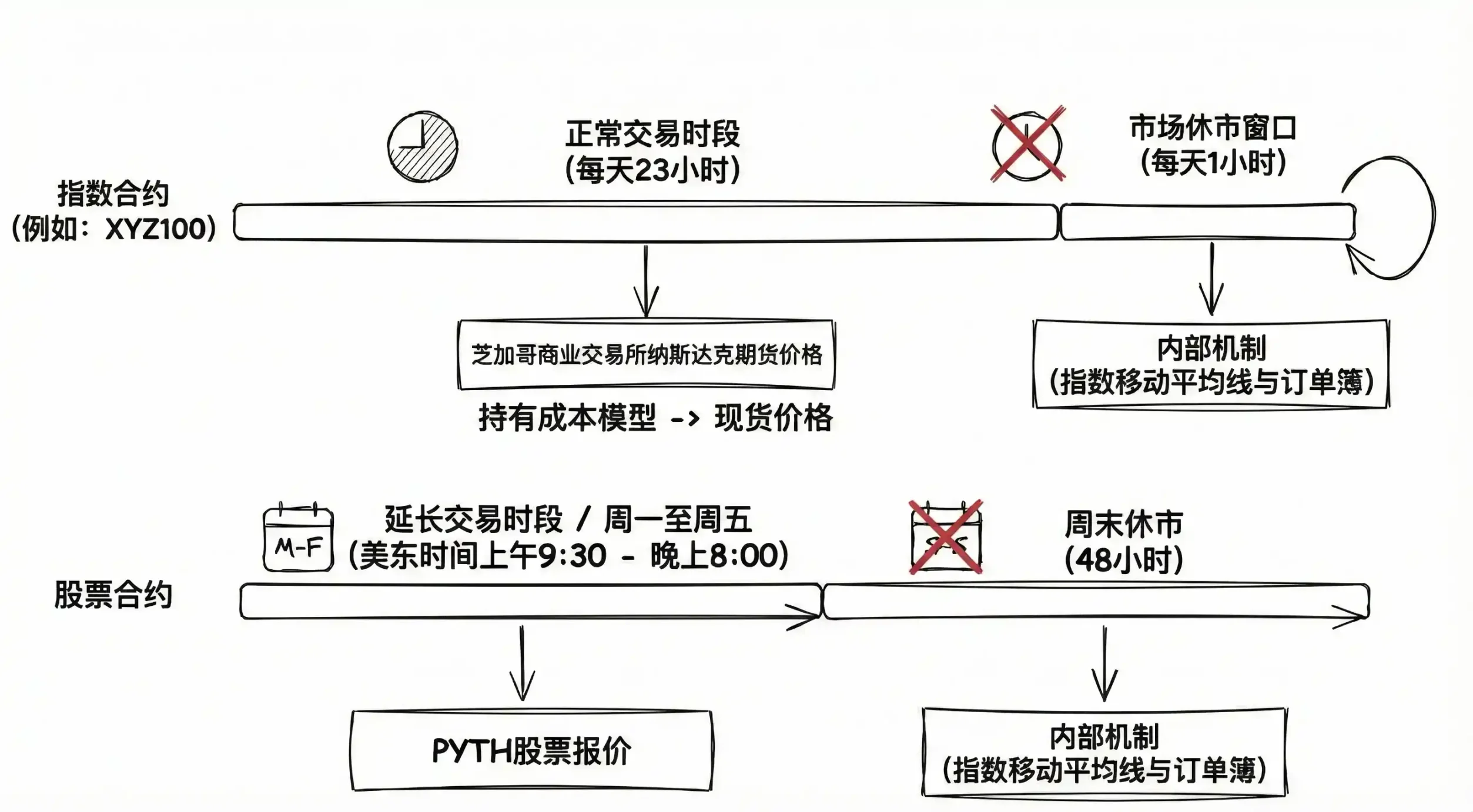
This design enables the oracle to self-adjust based on the on-chain order book when external data is unavailable, maintaining responsiveness to market supply and demand.
Ostium
Ostium has built its own pull-based RWA oracle system, carefully handling different asset trading hours, futures roll-over, and opening gaps. Data sources, exchange session information, and node aggregation logic are all developed internally by the team and then operated through node networks like Stork.
The overall cost is higher, hence trading on Ostium involves an oracle fee of $0.10 per transaction. This fee is still charged if the trade fails due to low slippage, etc., but may be refunded upon full settlement—refer to fee rules for specifics.
For regular users, this means prices won’t jump erratically during market closure, and you can still place advance orders—limit and stop-loss orders can be submitted, but will only execute once the market reopens and price conditions are met. Market orders cannot be placed during off-hours. This mechanism closely follows traditional market rhythms, even incorporating special holiday closures, making price feeds more aligned with real markets.
Additionally, although Ostium offers aggressive leverage up to 100x, this applies only intra-day. Once positions extend beyond the daily window or into overnight, leverage requirements are strictly tightened.
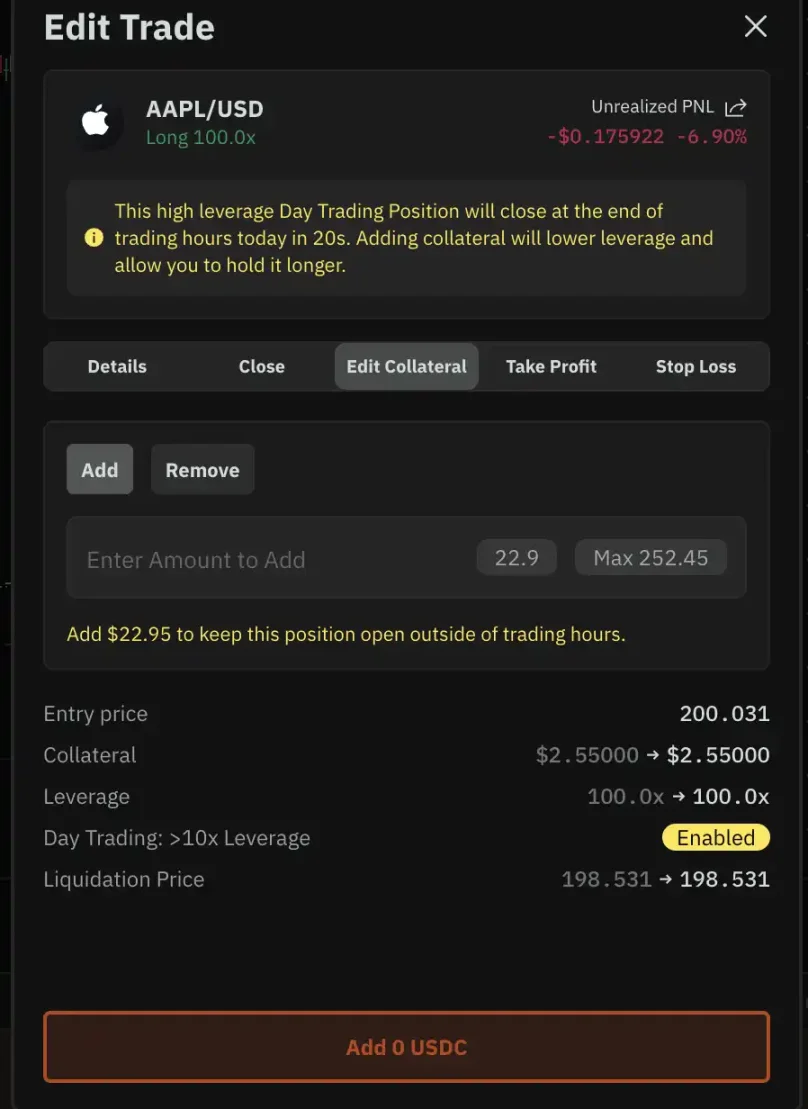
Example of intraday position
Specifically, leverage can be opened or adjusted anytime during normal market hours (9:30 AM to 4:00 PM ET). But once outside the daily window (9:31 AM to 3:45 PM ET) or going overnight, leverage limits are enforced, with exact reductions varying by asset class. All intraday positions exceeding the leverage limit will be forcibly closed 15 minutes before market close—i.e., at 3:45 PM ET—to reduce overnight risk.
Lighter
Lighter’s strategy is more direct.
During market closure, Lighter freezes the market into a relatively safe state: entering reduce-only mode, meaning users can only reduce positions, not open new ones or adjust leverage to increase risk.
During trading hours, RWA assets behave no differently than regular crypto assets—prices update normally, and orders are matched as usual. But once off-hours begin, index prices stop updating, and mark prices can fluctuate no more than ±0.5% around the current value to prevent extreme deviation.
Funding fees continue to accrue normally, but new active trades cannot be executed.
How to Capture This Dividend Pie?
When discussing U.S. equity perpetuals, one unavoidable issue arises: stocks pay dividends—how should contracts handle this?
Cryptocurrencies like Bitcoin never pay dividends—price is simply price. But companies like Apple and Microsoft distribute cash to shareholders every quarter. In traditional stock markets, share prices automatically drop on ex-dividend dates—for example, a $100 stock paying a $2 dividend drops to $98.
This creates a problem for perpetual contracts: if left unaddressed, short sellers would gain an unfair $2 spread advantage. Simply shorting before the dividend and waiting for the price to drop becomes a guaranteed arbitrage profit—risk-free money.
So how do these three platforms tackle this challenge?
trade.xyz
trade.xyz incorporates dividend calculations into the funding rate. Suppose the oracle price is $100 and is expected to drop to $98 at future time T due to a $2 dividend payout. Before T, the mark price must follow a smooth discount curve.
At T-1, to prevent arbitrage, the funding paid by shorts must exactly equal the profit they’d gain from the price dropping from the mark price to $98. According to the funding rate formula: funding rate = (mark price - oracle price) / oracle price + truncation function (...)
Since the mark price is lower than the oracle price, the funding rate becomes negative. A negative funding rate means shorts pay longs. Going further back to T-2, T-3, the mark price gradually slides from 99.95, 99.90... down to 98.975. Each hour, shorts pay a funding fee to longs.
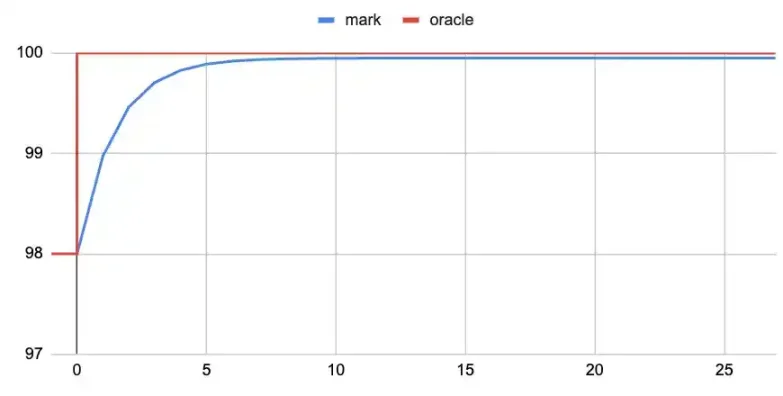
The end result: shorts appear to gain a $2 spread (100→98), but fully give it back via funding payments; longs nominally lose $2 (price drops from 100 to 98), but recover it entirely through received funding fees—effectively capturing the dividend.
Ostium
Ostium believes perpetual contracts track price movements, not ownership of the underlying stock. Since you don’t actually hold Apple shares, why should you receive dividends? A contract is a contract—the only thing that matters is price changes.
Therefore, on Ostium: on ex-dividend dates, prices drop accordingly, following the oracle feed; no funding compensation is given to longs, nor are additional fees charged to shorts.
Doesn’t this disadvantage longs? Here, Ostium balances it through another mechanism: the rollover fee.
What is the rollover fee? Simply put, it's the time cost of holding a position, akin to financing costs or gains from holding real stocks. Its characteristics include: asymmetry between longs and shorts—rates differ; compounded per block (every few seconds), though imperceptible in real time; settled upon closing—not deducted in real time, but accounted for when the position is closed.

The rollover fee appears under the net rate (L/S) tab. Hovering over it shows a tooltip explaining long and short rollover fees.
This means if you go long on a stock, the rollover fee could be positive; if you short, it could be negative.
This rollover fee mechanism indirectly reflects holding costs, including the impact of dividends. Although Ostium doesn't directly address dividends, through rollover fees and oracle adjustments, the P&L for both longs and shorts remains relatively fair.
Lighter
Lighter’s documentation doesn’t explicitly specify special handling for dividends, but judging from its mechanism, it likely relies on oracle price adjustments.
That is: when the spot price drops on ex-dividend date, the oracle follows suit; if the contract’s mark price lags behind, a negative premium occurs; negative premium leads to negative funding rates, with shorts paying longs—eventually reaching equilibrium.
This approach is somewhat similar to Trade.xyz, except Lighter doesn’t emphasize dividend handling separately, integrating it into the overall price-tracking mechanism.
Notably, Lighter imposes a funding rate cap: ±0.5% per hour. This prevents funding rates from spiking during extreme market conditions, protecting traders from being crushed by excessive fees.
Summary
The PMF (Product-Market Fit) of U.S. equity perpetuals has been preliminarily validated. Data shows that trade.xyz’s cumulative trading volume has surpassed $2 billion, setting a record $200 million daily volume during NVDA’s earnings release, with approximately $734 million traded in the past 24 hours.
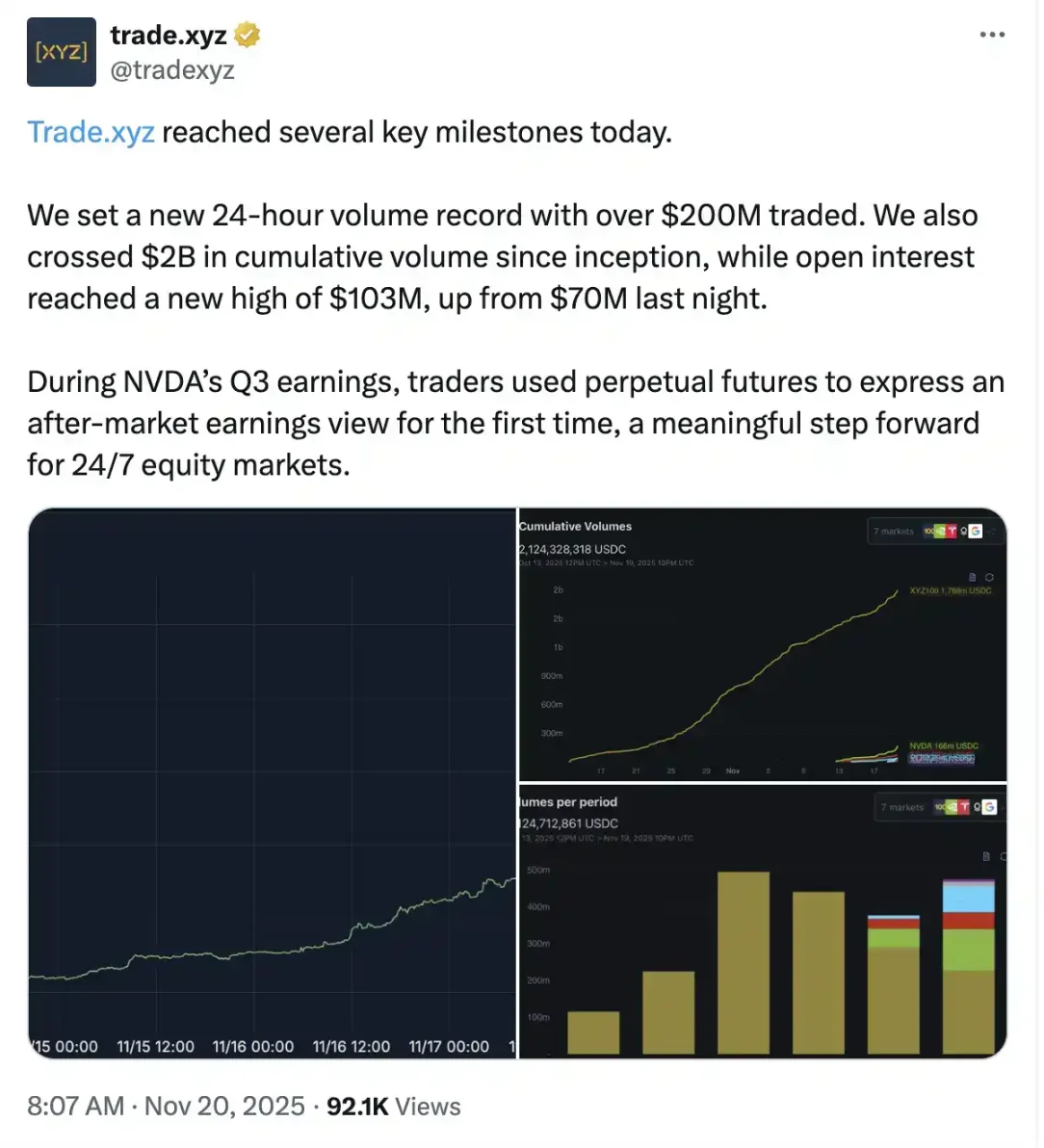
Lighter’s overall trading volume and OI (open interest) figures are impressive: $7.16 billion in 24-hour volume and $1.634 billion in OI. However, since Lighter only recently launched U.S. stock trading, reliable specific data on its equity trading remains limited.
Now consider Ostium: total trading volume exceeds $27.2 billion, with $138 million traded in the past 24 hours.
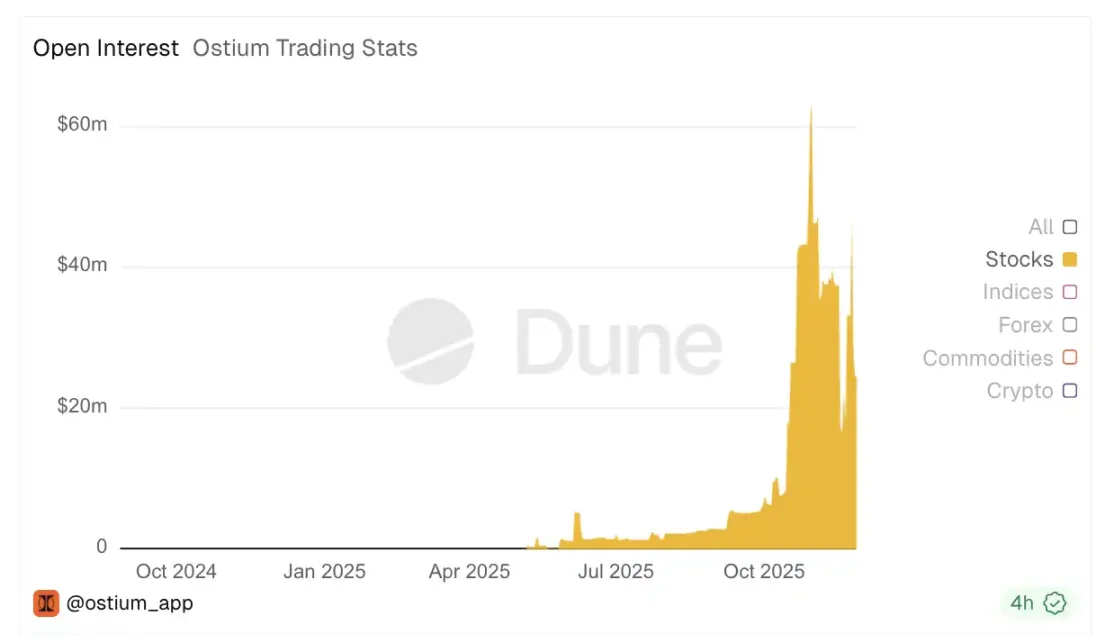
According to Dune analytics tracking Ostium’s U.S. equity contract trading, daily trading volume for U.S. equity contracts has already exceeded $50 million. The OI curve for U.S. equity contracts peaked historically in October this year at around $64 million, now settling at approximately $45 million. OI data also shows that U.S. equity contract positions account for about 20% of Ostium’s total open interest.
Yet amid the excitement, a word of caution is needed for all U.S. equity perpetual traders: financial market efficiency is ruthless. Behind the allure of 100x leverage lies 100x risk. Those interested in U.S. equity perpetuals should start small—with small positions and low leverage.
Join TechFlow official community to stay tuned
Telegram:https://t.me/TechFlowDaily
X (Twitter):https://x.com/TechFlowPost
X (Twitter) EN:https://x.com/BlockFlow_News
 BlockBeats