








Token buybacks, making a comeback
TechFlow Selected TechFlow Selected
Token buybacks, making a comeback
How did this mechanism, once considered unfeasible, re-enter the market?
 Navigating Web3 tides with focused insights
Written by: Ekko an and Ryan Yoon
Buybacks, which stalled in 2022 under pressure from the U.S. Securities and Exchange Commission (SEC), are now back in the spotlight. This report, written by Tiger Research, analyzes how this mechanism—once considered unfeasible—has re-entered the market.
Key Takeaways
-
Hyperliquid’s 99% buyback and renewed discussions around Uniswap’s buyback have brought buybacks back into focus.
-
Buybacks, once deemed unworkable, are now possible due to the SEC's “Crypto Projects” initiative and the introduction of the Clarity Act.
-
However, not all buyback structures are viable, confirming that core decentralization requirements remain critical.
1. Buybacks Return After Three Years
Buybacks, which disappeared from the crypto market after 2022, have re-emerged in 2025.
In 2022, the SEC viewed buybacks as activities subject to securities regulation. When a protocol uses its revenue to repurchase its own tokens, the SEC considered this as providing economic benefits to token holders—essentially equivalent to dividends. Since dividend distribution is a core characteristic of securities, any token conducting buybacks could be classified as a security.
As a result, major projects like Uniswap either postponed or completely halted their buyback plans. There was no reason to take on direct regulatory risk.
However, by 2025, the situation had changed.
Uniswap has reopened discussions on buybacks, and several protocols—including Hyperliquid and Pump.fun—have already implemented buyback programs. Something considered unfeasible just a few years ago has now become a trend. So, what changed?
This report explores why buybacks were halted, how regulations and structural models have evolved, and how each protocol’s current approach to buybacks differs.
2. Why Buybacks Disappeared: The SEC’s View on Securities
The disappearance of buybacks was directly tied to the SEC’s view on securities. From 2021 to 2024, regulatory uncertainty across the crypto sector was exceptionally high.
The Howey Test is the framework the SEC uses to determine whether an activity constitutes a security. It consists of four elements, and any asset meeting all four qualifies as an investment contract.
Under this test, the SEC repeatedly claimed many crypto assets fell within the scope of investment contracts. Buybacks were interpreted under the same logic. As regulatory pressure mounted across the market, most protocols had no choice but to abandon their buyback plans.
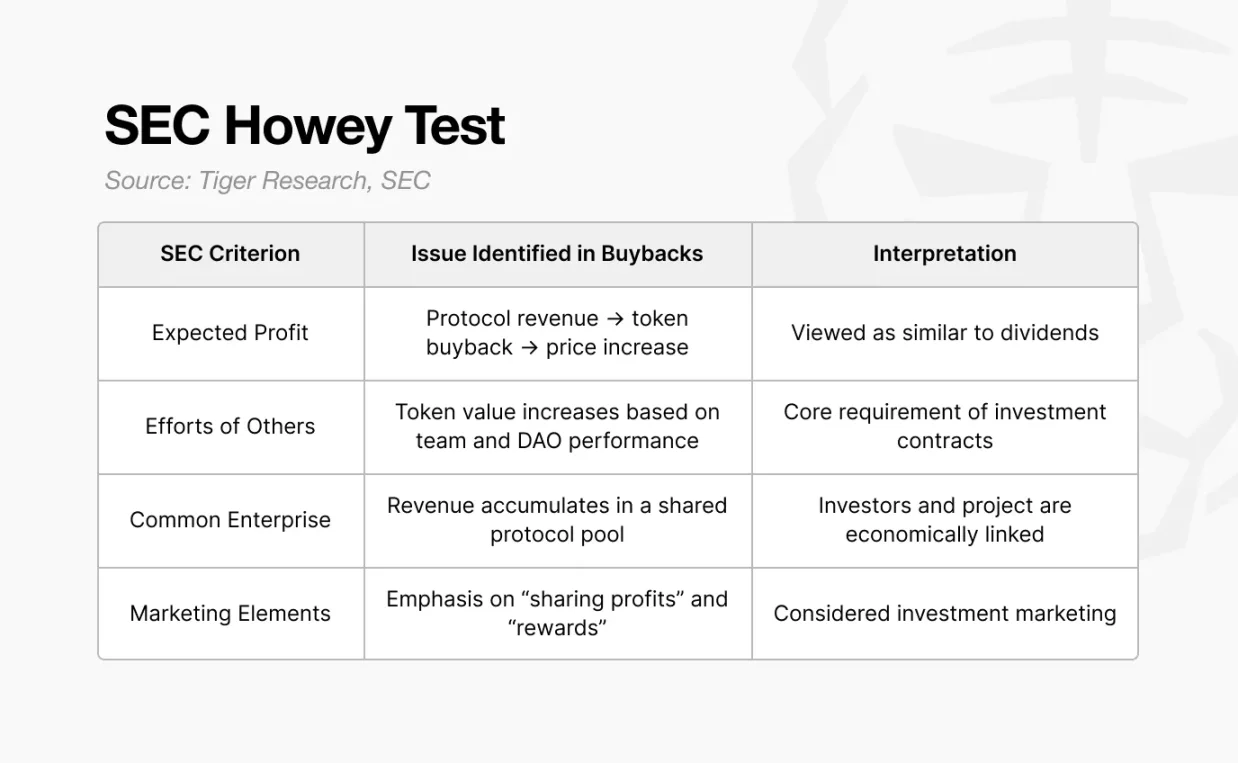
The SEC did not see buybacks as simple tokenomics mechanisms. In most models, protocols use their revenue to buy back tokens and then distribute value to token holders or ecosystem contributors. To the SEC, this resembled corporate dividends or shareholder distributions following a stock buyback.
Because the four elements of the Howey Test aligned with this structure, the interpretation of “buybacks = investment contract” became increasingly entrenched. This pressure was most severe for large U.S.-based protocols.
Uniswap and Compound, both operated by U.S. teams, faced direct regulatory scrutiny. As a result, they had to be extremely cautious when designing tokenomics and any form of revenue distribution. For example, Uniswap’s fee switch remained inactive after 2021.
Due to regulatory risk, major protocols avoided any mechanisms that directly distributed revenue to token holders or significantly influenced token prices. Terms like “price appreciation” or “profit sharing” were also removed from public communications and marketing materials.
3. Shift in SEC’s Stance: Crypto Projects
Strictly speaking, the SEC did not “approve” buybacks in 2025. What changed was its interpretation of what constitutes a security.
-
Gensler: Focused on outcomes and actions (How were tokens sold? Did the foundation directly distribute value?)
-
Atkins: Focused on structure and control (Is the system decentralized? Who actually controls it?)
Under Gensler’s leadership in 2022, the SEC emphasized outcomes and behaviors. If revenue was shared, the token tended to be seen as a security. If the foundation intervened in ways that affected price, it was also treated as a security.
By 2025, under Atkins’ leadership, the framework shifted toward structure and control. The focus moved to who governs the system and whether operations rely on human decisions or automated code. In short, the SEC began assessing actual decentralization.
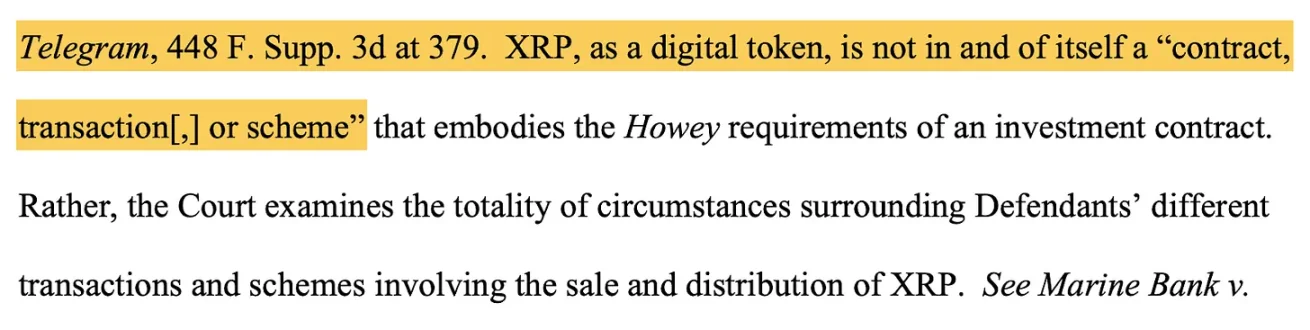
Source: U.S. District Court for the Southern District of New York
The Ripple (XRP) lawsuit became a key precedent.
In 2023, the court ruled that XRP sold to institutional investors qualified as a security, while XRP traded by retail investors on exchanges did not. The same token could fall into different categories depending on how it was sold. This reinforced the interpretation that securities status does not depend on the token itself, but rather on sales methods and operational structures—a view that directly impacted how buyback models were evaluated.
These shifts were later consolidated under an initiative called “Crypto Projects.” After “Crypto Projects,” the SEC’s central questions changed:
Who actually controls the network? Are decisions made by the foundation or by DAO governance? Is revenue distribution and token burning scheduled manually or executed automatically by code?
In other words, the SEC began examining substantive decentralization rather than superficial structure. Two conceptual shifts became particularly important.
-
Lifecycle
-
Functional Decentralization
3.1. Lifecycle
The first shift was the introduction of a token lifecycle perspective.
The SEC no longer views tokens as permanently securities or permanently non-securities. Instead, it recognizes that a token’s legal characteristics may change over time.
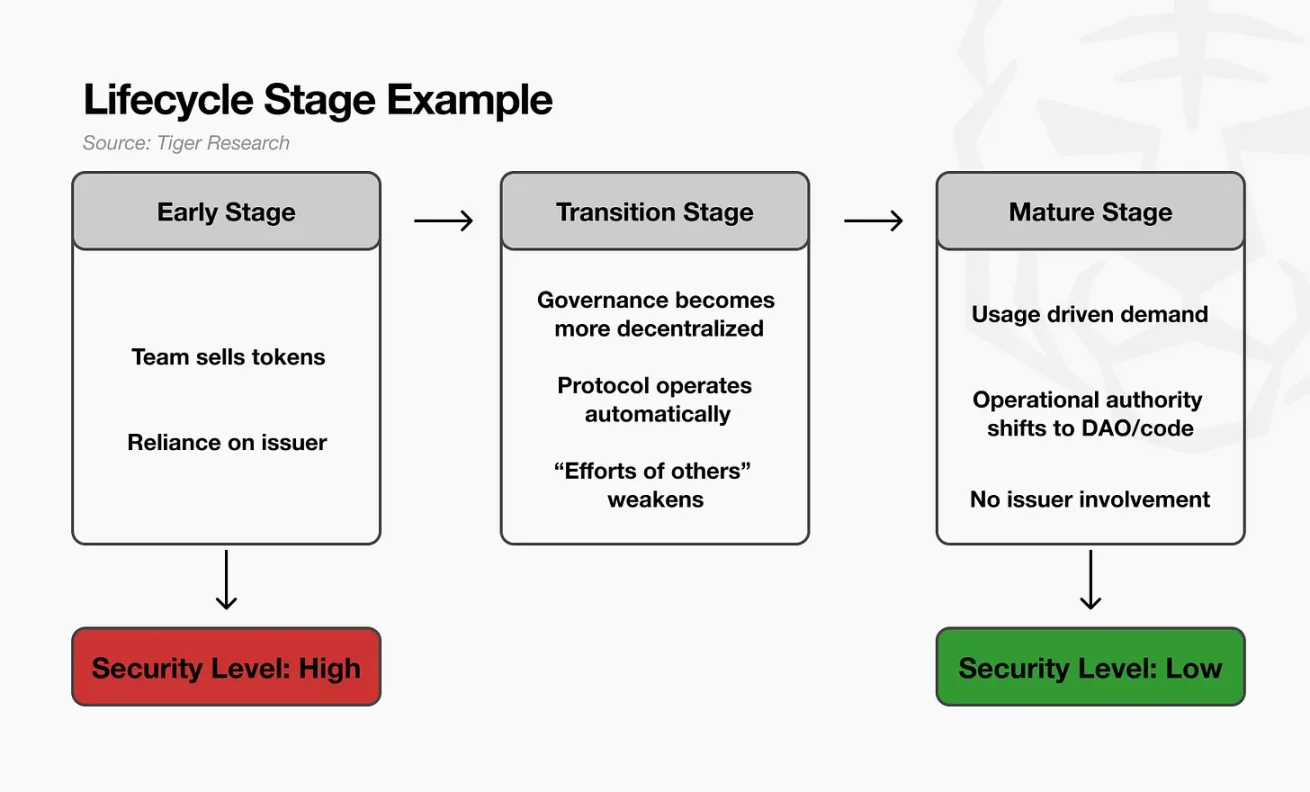
For example, in the early stages of a project, the team sells tokens to raise funds, and investors buy them expecting strong execution from the team to increase token value. At this point, the structure heavily depends on the team’s efforts, making the sale functionally similar to a traditional investment contract.
As the network begins to see real usage, governance becomes more decentralized, and the protocol operates reliably without direct team intervention, the interpretation changes. Price formation and system operations no longer depend on the team’s ability or ongoing work. A key element in the SEC’s assessment—“reliance on the efforts of others”—is weakened. The SEC describes this period as a transitional phase.
Eventually, when the network reaches maturity, the token’s characteristics differ significantly from its early stage. Demand is driven more by actual usage than speculation, and the token functions more like a network commodity. At this point, applying traditional securities logic becomes difficult.
In short, the SEC’s lifecycle view acknowledges that a token may resemble an investment contract in its early stages, but as the network becomes decentralized and self-sustaining, classifying it as a security becomes increasingly difficult.
3.2. Functional Decentralization
The second shift is functional decentralization. This perspective focuses not on how many nodes exist, but on who actually holds control.
For instance, a protocol might run ten thousand nodes globally, with DAO tokens distributed among tens of thousands of holders. On the surface, it appears fully decentralized.
Yet, if smart contract upgrade permissions are held by a multi-sig wallet controlled by a three-member foundation, if the treasury is managed by foundation wallets, and if fee parameters can be changed directly by the foundation, the SEC does not consider this decentralized. In reality, the foundation controls the entire system.
In contrast, even if a network runs on only one hundred nodes, if all major decisions require DAO voting, if outcomes are executed automatically by code, and if the foundation cannot arbitrarily intervene, the SEC may regard it as more decentralized.
4. The Clarity Act
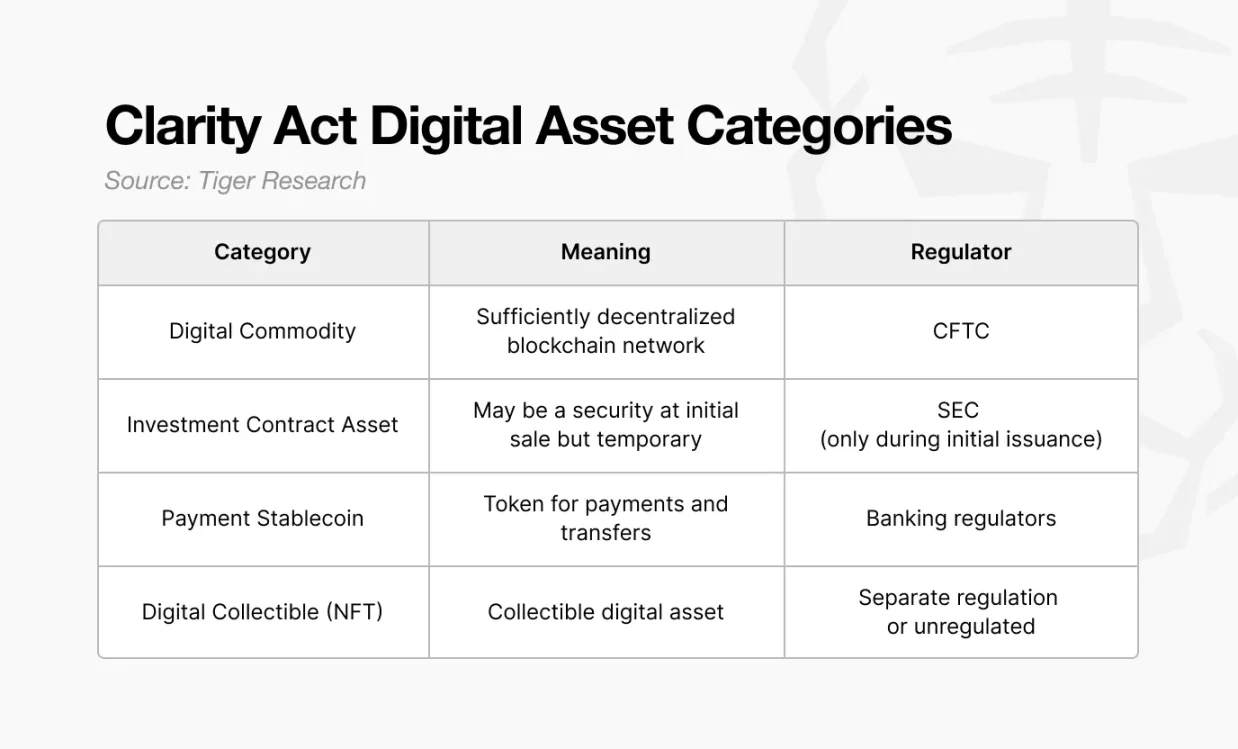
In 2025, another factor enabling the revival of buyback discussions was the Clarity Act, a legislative initiative proposed by the U.S. Congress. The act aims to redefine how tokens should be legally classified.
While the SEC’s “Crypto Projects” initiative focuses on determining which tokens qualify as securities, the Clarity Act poses a more fundamental question: As a legal asset, what is a token?
The core principle is simple: A token does not become a permanent security simply because it was initially sold under an investment contract. This concept resembles the SEC’s lifecycle approach but is applied differently.
Under the SEC’s previous interpretation, if a token was sold as part of an ICO investment contract, the token itself could be indefinitely treated as a security.
The Clarity Act separates these elements. If a token was sold under an investment contract at issuance, it is considered an “investment contract asset” at that moment. But once it enters the secondary market and is traded by retail users, it is reclassified as a “digital commodity.”
In short, a token may be a security at issuance, but once it is widely distributed and actively traded, it becomes an ordinary digital asset.
This classification matters because it changes the regulating authority. Initial sales fall under the SEC’s jurisdiction, while secondary market activities fall under the CFTC’s jurisdiction. As oversight shifts, the securities-related constraints on protocol economic design are reduced.
This shift directly affects how buybacks are interpreted. If a token is classified as a digital commodity in the secondary market, a buyback is no longer seen as “dividend-like” securities behavior. Instead, it can be interpreted as supply management, similar to monetary policy in a commodity-based system. It becomes a mechanism for operating the token economy, not for distributing profits to investors.
In essence, the Clarity Act formalizes the idea that a token’s legal status may change depending on context, reducing the structural regulatory burden associated with buyback designs.
5. Shifting Toward Buybacks and Burns
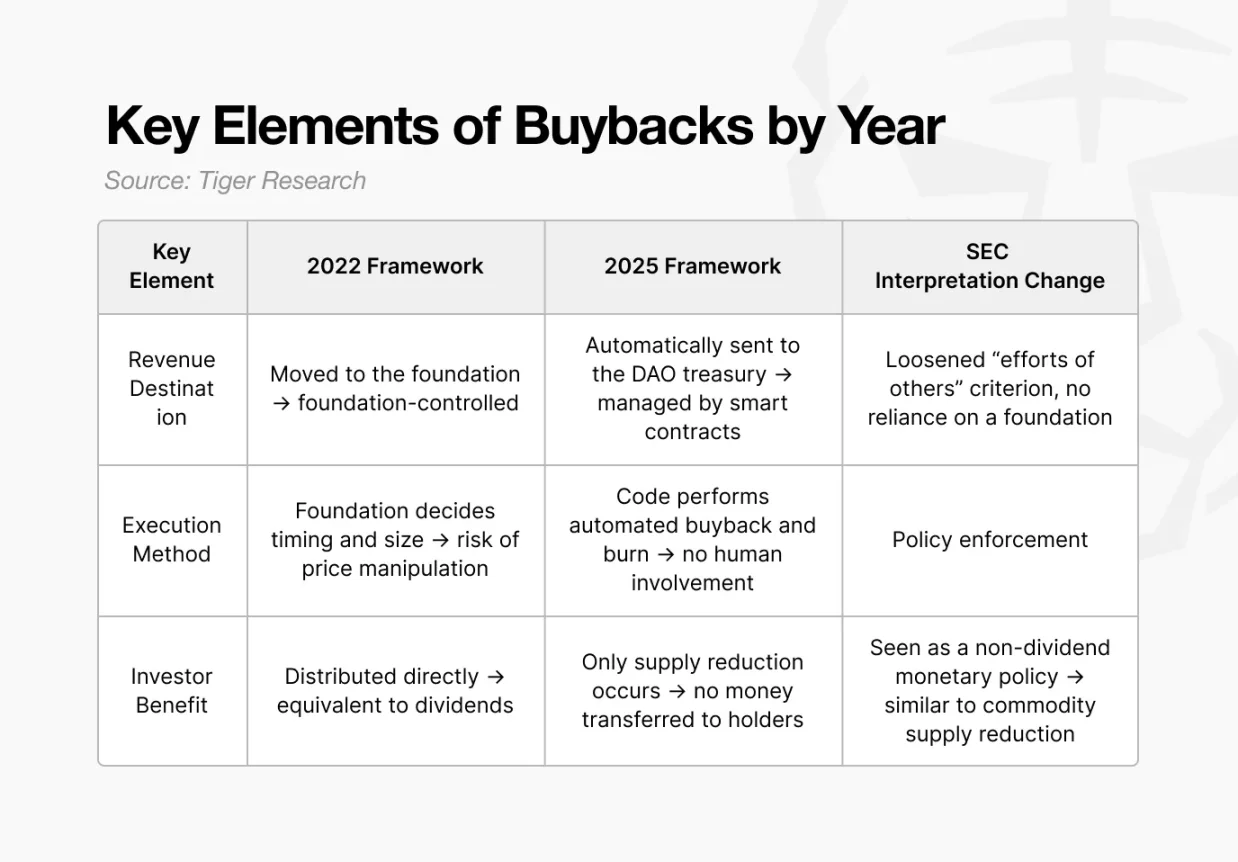
In 2025, buybacks returned combined with automatic burn mechanisms. In this model, revenue is not directly distributed to token holders, the foundation has no control over price or supply, and the burn process is algorithmically executed. As a result, the structure moves further away from elements previously flagged by regulators.
Uniswap’s “Unified Proposal,” announced in November 2025, clearly illustrates this shift.
In this model, a portion of trading fees is automatically allocated to the DAO treasury, but no revenue is directly distributed to UNI holders. Instead, a smart contract purchases UNI on the open market and burns it, reducing supply and indirectly supporting value. All decisions governing this process are made through DAO voting, with no intervention from the Uniswap Foundation.
The key change lies in how the action is interpreted.
Earlier buybacks were seen as a form of “profit distribution” to investors. The 2025 model redefines the mechanism as supply adjustment, operating as part of network policy rather than intentional price manipulation.
This structure does not conflict with the SEC’s 2022 stance and aligns with the “digital commodity” classification defined in the Clarity Act. Once a token is seen as a commodity rather than a security, adjusting supply resembles a monetary policy tool rather than a dividend-like payment.
The Uniswap Foundation stated in its proposal that “this environment has changed” and “regulatory clarity in the U.S. is evolving.” The key insight here is that regulators did not explicitly authorize buybacks. Instead, clearer regulatory boundaries allow protocols to design models that meet compliance expectations.
In the past, any form of buyback was seen as regulatory risk. By 2025, the question has shifted from “are buybacks allowed?” to “can its design avoid triggering securities concerns?”
This shift has opened space for protocols to implement buybacks within a compliant framework.
6. Protocols Implementing Buybacks
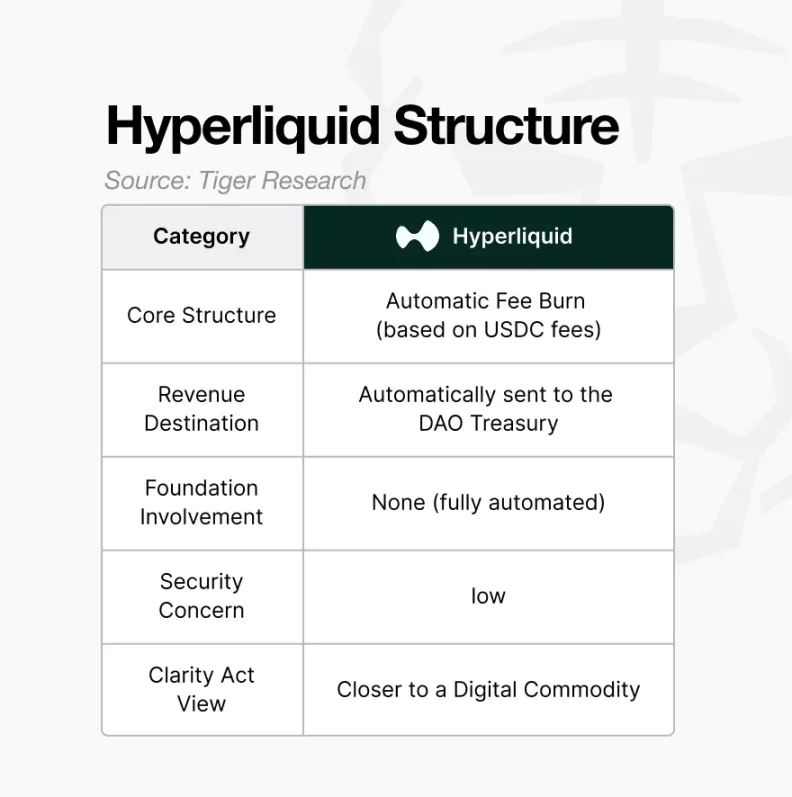
The representative protocol executing the buyback-and-burn mechanism in 2025 is Hyperliquid. Its structure demonstrates several defining features:
-
Automated Mechanism: Buybacks and burns operate based on protocol rules, not discretionary decisions by the foundation.
-
Non-Foundation Revenue Flow: Revenue does not flow into wallets controlled by the foundation, or even if it does, the foundation cannot use it to influence price.
-
No Direct Fee Sharing: Revenue is not paid to token holders. It is used only for supply adjustment or network operating costs.
The key point is that the model no longer promises direct economic benefits to token holders. It functions as a supply policy for the network. The mechanism has been redesigned to fit within boundaries acceptable to regulators.
However, this does not mean all buybacks are safe.
Although buybacks have regained momentum, not every implementation carries the same regulatory risk. The 2025 regulatory shift opened the door for structurally compliant buybacks—not for discretionary, one-off, or foundation-driven programs.
The SEC’s logic remains consistent:
-
If the foundation decides the timing of market purchases, it reinforces the interpretation of “intentional price support.”
-
Even with DAO voting, if upgrade or execution authority ultimately rests with the foundation, it fails the decentralization requirement.
-
If value accrues to specific holders instead of being burned, it resembles a dividend.
-
If revenue flows from the foundation to fund market purchases that lead to price appreciation, it strengthens investor expectations and aligns with elements of the Howey Test.
In short, discretionary, ad-hoc, or foundation-controlled buybacks still cannot escape securities scrutiny.
It’s also important to note that buybacks do not guarantee price appreciation. Burning reduces supply, but it is only a long-term tokenomic mechanism. Burning cannot turn a weak project into a strong one; rather, strong projects can reinforce their fundamentals through well-designed burn systems.
Join TechFlow official community to stay tuned
Telegram:https://t.me/TechFlowDaily
X (Twitter):https://x.com/TechFlowPost
X (Twitter) EN:https://x.com/BlockFlow_News
 @tiger_research






