"Whales" accelerate Bitcoin sell-off, but still not a panic signal?
TechFlow Selected TechFlow Selected
"Whales" accelerate Bitcoin sell-off, but still not a panic signal?
Data shows that some "whale" wallets are exhibiting regular selling patterns, likely related to profit-taking rather than panic signals, but market absorption capacity has weakened.
 Navigating Web3 tides with focused insights
Source: Jinshi Data
Bitcoin fell below the critical $100,000 mark last week, and recent selling by "whales" (investors holding large amounts of cryptocurrency) and other long-term holders has become a significant driver of the coin's recent weakness.
Most blockchain analytics firms define "whales" as individuals or institutions holding 1,000 or more bitcoins. Although the identities of most whales remain unknown, tracking their cryptocurrency wallets still provides clues about their activity through blockchain data.
Data shows that some whales have recently accelerated their bitcoin selling. Some analysts say this trend is worth noting but not necessarily a cause for panic. They point out that the recent sell-offs may reflect steady profit-taking rather than panic-driven liquidation—a pattern consistent with previous bull market cycles.
Martin Leinweber, Director of Digital Asset Research and Strategy at MarketVector Indexes, said such sales could reflect "planned asset allocation." "Some Bitcoin investors bought in when prices were in single digits and waited all this time. Now there’s finally enough liquidity to sell without completely disrupting the market," he told MarketWatch.
While crypto bulls have recently complained about drying market liquidity, buying and selling Bitcoin today is far easier compared to a decade ago.
However, analysts at blockchain analytics firm CryptoQuant warned that the timing of whale selling amid deteriorating market sentiment and slowing buying could put further downward pressure on Bitcoin’s price. Dow Jones market data showed that the largest cryptocurrency briefly approached $19,400 last Friday—the lowest level since May 6.
Then vs. Now
Selling of Bitcoin by long-term and large holders is not unique to the current cycle. Analysts from blockchain data platform Glassnode wrote in a recent report that signs suggest recent sell-offs are driven by profit-taking, not panic.
In detail, whale wallets that have held Bitcoin for over seven years and sold more than 1,000 BTC per hour exhibited a consistent and steady selling pattern over time (see chart below, data as of Thursday, November 13).
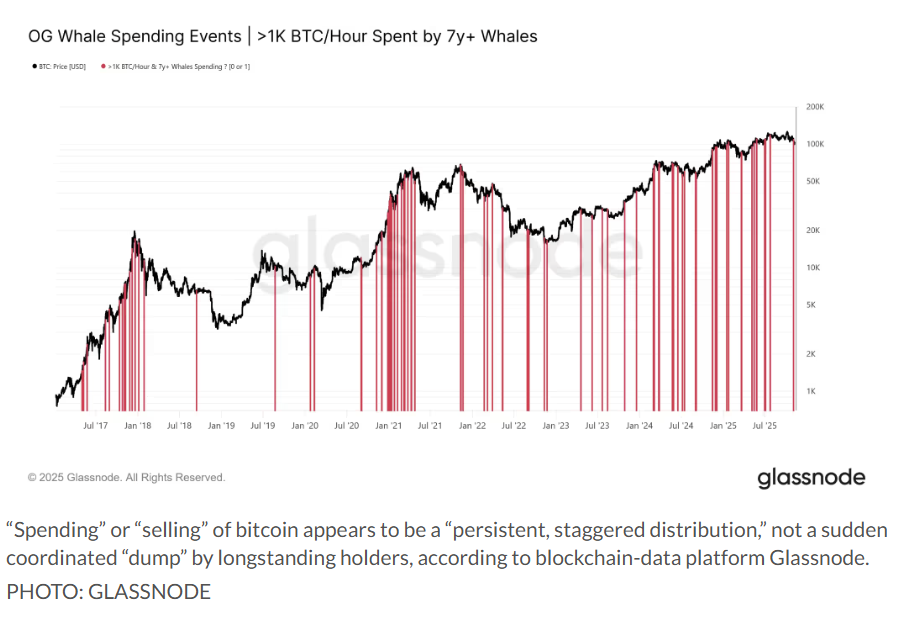
Whale selling behavior has shown a consistent and steady pattern over time
The Significance of the $100,000 Level
Meanwhile, Cory Klippsten, CEO of Swan Bitcoin, a financial services firm focused on Bitcoin and a long-term investor himself, said the heavy whale selling over the past few months appears tied to the $100,000 Bitcoin level—many early adopters have long viewed this figure as a psychological threshold for taking profits.
"Since I entered this space in 2017, many early holders I know have talked about the $100,000 number," Klippsten told MarketWatch. "For whatever reason, people always said they'd sell part of their holdings at that level."
Glassnode data shows that long-term holder selling intensified after Bitcoin first breached $100,000 in December 2024.
Potential Warning Signs
However, CryptoQuant analysts wrote in a recent report that one changing factor is the market's ability to absorb selling. When long-term holders sold Bitcoin at the end of last year and beginning of this year, other buyers stepped in to support prices—but that dynamic now appears to be shifting.
Fund flows into investment products reflect weakening demand—Dow Jones market data shows that Bitcoin exchange-traded funds (ETFs) saw $311.3 million in outflows for the week ended last Thursday, on track for a fifth consecutive weekly outflow, the longest such streak since the week ending March 14 (which also saw five straight weeks of outflows).
Over the past five weeks, Bitcoin ETFs have recorded cumulative outflows of $2.6 billion, the largest five-week outflow since the week ending March 28 (when outflows reached $3.3 billion).
Recent price action has also brought the $100,000 level back into focus. At the time of writing, Bitcoin continues to trade below this level. Some technical analysts say that failure to reclaim this key level could trigger additional profit-taking.
To make matters worse, the overall macroeconomic environment is unfavorable for risk assets. Joel Kruger, market strategist at LMAX Group, which operates foreign exchange and cryptocurrency exchanges, noted this has led to the liquidation of some bullish positions. "We believe the market entered the fourth quarter with overly optimistic expectations, driven by seasonal trend analysis—historically strong performance during this period," Kruger wrote in a note to MarketWatch.
Kruger pointed out that as investors scale back expectations for a Fed rate cut in December, coupled with weak labor market data fueling economic concerns, broader risk assets including Bitcoin face renewed pressure.
Saylor Still Buying
Despite this, one of the best-known major Bitcoin whales continues to buy.
Michael Saylor, chairman of software company Strategy Inc.—widely seen as a leveraged Bitcoin investment vehicle—said on CNBC last Friday that the company has been "accelerating" its Bitcoin purchases and will disclose details on Monday morning.
As of last Friday, Strategy held over 640,000 bitcoins, accounting for more than 3% of the cryptocurrency’s current 19.9 million circulating supply. Representatives for Strategy did not immediately respond to an email seeking comment.
Join TechFlow official community to stay tuned
Telegram:https://t.me/TechFlowDaily
X (Twitter):https://x.com/TechFlowPost
X (Twitter) EN:https://x.com/BlockFlow_News