Gold and tech stocks have people buying the dip, but Bitcoin remains "unrecoverable"
TechFlow Selected TechFlow Selected
Gold and tech stocks have people buying the dip, but Bitcoin remains "unrecoverable"
Why has the once-thriving cryptocurrency market become "惨不忍睹"?
 Navigating Web3 tides with focused insights
Tech stocks received bottom-fishing capital, gold rebounded after a sharp drop, but Bitcoin sank alone, "unable to recover." What exactly happened behind this? Why has the once-thriving cryptocurrency market become "惨不忍睹"?
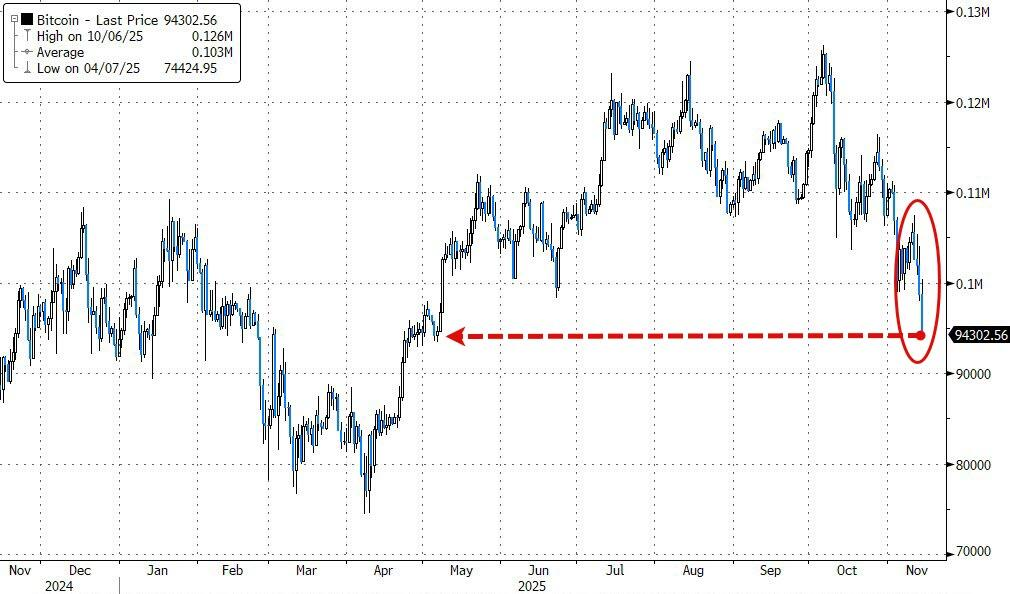
On Friday (November 14), the U.S. stock market saw a dramatic reversal. After an initial wave of panic selling at the opening, investors rushed in to buy tech stocks, leading the Nasdaq and S&P 500 indices to stage a strong rebound after hitting key technical support levels. Gold also recovered to around $4,080 after plunging over $150 intraday. But Bitcoin stood out as the clear exception: it dropped 5%, falling below the $94,000 mark and hitting a six-month low.
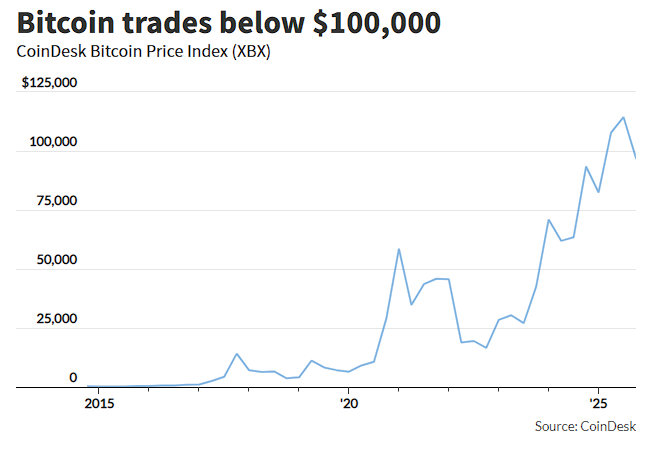
This marks Bitcoin’s third consecutive week of decline and its fifth drop in the past six weeks. More shockingly, since the flash crash on October 10, the ripple effects across the cryptocurrency market have shown no signs of easing—all cryptocurrencies combined have lost over $1 trillion in total market value.
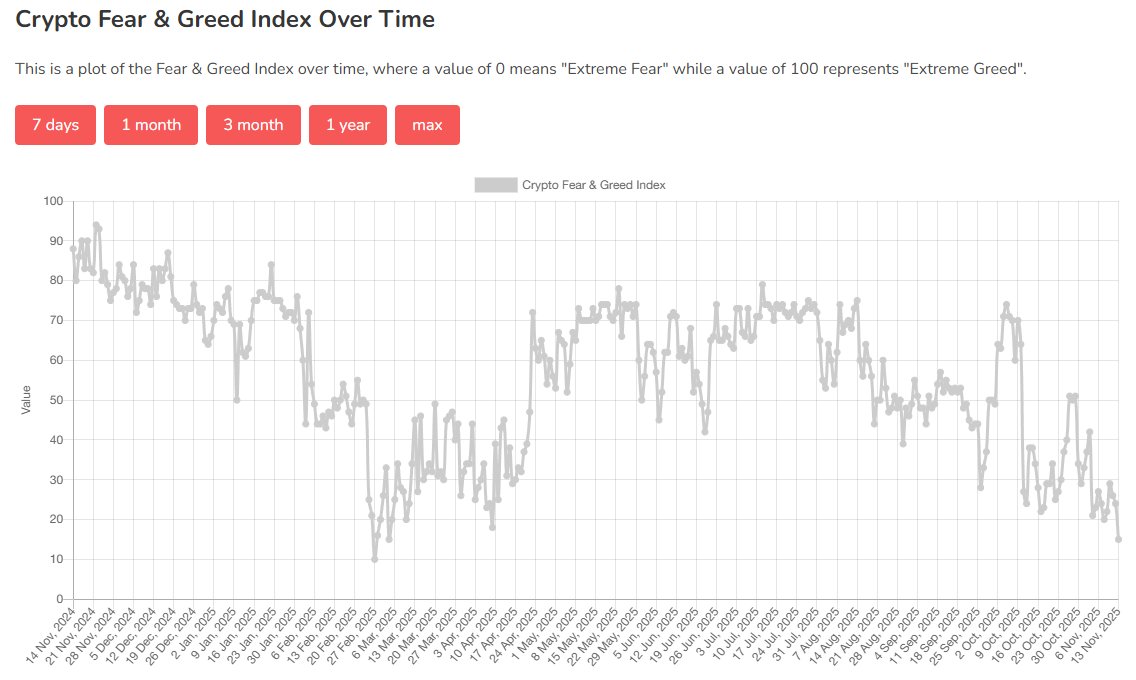
This contrast highlights Bitcoin's abnormal situation: despite maintaining a high correlation of 0.8 with the Nasdaq 100 Index, Bitcoin exhibits an asymmetric pattern of "falling harder and rising weaker." More notably, according to a WallStreetCN article, the Crypto Fear & Greed Index has plunged to 15, the lowest level since February this year. The last time the index fell below 20, Bitcoin crashed 25% within a month.
Meanwhile, multiple factors are jointly suppressing Bitcoin. Long-term holders have sold approximately 815,000 Bitcoins in the past 30 days—the highest level since early 2024; market liquidity has dried up, causing Bitcoin ETFs to experience net outflows for five consecutive weeks. Even the Trump family’s crypto-related wealth has not been spared, with their holdings in World Liberty Financial tokens and American Bitcoin shares each retreating about 30% from peak levels.
Tech Stocks Stage Comeback, Bitcoin Plunges Against Trend
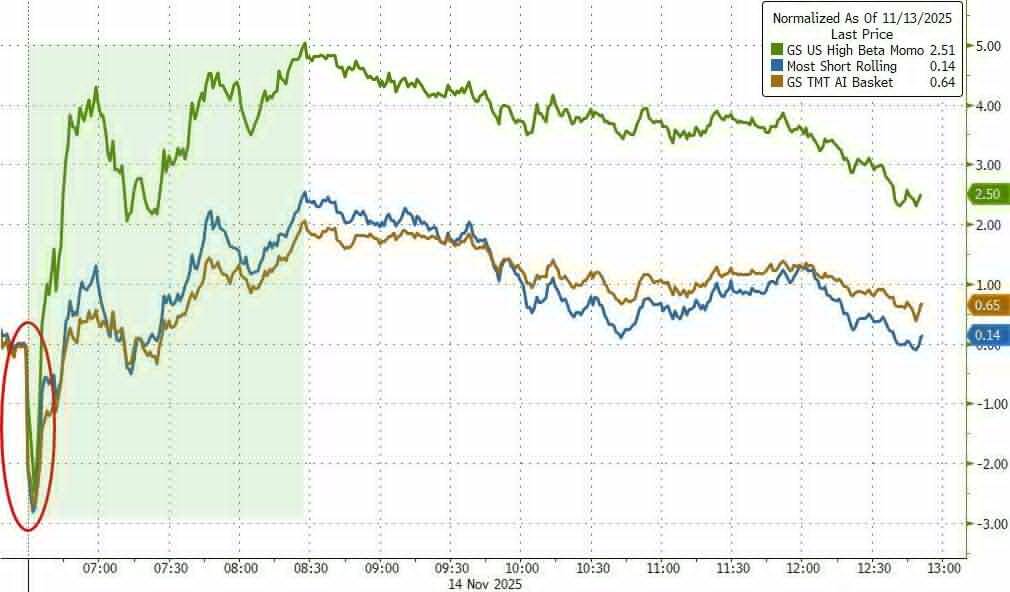
Friday’s market movement was nothing short of “two extremes.” The Nasdaq 100 and S&P 500 indices quickly rebounded after touching their 50-day moving average support, while small-cap stocks found footing at the 100-day moving average. According to Goldman Sachs trader Scott Rubner, market sentiment underwent a dramatic shift—from “absolute panic” (between 4 a.m. and 9:30 a.m.) to “strong recovery” (from 10 a.m. to 11 a.m.).
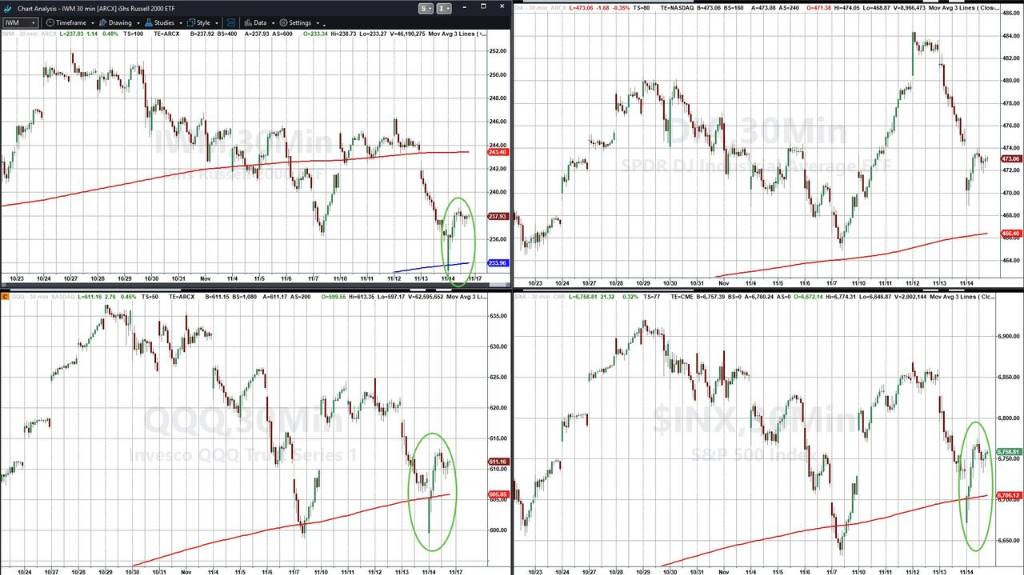
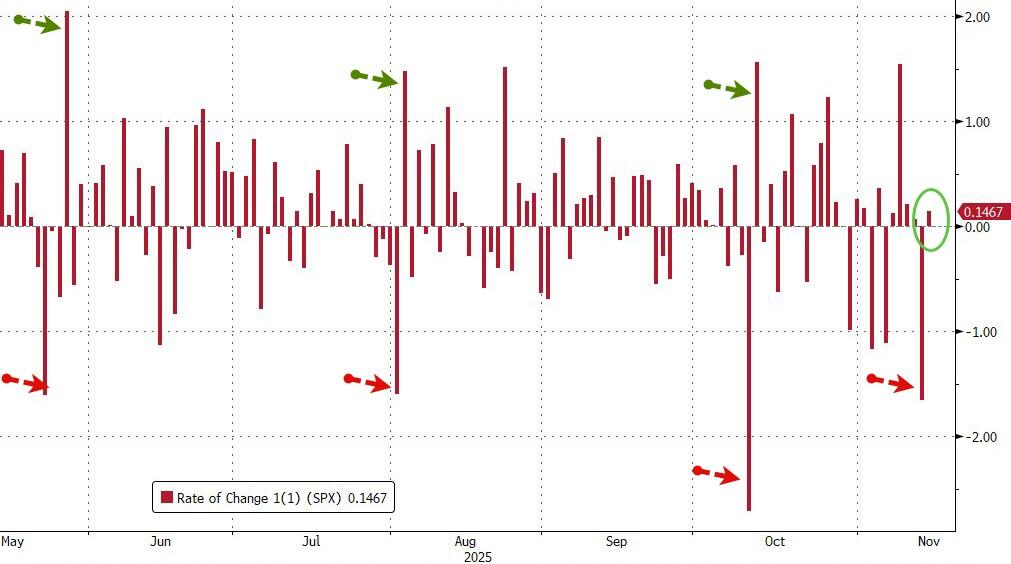
This V-shaped reversal was no accident. Goldman Sachs data shows that in 2025, whenever the S&P 500 dropped at least 1.5% in a single day, it rebounded on average by 1.1% the following day.
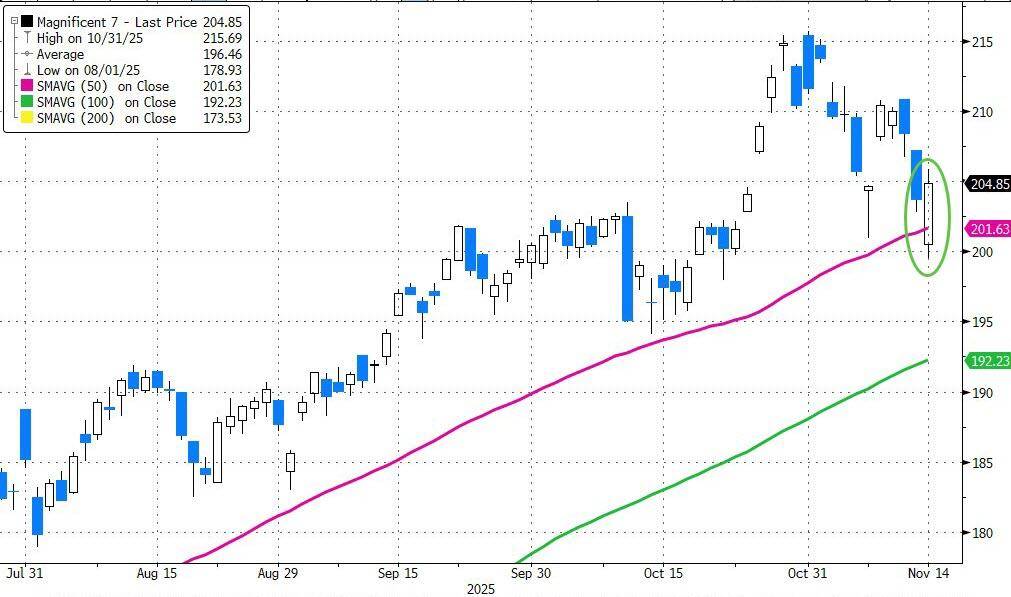
ETF trading activity led the early buying surge, accounting for 37% of daily volume—well above the year-to-date average of 27%. The Mag7 tech index, after hitting its 50-day moving average, staged a strong rebound, ending the week flat, with hedge fund covering demand at the 96th percentile.
However, Bitcoin did not participate in this rebound at all. On Friday, Bitcoin fell 5%, dipping as low as $94,519—the weakest level since May 6—with a weekly loss of 9.14%, marking its worst weekly performance since the week of February 28. Since peaking at $126,272 on October 5, Bitcoin has declined roughly 25%.
This divergence stands out especially sharply against improving market liquidity. Goldman Sachs traders noted:
Hedge funds are buying across the board, with demand at the 96th percentile; high-beta momentum stocks, most-shorted stocks, and AI leaders all bounced from down 3% at open to up 3% at close. Yet the Bitcoin market continues to face pressure, indicating it is undergoing difficulties distinct from traditional risk assets.
Distorted Correlation: "Falls Harder, Rises Weaker"
Bitcoin’s correlation with the Nasdaq 100 remains around 0.8, but this relationship has taken on a distorted form—Bitcoin moves in tandem with equities only when falling, while lagging during rallies.
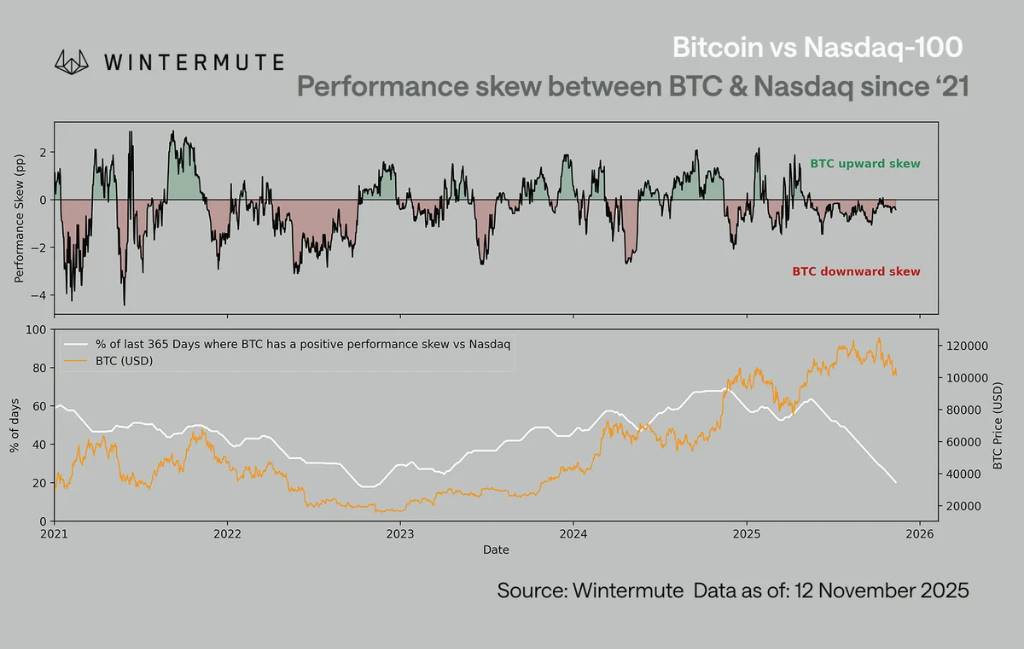
Data shows that Bitcoin’s performance skew relative to the Nasdaq has been clearly negative this year:
When the Nasdaq rises, Bitcoin gains significantly less; when the Nasdaq falls, Bitcoin drops even harder. This isn’t a breakdown in correlation—it’s asymmetry in action: Bitcoin absorbs downside risk but fails to share in upside gains.
More importantly, this negative skew over a rolling 365-day basis has reached its highest level since the end of the bear market in late 2022—the period one year after Bitcoin peaked in the previous cycle.
Historical patterns suggest such large-scale negative asymmetry typically occurs when market sentiment is extremely weak and prices are near bottoms—not at highs. What logic lies behind this anomaly?
A shift in market attention is the key factor. In 2025, narrative capital—new token launches, infrastructure upgrades, retail participation—that once flowed into cryptocurrencies has now shifted toward the stock market.
Large-cap tech stocks have become magnets for institutions and retail investors seeking high-beta growth. Compared to the frenzy of 2020–2021, marginal increases in risk appetite are now flowing more into Nasdaq than digital assets.
This means Bitcoin retains its high-beta trait during macro-driven sell-offs but has lost its narrative premium during rallies. It now reacts merely as the "high-beta tail" of macro risks rather than as an independent investment theme.
Changing liquidity structures have further exacerbated this asymmetry. Stablecoin issuance has peaked, ETF inflows have slowed, and exchange market depth has failed to return to early 2024 levels.
This fragility amplifies Bitcoin’s negative reactions during equity pullbacks, resulting in consistently higher downside participation compared to upside participation.
Crypto Fear Index Drops to Yearly Low
Market sentiment indicators confirm this deeply pessimistic atmosphere. According to a WallStreetCN article, on November 13, the Crypto Fear & Greed Index plummeted to 15—the lowest level since February this year.
This "extreme fear" reading is alarming—the last time the index dipped below 20 was on February 27, after which Bitcoin fell 25% to $75,000 within a month.
Santiment, a market sentiment analysis platform, reported that negative discussions around Bitcoin, Ethereum, and XRP have surged sharply, with the positive/negative sentiment ratio dropping significantly, far below normal levels.
This indicates that negative narratives now dominate market discourse, and investor confidence remains persistently low.
Since the massive liquidation event on October 11, key sentiment metrics show market sentiment has never recovered—and has instead deteriorated further.
Although Santiment interprets this extreme negativity as a potentially bullish signal hinting at a local bottom, current price action clearly shows no definitive reversal yet.
Whale Selling Intensifies, Long-Term Holders Offload En Masse
As Bitcoin remains "unable to recover," multiple forces are jointly pressuring it.
Reports indicate that behind Bitcoin’s breach below the critical $100,000 milestone, selling by "whales" (large holders with over 1,000 BTC) and long-term holders has become a significant driver.
Blockchain data shows that over the past 30 days, long-term Bitcoin holders have sold approximately 815,000 BTC—the highest level of selling activity since early 2024. More critically, whale wallets holding Bitcoin for over seven years have continuously sold at a rate exceeding 1,000 BTC per hour.
This selling displays a "persistent, staggered distribution" pattern rather than a sudden coordinated dump. Analysis suggests many early adopters view $100,000 as a psychological threshold—a profit-taking level they’ve discussed for years. Since Bitcoin first broke $100,000 in December 2024, long-term holder selling has accelerated.
Cory Klippsten, CEO of Swan Bitcoin and a veteran in the Bitcoin industry, said:
"Many early holders I know have talked about the $100,000 number since I entered this space in 2017. For some reason, that’s always been the level people say they’d sell some at."
Yet what’s truly concerning isn’t the selling itself, but the weakening ability of the market to absorb it. At the end of last year and beginning of this year, when long-term holders sold, other buyers stepped in to support prices—but this dynamic appears to have changed.
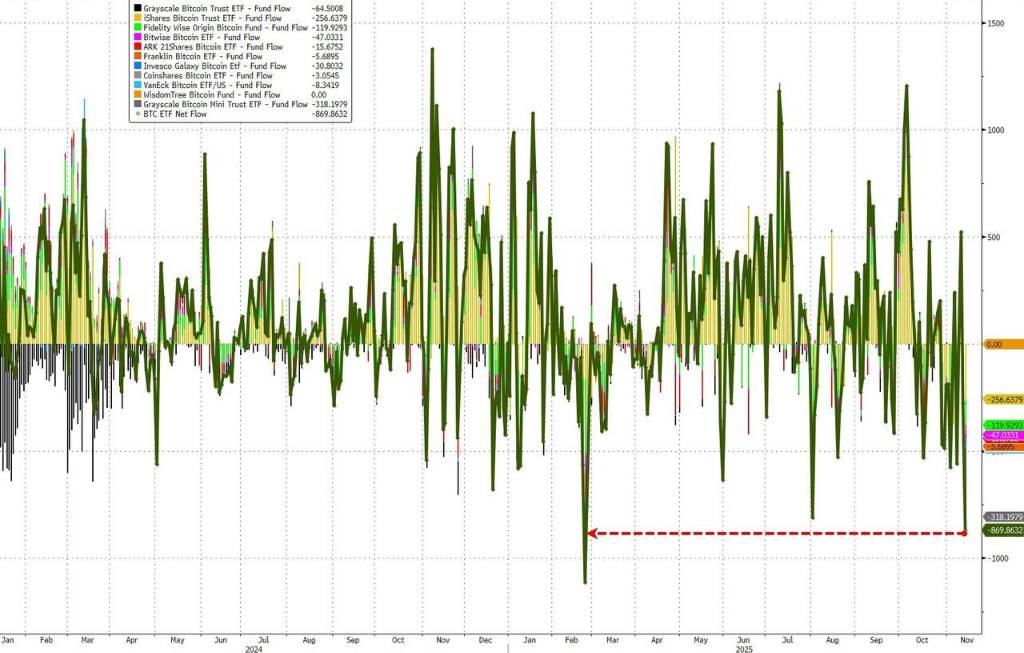
ETF flows confirm weak demand. As of Thursday, Bitcoin ETFs recorded $311.3 million in net outflows this week, marking the fifth consecutive week of outflows—the longest streak since March 14. Over the past five weeks, cumulative outflows reached $2.6 billion, second only to the $3.3 billion outflow over five weeks ending March 28.
Trump Family Wealth Also Hit Hard
Amid the turmoil in the cryptocurrency market, President Trump’s family wealth derived from crypto investments is also shrinking.
Within a month of Bitcoin’s peak at $126,272 on October 5, stocks and tokens tied to Trump and his family have all fallen sharply.
The Trump family’s crypto portfolio includes Trump Media & Technology Group, blockchain firm World Liberty Financial, and bitcoin miner American Bitcoin. Since Bitcoin’s October high, World Liberty Financial tokens and shares of American Bitcoin and DJT have each declined about 30%.
According to President Trump’s mid-June government financial disclosure, he indirectly holds nearly 115 million DJT shares through a revocable trust under his son Don Jr.’s name. Valued at Friday’s price, this stake is worth about $1.3 billion—down sharply from nearly $2 billion in early October.
World Liberty’s website states that Trump and his family hold about 22.5 billion World Liberty Financial tokens, worth approximately $3.4 billion at Friday’s price—down from a peak of $4.5 billion. Eric Trump holds a 7.5% stake in American Bitcoin, currently valued at about $340 million, down from a peak of $480 million.
Despite numerous efforts by the Trump administration to boost the cryptocurrency industry—including establishing a Bitcoin "strategic reserve" and the SEC dropping lawsuits against firms like Coinbase and Binance—these policy tailwinds have failed to prevent a major correction in the crypto market.
Join TechFlow official community to stay tuned
Telegram:https://t.me/TechFlowDaily
X (Twitter):https://x.com/TechFlowPost
X (Twitter) EN:https://x.com/BlockFlow_News