Bitcoin or Gold: Which One Is More Promising for the Upcoming "Santa Rally"?
TechFlow Selected TechFlow Selected
Bitcoin or Gold: Which One Is More Promising for the Upcoming "Santa Rally"?
This year's Christmas rally might arrive earlier.
 Navigating Web3 tides with focused insights
Author: Ashrith Rao
Translation: Chopper, Foresight News
The so-called "Santa Rally" refers to the phenomenon where cryptocurrency markets typically experience price surges in the last few weeks of December through early January. This trend is driven by multiple factors, including annual portfolio rebalancing by institutions and traders leading to capital reallocation, as well as seasonally boosted investor confidence.
Reduced market liquidity during holidays can amplify price volatility, further fueling the rebound momentum. The market behavior of crypto assets differs significantly between regular periods and the Christmas season. Although this trend originated in traditional stock markets, it has begun to manifest in the gold market and more recently in the Bitcoin market.
Whenever global markets slow down due to holidays, market participants reassess the possibility of a Santa Rally. During periods of low liquidity or shifting market sentiment, gold and Bitcoin may react very differently.
Now investors are increasingly debating: within the anticipated seasonal uptick in December, which asset—gold or Bitcoin—will benefit more?
For generations, people have purchased gold to protect wealth against inflation. Central banks around the world also hold substantial gold reserves as a key component of foreign exchange reserve management and monetary policy.
Toward the end of each year, seasonal demand for gold often rises, typically driven by several combined factors:
-
Jewelry purchases usually increase during festival and wedding seasons in India and China;
-
Central banks continuously adjust their reserve structures with a preference for increasing gold holdings;
-
Institutions conduct year-end risk management and portfolio adjustments.
Gold's Holiday Performance
December is usually not a month of sharp spikes in gold prices, but rather one of gradual upward movement. During economic downturns or geopolitical turmoil, gold tends to exhibit stronger safe-haven characteristics compared to other assets.
Although gold prices fluctuate with the broader economy, they rarely deliver the kind of spectacular returns seen in cryptocurrencies.
Nonetheless, this year gold prices surged repeatedly to record highs, peaking at $4,380 per ounce, followed by an unprecedented correction.
In recent weeks, gold has rebounded from steep declines, now trading above $4,100 per ounce, delivering strong performance. In this highly active trading environment, long positions have generated significant profits.
The precious metal has rebounded from deep losses as the U.S. government shutdown ended and national debt is expected to soon hit a historic high of $40 trillion.
Gold prices are currently just 7% below their all-time high, and investors understand that deficit spending will only increase further after the government shutdown ends.
Bitcoin: A New Store of Value
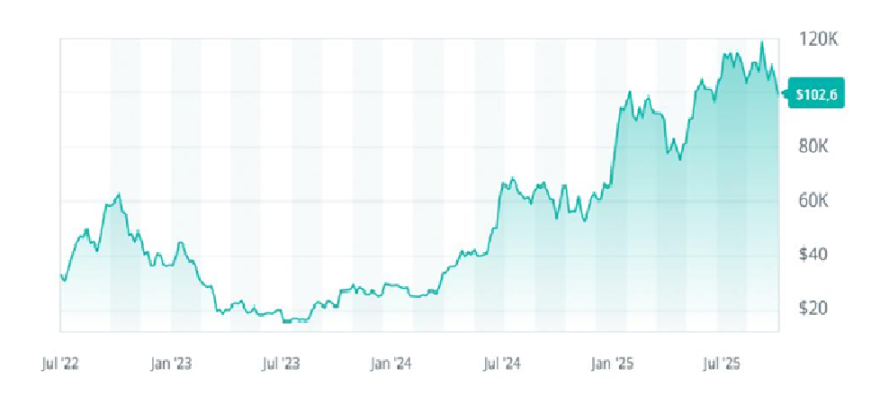
Since Bitcoin's price hit around $16,000 in November 2022, the notion that "Bitcoin is digital gold" has gained widespread acceptance, followed by sustained price increases.
On December 5, 2024, Bitcoin first broke the $100,000 mark and has since crossed it multiple times. During its peak in October this year, Bitcoin surpassed $125,000, but like gold, experienced a significant pullback afterward.
Nevertheless, Bitcoin has largely held the critical psychological level of $100,000, briefly dipping below only a few times.
Bitcoin’s decentralized structure and fixed supply cap of 21 million coins make it a potential hedge against monetary inflation.
Overall, however, Bitcoin is considered a higher-risk investment than gold: prices can surge dramatically when investor confidence is high, but also plummet when sentiment weakens.
Historically, Bitcoin’s performance in the fourth quarter of each year tends to be particularly notable.
Data source: TradingView
Macroeconomic Factors as Key Drivers This Year
This year, the macroeconomic landscape is the most critical factor determining whether the Santa Rally will materialize as expected.
Market liquidity availability, price stability indicators, and central bank policies—especially those of the Federal Reserve—are core influencing factors.
At the Federal Reserve’s October 2025 meeting, the central bank lowered the federal funds rate by 25 basis points, setting the new target range at 3.75%-4.00%. This rate cut was in line with market expectations and followed a previous cut in September, bringing borrowing costs to their lowest level since late 2022.
Falling interest rates typically lead to a weaker dollar, potentially increasing investor interest in alternative assets like Bitcoin.
Data showed that the official U.S. inflation rate in September 2025 was 3.0%, up from 2.9% in August; however, core inflation edged down slightly from 3.1% to 3.0%. During periods of elevated inflation, market attention to alternative assets like Bitcoin and safe-haven assets like gold typically rises significantly.
Unlike traditional assets, Bitcoin exhibits much higher liquidity volatility.
Institutional buying of Bitcoin exchange-traded funds (ETFs) and small-scale capital inflows can have a major impact on short-term price movements.
A core difference between the two assets lies in their buyer base: primary purchasers of gold include jewelers, sovereign wealth funds, and central banks, while Bitcoin’s core supporters are young digital currency enthusiasts, tech pioneers, and retail investors.
Historical Performance Comparison: Gold vs. Bitcoin
In recent years, both assets have risen together during multiple rallies, a trend especially pronounced in 2025. However, there have also been numerous instances where one asset began rallying only after the other had already started its upward cycle.
In 2020, governments rolled out massive stimulus programs to counter the economic recession triggered by the pandemic. As fiat currencies depreciated, investors seeking value preservation flocked to assets promising stability.
At the beginning of that year, gold prices surged; in the second half, Bitcoin gained momentum. By December 2020, gold closed at $1,900, marking a modest gain, while Bitcoin approached a cyclical peak, closing around $29,000.
This case illustrates that during periods of abundant market liquidity and low interest rates, Bitcoin typically outperforms traditional assets like gold.
From 2021 to 2022, inflation soared and central banks aggressively raised interest rates in response.
During this market crash, speculative risk assets like Bitcoin suffered heavily. Market participants turned to gold—the traditional safe-haven asset—whose price underwent multiple rounds of gains, demonstrating strong resilience.
This indicates that during periods of monetary tightening and market stress, gold’s value preservation capability typically outperforms Bitcoin.
With data releases previously frozen due to the government shutdown, the fiscal deadlock in Washington has now ended. The release of inflation data will largely determine which of the two assets will win the Santa Rally. TechFlow
Join TechFlow official community to stay tuned
Telegram:https://t.me/TechFlowDaily
X (Twitter):https://x.com/TechFlowPost
X (Twitter) EN:https://x.com/BlockFlow_News
 @blockhead_co