Space Recap | As DeFi collapses become frequent, how has TRON's ecosystem become a benchmark for stable returns?
TechFlow Selected TechFlow Selected
Space Recap | As DeFi collapses become frequent, how has TRON's ecosystem become a benchmark for stable returns?
This article provides an in-depth analysis of the root causes behind the successive DeFi collapses and explores stable yield strategies and risk management practices, using the TRON ecosystem as a case study.
 Navigating Web3 tides with focused insights
Recently, multiple notable security incidents have occurred in the DeFi space, with project collapses, liquidation chains, oracle manipulations, and liquidity shortages unfolding one after another, shifting market sentiment toward caution and self-protection. Against this backdrop, DeFi is no longer merely synonymous with technological innovation and wealth growth—it has become a testing ground where risks intertwine and fragilities are exposed.
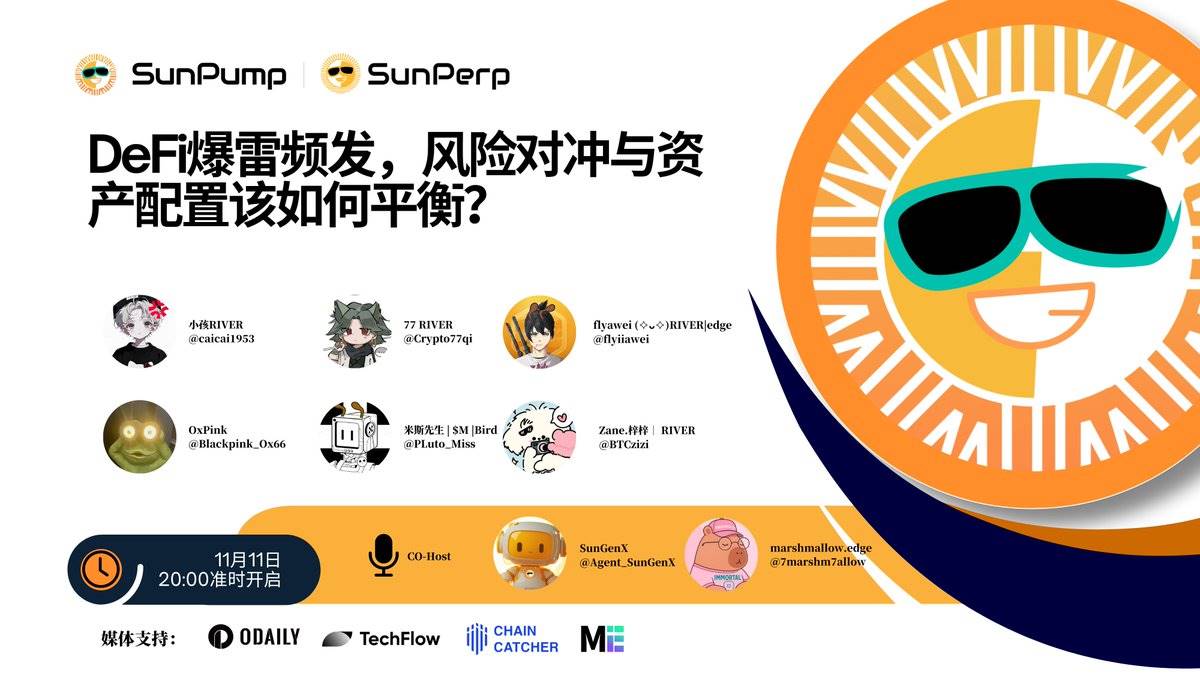
It is precisely during this period of industry reflection that SunPump hosted a new episode of its SunFlash online dialogue. This roundtable focused on the pressing issue: "With frequent DeFi collapses, how should risk hedging and asset allocation be balanced?" Inviting several seasoned KOLs from the industry, the discussion aimed to cut through market noise and return to fundamental questions: Are these risk events isolated accidents, or inevitable systemic growing pains inherent to DeFi’s current stage of development? Under multiple overlapping risks, how can users and institutions build their own defense systems? More importantly, after repeated trust breakdowns, does DeFi still possess the ability to rebuild credibility—and if so, what path will lead it toward a more robust and sustainable future?
Analyzing DeFi Collapses: Governance Gaps and Systemic Risks Beneath the Illusion of High Yields
Beneath the recent string of DeFi collapse incidents, several veteran practitioners and researchers gathered in a Space discussion to explore their root causes. While analytical perspectives varied, guests generally agreed that these events were not isolated technical failures, but rather the concentrated eruption of structural risks accumulated during the industry's rapid expansion. Among them, "pseudo-decentralization" governance flaws and unsustainable high-yield models were repeatedly cited as two core risk factors.
Mr. Mi sharply pointed out that many collapsed projects wear the cloak of "decentralization," yet core powers—such as fund allocation and contract control—are often highly concentrated among a small number of team members. He illustrated that some projects don’t even adopt basic multi-signature mechanisms; once internal issues arise, power can easily be abused, leading directly to collapse. This form of "pseudo-decentralization" makes projects essentially centralized, while leveraging blockchain's "transparency" image to lower investors' guard.
Kid RIVER and Zane strongly agreed, adding that such governance vulnerabilities may remain hidden during stable market conditions, but become fully exposed under extreme market movements or malicious attacks. 0xPink summarized vividly: despite open-source contracts and community governance appearances, core clearing and oracle logic still rest in the hands of a few, meaning the entire system could instantly fail due to team errors or malicious actions.
On the other hand, unsustainable high-yield models represent another major risk source. Mr. Mi raised a critical question: "Where does 100%, 200% annualized return come from?" He emphasized that such high yields often depend on a constant inflow of new capital; once market sentiment cools and liquidity dries up, the fragile yield model amplifies risks exponentially.
Finally, multiple guests stressed that DeFi risks are not isolated single-point issues, but highly contagious. 0xPink noted that the collapse of one protocol can trigger liquidations, which then spread to its associated collateral assets and other interconnected protocols, creating a domino effect similar to traditional financial bank runs. Within this seemingly high-tech financial system, centralized governance, unsustainable yield models, and widespread leverage together form a high-yield yet extremely fragile structure.
Finding Certainty Amid Uncertainty: TRON Ecosystem’s Strategy for Stable Returns
Faced with ever-present on-chain risks that cannot be entirely eliminated, how should individual users and institutional investors build their own "defensive fortifications" to hedge risks and balance returns? In the second segment of this Space session, panelists offered comprehensive strategies ranging from foundational to advanced levels. Their core consensus can be summarized as follows: bring uncontrollable systemic risks into manageable territory through prudent investment strategies and dynamic monitoring.
For ordinary users, guests unanimously emphasized the most basic yet effective principle: "Don't put all your eggs in one basket." Both Kid RIVER and Teacher 77 recommended allocating the majority of assets to mainstream stablecoins (such as USDT, USDC) and core assets like Bitcoin and Ethereum, reserving only a small portion (e.g., 10%-20% of total funds) for experimenting with high-yield new projects—as a form of "trial-and-error" cost, ensuring that even losses won’t cause serious damage.
When discussing specific investment strategies, 0xPink specifically used the TRON ecosystem as an example to present a viable approach balancing stability and returns. He first affirmed the transparency advantage of over-collateralized stablecoins like USDD within the ecosystem, noting their on-chain verifiability. Additionally, he regarded TRON’s native token TRX itself as a worthwhile "core asset," highlighting its solid performance gains over the year. By combining stablecoins, platform tokens, and reliable yield-generating protocols within the TRON ecosystem, users can build a flexible, low-risk hedging framework.
Building on this foundation, he suggested individual investors adopt a balanced allocation: placing half of funds in mainstream stablecoins like USDT, and the other half into core TRON-based protocols such as JustLend DAO and USDD. Leveraging TRON’s mature and well-developed DeFi infrastructure, users can enhance returns through diversified portfolios. For instance, users can convert TRX into staked liquidity tokens sTRX and deposit them into JustLend DAO to earn approximately 7.1% base staking yield. Meanwhile, sTRX can also serve as collateral to mint the stablecoin USDD, which can then be redeposited into JustLend DAO to generate additional returns. Through this "stake-mint-reinvest" cycle strategy, users can achieve around 13% overall annualized yield.
This "half-stable, half-aggressive" portfolio significantly improves capital efficiency under controlled risk exposure. Compared to high-return offers concealing substantial risks, the key advantage of this strategy lies in its controllable risk management and transparent process, offering investors a more secure path to returns.
For larger-scale investors or institutions, strategies must be more systematic and sophisticated. Mr. Mi stressed the necessity of establishing real-time on-chain alert systems to monitor critical indicators such as liquidation ratios and liquidity health, enabling timely position reduction or stop-loss execution at the first sign of risk.
In summary, rebuilding trust in DeFi may be a long journey. As the guests noted, trust cannot be rapidly built through marketing, but must be gradually restored through reliable mechanisms, transparent data, and battle-tested products. The TRON ecosystem’s explorations in transparency, infrastructure development, stable returns, and compliance are providing valuable practical directions for this rebuilding path.
Join TechFlow official community to stay tuned
Telegram:https://t.me/TechFlowDaily
X (Twitter):https://x.com/TechFlowPost
X (Twitter) EN:https://x.com/BlockFlow_News