Hotcoin Research | The Rise of Stablecoin Blockchains: Reshaping the New Infrastructure Order of Digital Finance
TechFlow Selected TechFlow Selected
Hotcoin Research | The Rise of Stablecoin Blockchains: Reshaping the New Infrastructure Order of Digital Finance
This article will systematically outline the characteristics of stablecoin chains, their impact on the crypto market, and review the most prominent stablecoin chain projects currently.
 Navigating Web3 tides with focused insights
Author: Hotcoin Research
1. Introduction
Recently, the stablecoin market has experienced a tale of two extremes: on one hand, Ethena's USDe suffered a flash crash and depegged to as low as $0.65, while Stream Finance's xUSD was liquidated and plunged over 57%, triggering a crisis of confidence in stablecoins; on the other hand, giants like Tether, Circle, Ethena, and Stripe are launching their own "dedicated stablecoin blockchains," reshaping the entire crypto payments landscape. In the past, Tether and Circle had to pay high fees to networks like Tron and Ethereum for on-chain transactions. Now, they're building their own networks or supporting proprietary blockchains—essentially constructing their own "highways" and terminal networks to keep channel profits within their ecosystems. These chains not only allow users to pay gas fees with USDT/USDC but also promise "zero fees" and come equipped with built-in KYC and audit modules, sparking intense market discussion. Stablecoins appear to be evolving from mere assets into central players in an entire "on-chain monetary infrastructure."
This article systematically examines the characteristics and market impact of stablecoin chains, reviews the most prominent current projects, analyzes the ecosystem strategies and data performance of representative chains such as Plasma, Stable, Arc, and Converge, explores how stablecoin chains are redefining the closed-loop logic of stablecoin issuance, circulation, and settlement, and evaluates their potential implications for DeFi, major public blockchains, payment networks, interest rate markets, and global financial regulation. It aims to help investors understand the dynamics, grasp the trends, and identify opportunities in this new race where "chains are born for stablecoins."
2. Overview of Stablecoin Chains
1. Characteristics of Stablecoin Chains
In simple terms, stablecoin chains are blockchain networks custom-built for stablecoin issuance and trading. Compared to general-purpose blockchains like Ethereum or Solana, stablecoin chains make targeted architectural trade-offs:
-
Stablecoin as core fuel: Stablecoin chains typically use the stablecoin itself as the gas fee, rather than volatile tokens. For example, Circle’s Arc uses USDC to pay for on-chain fees, while Tether’s Stable chain uses USDT. This eliminates the need for users to constantly swap assets, accelerates transactions, and avoids exchange rate risks.
-
High performance, low cost: These chains prioritize optimization for stablecoin transfers over complex smart contract functionality, aiming for faster confirmations and lower fees. They often adopt modified BFT or PoS consensus mechanisms, achieving sub-second finality with TPS reaching thousands—meeting the demands of large-scale payment systems. Some even offer zero or near-zero transaction fees to attract users.
-
Built-in compliance and privacy: To gain institutional and regulatory acceptance, stablecoin chains embed features such as KYC/AML tagging, auditable accounts, and transaction whitelists at the protocol level. For instance, Arc uses a permissioned PoA consensus that natively supports real-name account labels, aligning with EU MiCA and U.S. stablecoin regulations. At the same time, it offers optional privacy modes so institutions can protect transaction details while still meeting audit requirements.
-
Seamless fiat on/off ramps: Stablecoin chains are tightly integrated with traditional finance. For example, the Stable chain natively includes fiat on/off-ramp channels, allowing enterprise users to easily convert between USD and USDT directly on-chain. Circle’s Arc is deeply integrated with its own Circle Payments Network (CPN) and Cross-Chain Transfer Protocol (CCTP), aiming to become the “operating system” for a global stablecoin clearing network.
2. Impact of Stablecoin Chains on the Crypto Market
The rise of stablecoin chains is quietly reshaping the crypto market landscape, bringing several key impacts:
-
Shifts in stablecoin settlement dynamics: For years, the Tron network has handled the majority of global USDT transactions due to its low fees, effectively becoming the de facto USDT clearing layer. Ethereum has served as the primary platform for USDC and other stablecoins. However, with the emergence of dedicated chains like Plasma, Stable, and Arc, significant volumes of stablecoin activity may migrate away from existing networks. For Ethereum, this could reduce stablecoin transaction volume and fee revenue, though it might also alleviate network congestion. For Tron, the impact could be more severe, as its core business—USDT transfers—risks being diverted or even replaced by Tether’s own chain.
-
Changing fee structures and demand for native tokens: By using stablecoins as gas, these chains disrupt the token economics of existing blockchains. On Arc and Stable, users don’t need to buy ETH or TRX to pay fees. While this lowers transaction costs and entry barriers, it simultaneously reduces demand for native gas tokens like ETH and TRX. The ability to conduct all on-chain operations using only stablecoins reinforces their role as the universal unit of account in the crypto world.
-
DeFi ecosystem and innovation: Stablecoin chains will foster new DeFi ecosystems—for example, Aave and Pendle on Plasma have rapidly accumulated TVL. Moreover, because chains like Arc and Converge are designed with institutional compliance in mind, hybrid DeFi products may emerge, combining capital from regulated institutions and crypto-native users within a single protocol. Meanwhile, Ethereum’s dominance in DeFi could face fragmentation pressure. A multi-layered DeFi architecture may form: foundational settlement on stablecoin chains like Arc, complex applications on Ethereum, and interoperability via bridges. Such a structure could improve overall efficiency—if secure and seamless cross-chain interoperability is achieved.
-
Stablecoin yields and interest markets: New-generation stablecoins like Ethena’s USDe offer built-in yield to attract users, creating competitive pressure on non-interest-bearing stablecoins like USDT and USDC. Stablecoin chains provide greater flexibility to design yield-bearing products. Circle has already launched USYC, pegged to U.S. Treasury rates, and Tether may introduce interest-bearing accounts for institutions via the Stable chain, enabling more flexible yield distribution mechanisms. This could shift the perception of stablecoins from "zero-interest" instruments and drive development in on-chain dollar interest markets.
3. Analysis of Major Stablecoin Chains
Currently, the most notable stablecoin chains include: Tether-backed Plasma and Stable, Circle’s Arc, Converge (a collaboration between Ethena and Securitize), and Tempo led by Stripe.
1. Plasma: A Zero-Fee USDT Payment Network
Source:https://www.plasma.to/
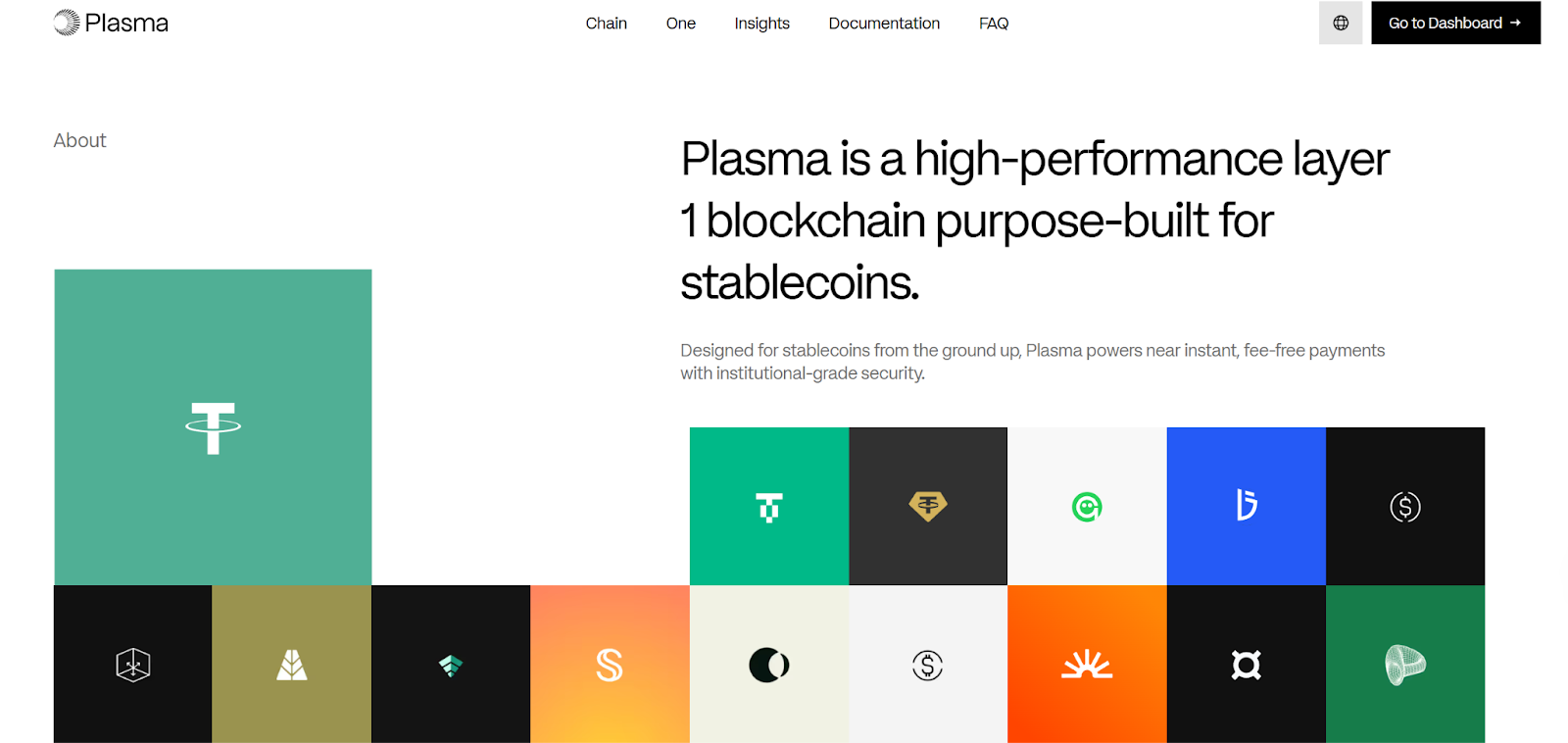
Background and team: Plasma is not directly operated by Tether, but has received strong support from Tether and Bitfinex. The team raised $24 million in February 2025, with investors including Framework Ventures and Paolo Ardoino, CTO of Tether. Positioned as the "payment highway for stablecoins," Plasma targets emerging market users and high-frequency, small-value transactions.
Key features: Plasma’s biggest selling point is zero-fee USDT transfers. Regular users can send USDT without paying gas, offering a frictionless experience similar to traditional digital payment apps. To achieve this, Plasma employs a Paymaster mechanism—backend systems cover gas costs through subsidies or alternative revenue streams. Additionally, Plasma supports multiple assets for gas payment, including its native token XPL, USDT, and even BTC.
Launch performance: Plasma’s mainnet launched in September 2025 and within weeks climbed into the top four in total DeFi TVL, reaching $8.4 billion. However, much of this early TVL stemmed from liquidity mining rather than genuine payment activity. Data shows about 65% of USDT on Plasma was deposited into lending protocols like Aave to earn yield, with stablecoin turnover far below that of networks like Tron. The XPL token price dropped 70% from its peak within a month of launch, indicating Plasma currently functions more as a "high-yield farm" than a widely used payment network.
2. Stable: Tether’s Institutional-Grade USDT Chain
Source:https://www.stable.xyz/
Background and positioning: Stable is a new blockchain led by Tether and its sister company Bitfinex, seen as a cornerstone of the future USDT ecosystem. Its vision is to create a high-performance, scalable, and compliance-friendly dedicated network for USDT, serving exchanges, market makers, and large merchants—elevating USDT from a simple stablecoin to an enterprise-grade digital cash solution.
Key features: Stable uses USDT natively for gas fees and introduces a dual-token model—gasUSDT and USDT0. gasUSDT serves as the fee-denominated fuel token, while USDT0 is a 1:1 pegged, "universally transferable" version of USDT. Peer-to-peer USDT0 transfers are completely gas-free, further lowering usage barriers. Stable also reserves dedicated block space for enterprises, ensuring priority inclusion and consistent confirmation times during network congestion. Future plans include confidential transfers using zero-knowledge proofs to hide transaction amounts while preserving auditability, meeting both privacy and compliance needs.
Progress and controversy: On October 23, Stable’s first-phase pre-deposit event sparked controversy over alleged "insider access," with $825 million in deposits filled instantly—$700 million pre-funded by whales before the official announcement. The second phase began on November 6, accepting up to $500 million in qualified deposits. On November 4, Stable launched its public testnet, now open to developers with features including public RPC endpoints, a test USDT faucet, a block explorer, and system modules supporting native USDT transfers and fee settlements. Stable says the testnet lays the foundation for mainnet deployment and ecosystem development.
Tether supports both Plasma and Stable, which serve different purposes despite both centering on USDT. Plasma, developed by an external team using Rust and innovative consensus, targets global retail users with zero-fee payments. Stable, built in-house, focuses on institutions, offering tailored enterprise features to meet the performance and reliability demands of exchanges and merchants. In the future, Plasma and Stable may complement each other—Plasma handling mass-market micropayments, Stable dominating institutional settlements—jointly strengthening USDT’s dominance.
3. Arc: Circle’s Compliance-First Stablecoin Network
Source:https://www.arc.network/
Background and strategy: In August 2025, U.S.-based compliant stablecoin issuer Circle announced Arc, its self-developed open L1 blockchain. Arc aims to be the "iOS of stablecoins"—by controlling the underlying chain, it enables USDC issuance, cross-chain movement, and settlement entirely within its ecosystem, positioning itself as a global digital dollar clearing hub. With Arc, Circle can deeply integrate its CPN, CCTP, and yield-bearing USYC into a closed loop.
Design and ecosystem vision: Arc is built to meet Western regulatory standards, complying with EU MiCA and the GENIUS Act framework. Its account system includes built-in KYC/AML tags and optional privacy modes with regulatory auditability. Arc is designed as a cross-chain stablecoin settlement layer, connecting multi-chain, multi-stablecoin flows. Beyond infrastructure, Arc aims to incubate a native stablecoin application ecosystem.
Progress and outlook: Arc has launched a testnet with over 100 participating institutions, including BlackRock, Visa, and HSBC. It has the potential to become the "officially recognized stablecoin chain." If successful, Arc would elevate the stablecoin competition from the application layer to the settlement layer, reinforcing USDC’s growing edge over USDT in regulated markets.
4. Converge: The Institutional Bridge Between TradFi and DeFi
Source:https://www.convergeonchain.xyz/
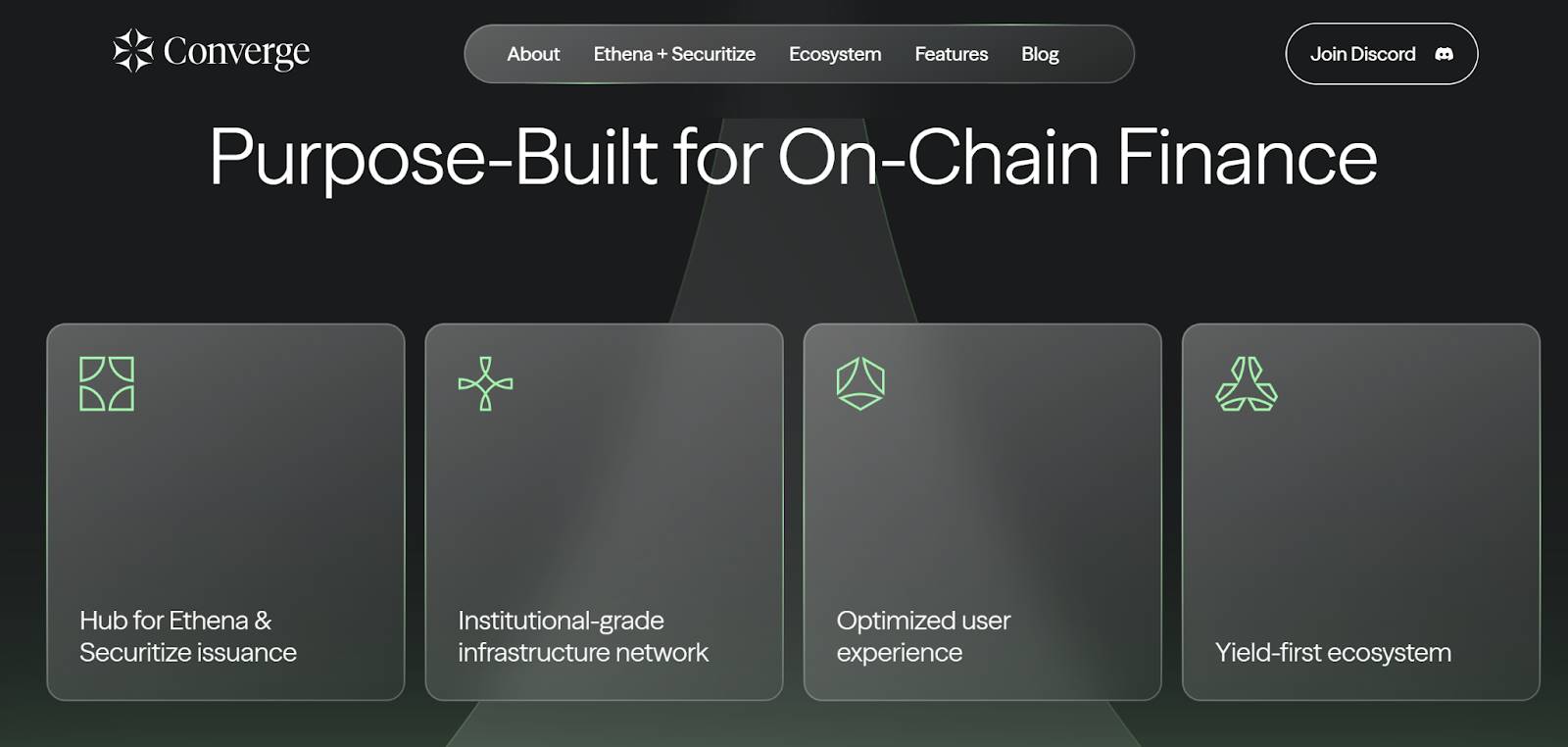
Background and vision: Launched jointly in 2025 by Ethena and tokenization platform Securitize, Converge addresses the challenge of how institutions can safely and compliantly participate in DeFi. It aims to bridge traditional finance (TradFi) and decentralized finance (DeFi), creating a hybrid chain that is both open and regulation-compliant.
Three-layer parallel architecture: Converge’s key innovation is its "three parallel layers":
-
DeFi Layer (Public Layer): Fully permissionless, allowing anyone without KYC to use stablecoins like USDe for decentralized trading, lending, and other protocols. This layer maintains the openness typical of crypto-native chains.
-
TradFi Layer (Permissioned Layer): Restricted to licensed institutions that complete KYC/AML verification. It offers regulated versions of assets such as iUSDe (institutional USDe) and USDtb—a compliant dollar token reportedly issued in partnership with regulated custodian Anchorage, adhering to U.S. stablecoin legislation. Both layers share liquidity, enabling interaction between institutional and open-market funds.
-
Asset Layer (RWA Layer): Powered by Securitize, this layer enables the issuance and trading of KYC-verified security tokens representing real-world assets like bonds, stocks, and notes. It runs parallel to the other two layers, leveraging shared settlement infrastructure. Only verified institutions can access this layer.
The three layers operate independently yet share liquidity, allowing retail and institutional users to coexist in one ecosystem while meeting distinct regulatory requirements. This design sets Converge apart as a hybrid chain serving both retail DeFi and institutional TradFi.
Progress and outlook: As of now, Converge remains in internal testing. Its success hinges on institutional adoption. Nonetheless, Converge presents a compelling vision: a tiered on-chain financial market where retail investors and Wall Street institutions coexist with shared liquidity. If proven viable, this model could profoundly reshape stablecoins and the broader crypto market.
5. Tempo: Stripe’s Payment-Focused Blockchain
Source:https://tempo.xyz/
Background and positioning: Tempo, developed by Stripe in collaboration with Paradigm, is a blockchain dedicated to payments. The rationale is straightforward: Stripe has millions of merchants and end users—providing a stablecoin settlement network could drastically reduce global payment costs. Tempo’s standout feature is its "no native token" design; it does not issue any token, and network fees can be paid in any major stablecoin. This makes its economic model resemble traditional payment systems.
Technology and partnerships: To facilitate institutional integration, Tempo adopts the ISO 20022 payment messaging standard, enabling banks and legacy systems to interpret on-chain transaction data. This is crucial for AML compliance and auditability, showing Tempo’s intent to interoperate with traditional banking from day one. During development, Tempo enlisted heavyweight partners as design advisors, including OpenAI, Visa, Deutsche Bank, Shopify, and Standard Chartered.
Progress and prospects: Tempo is currently in private testnet phase, with Paradigm co-founder Matt Huang serving as CEO. Its no-token, all-stablecoin model reduces regulatory friction—avoiding securities classification—and gains easier merchant acceptance. If successfully launched, Tempo could enable Stripe merchants to receive stablecoin payments at near-zero cost, posing a major disruption to traditional payment networks.
4. Opportunities and Challenges of Stablecoin Chains
Amid the momentum, it's essential to objectively assess the opportunities and challenges facing stablecoin chains:
Opportunities:
-
Access to underserved markets: Stablecoin chains target the $20 trillion global payments and clearing market. Capturing even a small share represents massive incremental value, especially in cross-border remittances and emerging market payments, where they can offer unprecedented low-cost solutions.
-
Revenue model evolution: For stablecoin issuers, income has traditionally come from reserve interest and minor fee sharing. Owning a chain opens new revenue streams—from transaction fees, FX spreads on cross-border payments, and more. For example, if Arc succeeds, Circle could earn micro-fees from every global USDC settlement, potentially surpassing its interest-based income.
-
Technological innovation and standard setting: The stablecoin chain space is still nascent, offering teams a chance to establish industry standards. A widely adopted solution could become the foundation for future digital payments, benefiting not just the project but also enhancing national influence in digital finance.
-
Integration with traditional finance: Initiatives like Converge open new pathways for traditional assets to go on-chain. If RWA achieves mainstream on-chain circulation, financial institutions may follow suit, moving more bonds, fund shares, and other instruments onto blockchain settlement—expanding market size and impact exponentially.
-
Improved user experience: Stablecoin chains offer tangible benefits: no gas fees, sending USDC as easily as a WeChat red envelope, seamless cross-chain transfers without bridges, and enhanced usability through account abstraction and privacy addresses. These improvements make crypto more accessible, lowering the barrier to mass adoption.
Challenges:
-
Network effects and cold start: Payment networks require both widespread merchant support and active user bases. Arc and Stable must integrate with numerous partners; Tempo depends on Stripe to onboard its millions of merchants; Plasma, despite its large user base, faces the challenge of turning USDT holdings into actual spending rather than just reward farming.
-
Regulatory scrutiny and trust: Despite claims of compliance, regulators may remain skeptical. Tether-linked chains face particular skepticism given Tether’s controversial history—its move to build a proprietary chain could invite stricter oversight. Even Arc, though highly compliant, could suffer if Circle faces political or legal issues. Additionally, most stablecoin chains initially rely on highly centralized validator sets, raising concerns among traditional crypto users about decentralization and security.
-
Security risks: New blockchains introduce new attack surfaces. Many chains employ cross-chain mechanisms or interface with legacy systems, making them attractive targets for hackers. Any major security incident—such as a bridge hack or data leak in the compliance layer—could destroy user and institutional trust. Chains that sacrifice decentralization for performance inherently carry security trade-offs, testing the team’s ability to balance safety and efficiency.
-
Market volatility and sustainability: These chains are currently popular, but crypto markets shift rapidly. In a bear market or changing interest rate environment, slowing stablecoin growth and reduced incentives could lead to mass user attrition. For example, the drop in XPL’s price caused rapid outflows from Plasma’s TVL. This shows that subsidy-driven growth is unsustainable—real use cases must be established during the incentive phase, or capital will simply move to the next "farm."
-
Homogenized competition: Over a dozen projects have entered this space, leading to functional overlap and internal competition. Plasma and Stable are both USDT chains; Arc and Tempo compete directly in cross-border payments; traditional players like Visa and SWIFT are also experimenting with blockchain payments. If the market fragments across too many variants, it could lead to renewed fragmentation in the stablecoin ecosystem.
5. Outlook and Conclusion
Despite the challenges, the direction represented by stablecoin chains is undeniably promising. They align with a major trend: the digitization of money and the migration of payments onto blockchains. Just as early internet networks competed before converging, stablecoin chains may follow a similar path. In the next three to five years, we may see the following developments:
-
Market consolidation: After market validation and resource competition, only a few stablecoin chains may achieve mainstream adoption. Likely, one dominant chain per dollar ecosystem will emerge: Circle’s Arc leading in compliant dollar settlements, and Tether’s Stable/Plasma dominating broad-market dollar payments. Others may either integrate into these ecosystems or focus on niche areas (e.g., Codex specializing in on/off ramps). This resembles the Visa-Mastercard duopoly, serving different segments and customer bases.
-
Deep institutional involvement: As regulations clarify, banks and payment firms will move beyond observation to active participation—as validators or partners. We may see JPMorgan running Arc nodes or Visa deploying services on Tempo, further blurring the line between blockchain and traditional finance. Stablecoin chains could become integral parts of mainstream financial infrastructure.
-
More robust stablecoin systems: Improved infrastructure will enhance stablecoin stability. Features like real-time on-chain audits, proof of reserves, and smart contract-based supply adjustments could make depegs rarer. Unified clearing layers may enable fast swaps between stablecoins, mitigating individual risks. If one fails, funds can cheaply migrate to safer alternatives, avoiding cascading failures.
-
Emergence of a global digital currency network: As sovereign CBDCs mature, they may plug directly into these stablecoin chains. Rather than building separate international networks, integrating with existing, proven chains—with controlled access at the gateway—would be more efficient. Eventually, a new monetary system may emerge: CBDCs + commercial stablecoins + stablecoin chains—where central banks issue base money, private entities issue CBDC-pegged stablecoins for circulation, and blockchains serve as the underlying ledger. At that point, "stablecoin public chains" will no longer be novel—they’ll be organic components of global financial infrastructure.
In summary, the rise of stablecoin chains signals that crypto technology is transitioning from speculation toward serving real economic and payment needs. These chains carry the hope of mass blockchain adoption, while grappling with the tension between traditional finance and decentralization ideals. As stablecoins begin building their own rails, the blockchain industry is entering a new era dominated by stable value. When the digital dollar highways are fully built, it may mark the moment crypto becomes part of mainstream finance. Let us wait and see where this digital payment revolution leads.
About Us
Hotcoin Research, the core investment research arm of Hotcoin Exchange, is committed to transforming professional analysis into practical tools for investors. Through our "Weekly Insights" and "In-Depth Reports," we unpack market dynamics. Our exclusive column "Hotcoin Select" (powered by AI and expert screening) identifies high-potential assets and reduces trial-and-error costs. Each week, our analysts host live sessions to discuss hot topics and forecast trends. We believe that personalized guidance and professional insights empower more investors to navigate market cycles and capture Web3’s value opportunities.
Join TechFlow official community to stay tuned
Telegram:https://t.me/TechFlowDaily
X (Twitter):https://x.com/TechFlowPost
X (Twitter) EN:https://x.com/BlockFlow_News
 @HotcoinAcademy