Stop packaging high-risk financial products as stablecoins
TechFlow Selected TechFlow Selected
Stop packaging high-risk financial products as stablecoins
Technology changes, names change, but human greed never does.
 Navigating Web3 tides with focused insights
By: Sleepy.txt
The world of stablecoins is never short of stories, but what it lacks is respect for risk. In November, stablecoins ran into trouble again.
A so-called stablecoin named xUSD crashed on November 4, plummeting from $1 to $0.26. As of today, it continues to fall, now down to $0.12, losing 88% of its market value.
Image source: Coingecko
The incident involved Stream Finance, a star project managing $500 million in assets.
They packaged their high-risk investment strategy as a yield-bearing stablecoin called xUSD, claiming it was "pegged to the dollar with automatic interest," essentially bundling investment returns into the token. But any investment strategy cannot guarantee perpetual profits. On October 11, amid a massive crypto market crash, their off-chain trading strategy failed, resulting in a $93 million loss—approximately 660 million RMB. That amount could buy over forty 100-square-meter apartments within Beijing's Second Ring Road.
A month later, Stream Finance announced it was suspending all deposits and withdrawals, causing xUSD to lose its peg.
Panic spread quickly. According to data from research firm stablewatch, more than $1 billion fled various "yield-bearing stablecoins" in the following week. This is equivalent to a medium-sized city commercial bank having all its deposits withdrawn in just seven days.
The entire DeFi lending market sounded alarms. In some protocols, borrowing rates even reached an astonishing -752%, meaning collateral became worthless and no one would repay loans to reclaim it—the market descended into chaos.
All of this stems from one seemingly beautiful promise: stability, plus high interest.
When the illusion of "stability" is shattered by a single massive red candle, we must re-examine which stablecoins are truly stable, which are merely high-risk investments disguised as stablecoins, and why such risky products can now openly call themselves "stablecoins."
The Emperor's New Clothes
In finance, the most beautiful masks often hide the sharpest fangs. Stream Finance and its stablecoin xUSD are a classic example.
The project claimed xUSD used a "Delta-neutral strategy"—a complex term from professional trading, implying that through sophisticated financial instruments, market volatility risks were hedged away, sounding very safe and professional. The story they told was that users would earn steady returns regardless of market movements.
In just a few months, it attracted as much as $500 million in capital. Yet, behind the mask, according to on-chain data analysts, the real operation of xUSD was full of holes.
First, extreme opacity. Of the claimed $500 million in assets, less than 30% could be verified on-chain. The remaining "Schrödinger’s $350 million" operated entirely out of sight. No one knew what happened inside that black box—until disaster struck.
Second, shockingly high leverage. With only $170 million in real assets, the team repeatedly mortgaged and borrowed across other DeFi protocols, leveraging up to $530 million in debt—an actual leverage ratio exceeding 4x.
What does this mean? You thought you were exchanging for a solidly pegged "digital dollar," dreaming of double-digit annualized yields. In reality, you bought a limited partnership share in a 4x leveraged hedge fund—and 70% of its positions are invisible to you.
Beneath your idea of "stability," your money is engaging in ultra-high-frequency trading in the world’s largest digital casino.
This is precisely where these "stablecoins" become most dangerous. They use the label "stable" to conceal the essence of a "hedge fund." They promise ordinary investors the safety of bank savings, while operating underneath with high-risk strategies only the most skilled traders should handle.
Deddy Lavid, CEO of blockchain security firm Cyvers, commented after the event: "Even if the protocol itself is secure, external fund managers, off-chain custody, and human oversight remain critical weak points. The collapse of Stream wasn’t a code problem—it was a people problem."
This insight hits the nail on the head. The root issue with Stream Finance was that the team carefully packaged an extremely complex, high-risk, unregulated financial game into a product marketed as a simple, accessible "stable yield product" for everyday users.
Domino Effect
If Stream Finance built the bomb, then Curators in DeFi lending platforms acted as couriers delivering it—triggering a widespread chain explosion.
In emerging lending protocols like Morpho and Euler, Curators play the role of "fund managers." Mostly professional investment teams, they package complex DeFi strategies into "strategy vaults," allowing regular users to deposit funds with one click and enjoy passive income—just like buying wealth management products via a banking app. Their main income comes from performance fees taken from user earnings.
Theoretically, they should act as professional gatekeepers, helping users select quality assets. But the performance-fee business model creates an incentive to chase high-risk assets. In the hyper-competitive DeFi market, higher APY means attracting more users and capital—and thus more fees.
When Stream Finance’s "stable and high-yield" asset emerged, it immediately became a favorite among many Curators.
In the Stream Finance incident, we saw the worst-case scenario unfold. According to on-chain tracking, multiple well-known Curators—including MEV Capital, Re7 Labs, and TelosC—allocated large portions of their vaults to the high-risk xUSD on protocols like Euler and Morpho. TelosC alone had exposure as high as $123 million.
More critically, this allocation was not accidental. Evidence shows that several industry KOLs and analysts publicly warned on social media about xUSD’s lack of transparency and excessive leverage days before the collapse. Yet these Curators, who held vast sums and should have been first-line risk guardians, chose to ignore the warnings.
However, some Curators were also victims of this packaging scam. K3 Capital was one of them. This Curator, managing millions in assets on the Euler protocol, lost $2 million in the blast.
On November 7, K3’s founder spoke out publicly in Euler’s Discord channel, revealing how they were deceived.
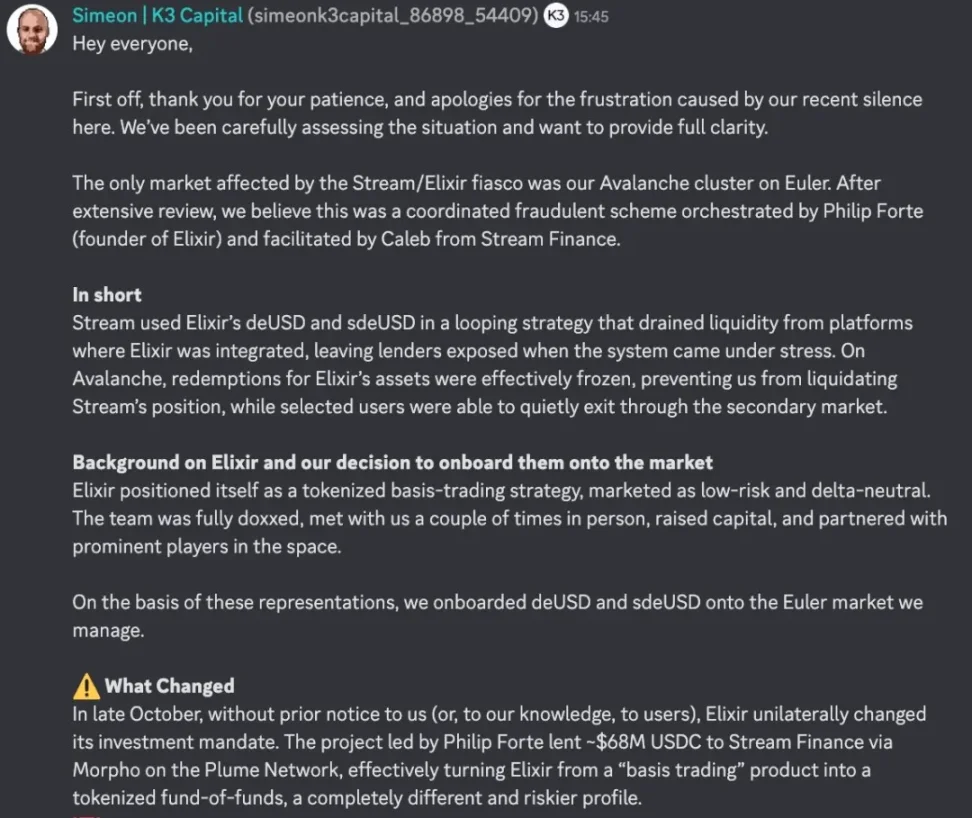
Image source: Discord
The story begins with another "stablecoin" project. Elixir is a project issuing a yield-bearing stablecoin called deUSD, claiming to use a "basis trading strategy." Based on this promise, K3 allocated deUSD into their managed vaults.
But in late October, without consulting any Curators, Elixir unilaterally changed its investment strategy, lending approximately 68 million USDC via Morpho to Stream Finance—transforming basis trading into a nested investment scheme.
These are completely different products. Basis trading directly invests in specific strategies, with relatively controllable risk. Nested investing lends money to another investment product, layering additional risk atop existing high risk.
After Stream’s bad debt became public on November 3, K3 immediately contacted Elixir founder Philip Forte, demanding the ability to redeem deUSD at a 1:1 rate. But Philip went silent, refusing all communication. Left with no choice, K3 forcibly liquidated on November 4, ending up holding $2 million in deUSD. On November 6, Elixir announced insolvency, proposing that retail holders and liquidity pools could exchange deUSD for USDC at 1:1—but excluding Curator vaults, instead calling for collective negotiation.
K3 has now hired top U.S. lawyers, preparing to sue Elixir and Philip Forte for unauthorized changes to terms and false advertising, seeking damages for reputational harm and forced redemption of deUSD into USDC.
When gatekeepers start selling risk, the fall of the entire fortress is only a matter of time. And when the gatekeepers themselves are deceived—who is left to protect users?
Same Soup, Different Pot
This pattern of "packaging → distribution → collapse" feels eerily familiar throughout financial history.
Whether it’s LUNA in 2022, which vanished $40 billion in 72 hours based on the story of "algorithmic stability with 20% annual yield," or the 2008 Wall Street crisis, where elite bankers repackaged bundles of high-risk subprime mortgages into AAA-rated "high-quality bonds (CDOs)" using complex financial engineering—ultimately triggering a global financial meltdown—the core is strikingly consistent: wrapping high-risk assets in complex packaging to make them appear low-risk, then selling them through various channels to investors who don’t fully understand the underlying risks.
From Wall Street to DeFi, from CDOs to "yield-bearing stablecoins," technology evolves, names change, but human greed remains unchanged.
Industry data shows there are still over 50 similar yield-bearing stablecoin projects operating in the DeFi market today, with total value locked exceeding $8 billion. Most use intricate financial engineering to disguise high-leverage, high-risk trading strategies as stable, high-yield investment products.
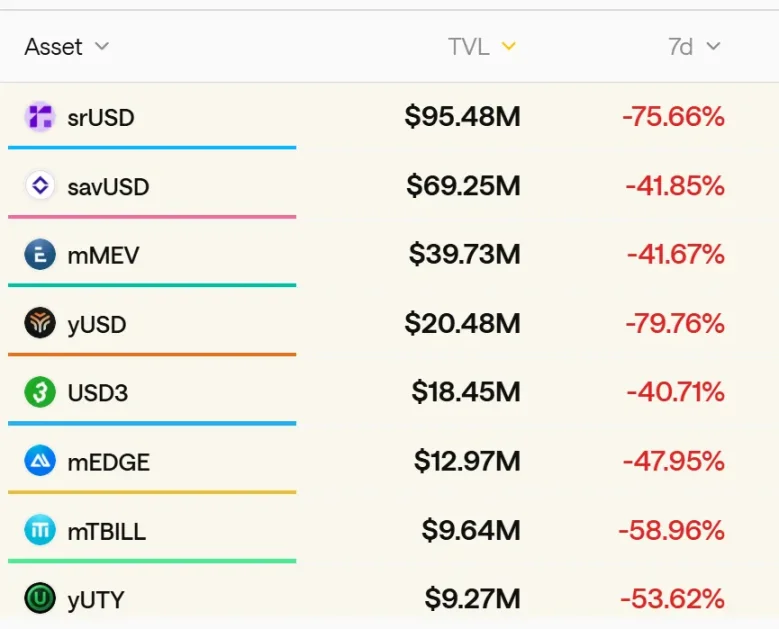
Image source: stablewatch
The root problem lies in giving these products the wrong name. The term "stablecoin" creates an illusion of safety and numbs people to risk. When people see "stablecoin," they think of reserve-backed assets like USDC or USDT—not a highly leveraged hedge fund.
One lawsuit won’t save a market, but it can wake it up. When the tide recedes, we should see not only those who were swimming naked—but also those who never intended to wear swim trunks in the first place.
$8 billion, 50 projects—another Stream could emerge at any moment. Until then, remember one simple truth: when a product tries to lure you with extremely high annualized returns, it is inherently unstable.
Join TechFlow official community to stay tuned
Telegram:https://t.me/TechFlowDaily
X (Twitter):https://x.com/TechFlowPost
X (Twitter) EN:https://x.com/BlockFlow_News
 BlockBeats