








IOSG: x402 – A New Standard for Cryptocurrency Payments by Digital Agents
TechFlow Selected TechFlow Selected
IOSG: x402 – A New Standard for Cryptocurrency Payments by Digital Agents
The long-term value of x402 does not lie in the standard itself, but in the entire set of new infrastructure it activates.
 Navigating Web3 tides with focused insights
Author|Figo @IOSG
The underlying architecture of the internet was never built for "payments"
The original design goal of the internet was to transmit information, not value. Protocols like HTTP and DNS enable data to be transmitted instantly across the globe, but they lack a native built-in payment mechanism. HTTP reserved a status code—402 Payment Required—for handling access-to-paid content scenarios, but due to the absence of a machine-programmable, verifiable payment method at the time, this status code remained dormant for over thirty years and was never truly activated.
Result: A patchwork system of workarounds emerged
To monetize content, developers were forced to layer external systems on top of the protocol stack:
- Subscription accounts tied to credit cards
- API Key models with monthly billing cycles
- Advertising-based business models where users pay indirectly through "attention or data"
These systems all assume "users are humans." They rely on registration, logins, forms, and intermediaries, making them unsuitable for autonomous software or machines.
The internet is entering the "software-as-user" era
We are entering a new usage paradigm: requests are no longer initiated by people, but by software itself.
- AI agents are independently requesting data, invoking models, and executing tasks
- Digital services are shifting from subscriptions to "pay-per-call" models, charging per API call, per inference, or per millisecond of compute
In such scenarios, traditional payment methods (credit cards, account top-ups) completely fail. Machines require a "payment mechanism embedded in the protocol" to enable automatic settlement without human intervention.
The internet already has the bandwidth for machines to communicate; now it needs native capabilities for machines to transact.
The emergence of x402: Activating the internet's native payment layer
x402 is an open payment standard launched in 2025, designed to formally activate the HTTP 402 status code and transform it into a native internet payment mechanism. Unlike traditional models that require account creation, credit card binding, or pre-top-ups, x402 embeds payment requests directly within HTTP responses, allowing clients (whether human, bot, or AI agent) to automatically detect payment requirements and complete settlements.
In short, x402 gives a single HTTP request both "data transfer" and "value transfer" properties. Once payment is completed, access is instantly granted—no account or manual action required.
Standardized interaction model of x402
x402 defines three types of participants:
- Client: The user, application, or AI agent initiating the request
- Server: The entity providing data or services (APIs, websites, etc.)
- Facilitator: Responsible for verifying payment completion. Most current implementations are blockchain-based, but in theory, any system with verifiable settlement capability can integrate
Basic flow:
1. Client requests a resource (e.g., GET /premium-data)
2. Server returns HTTP 402 with payment conditions (asset type, amount, recipient address, etc.)
3. Client initiates payment using stablecoins (e.g., USDC)
4. Facilitator verifies payment completion
5. Client reissues the request with payment proof attached
6. Server returns the data
This entire process is programmable and requires no human involvement or account system.
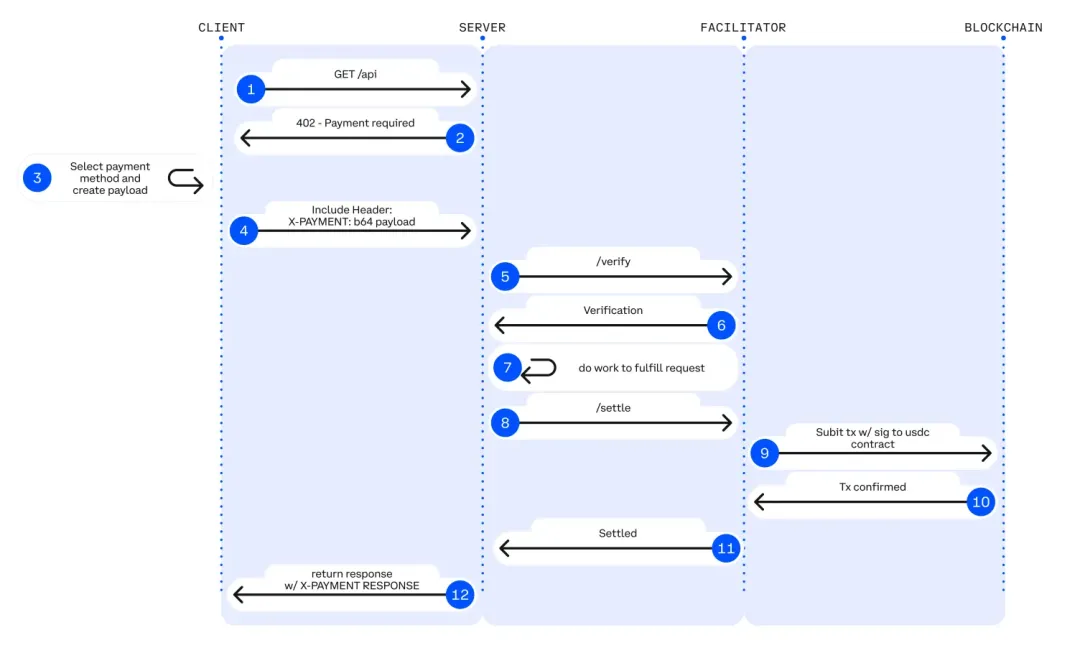
▲ x402 payment flow (Source: x402 Whitepaper https://www.x402.org/x402-whitepaper.pdf)
Core differences between x402 and traditional models
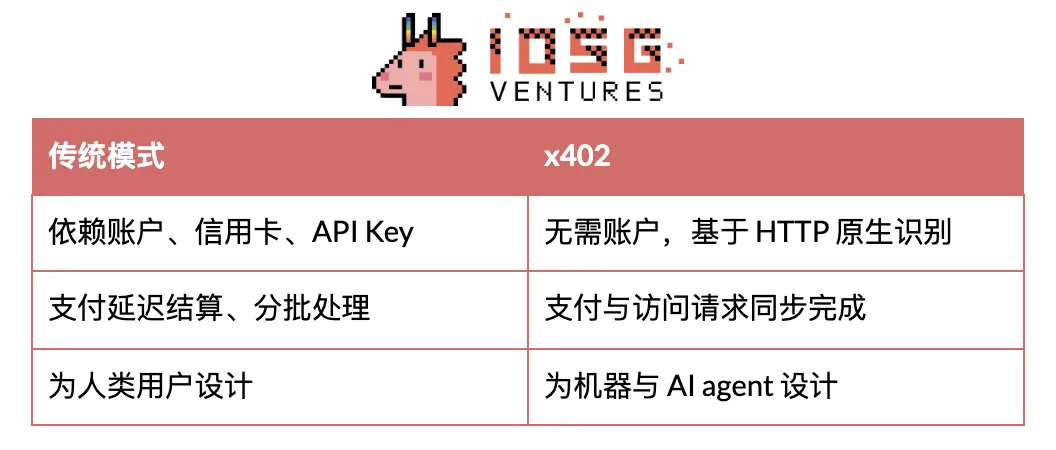
By analogy: HTTPS didn't create new websites, but made "secure communication" a native capability of the internet. Similarly, x402 isn't a new application—it pushes "payments" down to the internet protocol layer, making value transfer as fundamental as data transfer.
Why now, and what changes will it bring?
The internet has always operated under the assumption that "users are humans"—they open browsers, log into accounts, and manually complete payments. But this premise is breaking down. AI agents and automated systems are becoming active participants on the internet, autonomously requesting data, invoking services, and performing actions—without needing human approval for every interaction. If these agents are to truly participate in economic activity, they must not only send requests but also have the ability to make instant, programmable payments.
Why now is the turning point
Several key technological trends are converging to enable x402 adoption:
- Stablecoins have become native internet currencies, offering machines a globally accepted, programmable, and instantly settled payment asset.
- The emergence of low-cost rollups and high-performance settlement chains makes micro-payment models ("pay-per-request") economically viable, with transaction costs as low as one-thousandth of a cent.
- AI agents are evolving from passive tools into active economic actors capable of initiating transactions, purchasing services, and creating value.
- Agent identity standards like ERC-8004 and protocols like Google AP2 provide verifiable identities and transaction histories, enabling the network to recognize "who is paying and why."
Together, these trends form the foundation for x402 to become the native payment transport layer for machines.
New models unlocked by x402
x402 enables value to flow freely across the internet just like data. This means payments no longer depend on human interaction or subscription models, but instead serve real-time, machine-to-machine economic activity.
On-demand transactions between AI and APIs
Agents can pay per call for data or model access—no API keys or pre-funding required:
- AI agents pay in real-time for market data
- Research models unlock proprietary information upon retrieval
Autonomous infrastructure consumption
Compute and storage are billed based on actual usage:
- AI agents pay per GPU inference
- Decentralized models charge per invocation rather than via subscriptions
Autonomous commercial activities between machines
Digital agents can transact directly:
- In-game AI agents automatically purchase resources
- IoT devices automatically pay for bandwidth or sensor data as needed
This shift is upgrading the internet from an "information network" to a "machine economic network"—a market system composed of agents that can natively pay, purchase, and coordinate services at the protocol level.
Ecosystem momentum is building
x402 is no longer confined to crypto-native spaces—it's being adopted by institutions operating at the foundational layers of the internet and payment infrastructure. This signals that x402 is on a path toward standardization and could become the underlying component for native machine transactions online. Mainstream industry analysts, including a16z, have highlighted x402 as one of the key solutions to AI payment and settlement challenges.
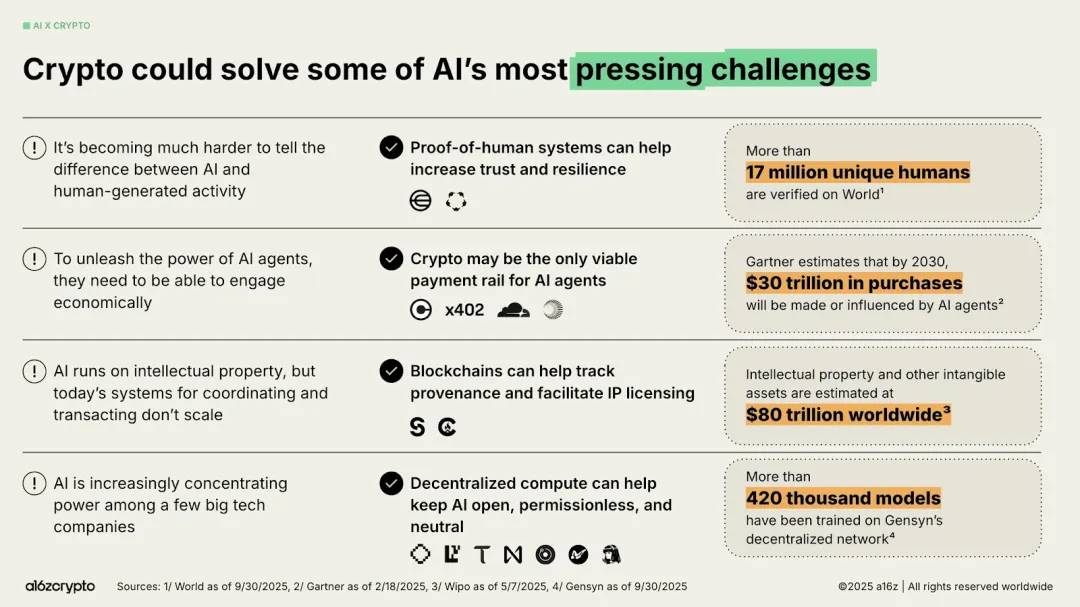
▲ Crypto solutions addressing AI challenges (Source: a16z "State of Crypto 2025" report https://a16zcrypto.com/posts/article/state-of-crypto-report-2025/)
Key drivers of adoption
Cloudflare: Integration into internet infrastructure
Cloudflare is integrating x402 payment processing directly into its global edge network, enabling payment logic to execute at the infrastructure layer rather than as application-level code. Additionally, Cloudflare has launched NET Dollar, a USD-pegged stablecoin designed for machine-to-machine settlements, enabling instant confirmation and global reach. Cloudflare explicitly states that the next generation of internet business models will be based on micropayment interactions between agents.
Google: Agent Payments Protocol (AP2)
Google has introduced the Agent Payments Protocol (AP2), enabling AI agents to authenticate, initiate payments, and settle transactions across both Web2 and Web3 environments. While AP2 is payment-agnostic, it natively supports x402-based crypto payment extensions, positioning x402 as the default settlement layer for agents across Google Cloud, consumer apps, and enterprise services.
Visa: Trusted Agent Protocol
Visa has launched the Trusted Agent Protocol to ensure that AI agents initiating payments are verifiable, authorized, and linked to genuine user intent. Built in collaboration with Cloudflare and aligned with x402, this protocol provides identity and trust infrastructure for mainstream, compliant use cases.
Rapid growth in usage
Over the past month, as more services integrate the standard and autonomous agents prepare to initiate payments via x402 endpoints, x402 usage has accelerated.
Past 30 days (data from x402scan):
- Transactions: 1.35 million
- Total payments: $1.48 million
- Active paying agents: 72,150
- Valid payment endpoints: 960
Notably, most of this growth occurred in the last 7 days, indicating that adoption has entered an acceleration phase.
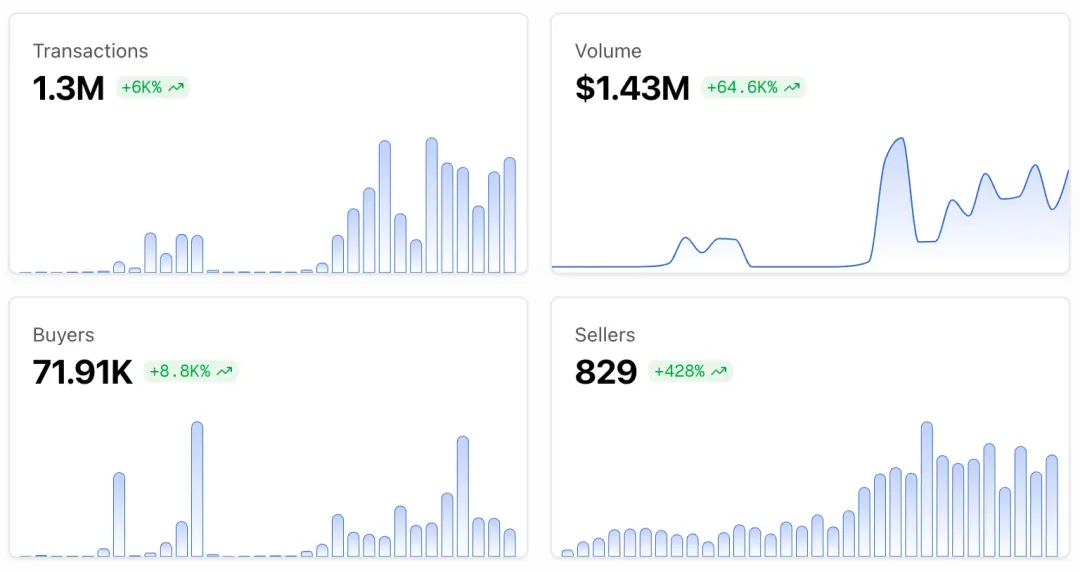
▲ x402 global statistics (past 7 days, Source: x402scan https://www.x402scan.com/)
This surge is largely driven by speculative experiments using x402 (e.g., minting tokens via x402 endpoints). While these activities are speculative in nature, they serve as stress tests and have significantly raised developer awareness of x402 as a payment primitive.
Ecosystem landscape
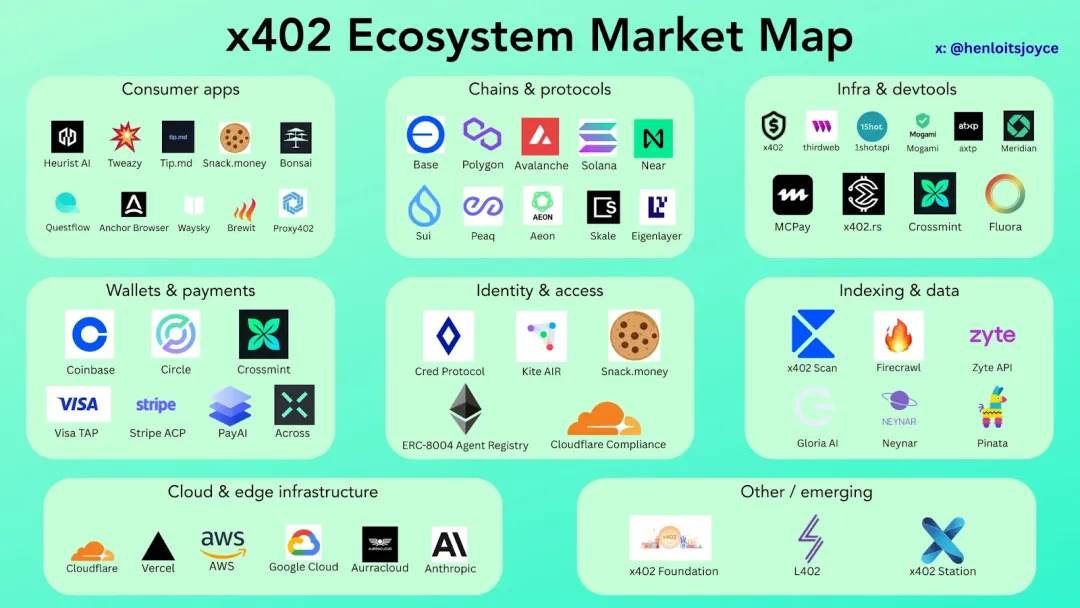
▲ x402 ecosystem map (Source: @henloitsjoyce https://x.com/henloitsjoyce/status/1980654010249167279)
Prediction markets have long focused on binary settlements, leading to severe information reduction. Future socially aware oracles will need broader data sources and dynamic models to synthesize diverse inputs. Conversations with DeFi projects related to Polymarket reveal significant design potential in dynamic, in-process settlement data. Continuous prediction markets—such as live in-game betting during sports events—or combinatorial markets like parlays offer major opportunities, yet current oracles do not support them.
The x402 ecosystem is rapidly expanding, encompassing settlement providers, infrastructure platforms, agent frameworks, and applications. This trend suggests x402 is increasingly becoming the foundational layer upon which other machine-centric protocols are built.
Outlook
x402 is still in its early stages, and there is indeed speculative interest in the market. However, this short-term noise cannot obscure the profound structural shift it represents: for the first time, payments can occur at the same protocol layer as data transmission, enabling autonomous agents to conduct native transactions on the internet—without accounts, without intermediaries, and without human authorization.
The long-term value of x402 does not lie solely in the standard itself, but in the entire suite of new infrastructure it activates—agent identity standards, programmable wallets, low-latency settlement networks, and coordination protocols between machines. Regardless of whether x402 remains the final payment standard, it has already set an irreversible course: the internet is evolving from a network "delivering information to humans" into a network "driving economic activity through software."
Join TechFlow official community to stay tuned
Telegram:https://t.me/TechFlowDaily
X (Twitter):https://x.com/TechFlowPost
X (Twitter) EN:https://x.com/BlockFlow_News
 IOSG Ventures






