Messari researcher: Trading U.S. stocks with Perp DEX, the next new blue ocean
TechFlow Selected TechFlow Selected
Messari researcher: Trading U.S. stocks with Perp DEX, the next new blue ocean
But current data suggests this field is unlikely to achieve breakthroughs in the short term.
 Navigating Web3 tides with focused insights
Author: Sam
Translation: TechFlow
Key Insights:
-
Stock perpetuals remain a high-potential yet unproven category, with limited appeal in on-chain markets due to audience misalignment, weak demand, and more popular alternatives (e.g., 0DTE options).
-
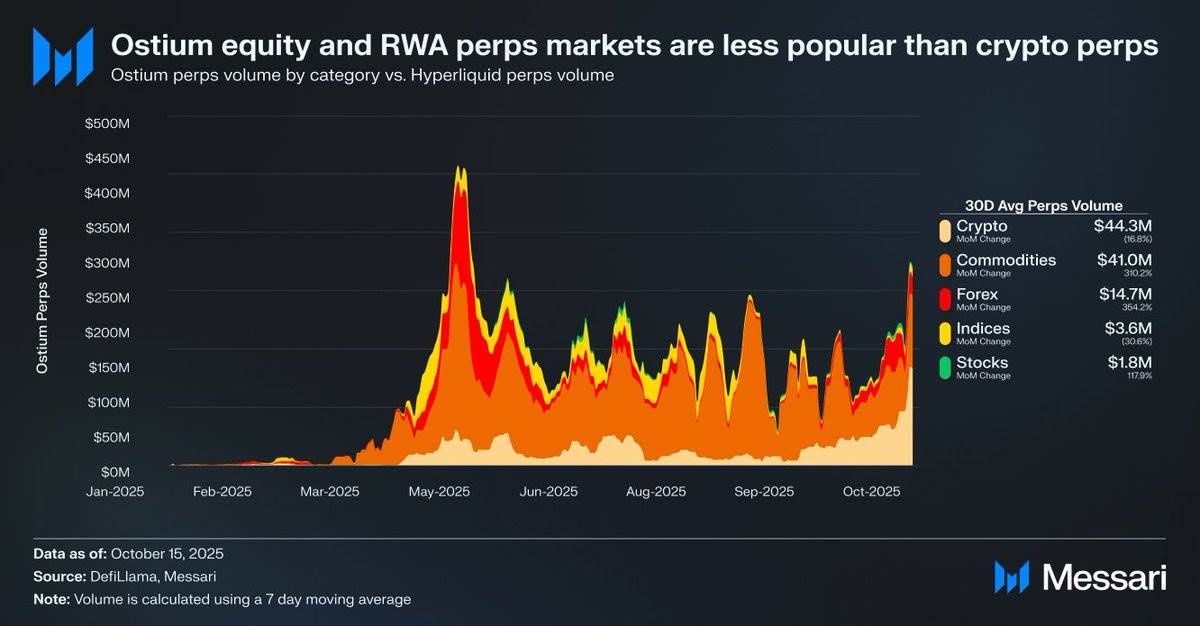
For example, Ostium’s daily trading volume for stock perpetuals is only $1.8 million, compared to $44.3 million for crypto perpetuals, highlighting weak market demand.
-
This may suggest that demand has not been fully unlocked due to infrastructure and regulatory constraints. Hyperliquid’s recent HIP-3 upgrade presents the best opportunity yet for stock perpetuals, but adoption is expected to be gradual.
Source: Messari (@0xCryptoSam)
Stock perpetuals are considered an inevitable next blue ocean for on-chain markets, but current data suggests this sector is unlikely to break through in the short term. Ostium, a decentralized exchange focused on real-world assets (RWAs), sees only $1.8 million in average daily trading volume for stock perpetuals, while its crypto perpetuals reach $44.3 million—reflecting weak demand.
This adoption gap primarily stems from audience misalignment. On-chain traders show little interest in stocks, while off-chain platform users (such as those on Robinhood) can easily trade stocks and options but cannot access perpetual contracts. International investors may become a potential target group, as they lack direct access to U.S. equity markets. However, these investors may prefer holding actual stocks to gain shareholder rights, while avoiding funding fees and liquidation risks.
Compared to tokens, stocks face fewer interoperability challenges, whereas tokens benefit from the convenience of synthetic wrapping. For most investors, nearly every stock in global markets is already abstracted via individual ticker symbols in search bars. Therefore, although perpetuals add permissionless and censorship-resistant features to stocks, traditional stock investors are either unaware or simply uninterested.
https://www.fow.com/insights/analysis-cboe-points-to-retail-flow-as-zero-day-options-grow
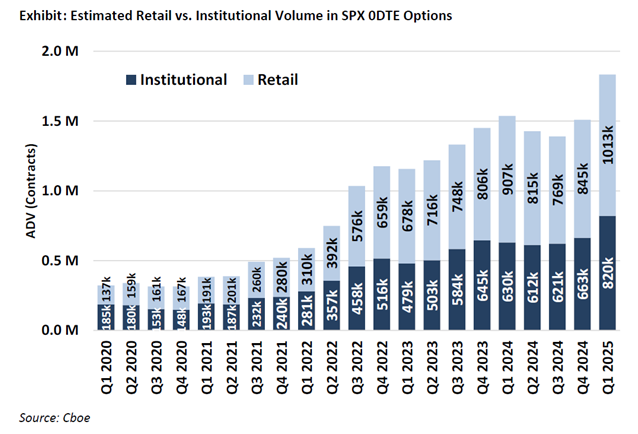
The most likely users of stock perpetuals are retail options traders (who drive 50%-60% of 0DTE trading on Robinhood). However, traditional exchanges reliant on banking services will only adopt stock perpetuals when legal clarity is achieved. The U.S. Commodity Futures Trading Commission (CFTC) has approved perpetual contracts for BTC and ETH, but both have been classified as non-securities. While perpetuals are more intuitive than options, adoption of stock perpetuals may be slower than expected due to the tight link between retail adoption and legal certainty.
Source: @Kaleb0x
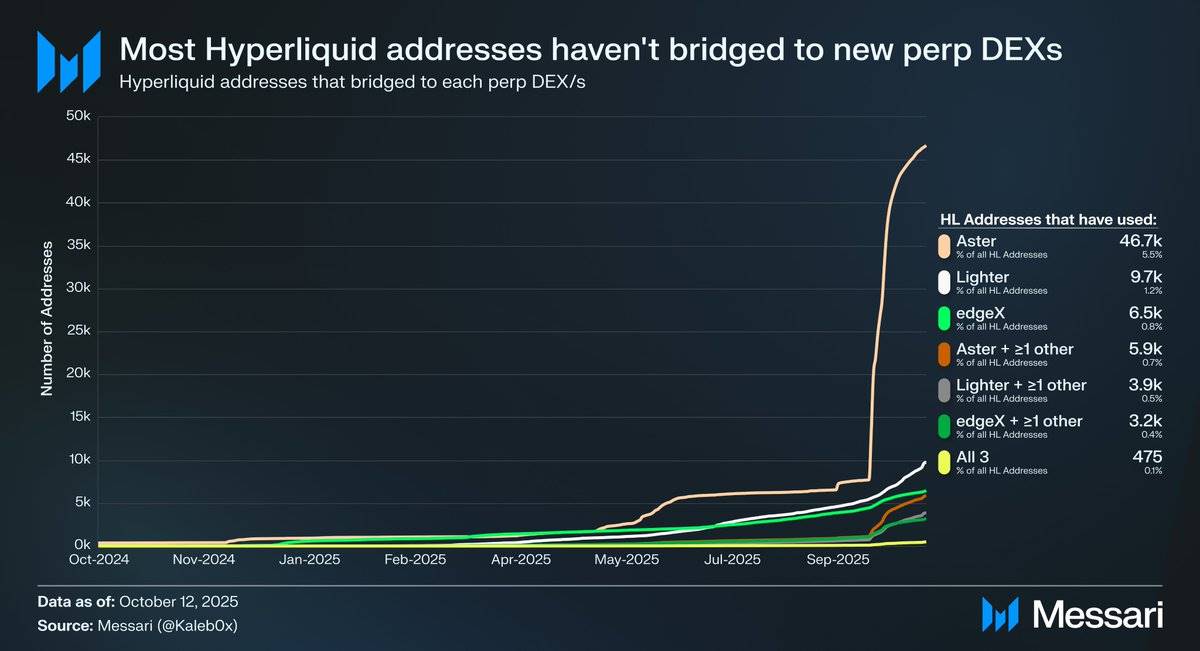
Let’s explore potential directions for stock perpetuals in the context of Hyperliquid’s HIP-3 upgrade. HIP-3 introduces permissionless perpetual markets, and data shows fewer than 10% of Hyperliquid addresses have bridged to Aster, Lighter, and edgeX—and even fewer use multiple perpetual DEXs. This indicates capital stickiness and high quality on Hyperliquid. Based on this, we can predict two possible futures for stock perpetuals:
-
Hyperliquid users are loyal to the platform and will prefer it over other perpetual DEXs regardless of asset listings or features.
-
Hyperliquid users are satisfied with the current perpetual market offerings.
I believe both perspectives hold merit. Given that Hyperliquid users haven’t moved their funds en masse despite incentives, loyalty seems plausible. However, since most trading volume and open interest on Hyperliquid are concentrated in mainstream assets—similar to other perpetual DEXs—it remains unclear whether Hyperliquid users value market diversity, or whether stock perpetuals would appeal to average users (and more importantly, to large holders who account for 70% of Hyperliquid’s open interest).
Moreover, these traders may already hold accounts on traditional exchanges and brokerages, further limiting the potential market size for stock perpetuals on Hyperliquid.
It's important to note that stock perpetuals may not bring new open interest or volume to Hyperliquid, but instead could divert existing trading flow.
Although Ostium (with $2.2 billion in annualized perpetual volume) and stock tokenization tools (like xStocks, with $279 million in spot volume) have not seen explosive growth, this may reflect infrastructure limitations rather than a lack of underlying demand. This pattern resembles the early growth trajectory of perpetual contracts. GMX demonstrated that demand for on-chain perpetual markets exists, but infrastructure at the time couldn't sustain volume. Hyperliquid solved that bottleneck and unlocked latent demand. By the same logic, stock perpetuals may find their first scalable product-market fit on Hyperliquid once HIP-3 provides the necessary performance and liquidity. While current data cannot confirm this outcome, this precedent is worth watching.
In the long run, the potential of stock perpetuals remains clear compared to 0DTE options. Projects like Trade[XYZ] could leverage regulatory arbitrage to build early user bases before traditional exchanges enter the space. However, the real challenge lies in attracting off-chain retail traders—a persistent difficulty for crypto applications.
Join TechFlow official community to stay tuned
Telegram:https://t.me/TechFlowDaily
X (Twitter):https://x.com/TechFlowPost
X (Twitter) EN:https://x.com/BlockFlow_News
 @0xCryptoSam