








Like a 30x larger golden dog inscription, what is the x402 protocol?
TechFlow Selected TechFlow Selected
Like a 30x larger golden dog inscription, what is the x402 protocol?
What opportunities are worth watching in the payment protocol backed by Coinbase?
 Navigating Web3 tides with focused insights
By: Cookie
Yesterday, a special golden dog was born on Base—it's $PING. Based on minting cost versus current token price, a successful mint yields approximately an 18x return.
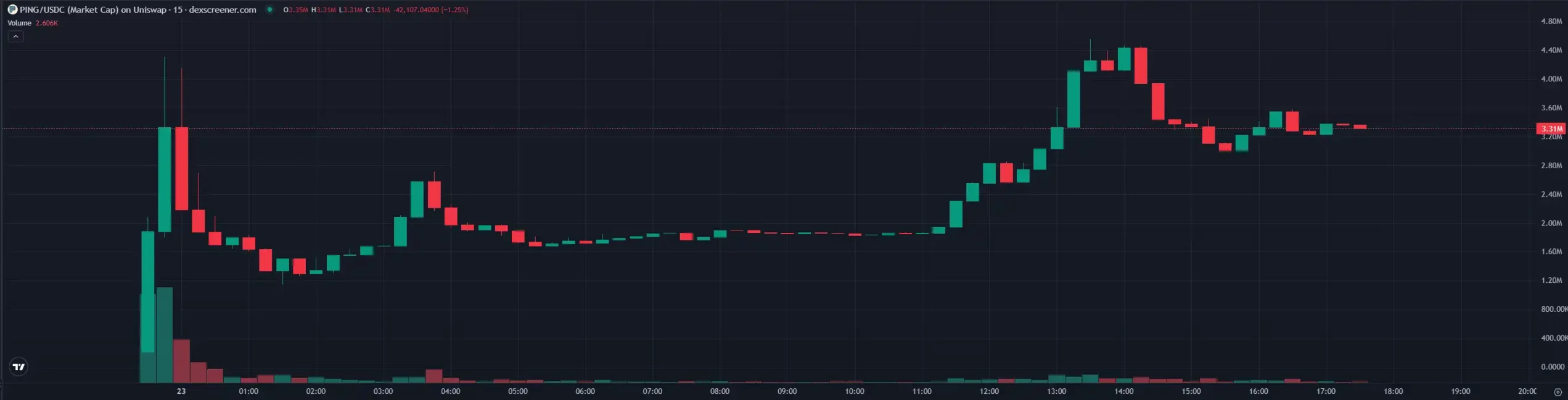
What makes $PING special is that its minting process recalls the inscriptions from two years ago. The cost of minting one $PING is about $1 USD; if successful, users receive 5,000 $PING tokens. Furthermore, the $PING minting page, much like those early inscription projects, lacks a polished frontend interface and appears rather hardcore.
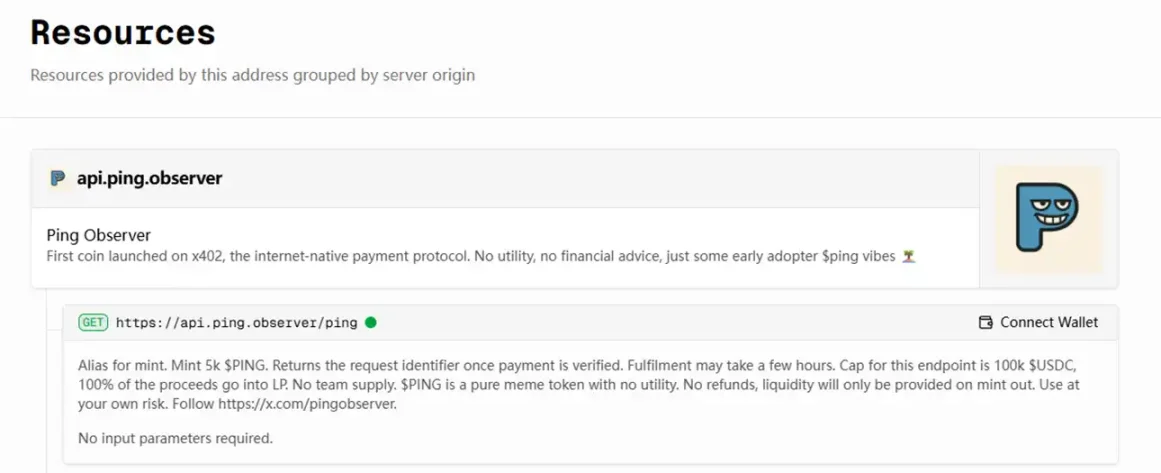
This is the first token issued via the x402 protocol. So what exactly is the x402 protocol? Why is the $PING minting process so unique? And what’s the current state of the x402 ecosystem?
What is the x402 Protocol?
x402 is an open payment protocol developed by Coinbase that enables AI agents to autonomously complete transactions.
The x402 protocol leverages the long-dormant "HTTP 402 Payment Required" status code to require payments before fulfilling API requests or loading web pages. If an API request lacks payment information, x402 returns an HTTP 402 status code, prompting the client to make a payment and retry the request.
The following diagram clearly illustrates how the x402 protocol works:
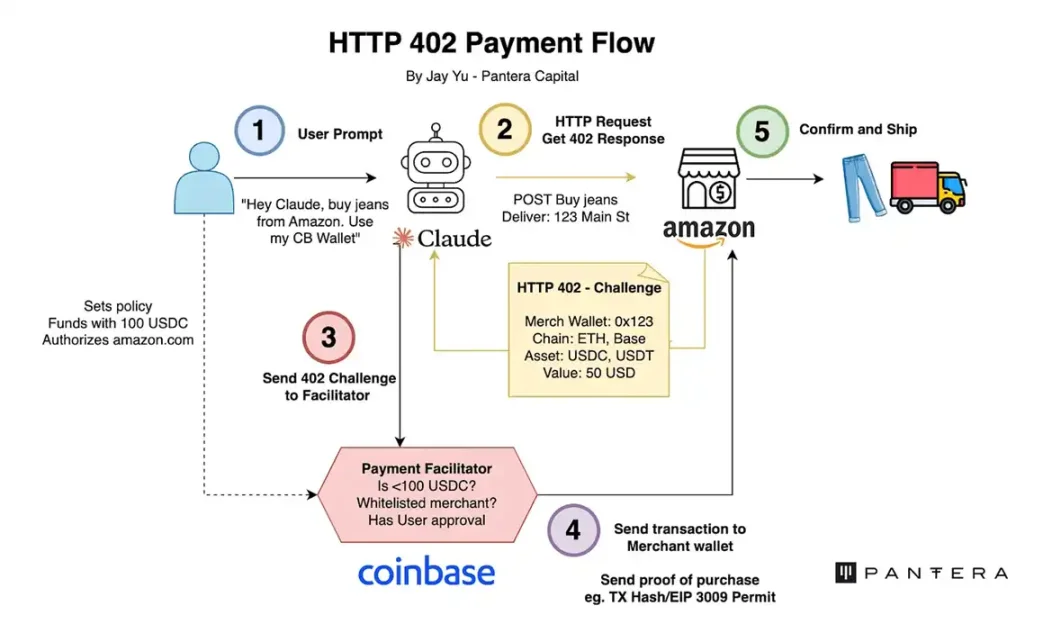
(Image source: Jay Yu – Pantera Capital)
A user asks Claude: “Use my Coinbase wallet to buy me a pair of jeans on Amazon.” After receiving the request, the AI agent sends a purchase request to Amazon. Amazon then constructs a preliminary transaction including the wallet address to use, blockchain network, currency type, and exact amount. Upon receipt, the AI forwards this transaction to the x402 protocol validator, which checks whether the specified wallet holds sufficient assets on the given chain, whether the item is available for trade, and whether the user has confirmed authorization. Once verified, the required funds and proof of payment are sent to the merchant's address—completing the transaction.
In summary, the HTTP 402 status code serves as a signaling mechanism within the protocol, indicating whether a transaction succeeded. By building blockchain-based payments atop this status code, Coinbase created the x402 protocol.
It sounds simple, but two aspects stand out from the workflow above. First, using on-chain assets for real-world payments becomes significantly easier—users no longer need to withdraw into fiat before spending, but can directly use USDT, USDC, or other on-chain assets. However, widespread adoption depends heavily on broad merchant integration.
Any Web API or content provider (crypto or Web2) looking to offer low-cost, frictionless payment paths for microtransactions or usage-based billing can integrate x402.
The second exciting aspect involves AI Agents. As payers or recipients, AI Agents are highly compatible with blockchain payments since they cannot naturally obtain bank accounts or payment app access through KYC like humans. As AI Agent intelligence improves, novel consumer and on-chain experiences become increasingly promising.
The workflow also explains why $PING minting resembles inscription minting—it must go through confirmation by the x402 validator. During the minting process, massive numbers of minting requests repeatedly overwhelmed the minting interface, marking the first real stress test for the x402 protocol.
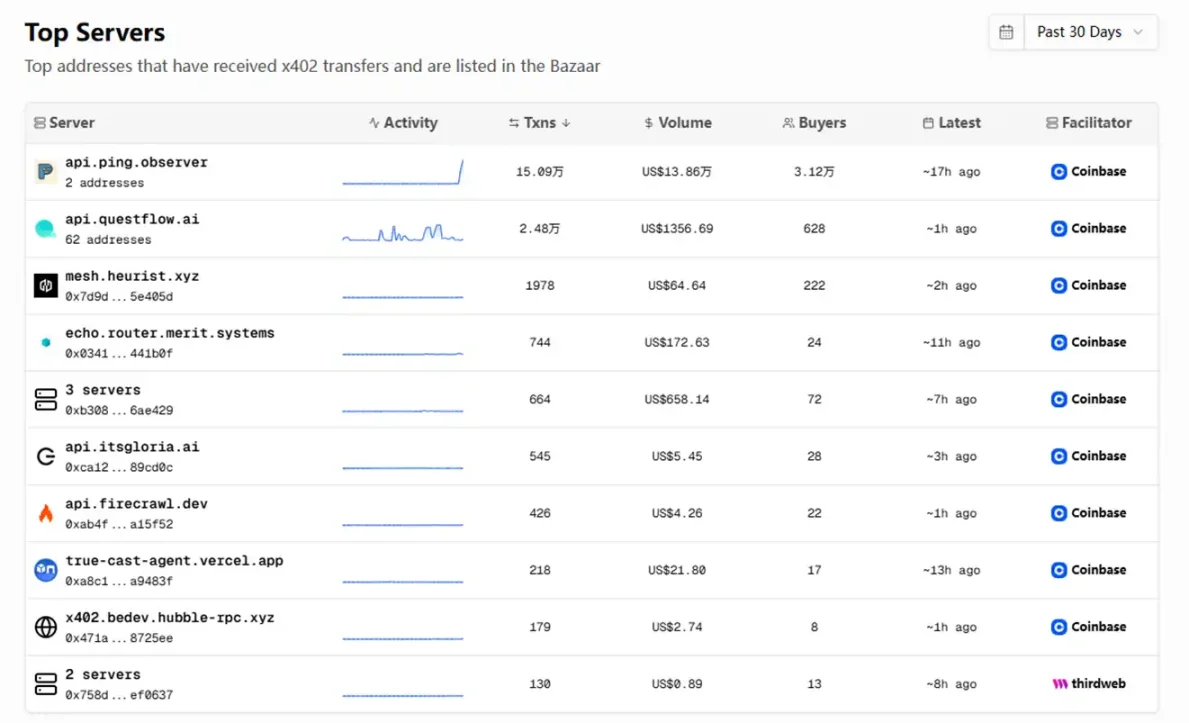
Data over the past 30 days shows that the $PING interface received over 150,000 x402 transactions totaling around $140,000—dramatically ahead of Questflow, the second-ranked project
This marks the first time in nearly half a year since x402 launched that it has drawn such public attention. Regardless of chain or protocol, new asset launches remain a perennial hotspot in crypto.
x402 Ecosystem Overview
Besides $PING, what other x402 protocol projects are worth watching?
The x402 protocol website features an Ecosystem page listing current projects. Browsing them individually reveals the protocol remains in a very early development stage, with many links leading straight to technical documentation or GitHub repositories.
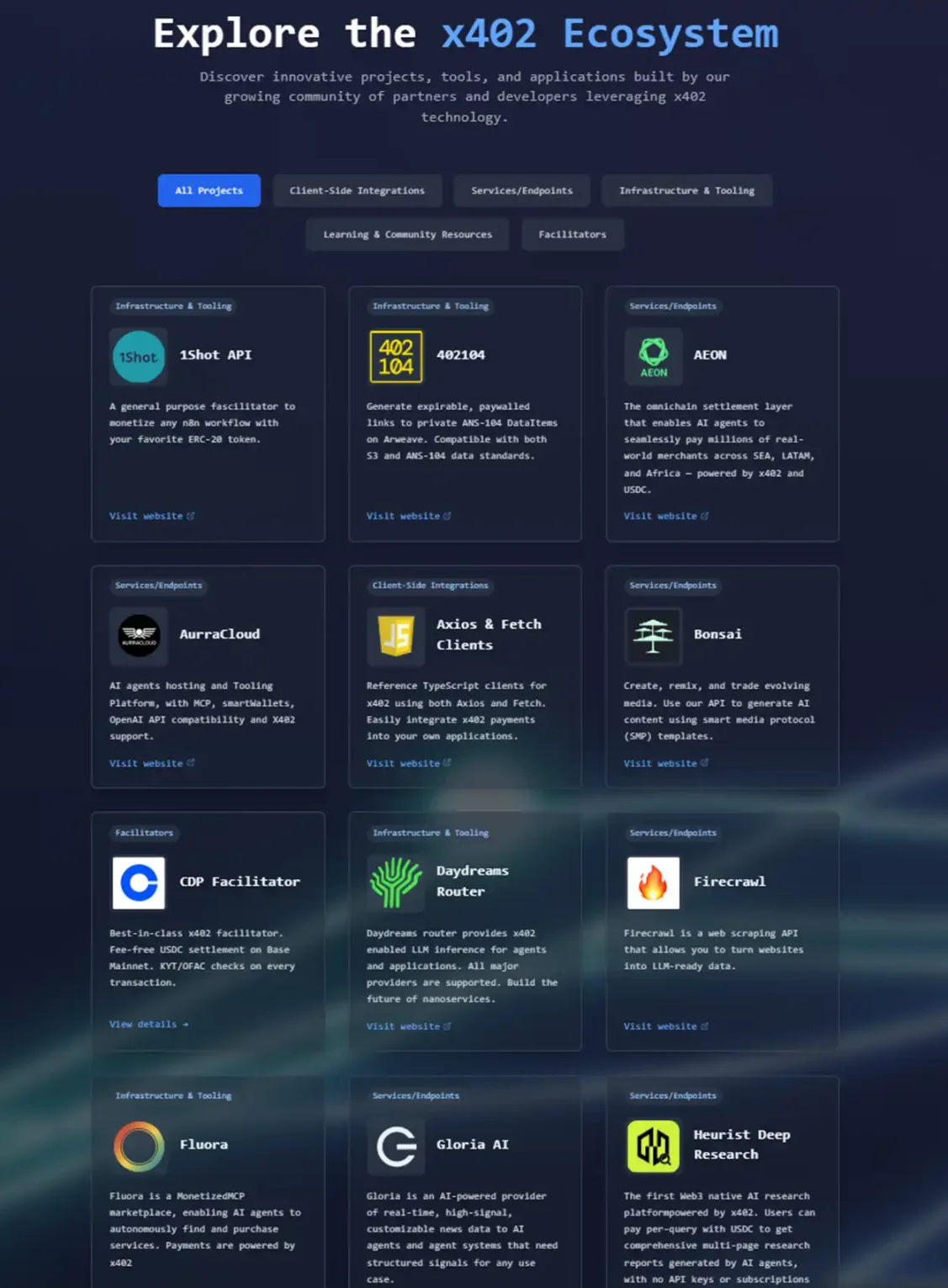
Below we summarize several projects that already have—or are about to launch—tokens.
Questflow

A multi-AI agent task orchestration layer enabling autonomous coordination among multiple AI agents. In July this year, it announced a $6.5 million seed round led by cyber•Fund, with participation from Delphi Labs, Systemic Ventures, Eden Block, HashKey Capital, Animoca Brands, Tezos, and grants from Coinbase Developer Platform, Aptos, and Virtuals.
No official token has been launched yet, but in December last year, it co-launched $SANTA with Virtuals—a cluster of autonomous agents built using Questflow’s QDP (Questflow Developer Platform) and MAOP (Multi-Agent Orchestration Protocol).
$SANTA currently has a market cap of approximately $4.5 million.
AurraCloud
An AI agent infrastructure designed for crypto-native applications. It allows immediate hosting of AI agents via OpenAI-compatible APIs or MCP servers and monetizes AI services on-chain via the x402 protocol on Base.
In addition, earlier this month the project began offering x402 validation services.
The $AURA token was launched via Virtuals and currently has a market cap of about $1.6 million.
Meridian

Incubated by uOS, providing multi-chain settlement and custody services for the x402 protocol.
The $MRDN token currently has a market cap of about $1.5 million.
PayAI

Supports multi-chain x402 payment services including Solana, and also offers x402 validation services.
The $PAYAI token currently has a market cap of about $5 million.
Daydreams
Provides LLM inference powered by x402 for apps and AI agents. Additionally, it is building Lucid—an open platform where anyone can deploy Daydreams Agents to solve problems. Users sign transactions via x402 to pay in USDC, while agents can pay each other for access.
The $dreams token currently has a market cap of about $6.7 million.
Gloria AI

A real-time news platform built for traders, creators, AI agents, and automation systems, accessible via $GLORIA payments using x402.
The $GLORIA token currently has a market cap of about $1.65 million.
Kite AI

Kite AI aims to build the foundational transaction layer for the "Agentic Internet," providing unified identity, payment, and governance infrastructure for autonomous agents. Kite AI's work is closely aligned with x402—support for x402 was mentioned as early as July—and it may be the only project in the x402 ecosystem that qualifies as a blockchain itself.
On September 2, Fortune reported that Kite AI announced total funding of $33 million, including an $18 million Series A round led by PayPal Ventures and General Catalyst, with participation from 8VC, Samsung Next, SBI US Gateway Fund, Vertex Ventures, Hashed, HashKey Capital, Dispersion Capital, Alumni Ventures, Avalanche Foundation, GSR Markets, LayerZero, Animoca Brands, Essence VC, and Alchemy.
Kite AI has not yet launched a token, but recently launched the Kite Foundation X account, clearly signaling imminent token issuance. Currently tradable related assets include the officially released FLY THE KITE NFT, with a floor price of 0.375 ETH.
Conclusion
In September this year, Coinbase and Cloudflare announced the joint establishment of the x402 Foundation to advance the protocol. While there are some competing solutions such as bitGPT’s h402 and Radius’s EVMAuth, x402 undoubtedly boasts the strongest backing and highest visibility.
If $PING sees significant market cap growth in the coming period, x402 will gain even greater market attention—not just beneficial for meme coins, but also positive for infrastructure projects.
Join TechFlow official community to stay tuned
Telegram:https://t.me/TechFlowDaily
X (Twitter):https://x.com/TechFlowPost
X (Twitter) EN:https://x.com/BlockFlow_News
 BlockBeats


