x402 Wishlist
TechFlow Selected TechFlow Selected
x402 Wishlist
x402 seamlessly integrates with data aggregation and management.
 Navigating Web3 tides with focused insights
By: David Christopher
Translated by: Block Unicorn
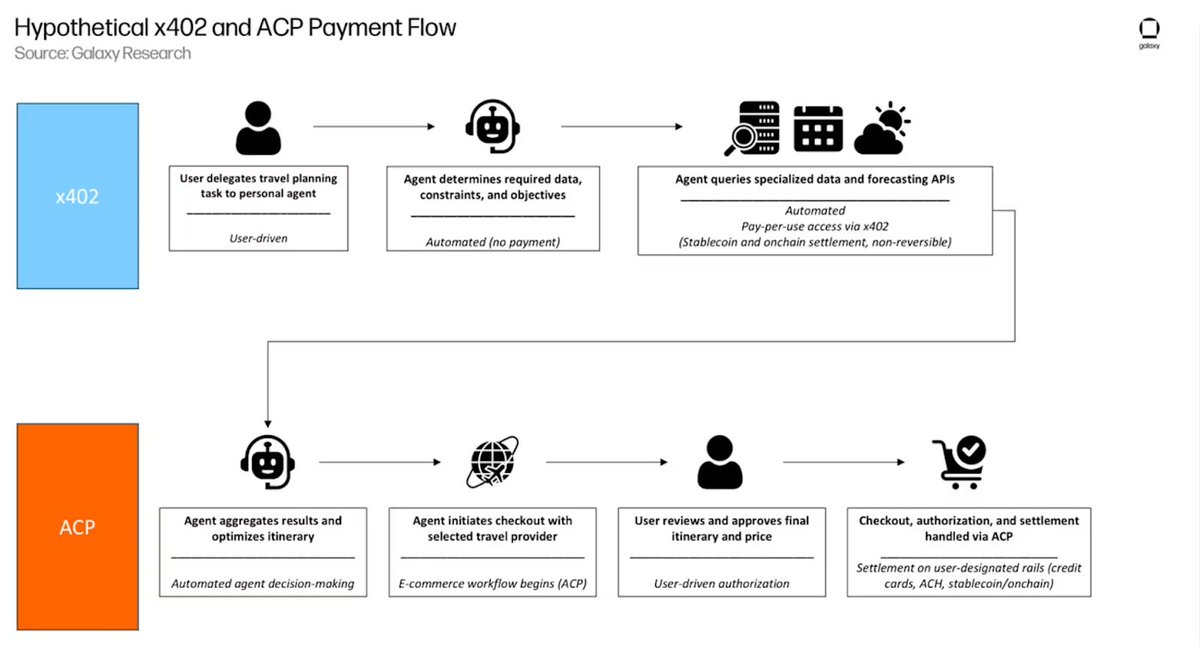
Reading Galaxy Research’s recent report gave me one of the clearest visions yet of x402’s future value.
One example stood out to me: an intelligent agent helps users book trips—querying high-quality weather data via x402 to identify optimal dates and destinations, then surfacing flight and hotel options, and finally passing all information to the booking workflow. Each query constitutes a micropayment. Every data source gets compensated. The intelligent agent aggregates all inputs and ultimately makes the booking decision.
What impressed me most was x402’s seamless integration with data aggregation and management. Someone consolidates fragmented data sources into proprietary datasets—making them more valuable than any single provider—and sells access via x402. Data managers incur integration costs only once; callers pay per query. Everyone benefits—provided the data volume is large enough (a point we’ll revisit shortly).
Source: Galaxy Research
Even before such services become widespread, I still view x402 as being in its infancy. If you’re a developer eager to build on x402 but struggling for inspiration, here are some theoretical products I’d rush to try—if they were available right now!
Skills Endpoint
Skills are carefully crafted instruction sets written by humans for AI agents to execute specific tasks.
Today, most skills marketplaces use flat-fee pricing: $5, $15, or $20 for perpetual access. This misaligns incentives. Occasional users overpay; heavy users underpay; and skill creators don’t earn value proportional to usage. A truly useful skill—like a truly useful consultant (if one existed)—is worth far more than a one-time $15 fee.
x402 offers an alternative. Skill creators can publish their work via x402 endpoints and price flexibly: pay-per-use (one-time), monthly subscription (a new feature in x402 V2), or both. The payment system supports either model. A skill invoked thousands of times per month can generate recurring revenue for its creator, while low-frequency skills require no upfront payment from users.
Niche Cryptocurrency News Aggregation Package
Crypto news is scattered across Twitter, Telegram groups, podcasts, RSS feeds, and Substacks. Tracking developments within a specific ecosystem compounds the challenge: monitoring everything happening around Sui or Starknet means watching a dozen sources daily.
An ecosystem-specific x402 data stream solves this. Someone aggregates tweets from relevant Twitter accounts, articles from website RSS feeds, and Telegram messages into a curated, ecosystem-focused feed via API. An agent queries: “What happened on Starknet in the past 24 hours?” and receives a structured response—no more tab-switching or app-hopping.
Aggregated Ecosystem Data
Measuring developer activity accurately has always been difficult.
Electric Capital’s annual report—and its continuously updated dashboard—is an excellent open-source resource, yet it has limitations. For instance, I just checked the top ecosystems ranked by developer growth over the past year: PancakeSwap, Monad, and Aleo appeared at the top. Of course, that’s because I filtered on just one metric—but it also reflects a broader problem: developer activity data in crypto is highly fragmented, with no single source offering a comprehensive view.
An x402 data source aggregating Electric Capital data, GitHub activity, Artemis metrics, and protocol-specific data into a quality-weighted developer activity stream would fill a genuine gap. An agent queries: “How is Solana’s developer momentum trending this quarter?” and receives insights far more actionable than raw commit counts.
Newsletter & Podcast Performance Tracker
A personal idea I’d use: a service that clearly tracks claims made in newsletters or podcasts—and measures how those claims evolve over time.
Citron does something similar for equities, publishing an annual scorecard at year-end rating its predictions against actual performance. But for most newsletters and podcasts, if you want to know whether a given outlet’s forecasts have genuinely delivered returns over time, you’re stuck doing manual research.
An x402 service could benchmark media forecasts to fill this gap. Feed it a newsletter or podcast, and it tracks every forecast, timestamps it, monitors subsequent price action, and scores the outlet’s historical track record. An agent queries: “How did X’s asset predictions perform over the past year?” and receives a verified answer.
Security & Audit Tracker
Protocols rarely announce breaches proactively. And with news cycles moving so fast, if you weren’t online the day a vulnerability surfaced, you likely missed it entirely. By the time you need to act, what should’ve been a high-priority event is already buried beneath weeks of coverage.
Security audits aren’t much better. Audit reports live scattered across auditing firms’ websites, protocol documentation, and GitHub repositories. Checking a protocol’s full audit history is far harder than it sounds.
An x402 feed aggregating all this into a queryable endpoint—where users pay just a few cents to access it before deciding whether to allocate yield—would be ideal, especially when interacting through an agent interface.
Is This Really Feasible?
All the ideas above face two questions: Can the economics sustain teams building these data streams? And can they be built legally?
On economics, historical precedent isn’t encouraging. Pay-per-project models have struggled since the early internet. The cognitive cost of deciding whether content is worth paying for often exceeds the payment itself—that’s why the internet shifted toward subscriptions: predictable billing, reduced decision fatigue, and lower churn.
But agents change everything. You top up your wallet; the agent spends on your behalf; you top up again when the balance runs low. API credits work similarly. The question shifts from “Are these few cents worth it?” to “Can the endpoint provider recoup costs at scale?” That depends on call volume.
On legality, x402 handles payments and metering—but doesn’t alter upstream copyright issues. If you’re using licensed APIs, public data, or first-party x402 endpoints, this is straightforward product development. But if you rely on web scrapers or operate in a gray area of terms of service, longevity and scalability may be constrained. Once an upstream provider notices and objects, you’re in risky territory.
x402 V2 introduces dynamic payment routing, enabling revenue sharing. Data managers can pass a portion of earnings back to original data providers—aligning incentives and turning potential ToS conflicts into partnerships. But this does compress margins.
Whether both the economics and legality hold up at scale remains to be seen. If they do, these are exactly the data streams I’d pay for.
Whether this economic and legal model can succeed simultaneously at scale remains to be seen. If it does, these are exactly the data streams I’d pay for.
Join TechFlow official community to stay tuned
Telegram:https://t.me/TechFlowDaily
X (Twitter):https://x.com/TechFlowPost
X (Twitter) EN:https://x.com/BlockFlow_News
 Bankless