The Lie of "Randomness": How a $15 Billion Bitcoin Empire Collapsed Due to a Single Line of Code
TechFlow Selected TechFlow Selected
The Lie of "Randomness": How a $15 Billion Bitcoin Empire Collapsed Due to a Single Line of Code
In the face of powerful nation-state adversaries, no technical measures can guarantee absolute security.
 Navigating Web3 tides with focused insights
Author: Lewis
Introduction: Ghost Code
In December 2020, a staggering 127,000 bitcoins—worth about $3.5 billion at the time—mysteriously vanished from an address belonging to LuBian, a Chinese mining pool. The pool operator desperately appealed to the "hacker" on the blockchain, pleading for the return of the assets and offering a reward, turning it into a public digital chase.
The massive sum then lay dormant for years. Then, on October 14, 2025, a statement from the U.S. Department of Justice (DOJ) shocked the world: they had successfully seized these bitcoins, now valued at an astonishing $15 billion.
Yet this was not a typical hacking or arrest operation. U.S. law enforcement gained access to the private keys of this enormous fortune because they uncovered an absurd yet fatal secret—the foundation of this criminal empire’s treasury wasn’t an impenetrable cryptographic fortress, but a tiny lie about “randomness.”
This story not only reveals the inside details of the largest cryptocurrency seizure in history but also sounds a dire warning about digital security for all of us.
Part One: The Illusion of Randomness—Anatomy of the “Milk Sad” Vulnerability
The Foundation of Cryptographic Security: Private Keys and Randomness
To understand this $15 billion vulnerability, we must first grasp the core of Bitcoin security: private keys. A private key is not just an ordinary password—it's an extremely large 256-bit number. The total number of possible values (2^256) exceeds the estimated number of atoms in the observable universe (approximately 10^80) by countless orders of magnitude. Therefore, as long as your private key is truly random, cracking it through brute-force guessing is physically impossible.
For user convenience, modern wallets typically use a “seed phrase” (usually 12 to 24 words) to generate all private keys. This process relies on an algorithm called a **Pseudo-Random Number Generator (PRNG)**. The quality of this generator directly determines the life or death of your digital assets. A PRNG used in cryptography must be “cryptographically secure” (CSPRNG), ensuring its output cannot be predicted.
Using a weak, non-cryptographically secure PRNG to generate private keys is like protecting the world’s most fortified bank vault with a cardboard wall.
The “Milk Sad” Vulnerability (CVE-2023-39910): A 32-Bit Disaster
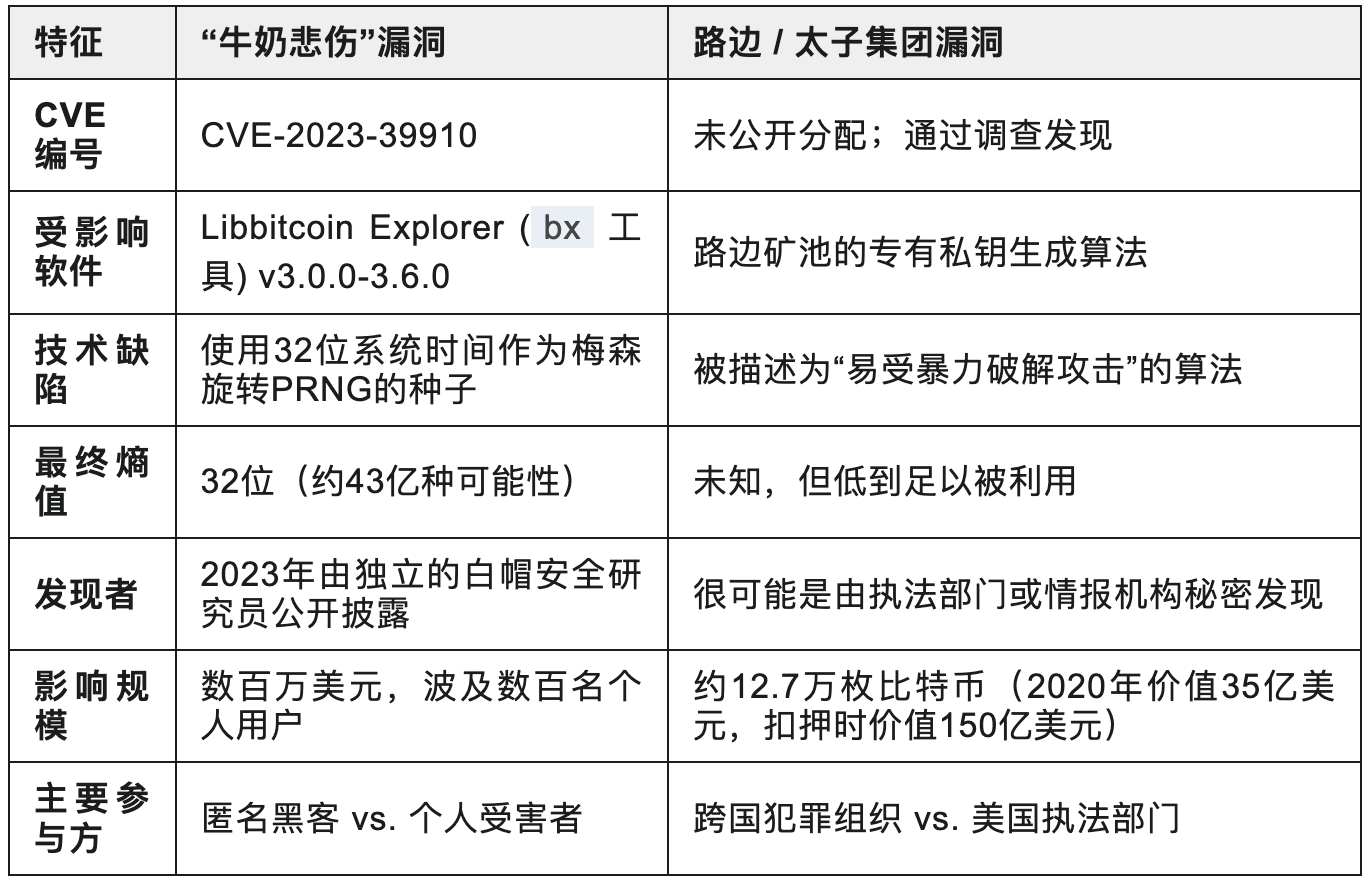
The “Milk Sad” vulnerability is a textbook example of such a failure. This flaw existed in a command-line tool called Libbitcoin Explorer, which many developers and advanced users once relied on to generate wallets.
The technical error was shockingly simple: when generating random seeds, the tool used a PRNG algorithm known as the “Mersenne Twister.” This algorithm is inherently unsuitable for cryptographic purposes, and worse, the developer initialized it using only the system’s 32-bit timestamp as its seed.
This meant that no matter how complex the resulting private key appeared, the true source of its “randomness” was limited to just 32 bits. How big is a 32-bit space? Only 2^32—about 4.3 billion possibilities. For a modern computer, exhaustively testing all 4.3 billion combinations takes at most one day. A problem that should have been a cosmic-scale impossibility was reduced to a guaranteed lottery win.
The name “Milk Sad” comes from the fact that when the system timestamp was “0.0,” the generated mnemonic phrase started with the words “milk sad,” becoming its unique “fingerprint.” On July 12, 2023, attackers exploited this vulnerability in a coordinated mass theft, stealing millions of dollars from unsuspecting users’ wallets.
The “Milk Sad” incident clearly demonstrated that even if cryptographic algorithms themselves are rock-solid, a minor flaw in their software implementation can cause the entire security system to collapse.
Part Two: A Criminal Empire Built on a Flaw—LuBian Pool and the Prince Group
The Phantom Mining Pool and a Carefully Staged “Theft”
While the “Milk Sad” vulnerability was being analyzed in the tech community, a far larger and darker story was quietly unfolding. In December 2020, LuBian Pool—the previously mentioned mining pool that once controlled nearly 6% of global Bitcoin hash power—reported that approximately 127,000 bitcoins were “stolen” from its wallet. Afterward, the pool operators left hundreds of messages on the blockchain, begging the “hacker” to return the funds and promising rewards.
By February 2021, LuBian Pool had vanished completely.
Years later, research from blockchain analysis firms Arkham Intelligence and Elliptic revealed that this “theft” likely occurred because LuBian Pool used a flawed proprietary algorithm to generate private keys, making them vulnerable to brute-force attacks—exactly the same principle as the “Milk Sad” vulnerability.
The Mastermind: Chen Zhi and the Prince Group
On October 14, 2025, the U.S. Department of Justice unsealed indictments that finally revealed the truth. The mastermind behind it all was a man named Chen Zhi (also known as “Vincent”), chairman of a multinational conglomerate called the “Prince Group.”
On the surface, the Prince Group operated across real estate, finance, and more than 30 countries—a glittering facade. In reality, it was a vast and violent Transnational Criminal Organization (TCO) designated by the U.S. Treasury. Its core business was industrial-scale fraud, particularly a scheme known as “Pig Butchering” (Sha Zhu Pan).
The indictment painted a hellish picture: the Prince Group operated multiple forced labor camps in Cambodia and elsewhere, surrounded by high walls and electric fences. Thousands of trafficked workers were forced to conduct “pig butchering” scams, working for hours on end each day. Those who disobeyed or failed to meet quotas faced beatings and abuse. At its peak, this criminal network generated up to $30 million in illegal profits per day.
The Truth Revealed: The Crime Empire’s Vault
The DOJ’s civil asset forfeiture complaint ultimately connected all the dots: the 127,000 bitcoins “stolen” from LuBian Pool in 2020 were actually the illicit proceeds amassed by the Prince Group through fraud and human trafficking—and Chen Zhi had maintained control over these assets all along.
LuBian Pool itself was merely one of the Prince Group’s “legitimate” fronts for money laundering. By mining, they could continuously generate “clean” bitcoins with no transaction history, which they then mixed with “dirty” money obtained from victims to conceal its bloody origins. Chen Zhi even reportedly boasted to associates that his mining business was highly profitable—because “there are no costs”—a tacit admission that his entire capital came from victims’ sweat and suffering.
Thus, the truth behind the 2020 “theft” became clear: this was never a hacker attack, but a meticulously orchestrated act of thieves crying “thief”. The public blockchain messages were staged to create a false record of theft, attempting to “whiten” the origin of this massive illicit fortune and sever its link to human trafficking and fraud.
Tragically, the very vault this vast criminal empire used to hide its wealth was secured by a fragile randomness-generation flaw similar to “Milk Sad.”
Part Three: The Digital Net—A Historic Law Enforcement Operation
Tracking on an Immutable Ledger
Although cryptocurrencies are often misunderstood as anonymous havens for crime, their public and immutable nature provides investigators with powerful tracking tools. The U.S. Department of Justice, FBI, Secret Service, Treasury, and other agencies, together with international partners including the UK, launched an unprecedented cross-border digital pursuit.
Using advanced blockchain forensic tools, investigators were able to sift through mountains of transaction data and reconstruct the Prince Group’s complex money laundering network. From June to July 2024, the long-dormant bitcoins suddenly began moving in large volumes. Later analysis confirmed this was not criminals relocating assets—but rather U.S. authorities transferring the funds into government-controlled wallets after gaining control of the private keys.
The Ultimate Puzzle: How Did the U.S. Government Obtain the Private Key?
The most intriguing and unresolved question in the entire case is: how did the U.S. government obtain the private key to $15 billion worth of bitcoin while the main suspect, Chen Zhi, remains at large?
This case differs sharply from previous ones. In the Silk Road and Bitfinex hack cases, fund recovery heavily depended on arresting suspects and seizing their physical devices containing private keys.
Currently, several scenarios are speculated:
-
Human Intelligence: Investigators may have turned a high-level insider within the Prince Group who had access to the private keys.
-
Physical Seizure: Law enforcement may have secretly seized hardware wallets, computers, or paper records containing the private keys or seed phrases through raids, even without arresting Chen Zhi.
-
Direct Technical Exploitation: This is the boldest and most fascinating theory. U.S. intelligence agencies (such as the NSA) may have independently discovered the flaw in LuBian Pool’s key generation algorithm. Leveraging immense computing power, they might have directly attacked the vulnerability, reconstructed the private key, and executed a remote “heist” of their own—an act of “robbing the robber.”
Regardless of the exact method, this case marks a major shift in law enforcement strategy: from “arrest first, seize assets later” to remotely and proactively dismantling criminal organizations’ financial capabilities. This fundamentally alters the risk landscape of cryptocurrency crime.
Conclusion: Lessons from the Abyss
From “Milk Sad” to the downfall of the Prince Group, two seemingly unrelated stories converge on the same root cause: negligence in random number generation. Whether it’s ordinary users losing their life savings or crime lords collapsing a billion-dollar empire, both fell due to failures in entropy. This proves that the strength of the cryptographic security chain depends on its weakest link.
This unprecedented case has also shattered the myth of Bitcoin being “unseizable.” It sends a clear message to criminal organizations worldwide: against a determined nation-state adversary, no technological measure can guarantee absolute security.
These painful lessons offer clear guidance for every participant in the digital economy:
-
For regular users: Always use reputable, audited open-source wallet software and hardware. Avoid obscure or unverified tools.
-
For developers: You bear great responsibility. In any security-related application, always use rigorously validated, cryptographically secure random number generators.
-
For the public: Be vigilant against “Pig Butchering” and similar emotional-financial scams. Any investment promising unrealistic returns may hide an abyss beneath.
In the end, the ghosts in the machine are not abstract technical concepts—they are real threats. Whether building personal wealth or a criminal empire, survival or destruction may hinge on the quality of a single small random number.
Join TechFlow official community to stay tuned
Telegram:https://t.me/TechFlowDaily
X (Twitter):https://x.com/TechFlowPost
X (Twitter) EN:https://x.com/BlockFlow_News