Ethereum developers bringing their talents to private enterprises
TechFlow Selected TechFlow Selected
Ethereum developers bringing their talents to private enterprises
Open source communities cannot rely solely on passion.
 Navigating Web3 tides with focused insights
Author: Eric, Foresight News
On the evening of the 19th Beijing time, Bankless co-founder David Hoffman posted on X to "mourn" the departure of Dankrad Feist, Ethereum Foundation's longest-serving researcher, who has chosen to leave Ethereum and join stablecoin L1 Tempo.
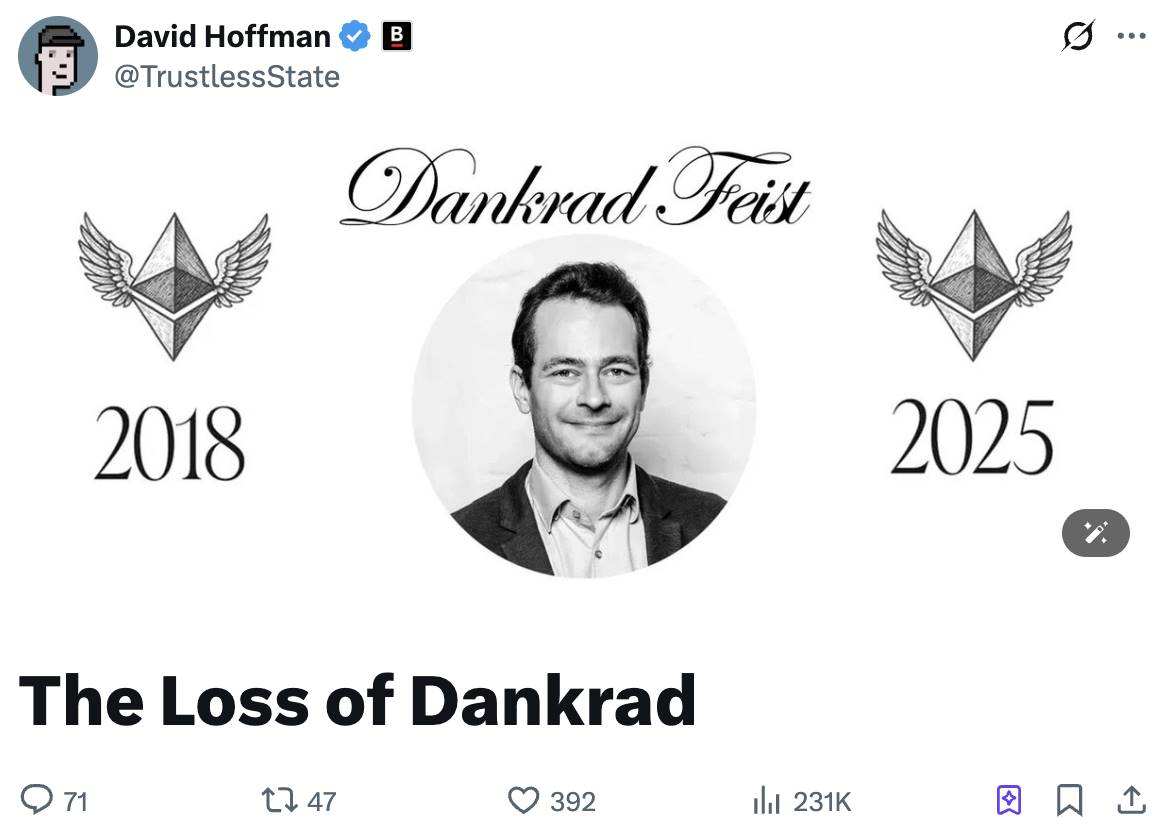
David Hoffman believes the issue of for-profit companies absorbing talent cultivated by the open-source Ethereum community is not trivial, and stated that these companies won't necessarily bring greater benefits to Ethereum as they claim. He bluntly said, "In my view, the purpose of Tempo is to intercept the trillions of dollars expected to flow into stablecoins over the next decade and move them onto their private blockchain. Sure, this grows the pie, but Tempo still intends to capture as large a share of it as possible." He argues that Tempo will always be constrained by compliance issues, which cannot be resolved even with token issuance. While both Tempo and Ethereum may change the world, only Ethereum is best suited to serve as a trust-minimized, neutral global settlement layer—without shareholders or legal jurisdiction.
The frustration toward Ethereum began when its price performance started lagging behind Bitcoin in this market cycle. Over time, however, people have come to realize that the exodus of top talent from the Ethereum community appears to be an irreversible trend. When ideals clash with financial incentives, many ultimately choose the latter—a concern long held across the industry...
Dankrad Feist is not the first, nor will he be the last
Dankrad Feist announced on X on the 17th of this month his move to Tempo, while continuing to serve as a research advisor for three strategic initiatives within the Ethereum Foundation’s protocol stack: scaling L1, scaling blobs, and improving user experience. He said, "Ethereum has powerful values and technical choices that make it unique. Tempo will be a great complement, built on similar technology and values, while pushing boundaries in scale and speed. I believe this will greatly benefit Ethereum. Tempo’s open-source technology can easily be re-integrated back into Ethereum, benefiting the entire ecosystem."
According to LinkedIn, Dankrad Feist officially became an Ethereum researcher in 2019, primarily focusing on sharding technologies to scale the Ethereum mainnet. Danksharding—one of the core components of Ethereum's current scalability roadmap—is named after him. Danksharding is a key technological pathway for Ethereum to achieve high throughput and low-cost transactions, widely regarded by the community as the most important upgrade direction since "Ethereum 2.0."
Dankrad Feist drove the development of Proto-Danksharding (EIP-4844), the precursor to Danksharding. This EIP introduced blob transaction types, providing Rollups with cheaper and more efficient data availability layers, significantly reducing Rollup data publishing costs.
In addition, he previously engaged in a public debate with Geth lead developer Péter Szilágyi over MEV, which eventually prompted Vitalik Buterin to intervene and helped raise community awareness around MEV mitigation mechanisms such as PBS (Proposer-Builder Separation).
Tempo researcher Mallesh Pai introduced new team members joining Tempo in September, including Liam Horne, former CEO of OP Labs and co-founder of ETHGlobal.
Prior to Dankrad Feist, the industry was surprised by Danny Ryan—the former core member of the Ethereum Foundation known as the "chief engineer of Ethereum 2.0"—who joined Etherealize just six months after announcing an indefinite break in September 2024. However, since Etherealize shares similarities with ConsenSys, founded by Ethereum co-founder Joseph Lubin amid commercialization disputes 11 years ago, Danny Ryan's move was largely understood by the community.
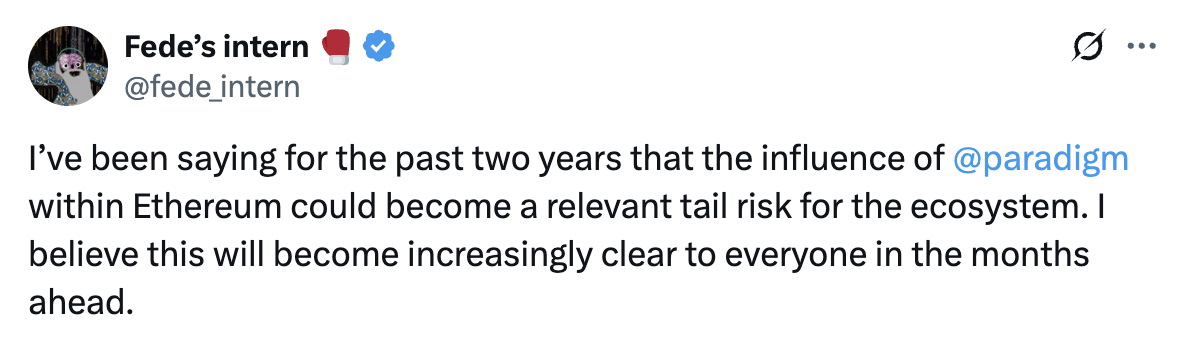
What truly concerns David Hoffman are companies like Tempo and Paradigm. Prominent Ethereum developer Federico Carrone echoed similar views, retweeting David Hoffman’s post about Dankrad Feist joining Tempo and stating that he has been warning for the past two years that Paradigm’s influence within Ethereum could become a tail risk for the entire ecosystem.
Federico Carrone wrote that the sole objective of venture capital funds is to maximize returns for LPs, and Ethereum should not develop deep technical dependencies on a VC playing with extremely high strategic acumen. After the FTX collapse, Paradigm nearly removed all crypto-related branding and made a high-profile pivot to AI. According to Carrone, this alone proves his point.
After Trump returned to the White House, Paradigm re-entered the Web3 space, aggressively recruiting top-tier researchers from the community, funding critical open-source Ethereum libraries, and supporting Stripe’s launch of Tempo. While Paradigm claims everything they do benefits Ethereum—more funding, more tools, more experimentation, and new ideas feeding back into Ethereum—these are indeed potential upsides. But, as Carrone argues, when corporations gain excessive visibility and influence over open-source projects, priorities shift from the community’s long-term vision to corporate interests.
Ethereum’s technical debt is accumulating
The mere loss of talent from Ethereum’s open-source community might not trigger widespread alarm. But if talent drain coincides with growing technical debt, it becomes a serious concern.
A week ago, a community member shared a screenshot on X showing that top contributors to the Solidity language have almost entirely stopped active development. Only Cameel continues to raise new issues and push technical progress forward—but even he seems to be operating in maintenance mode. The user argued that the community needs to invest more resources in supporting this programming language.
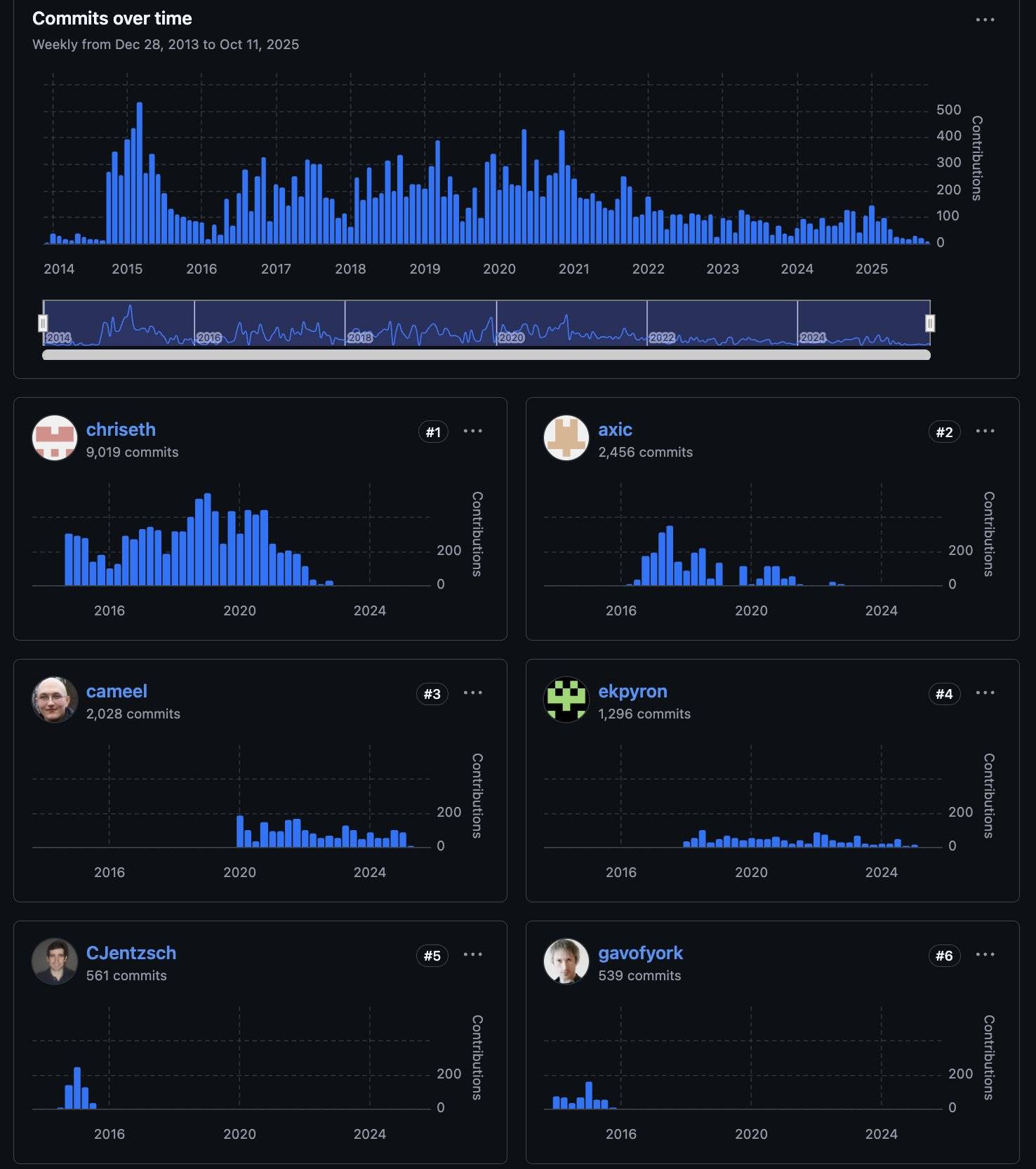
In the comments, some users questioned why efforts should continue to improve and upgrade Solidity instead of merely maintaining it for stability and security. The original poster clarified that changing the Solidity compiler doesn’t affect any already-deployed contracts, but can enhance security, improve developer experience, or support new contract use cases. As seen in the image above, development activity began sharply declining right from the start of the previous booming bull market.
Federico Carrone also weighed in, expressing concern that a vast number of core tools and libraries built around Solidity may no longer receive long-term maintenance. Even the latest version of the Solidity compiler is currently supported by only a handful of developers. Furthermore, companies working on L2 and ZK technologies are downsizing, meaning cutting-edge innovation may soon depend on just a few firms. As gas limits rise, many execution clients have failed to deliver meaningful performance improvements, and judging by their repositories, client development teams appear to be falling behind.
Carrone stated, "Ethereum’s technical debt keeps piling up—not only because the protocol must continuously evolve, but also because numerous dependent libraries and peripheral repositories have stagnated. The ecosystem continues to expand, safeguarding tens of billions of dollars in assets, while parts of its foundation quietly erode."
Open-source communities cannot run solely on goodwill
For an open-source community like Ethereum, which safeguards quantifiable, real-world value, balancing passion-driven contributions with economic incentives is an unprecedented challenge. This should have been a top priority for the Ethereum Foundation, yet it appears to have been overlooked.
Péter Szilágyi, who joined the Ethereum Foundation in 2015 to lead Geth development and maintenance, clearly outlined three major sources of disappointment in a letter to Ethereum Foundation leadership a year and a half ago: being portrayed as a leader externally while marginalized internally; income grossly disproportionate to Ethereum’s market cap growth; and excessive influence held by Vitalik and a small inner circle over the Ethereum ecosystem.
In late 2024, Szilágyi discovered the Ethereum Foundation was secretly incubating a separate Geth fork team. Following disputes with the foundation, he was dismissed and repeatedly declined re-employment offers. Later, the Ethereum Foundation reportedly offered him $5 million to spin Geth out independently—an offer he rejected. Currently, Szilágyi continues maintaining the Geth codebase as an independent contributor.
Rumors of internal corruption at the Ethereum Foundation persist, but these were problems foreseeable from the moment the foundation was established. As the saying goes, “wherever there are people, there is politics.” We cannot eliminate human greed, but we must not allow Ethereum to gradually lose its core values due to commercialization.
Ethereum’s multi-hundred-billion-dollar market cap and years of facilitating trillions in on-chain value transfers rest on infrastructure built by professional technical teams, driven by permissionless open-source principles, and amplified by commercial adoption across enterprises. Yet maintaining such a massive system requires constant human effort—and as we’ve seen, these individuals are leaving out of disillusionment or choosing other projects for financial gain.
The Ethereum Foundation has implemented sweeping reforms this year, but so far, results remain underwhelming. Ethereum can still be called the world computer, and its potential in commercial applications continues to be explored by brilliant teams worldwide. But as the foundation of it all, Ethereum must stop letting those who still hold onto ideals feel betrayed.
Join TechFlow official community to stay tuned
Telegram:https://t.me/TechFlowDaily
X (Twitter):https://x.com/TechFlowPost
X (Twitter) EN:https://x.com/BlockFlow_News
 Foresight News