Kalshi's on-chain ambitions: From compliant prediction markets to Web3 infrastructure
TechFlow Selected TechFlow Selected
Kalshi's on-chain ambitions: From compliant prediction markets to Web3 infrastructure
Advantages include broader coverage, legitimacy, mainstream adoption, and hybrid models.
 Navigating Web3 tides with focused insights
Author: Baheet
Translation: TechFlow
The prediction market industry is undergoing rapid transformation, primarily driven by the intense competition between Kalshi and Polymarket.
Kalshi recently completed a funding round of $3 billion, reaching a valuation as high as $5 billion; meanwhile, Polymarket has also raised $2 billion from Intercontinental Exchange (ICE).
This means one thing: we are about to witness a new race between the two companies in product launches.
The stage is set—now it's a matter of which platform will emerge victorious.
But the core focus of this article is:
Kalshi is executing its carefully planned on-chain expansion strategy.
@Kalshi has long faced criticism from crypto-native competitors for not being fully on-chain. The crux of this criticism lies in Kalshi operating as a regulated centralized exchange, maintaining full control over markets, user funds, and settlement processes—this stands in stark contrast to blockchain’s ethos of decentralization.
However, Kalshi has begun executing its on-chain expansion plan, starting with appointing @j0hnwang as Head of Crypto.
Now, they are taking it further by opening up Kalshi’s market data to Web3 users and applications.
Let’s dive into the details;
Multiple Oracle Partnerships: Pyth and Stork
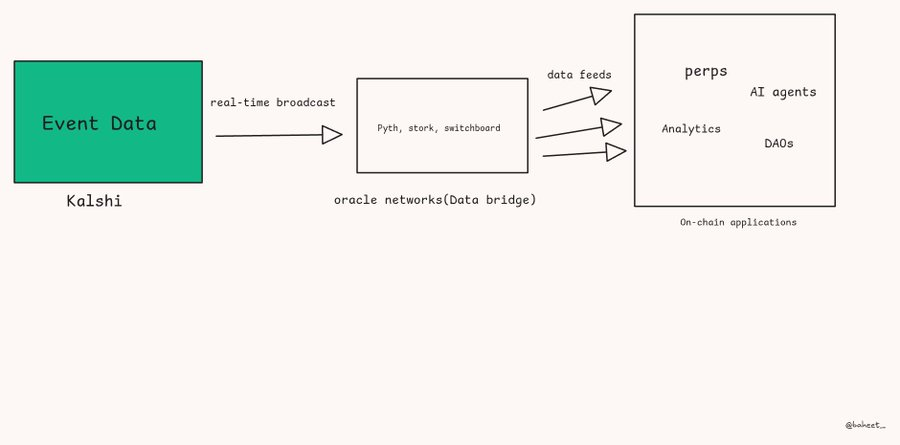
By partnering with oracle networks such as Pyth, Switchboard, and Stork, Kalshi is distributing its federally regulated centralized prediction market data across multiple blockchains. This is a deliberate move aimed at bringing Kalshi’s prediction market data into the decentralized Web3 ecosystem.
-
Pyth Network: The collaboration with @PythNetwork enables Kalshi to stream real-time, regulated prediction market data onto over 100 blockchains. Developers can now leverage Kalshi’s probability data for DeFi applications, risk modeling, and more.
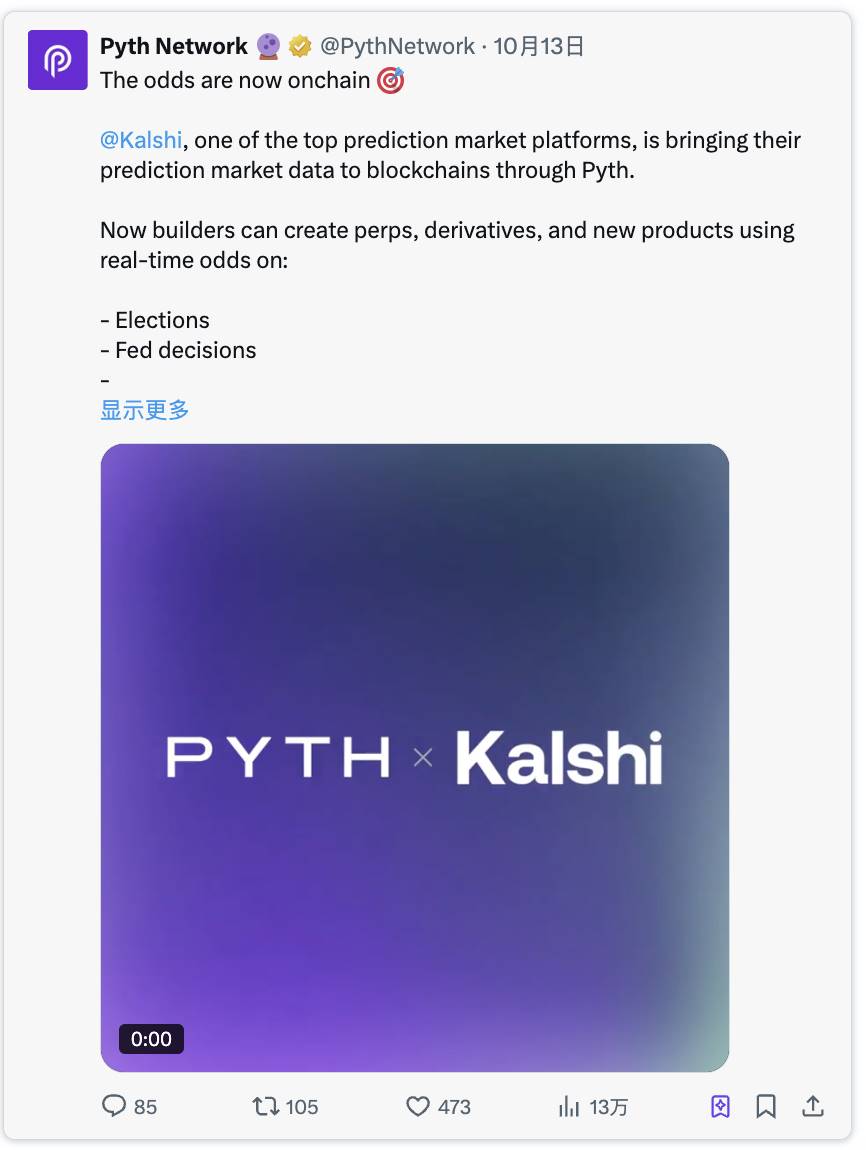
Original tweet link: Click here
-
Stork: Kalshi’s collaboration with @StorkOracle's open data marketplace further enhances the availability of Kalshi’s data within the Web3 ecosystem.
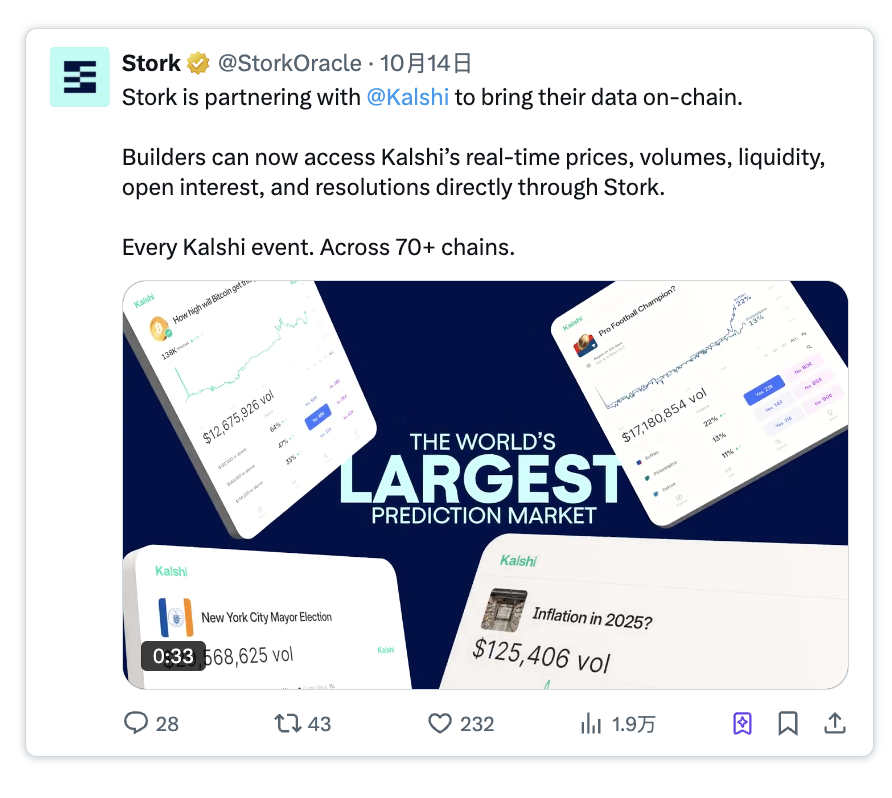
Original tweet link: Click here
-
Switchboard: @switchboardxyz oracle has also announced support and integration of Kalshi’s data.
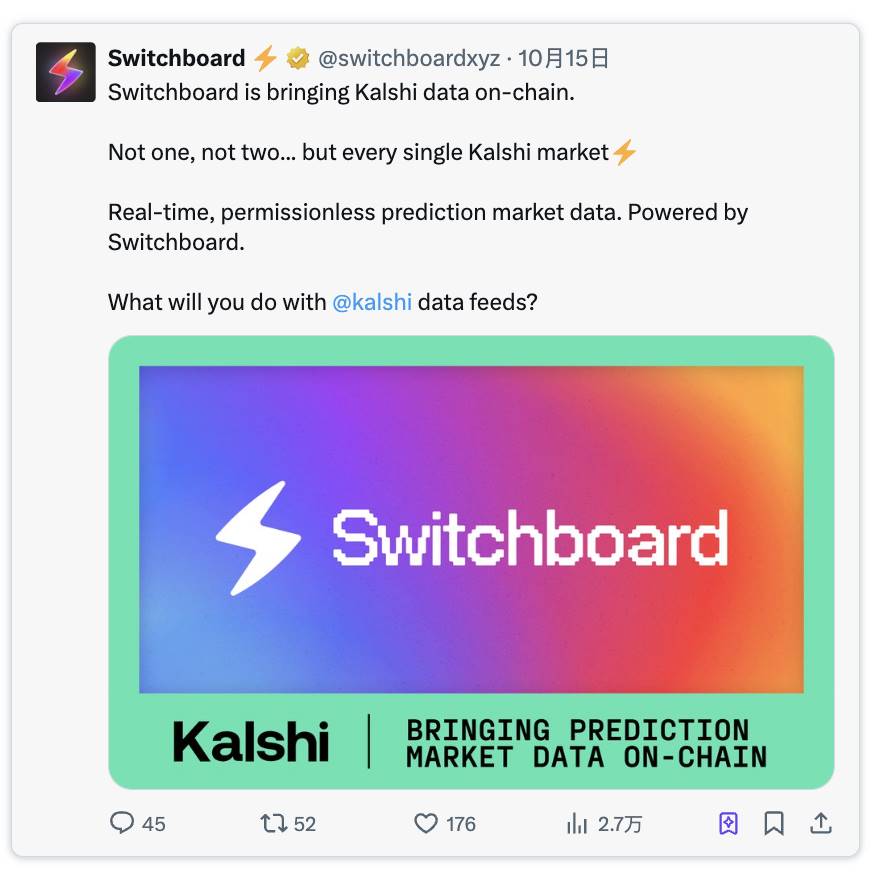
Original tweet link: Click here
This strategy not only helps Kalshi extend its influence beyond its own platform but also allows it to maintain its regulated status—an essential distinction from its main on-chain competitor @Polymarket.
Kalshi’s Strategic Implications
-
Expanded Reach: By distributing data through multiple oracle networks, Kalshi ensures its regulated data becomes accessible to a broader range of Web3 developers, institutions, and decentralized applications (dApps) across various blockchains.
-
Empowering DeFi Products: Kalshi’s real-time market probability data can serve as building blocks for novel DeFi tools, including derivatives, insurance markets, gaming mechanics, and governance systems.
-
Acting as a “Referee”: With its robust regulated data feed, Kalshi has the potential to become a trusted arbiter for decentralized prediction markets, providing trust for markets that rely on its data for settlement and enhancing overall ecosystem credibility.
-
Remaining Competitive: This approach enables Kalshi to compete more effectively with fully on-chain platforms like Polymarket. By combining regulatory compliance with on-chain integration, Kalshi offers the best of both worlds.
Ecosystem Hubs on Solana and Base
To support application development based on its data and platform, Kalshi has launched the @KalshiEco ecosystem hub in partnership with @solana and @base.
This initiative provides funding, technical support, and resources to attract developers, traders, and creators into the prediction market space, driving innovation both on and off-chain.
Comparison with Polymarket: Where Does Kalshi Hold an Edge?
The rivalry between Kalshi and Polymarket goes beyond market share—these two platforms clearly dominate the landscape.
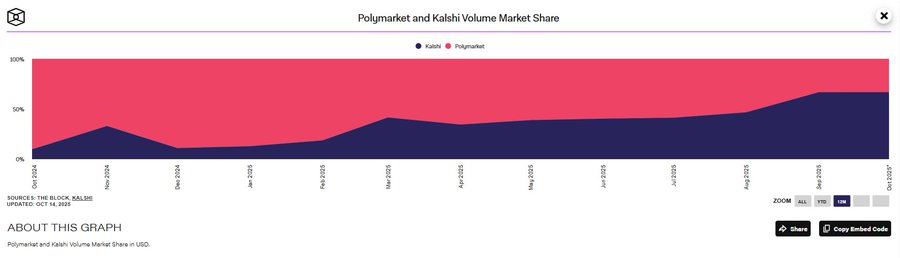
Frankly, this is more of a philosophical clash.
-
Kalshi’s Methodology: Centered on compliance, pushing for the institutionalization of prediction markets. This philosophy has been consistent since the company’s inception.
-
Polymarket’s Methodology: Represents the experimental frontier of crypto-native platforms. Initially built on the Polygon blockchain, it allowed users to trade on a wide array of topics but was eventually banned in the U.S. due to regulatory risks stemming from its non-custodial model.
Although Polymarket is now pursuing compliance and has gained institutional backing, Kalshi’s compliance-first strategy and longstanding institutional support give it a clear advantage in attracting mainstream users and larger capital flows.
I believe Kalshi currently holds several advantages over Polymarket;
-
Broad Coverage and Legitimacy: By distributing data via multiple oracle networks, Kalshi’s regulated data achieves wider reach, positioning itself as a foundational “source of truth” for real-world event data in DeFi, thereby enhancing its legitimacy and influence.
-
Mainstream User Adoption: Kalshi’s partnerships with traditional brokerages like Robinhood have attracted a broader, non-crypto-native audience, securing a larger market share in the prediction market space.
-
Hybrid Model: While debates on CT often frame Kalshi and Polymarket as opposites, both are moving toward hybrid models. Kalshi is innovating on-chain to engage the Web3 community, while Polymarket is attracting institutional capital through U.S. regulatory approvals. Nevertheless, Kalshi’s long-standing compliance foundation remains a durable and trustworthy advantage.
Looking Ahead: Kalshi’s Next Phase
I believe Kalshi’s current momentum and recent funding round have clearly charted the course for its next strategic phase.
In my view, based on its strong regulatory foundation and growing on-chain presence, Kalshi’s next phase should include the following elements:
-
Increased Institutional Adoption: Kalshi should further integrate its data streams into mainstream financial systems through additional partnerships. Polymarket made a precise move by gaining ICE support—Kalshi should target similar or even larger collaborations. This would attract greater institutional liquidity and establish prediction markets as a new category of financial derivatives.
-
Global Expansion and Localization: Kalshi has already expanded to 140 countries, but it should leverage its latest funding and on-chain infrastructure to accelerate entry into more international markets, tailoring its products to local regulatory frameworks and user preferences.
-
Diversified Product Offerings: Kalshi should continue innovating across its product suite—expanding parlay-style wagers, supporting scalar markets, and developing more advanced financial instruments based on event outcomes.
-
Enhanced Support for Web3 Ecosystem Development:
Kalshi should further strengthen its ecosystem by offering more developer tools, dedicated grants, and resources to encourage innovative decentralized applications (dApps) built on its regulated event data. This would solidify its role as an infrastructure provider, not just a marketplace.
Conclusion
Kalshi’s expansion presents unique opportunities for developers. They can now build upon a robust, CFTC-regulated data source, ensuring the integrity and legitimacy of their applications.
This move gives developers confidence to build products securely, knowing their solutions are anchored in a compliant and high-quality data foundation.
Here are some application ideas I can envision:
-
DeFi Tools: Use Kalshi’s data to create new perpetual futures, options, and interest rate swap products that trigger based on economic indicators such as CPI or interest rate decisions.
-
Arbitrage Tools: Develop AI agents and specialized data dashboards that use Kalshi’s data to identify pricing discrepancies across markets, unlocking new opportunities for informational arbitrage.
-
DAOs: Build automated governance mechanisms where voting power or proposal weights are dynamically adjusted based on market probabilities provided by Kalshi—such as project milestones, product launches, or even internal predictions.
The launch of @KalshiEco and its grant program sends a clear invitation to the developer community.
This moment offers a unique opportunity to build and shape the future of prediction markets, transforming them from speculative ventures into vital components of financial and information infrastructure.
I believe developers who seize this opportunity to innovate will be at the forefront of this transformation.
Let’s build the next generation of financial applications together!
Join TechFlow official community to stay tuned
Telegram:https://t.me/TechFlowDaily
X (Twitter):https://x.com/TechFlowPost
X (Twitter) EN:https://x.com/BlockFlow_News
 @Baheet_