








Crypto VC is almost gone
TechFlow Selected TechFlow Selected
Crypto VC is almost gone
The "weightless era" of crypto VC may be孕育ing the birth of the next star.
 Navigating Web3 tides with focused insights
Author: Ada, TechFlow
In April 2025, ABCDE, a well-known crypto VC founded by Du Jun, announced it would cease investing in new projects and halt fundraising for its second fund.
This once-active investment firm has shifted its focus to post-investment management and exit arrangements for existing portfolio companies—a reflection of the current state of the crypto VC landscape.
In 2024, we reported on a wave of "rights protection" movements among crypto VCs. At that time, seasoned partners shed their "VC" status and turned toward project teams or secondary markets—all because of one blunt statement: "Being a VC doesn’t make money."
A year has passed, and the bull market is truly here.
Bitcoin has consistently held above $100,000, Ethereum has rebounded past $4,000, and the secondary market occasionally echoes with stories of overnight wealth. Yet, when the spotlight turns to the primary market, crypto VCs are struggling more than in the previous cycle.
They haven’t made money—but they’ve certainly accumulated criticism.
They are squeezed层层 within the ecosystem by exchanges, market makers, and project teams;
Their investment logic has been shattered as narratives collapse;
They can't raise funds and are even questioned whether they’re "less useful than KOLs."
Where should crypto VCs go from here?
What’s Happening to Crypto VCs?
In the last cycle, crypto VCs were accustomed to making quick bets. They chased narrative trends, willing to pour money into projects without products—or even complete teams—as long as the story was compelling enough to convince LPs and the secondary market to pay up.
It was an era where “telling stories mattered more than building products.” But entering 2024–2025, this logic suddenly stopped working.
So, what has become of Asia’s once-active crypto VCs?
Data from RootData shows that, compared to 2024, Asian crypto VC investments in the primary market have plummeted dramatically in 2025.
Take the three major crypto VCs most active in the previous cycle: SevenX Ventures' last public investment was in December 2024; Foresight Ventures dropped from 54 deals to just 5; HashKey Capital’s investment count fell from 51 to 18.
In the 2024 Top 10 list of active investment firms, OKX Ventures led with 72 investments, but this number sharply declined to only 12 in 2025.
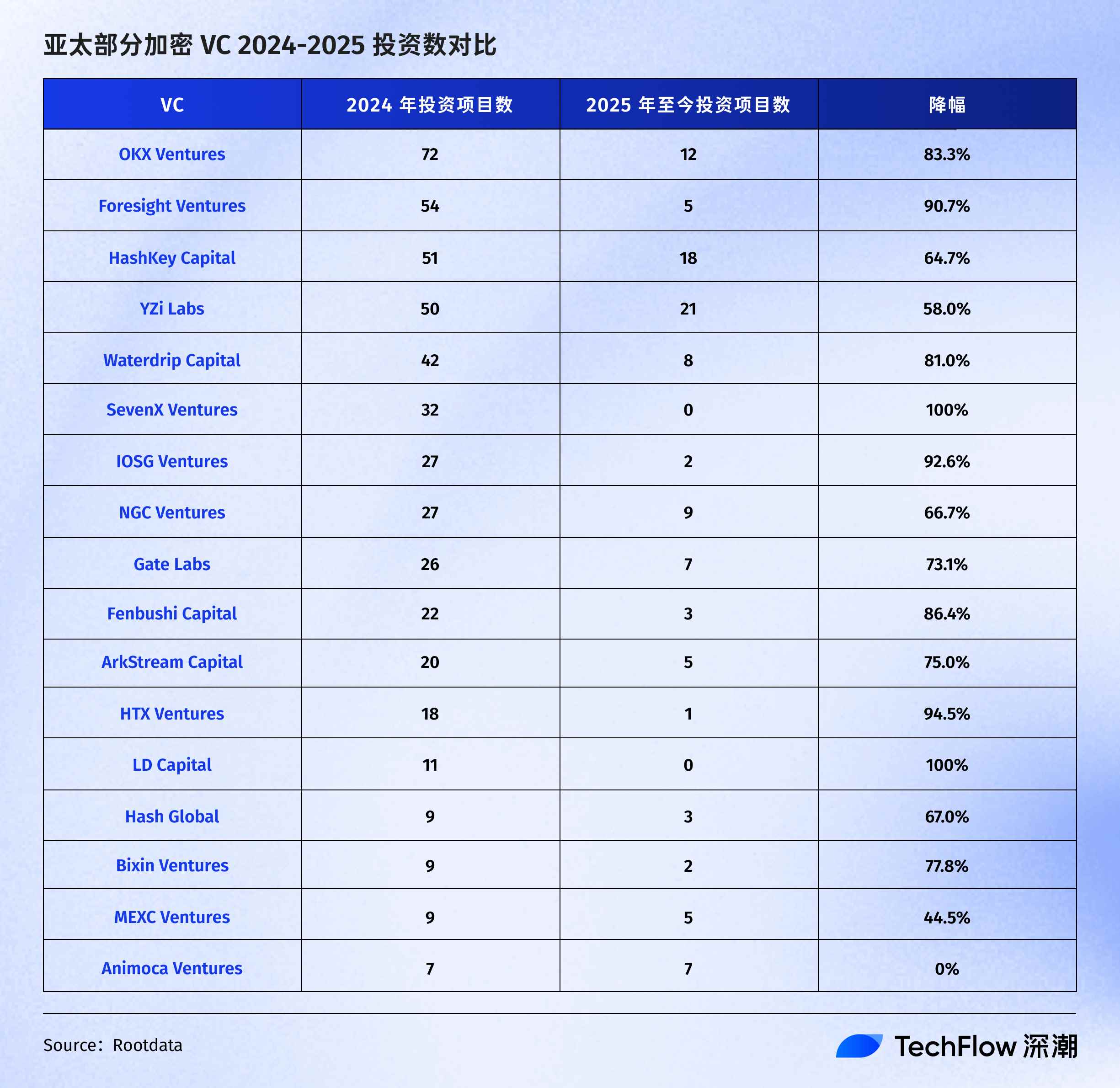
According to Jack, a crypto VC partner, there is now severe fragmentation among crypto VCs. Smaller and mid-sized funds face particular hardship, with many forced to pivot.
Here’s his observation:
Between 2023 and 2025, about 5–7% of crypto VCs shifted into marketing/KOL agency businesses;
About 8–10% transitioned into incubation or post-investment-driven institutions, expanding their post-investment teams by 30–50%;
The majority adopted strategies such as moving into the secondary market, extending fund cycles, reducing management costs, or pursuing compliant exit routes like ETFs, DATs, and PIPEs.
In other words: VCs become service providers—or simply turn into "big retail韭菜".
A former crypto VC investor, Mark, put it bluntly: "Nowadays, purely doing early-stage investing is almost equivalent to suicide."
LD Capital pivoted to the secondary market, with founder Yi Lihua becoming a prominent ETH bull, maintaining visibility.
Additionally, some crypto VCs are being "forced" into AI investments.
As early as March, Jocy, founding partner at IOSG, posted on social media that another one of her portfolio projects had shifted into AI. As more and more crypto investors find their portfolios unexpectedly filled with AI startups, they too are voting with their feet.
For example, Bixin Ventures significantly reduced its investments in the crypto sector and instead backed emerging AI companies like IntelliGen AI, focusing on the AI healthcare space.
Transformation represents a proactive form of self-rescue, while others have simply ceased operations. The prominent crypto VC ABCDE, founded by Du Jun, announced in April 2025 it would stop investing in new projects and raising its second fund, shifting future efforts toward post-investment management and exits for existing holdings.
"ABCDE is relatively honest—they openly said they’re done. But many other crypto VCs are quietly shutting down without announcement," commented one interviewed VC professional.
Alongside the sharp decline in deal activity, the foundational paradigm of the crypto primary market is shifting. As Jack puts it, transitioning from “liquidity-driven narrative speculation” to “cash-flow and compliance-driven infrastructure development.”
In recent years, crypto VC investment logic heavily relied on narratives. However, financing data from 2024–2025 shows a clear shift: according to Pitchbook, global crypto/blockchain VC funding totaled just $1.97 billion in Q2 2025, down 59% quarter-on-quarter—the lowest since 2020. Meanwhile, late-stage financings accounted for over 50%, indicating investors are increasingly focused on mature projects with real revenue and verifiable cash flows.
"Early-stage narrative-driven projects now face greater difficulty raising funds. Projects that generate income and profits—such as exchanges, stablecoin issuers, and RWA protocols—are more likely to attract capital," said Dashan, partner at Shuidi Capital.
Moreover, the “listing effect” of top-tier exchanges has significantly weakened this cycle. Previously, getting listed on a major exchange guaranteed valuation and liquidity. But since 2025, despite increased listings on Binance, the premium effect on secondary market valuations has diminished. According to CoinGecko, new tokens averaged over 42% decline in price within 30 days post-TGE in the first half. Exit paths are also evolving—compliant ETFs, tokenized funds (DAT), protocol buybacks, ecosystem funds, and structured secondary market liquidity engineering are emerging.
"This shift doesn’t mean 'speculation is gone'—rather, the speculative window has shortened, and beta returns are giving way to alpha selection," said Jack.
The VC Dilemma
The current plight of crypto VCs can be summed up in one phrase: not profitable.
Crypto analyst KK candidly stated that the primary issue is crypto VCs’ low positioning within the industry ecosystem. A typical project imposes a 1–3 year lock-up period on VCs. However, given how quickly crypto narratives evolve, by the time tokens unlock, the hype may have already passed, leading to steep price drops—or even near-zero valuations. Some projects don’t even survive long enough to get listed.
Besides, many crypto VCs overpaid for high-valuation projects in the last cycle, only to see those valuations invalidated as actual revenues fail to justify them.
"Back then, many VCs bought into overseas projects at peak valuations—partly because they believed higher valuations meant stability, partly because co-investing with renowned foreign funds boosted their brand image. But now, many of these investments are deeply underwater," said KK.
Most critically, crypto VCs lack pricing power. "Ultimately, all they can offer is money," said Mark.
One interviewee went further: "In this market, a VC's capital is less valuable than a Twitter KOL's endorsement."
What do projects really need?
Not just money—but "liquidity resources."
Market makers provide depth in secondary markets; exchange listings directly determine whether a project can achieve liquidity; KOL promotions help teams sell tokens faster… These liquidity participants often secure the cheapest tokens, then resell them to VCs at multiples. The result? Crypto VCs invest the most but get the worst prices.
Thus, an absurd reality emerges: in the crypto market, VCs—who are kings of capital in traditional primary markets—become the weakest link in the ecosystem chain, inferior to exchanges, market makers, and even KOLs.
Fundraising Crisis
If "not making money" defines the survival crisis for VCs, then "inability to raise funds" is their existential threat.
According to PitchBook, global crypto VC fundraising in Q2 2025 reached only $1.97 billion, down 59% from the previous quarter—starkly contrasting with the over $10 billion raised per quarter during 2021 peaks.
Why are traditional LPs pulling back? Besides poor returns from last cycle’s investments, there’s also “simpler ways to make money in crypto,” said Dashan. "For example, buying blue-chip coins, DeFi yield farming, options arbitrage—average returns exceed 30%. It’s hard to convince LPs to invest in VCs requiring multi-year holds with high risk of loss."
Meanwhile, the source of capital is shifting.
Jack observed that traditional U.S. dollar LPs are retrenching, replaced by Middle Eastern sovereign funds like Mubadala and QIA, and Asian family offices—especially in Singapore and Hong Kong—where many FOs allocate to crypto via multi-strategy funds across secondary and early equity.
But these new LPs are more selective:
They demand real cash flows, no longer paying for PPTs; require compliant custody, audits, and fund licenses to avoid regulatory risks; prefer hybrid funds combining secondary and primary exposure to enable partial early realization…
The harsh truth is, capital is increasingly concentrated among a few top players.
"Unless a fund has strong vertical differentiation or key resources, smaller funds will struggle to attract LPs," said Jack.
And this fundraising difficulty is especially deadly for native crypto VCs. On one hand, they must continuously raise externally; on the other, they lack industrial synergies to add value. In contrast, VCs with exchange or market-making backgrounds—or those using proprietary capital—not only have funding but also strategic resources, enabling them to secure better terms. Native crypto VCs, however, must endure this life-or-death test.
Put more bluntly: in this market, LPs aren’t short of opportunities—they’re short of certainty. And native crypto VCs simply can’t provide it.
Paths to Breakthrough?
Despite the grim state of the primary market, those still in the game believe this is merely a painful transition phase. Only those who survive the shakeout will be positioned to reap rewards.
They remain optimistic about the future.
"Within this transformation lie new opportunities," said Dashan. "Take stablecoins—some predict issuance could surpass $3 trillion. Around this $3 trillion in settlement, clearing, and compliance services, a new set of investment targets will emerge. This is where crypto VCs can still get ahead."
Bigger macro narratives are equally compelling. According to Citi GPS 2024 report, tokenized assets could reach $10–16 trillion by 2030. Whether it’s on-chain settlement platforms or real-world asset (RWA) issuance, these areas offer entry points for VCs.
"In every cycle, new assets create new opportunities—be it trading platforms, financial derivatives, or innovative DeFi projects—all injecting vitality into the market," said Mark.
But if crypto VCs hope to survive this game, they must fundamentally reinvent their role.
They can move beyond pure financial investors to offer market making, compliance support, liquidity provision, or even direct operational involvement—acting more like "investment banks" than traditional VCs.
Alternatively, they can build structured funds using financial engineering tools like DAT, PIPE, SPAC to design diverse exit paths for LPs, transforming "uncertain narratives" into "predictable cash flows."
They must also develop genuine research and data capabilities, focusing on quantifiable metrics like on-chain revenue, user retention, and protocol fees—instead of betting on the next "empty narrative."
These directions may represent the last cards crypto VCs have to play.
Yet history has a strange way: those who ultimately endure are often the ones who survived the harshest conditions. The "weightless era" for crypto VCs might just be incubating the next generation of stars.
After all, only those standing amid the ruins will be ready to greet the next bull market.
Join TechFlow official community to stay tuned
Telegram:https://t.me/TechFlowDaily
X (Twitter):https://x.com/TechFlowPost
X (Twitter) EN:https://x.com/BlockFlow_News
 深潮TechFlow


