Arete Capital: Hyperliquid 2026 Investment Thesis, Building the On-Chain Financial Panorama
TechFlow Selected TechFlow Selected
Arete Capital: Hyperliquid 2026 Investment Thesis, Building the On-Chain Financial Panorama
The grand vision of the entire financial sector converging and developing on Hyperliquid has never been clearer.
 Navigating Web3 tides with focused insights
Author: McKenna
Translation: TechFlow
Introduction
Hyperliquid has swept through the digital asset space in 2024/25, finally achieving the long-awaited transformative shift from centralized traditional institutions to a fully permissionless, transparent, and global perpetual futures market. In a short time, Hyperliquid has become the top revenue-generating entity in the blockchain space, surpassing other general-purpose networks—all driven by a small team of just 11 people. This technological achievement is nothing short of astonishing and demonstrates the brilliance and strength of Hyperliquid’s core team. We believe Hyperliquid represents one of the most significant growth stories in digital assets, even exceeding the massive growth trend seen in stablecoins following regulatory clarity (via the GENIUS Act's oversight of stablecoin issuers).
Despite its remarkable success, we believe it is necessary to step back, re-examine this thesis from first principles, and integrate a concrete valuation framework. As we refine our argument, we will review Hyperliquid’s rise, how it has significantly eroded the perpetual trading market share of centralized competitors, and further outline a grander vision for the coming years—one that encompasses the entire financial system.
Hyperliquid’s Growth Story
Perpetual Trading
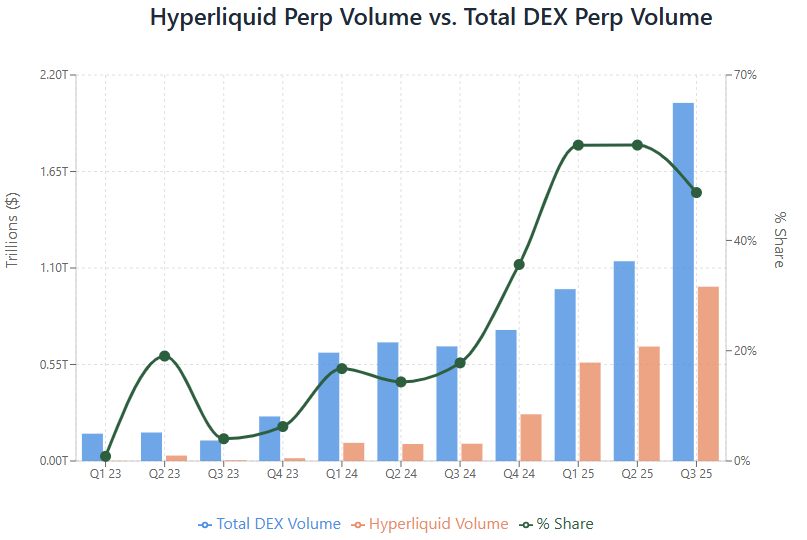
Hyperliquid Volume vs Total DEX Volume
Hyperliquid’s rise is primarily due to its protocol architecture meticulously optimized for perpetual futures trading. HyperCore, the underlying trading and settlement engine of the Hyperliquid protocol, offers an off-chain experience comparable to centralized exchanges (CEXs), with millisecond execution speed and session keys enabling traders to execute orders without transaction confirmations. Below is a brief overview of all relevant perpetual futures trading statistics since the platform’s inception:
In total, since launch, Hyperliquid has processed $2.77 trillion in trading volume, with users executing 165 billion trades.
Quarter-over-quarter, Hyperliquid’s perpetual trading volume grew by 110.72% in Q1 2025, 16.27% in Q2, and 52.25% in Q3.
In August 2025, Hyperliquid set a record high for trading volume, reaching $398 billion in perpetual trading volume.
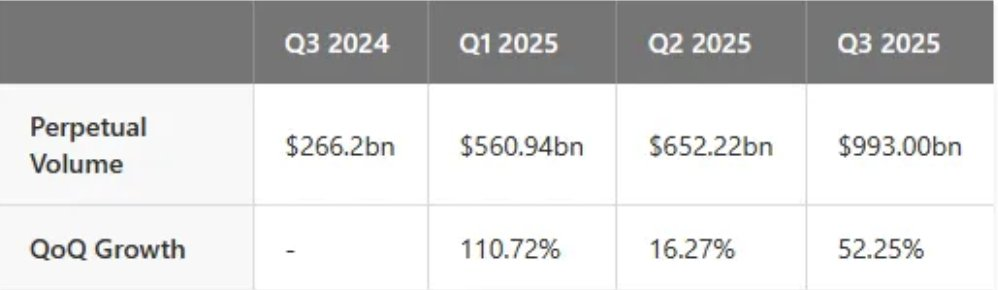
Hyperliquid Perpetual Trading Volume Quarter-over-Quarter
Hyperliquid vs Centralized Exchange (CEX) Competitors
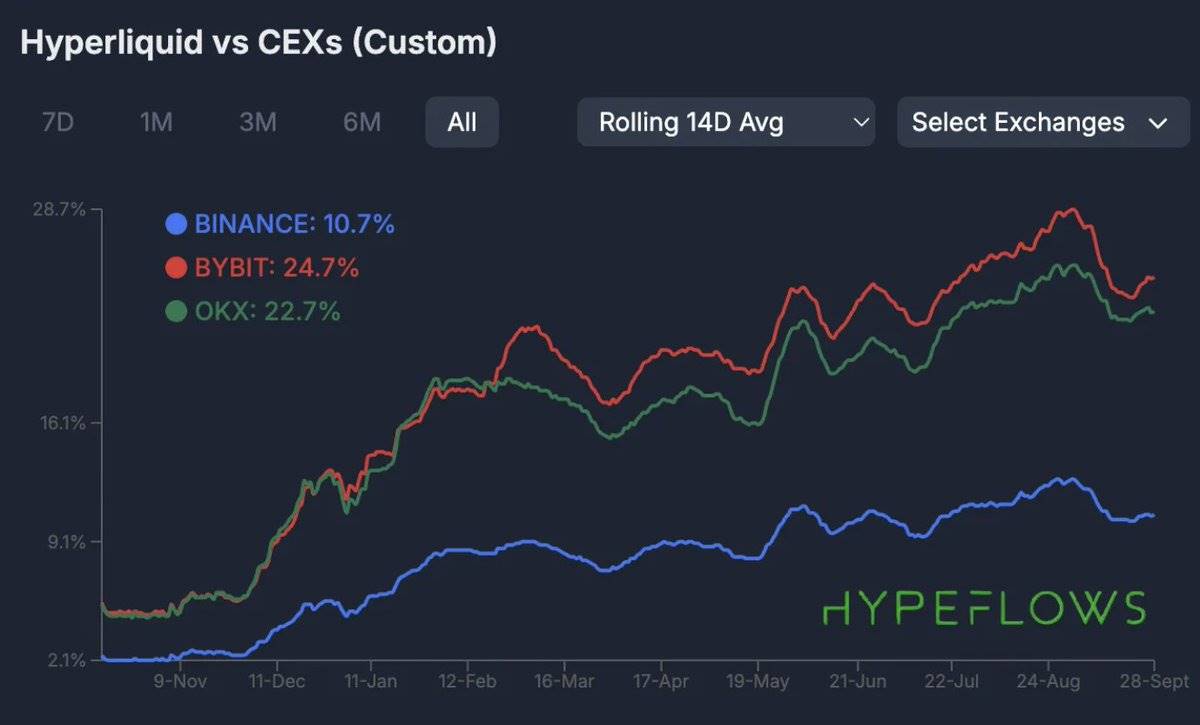
Hyperliquid Volume vs CEX 14-Day Rolling Average (Source: Hypeflows.com)
In terms of perpetual market share compared to centralized exchange competitors, Hyperliquid currently accounts for 10.7% of Binance’s volume, 24.7% of ByBit’s, and 22.7% of OKX’s (based on 14-day rolling averages). Globally, Hyperliquid holds 5.1% of the market share in trading volume.
A key metric for all exchanges is Open Interest—the total number of outstanding contracts currently held. This indicates strong user stickiness and adoption as a primary trading venue, driven by performance, liquidity depth, and other factors. Throughout 2025, Hyperliquid’s open interest grew from $3.19 billion to $15.3 billion—an increase of +479%. Currently, Hyperliquid accounts for 5.3% of open interest across all crypto exchanges.
Fees Structure
Hyperliquid’s fee structure includes a 0.45% taker fee and a 0.015% maker fee, with tiered rates adjusted based on 14-day weighted trading volume thresholds. The taker fee can be reduced to as low as 0.024%, and the maker fee can go down to 0%, incentivizing market makers to provide deep liquidity to HyperCore’s order book.
Additionally, Hyperliquid’s fee structure is linked to holding and staking HYPE, offering 5%-40% fee discounts based on staking tiers, with balances ranging from 10k to 500k HYPE.
On average, Hyperliquid generates 0.0258% of revenue per unit of trading volume, remaining stable.
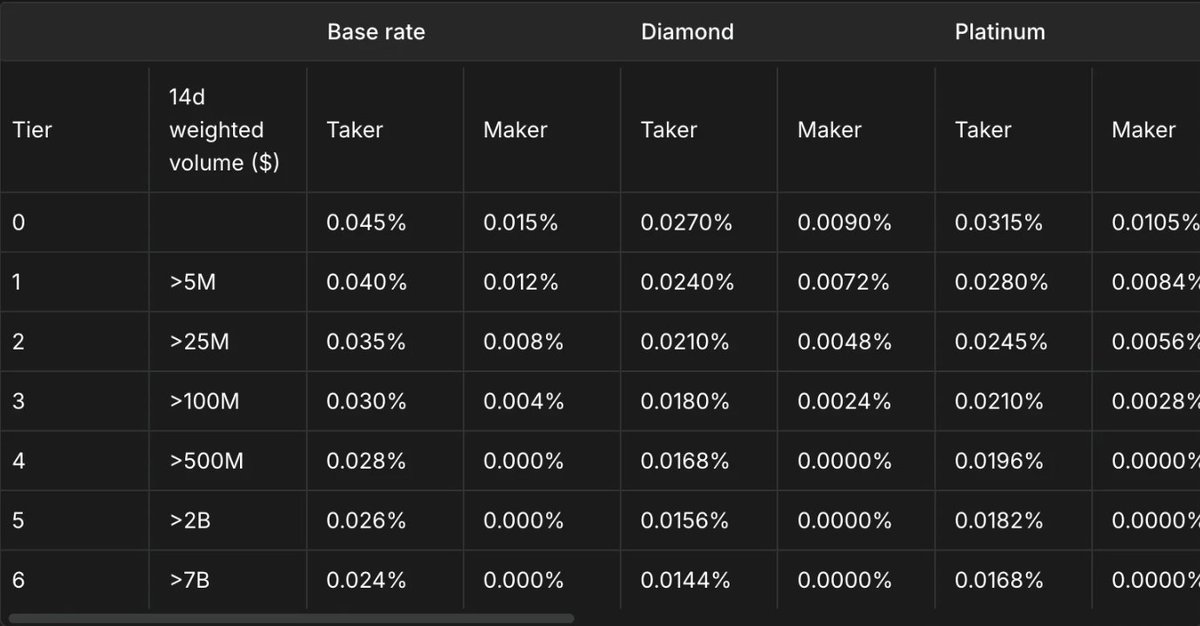
Hyperliquid Taker and Maker Fee Structure
Hyperliquid Assistance Fund (AF)
The Hyperliquid Assistance Fund (AF) is a programmable engine that uses 99% of the protocol’s generated revenue to buy back HYPE tokens on the secondary market. Revenue from taker fees, maker fees, spot trading fees, liquidation fees, and HIP-1 token listing fees is almost entirely redistributed to the AF.
To date, the AF has repurchased 32.2 million HYPE tokens on the secondary market, investing $692 million cumulatively, now valued at $1.48 billion, with a total unrealized PnL of $788 million—marking a +113% return. The AF holds 9.56% of the circulating supply of HYPE.
In 2024, Robinhood reported net revenue of $2.95 billion (per its Q4 disclosure) and repurchased $257 million worth of HOOD stock, representing 8.7% of its annual net revenue. Even taking Apple—the company with the highest buyback ratio among MAG7—as an example, it repurchased $95 billion in stock in 2024, equal to 24.3% of its annual net income.
We cite these figures to make two points: First, Hyperliquid’s value does not diverge; second, even compared to traditional equity markets, its buyback structure is unique within both the digital asset and traditional stock markets.
In a short period, Hyperliquid has become the highest-revenue-generating Layer-1 protocol, fueled by strong demand for a superior decentralized trading product. Below is the sustained growth trend in Hyperliquid’s quarterly and monthly revenue:
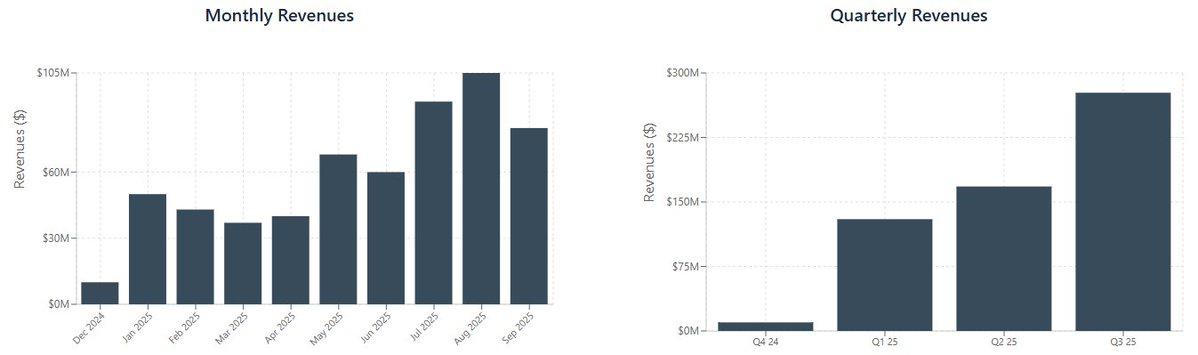
Hyperliquid Monthly and Quarterly Revenue
Not only has Hyperliquid become the highest-revenue protocol in digital assets, but it also uses nearly all of its protocol revenue to accumulate its own token on HyperCore.
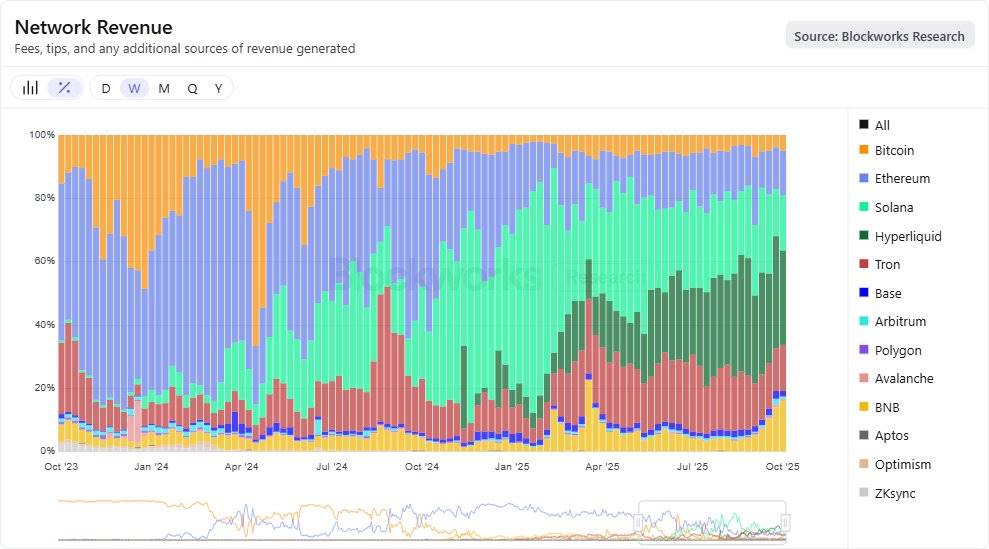
Network Revenue Across Major Public Blockchains (Source: blockworks.com)
HyperUnit Spot Market
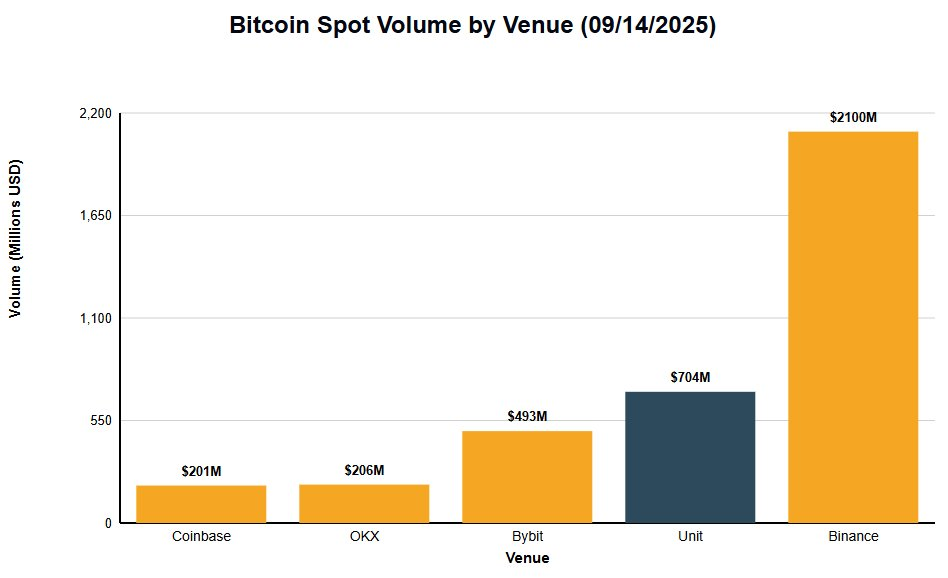
On September 14, 2025, HyperCore ranked second in Bitcoin spot trading volume among major centralized exchanges (CEXs).
HyperUnit is an asset tokenization and cross-chain bridging layer that enables native assets (such as BTC, ETH, and SOL) to trade seamlessly on HyperCore’s order book via spot markets. Assets bridged through HyperUnit are converted into u-assets, which can be traded on HyperCore’s order book or used in emerging HyperEVM ecosystem protocols such as Felix, a money market protocol.
Assets are sent to a HyperUnit address on their native chain, locked, and then minted 1:1 as u-tokens on Hyperliquid. This ensures 1:1 backing of native spot assets on both HyperCore and HyperEVM.
As a case study demonstrating how HyperUnit and HyperCore’s trading engine efficiently support spot assets, between August 20 and 25, 2025, a Bitcoin whale deposited 22,769 BTC (worth $2.59 billion) into Hyperliquid via HyperUnit and converted UBTC into 472,920 UETH (worth $2.22 billion). This was one of the largest public asset conversions to date and enabled seamless, permissionless trading via HyperCore’s spot market.
To date, HyperUnit has processed $718 million in asset deposits, covering BTC, ETH, SOL, and FARTCOIN, providing a fully permissionless, high-performance order book trading experience for spot assets. Since inception, the HyperUnit spot market has executed $40.5 billion in spot volume, including $21.4 billion in Bitcoin spot trading on Hyperliquid.
Moreover, HyperUnit has successfully enabled first-day trading opportunities for several major token generation events (TGEs), recent examples being PUMP and XPL. We expect this trend to continue, with increasing asset deposits and new premium projects launching on TGE days, further boosting spot order book volume.
Builder Codes: Hyperliquid’s Liquidity and Distribution Flywheel
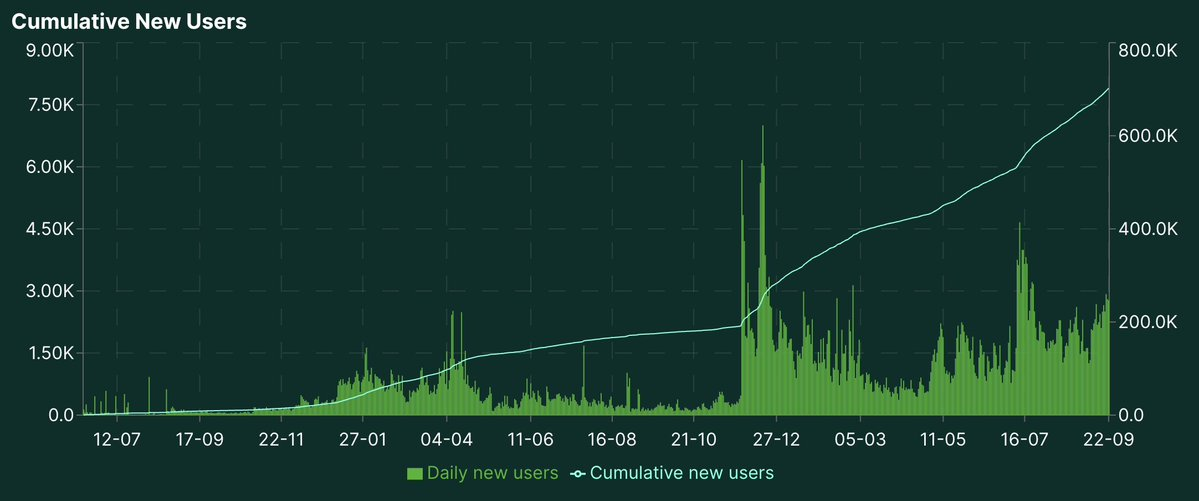
HyperCore Daily and Cumulative New Users
Builder Codes are one of the most critical components of the Hyperliquid protocol, opening distribution channels for new users and allowing third parties direct access to HyperCore’s high-performance trading engine and liquidity. Third-party applications build the front-end and use HyperCore as the backend, offering native perpetual trading services to their user base. To date, Builder Codes have generated over $30 million in revenue and attracted 169,900 new wallets interacting with HyperCore.
Paxos Labs explicitly stated in its recent USDH proposal that Hyperliquid will serve as the default liquidity infrastructure, providing seamless and efficient spot and perpetual trading. Based on Paxos’ USDH proposal, we believe the next phase of growth for Builder Codes will come from direct integrations with fintechs and brokerage platforms. Builder Codes have already achieved notable success with crypto-native wallet providers like Phantom and other crypto-native integrations such as Axiom and BasedApp. Given that fintechs or prime brokers currently do not offer perpetual trading to their users, this presents a convenient path for these platforms to offer perpetual trading to their large, well-capitalized user bases without building backend infrastructure or bootstrapping liquidity.
For companies with crypto-native user bases or larger players such as fintech firms, it is hard to resist such an easy integration of a new revenue stream that benefits both users and platform revenue. For example, Phantom generated $18.8 million in revenue in Q3 alone through this integration. We expect multiple large fintechs and brokerage platforms to directly integrate Builder Codes into their platforms, potentially attracting millions of new users to Hyperliquid and significantly increasing trading volume. Given that Interactive Brokers is exploring stablecoin deposits, we believe its 3.3 million clients could soon access perpetual trading via Hyperliquid’s Builder Codes. Other potential strong integration candidates include Revolut, a fintech with 65 million customers.
Builder Code Growth Analysis for 2026
Assuming a builder fee of 0.05%, Builder Codes brought $20 billion in trading volume to Hyperliquid in September. It has rapidly grown into a significant source of trading volume for the protocol, accounting for 7.1% of total perpetual contract volume in September alone:
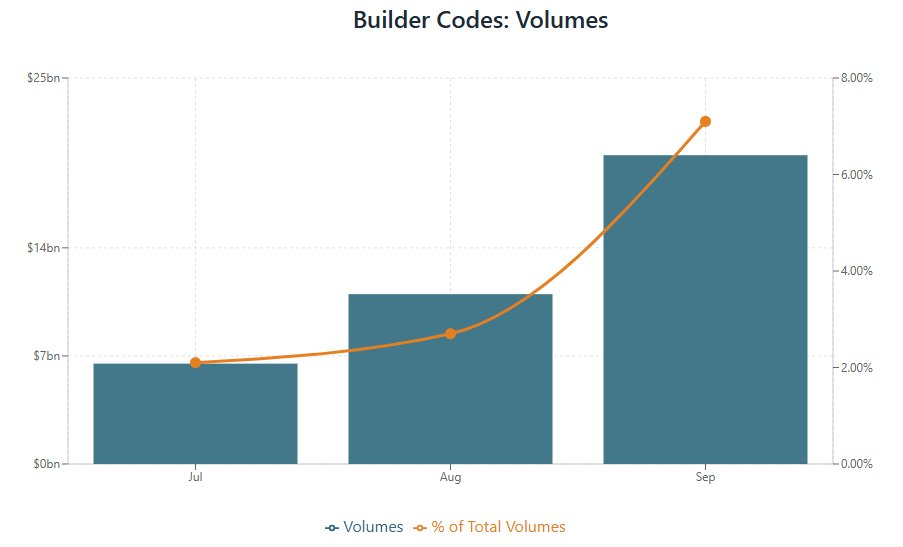
Builder Code Monthly Volume and Percentage of Total Perpetual Volume
We conducted a scenario analysis on the impact of Builder Codes on Hyperliquid’s revenue. Assuming average revenue per unit of volume at 0.026%, and setting a baseline scenario where 10 major Builder Code integrations exist by end of 2026, each averaging $5 billion in monthly volume, we project these integrations will generate $154 million in annualized revenue for Hyperliquid by end of 2026:
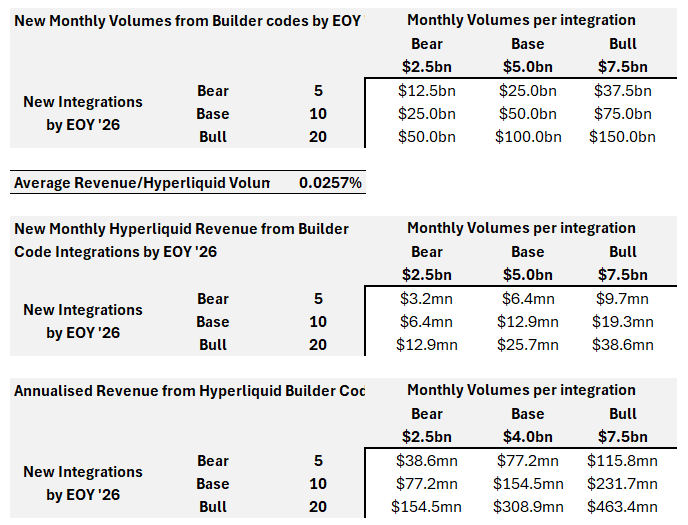
2026 Builder Code Model Analysis
This would represent a 15.6% increase in Hyperliquid’s revenue—excluding any organic growth of Hyperliquid’s perpetual exchange or overall growth of the perpetual market.
Hyperliquid Enters the Stablecoin Boom
USDH: Hyperliquid’s Native Stablecoin
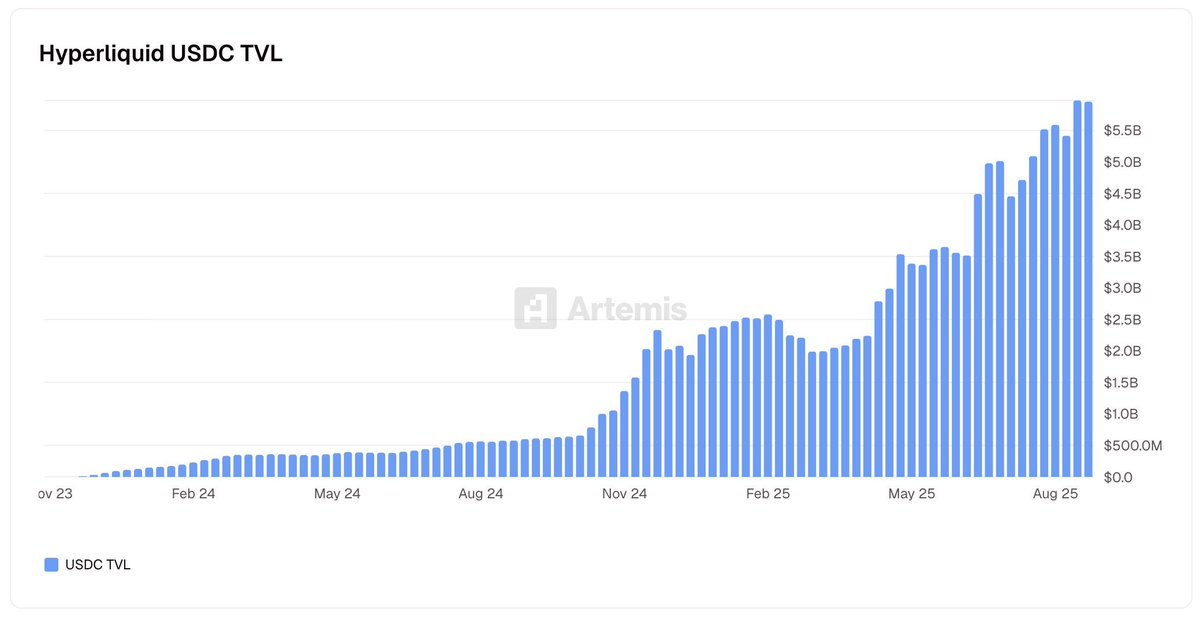
Total USDC Bridged to HyperCore
Hyperliquid recently entered the upcoming stablecoin boom with USDH, its native stablecoin. USDH is a fiat-backed native stablecoin used as a quote and collateral asset on HyperCore.
To date, prominent stablecoin issuers like Circle and Tether have been the primary beneficiaries of treasury yields supporting USDC/USDT. USDH aims to change this status quo by returning 50% of the yield generated by USDH to the Assistance Fund for secondary market purchases of HYPE.
USDH received multiple proposals from well-known institutional players, including Paxos/PayPal, Agora, Ethena, BitGo, and Native Markets. These proposals detailed custodianship, treasury yield distribution, compliance with the newly passed GENIUS Act, and proposed partnerships. Among them, Native Markets’ proposal has been approved through Hyperliquid’s governance mechanism.
Currently, Hyperliquid holds approximately $5.6 billion in Circle USDC on HyperCore, primarily benefiting Circle and Coinbase rather than the Hyperliquid ecosystem. Based on deposited USDC and forward guidance from the Fed’s recent dot plot (projecting a 75 bps rate cut by end of 2025), assuming full conversion to USDH, this would generate $98 million annually in protocol revenue for HYPE buybacks.
Recently, Circle launched native USDC on HyperEVM and CCTP V2, began purchasing HYPE on the secondary market, and is seeking validator status. This move is significant because it reflects full alignment between Circle and Hyperliquid, enabling a complete institutional-grade deposit and withdrawal channel via Circle Mint and kickstarting DeFi protocols on HyperEVM, particularly emerging money market protocols. Plans include seamless deposits and withdrawals between HyperEVM and HyperCore via CCTP V2, spanning 14 other blockchains.
Although some notable proposals did not secure the USDH code, many will proceed independently by deploying stablecoins under different codes. Ultimately, this means Hyperliquid will host multiple fiat-backed stablecoins and multiple ecosystem-aligned stablecoins, all with mature deposit/withdrawal rails and enterprise-grade infrastructure. We expect major payment providers such as PayPal and Venmo to make progress in Hyperliquid’s emerging stablecoin ecosystem by integrating direct deposit/withdrawal channels, potentially opening doors for PayPal’s 400 million users and 35 million merchants.
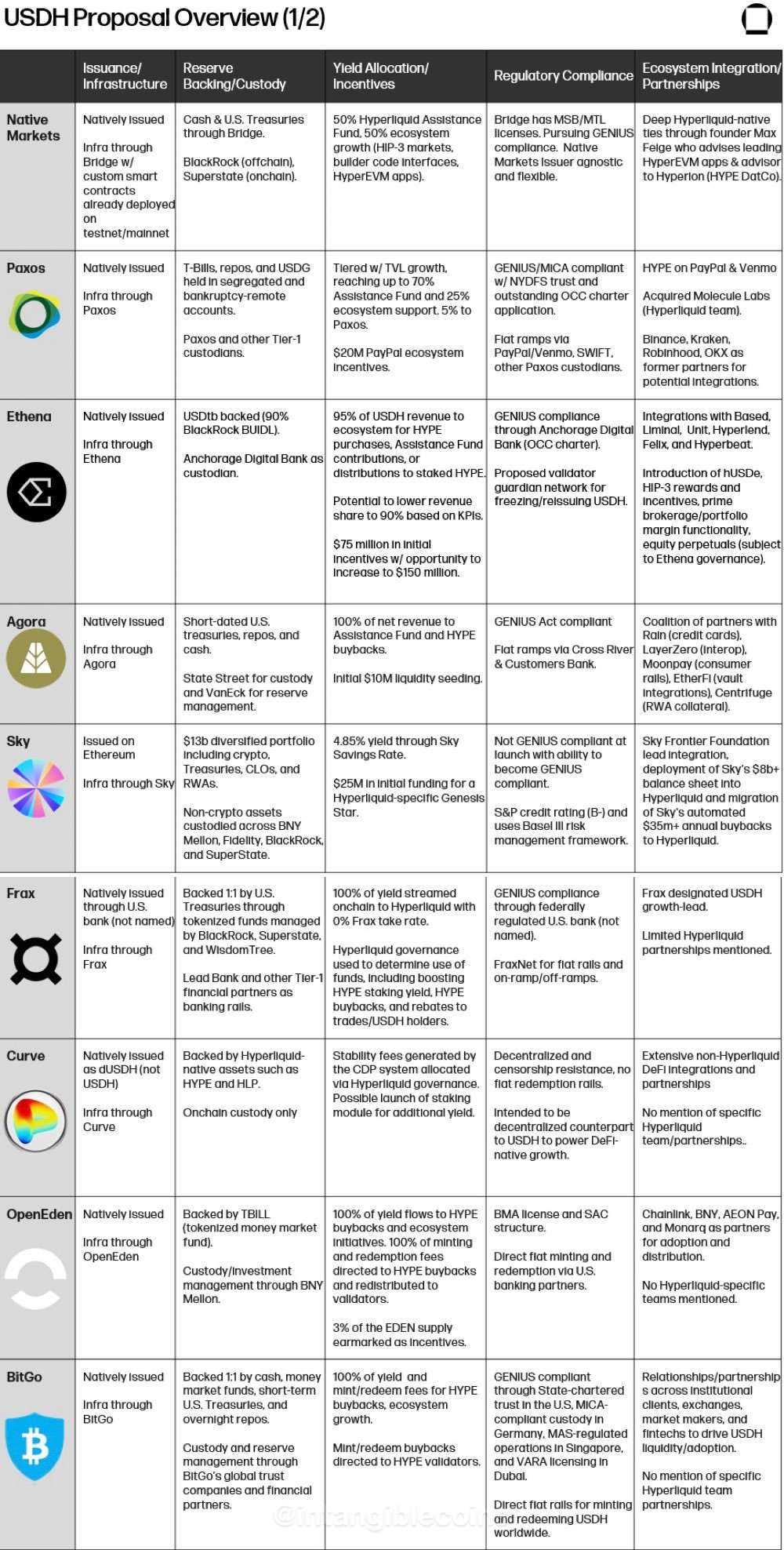
USDH Proposals (Galaxy Research)
Hyperliquid-Aligned Stablecoins
The Hyperliquid Foundation announced a new stablecoin-focused proposal aimed at providing a permissionless primitive for stablecoin issuers.
This primitive offers stablecoin issuers 20% lower trader fees, 50% better market maker fees, and a 20% boost in volume contribution when used as a quote asset in spot pairs or as collateral in HIP-3 deployed markets on HyperCore.
These measures ultimately accelerate Hyperliquid’s liquidity flywheel further, incentivizing liquidity provision and volume growth while encouraging the migration from USDC to USDH, thereby generating additional revenue from aligned stablecoins.
To become a Hyperliquid-aligned stablecoin, issuers must enable permissionless quoting, require deployers to stake 800k HYPE, quote token deployment to stake 200k HYPE, totaling 1M HYPE staked by the issuer to qualify for the above benefits. Additionally, 50% of off-chain yield must be shared with the protocol, directly flowing into the Assistance Fund for HYPE secondary market buybacks.
The aligned stablecoin proposal aims to position Hyperliquid as the settlement layer for next-generation payments and personal financial technology. Encompassing all finance means fully entering the upcoming stablecoin race. As cited in Hyperliquid’s announcement, “the blockchain that carries the future of finance should also be the premier stablecoin chain.”
Similar to Builder Codes, we conducted a scenario analysis to project the state of Hyperliquid’s stablecoin market by end of 2026. Stablecoin deposits on Hyperliquid chains have expanded significantly—from $2 billion at the start of the year to $5.9 billion by the end of Q3, achieving a 314% annualized growth rate, compared to 64% for the overall stablecoin market.
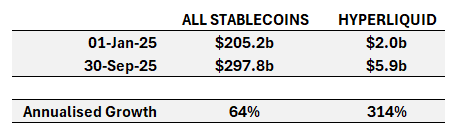
Hyperliquid USDC Growth Rate in 2025 (January to September)
Hyperliquid achieved remarkable USDC growth during 2025, with standout growth from January to September. However, given the scale Hyperliquid has reached this year, growth in 2026 is expected to slow. As a base case, we assume a 150% growth rate in USDC by end of 2026 (EOY '26).
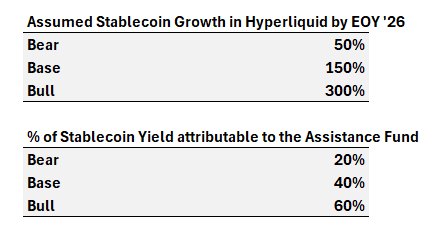
Hyperliquid USDC Growth Rate to End of 2026
Critically, we expect the dominance of USDC to significantly migrate toward Hyperliquid-aligned stablecoins as the above USDH proposals are implemented. Assuming Treasury yields drop to 3% based on latest FedWatch probabilities, and 50% of yield from stablecoin backing flows to the Assistance Fund per USDH proposal, we project the protocol will generate an additional $110 million in annual revenue by end of 2026:
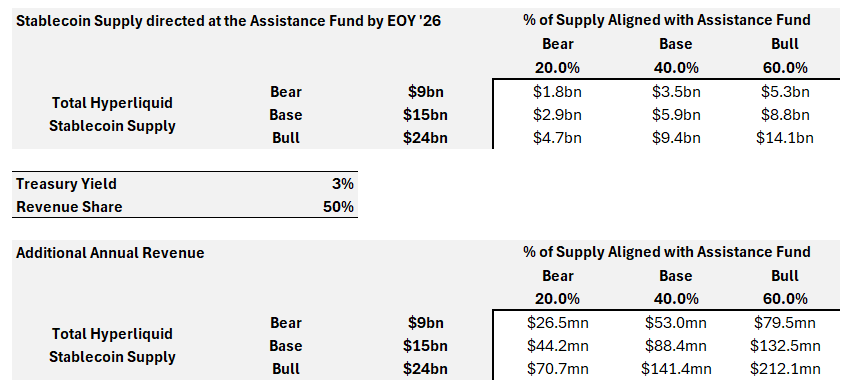
2026 Aligned Stablecoin Model Analysis
HIP-3: Builder-Deployed Perpetual Markets
HIP-3 is a new Hyperliquid Improvement Proposal designed to transform the exchange’s perpetual listing process into an on-chain primitive, eliminating the need for validator approval. This change allows anyone to create their own native perpetual market on HyperCore without permission.
With HIP-3, each market has its own order book, and new market deployments on HyperCore occur via a Dutch auction process running every 31 hours, projecting ~282 new markets annually. Each entity must stake 500k HYPE to deploy an order book on HyperCore via Dutch auction.
HIP-3 offers maximum flexibility to deployers, enabling full customization including Oracle integration, designated collateral assets, fee parameter settings, and the ability to add additional deployer fees on top of base fees.
HIP-3 opens HyperCore to traditional markets such as indices, equities, FX, commodities, bonds, and non-traditional markets such as political prediction markets and pre-IPO markets.
We are moving toward a digital era where people prefer holding digital dollars. There is significant friction between deposit/withdrawal rails and transferring funds to brokerage accounts. Moreover, traders are accustomed to trading perpetuals, as they are the easiest derivative contract for end-users to understand and express market views. Hyperliquid aims to carry all finance, and this statement should be taken literally: any market with available Oracles will be tradable on HyperCore.
Since HIP-3 has not yet launched, it is difficult to quantify the potential trading volume these markets may achieve. We have already seen several strong teams announce plans to launch perpetual markets via HIP-3, including:
-
Kinetiq’s Launch: Kinetiq, the leading liquid staking protocol on Hyperliquid, announced in July “Launch,” a HIP-3-based “exchange-as-a-service” infrastructure product designed to help teams deploy new perpetual markets.
-
Ventuals: On October 6, Ventuals announced they will launch a perpetual exchange for pre-IPO companies with 10x leverage via HIP-3.
-
HyperUnit’s trade.xyz: As previously noted, HyperUnit is a key component of the Hyperliquid ecosystem, facilitating spot trading activity on HyperEVM. They shared news about trade.xyz, presumably their HIP-3-powered perpetual decentralized exchange.
These teams will immediately create new perpetual market activity, contributing to Hyperliquid’s economy. Fees on HIP-3 markets can be up to double—Hyperliquid charges the same fee on HIP-3 volume, while deployers can earn up to 50% of fees. Thus, HIP-3 serves as a scaling mechanism for Hyperliquid without compromising unit economics.
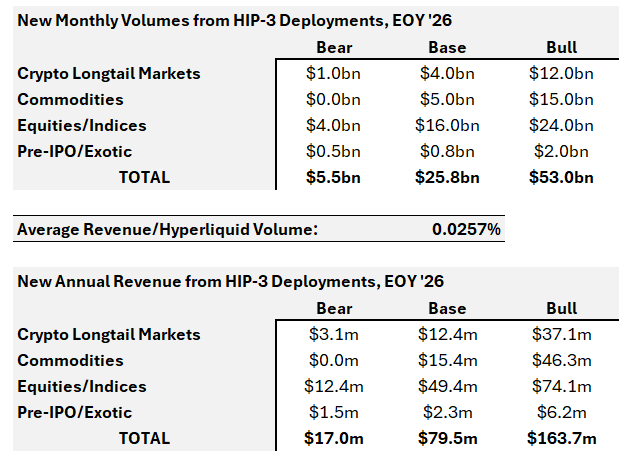
Given that HIP-3 enables the creation of new perpetual markets, we believe its impact could be greater than Builder Codes, which merely offer further access to HyperCore’s current perpetual markets. HIP-3 perpetual instances will support crypto assets, but more importantly, they may expand into commodities, equities & indices, and pre-IPO/non-traditional markets. As a baseline scenario, we believe 15 strong HIP-3 perpetual integrations will be live by end of 2026, collectively bringing over $40 billion in monthly trading volume to the protocol:
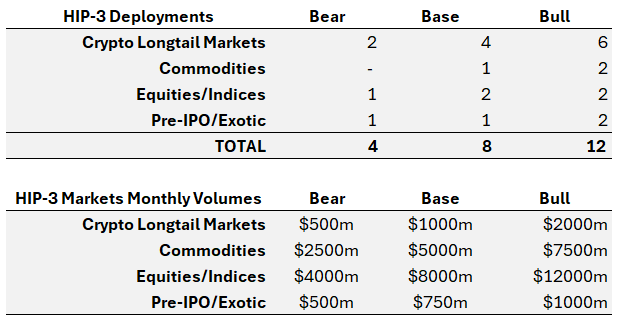
Assuming a fee rate of 0.0225%, this would generate an additional $120 million in annualized revenue under the baseline scenario:
HIP-4: Event Markets and Parlays
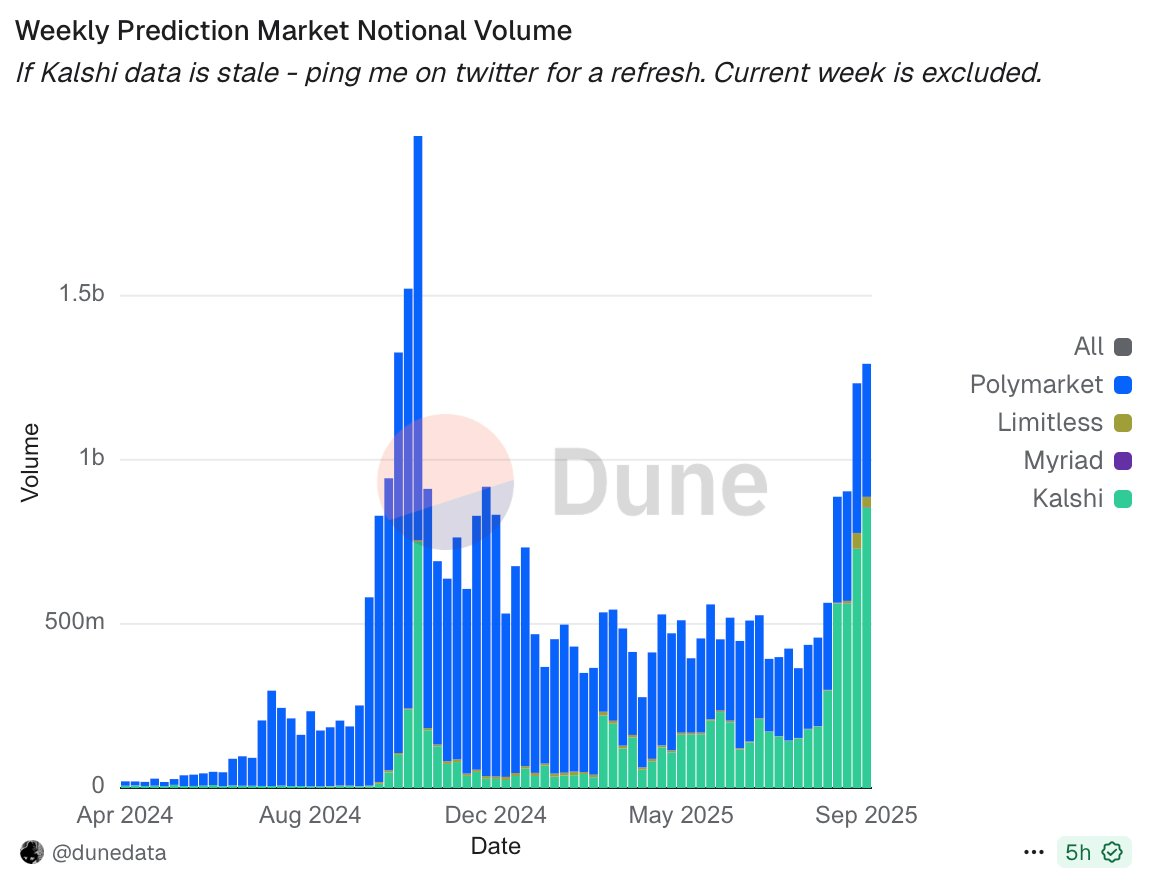
Weekly Prediction Market Volume (Polymarket and Kalshi)
HIP-4 is a brand-new Hyperliquid protocol improvement proposal aimed at introducing binary markets similar to prediction markets like Kalshi and Polymarket, both of which have seen significant adoption primarily driven by political predictions.
Prediction markets like Kalshi and Polymarket have drawn substantial attention, with notional trading volume exceeding $11 billion weekly and cumulative volumes reaching $8.2 billion and $27.9 billion respectively.
While HIP-3 introduces builder-deployed perpetual order books, it does not support current forms of prediction markets because mark prices can only change by <1% per update, making binary payout structures unfeasible.
In response to queries from the Hyperliquid team, Jeff commented on event perpetuals, suggesting they are better viewed as permissionless spot deployments with full collateralization, no liquidations, and no ongoing funding fees.
HIP-4 also opens the possibility for parlays—multiple independent single bets, commonly used in sports betting, offering convexity without leverage.
In summary, HIP-4 aims to redefine how markets are deployed on Hyperliquid and pave the way for Hyperliquid to enter the emerging prediction market trend, potentially competing with rivals like Polymarket and Kalshi.
Hyperliquid Digital Asset Treasuries
Like many other prominent protocols, Hyperliquid is well-positioned to capture the emerging wave of digital asset treasuries, which aim to acquire underlying assets for balance sheet holdings. Through Nasdaq-listed shares, accredited investors will gain exposure to HYPE without needing to self-custody assets. As we know, HYPE has poor distribution on centralized exchanges (CEXs), currently limiting accessibility, especially for U.S. users. Digital Asset Treasuries (DATs) such as Hyperliquid Strategies Inc. plan to solve this accessibility issue by end of 2025.
Hyperliquid Strategies Inc (Nasdaq: PURR)
Hyperliquid Strategies Inc is a newly formed treasury company focused primarily on acquiring HYPE, resulting from a business combination between Sonnet BioTherapeutics and Rorscach I LLC. The new ticker symbol HSI will be listed on Nasdaq.
HSI is led by Bob Diamond, founding partner of Atlas Merchant Capital, former CEO of Barclays, and former senior executive at Credit Suisse and Morgan Stanley. Also joining is David Schamis, Chief Investment Officer of Atlas Merchant Capital, formerly Managing Director at J.C. Flowers.
Upon closing, Hyperliquid Strategies Inc is expected to hold approximately 12.6 million HYPE tokens (worth $578 million) and at least $305 million in cash investments. HSI is expected to complete the transaction in Q4 2025.
Participants include renowned institutions such as Paradigm, Galaxy Digital, Pantera, and D1 Capital.
HSI filed an S-4 with the U.S. Securities and Exchange Commission (SEC) on September 4, 2025, meaning the merger is being formalized for shareholders.
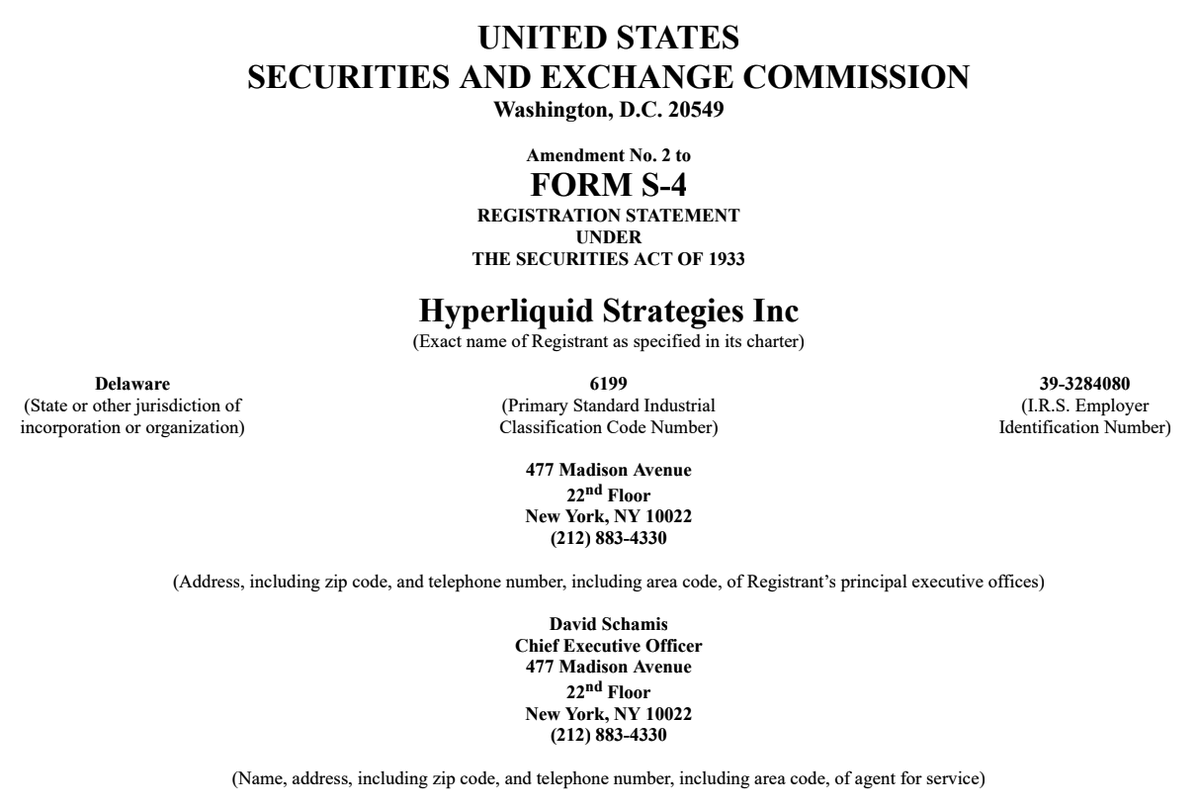
Hyperliquid Strategies Inc S-4 Filing
Hyperion DeFi (Nasdaq: HYPD)
Hyperion DeFi is a rebranded entity of Eyenovia Inc, with a core focus on acquiring, staking, and generating yield from HYPE via HyperEVM.
According to a press release on September 25, Hyperion DeFi holds 1.71 million HYPE, with an average purchase price of $38.25.
Sonnet and Hyperion DeFi together now hold 18.43 million HYPE, worth $834 million, permanently removed from circulating supply.
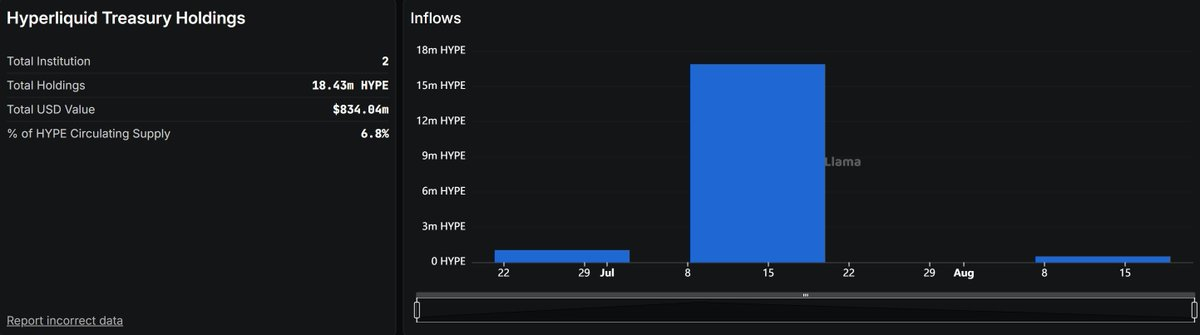
HYPE Holdings of Hyperliquid Strategies Inc and Hyperion DeFi
Core Contributors Unlock Schedule
Accounts belonging to Hyperliquid core contributors hold 238 million HYPE tokens, representing 23.8% of total supply. These tokens will begin unlocking monthly starting after November 29, 2025.
We believe it is unreasonable to assume that 23.8% of the token supply will be fully allocated to just 11 team members. Tokens allocated to core contributors post-genesis will be locked for one year and vest between 2027 and 2028. In some cases, vesting may extend beyond 2028. We believe this suggests that post-2028 supply may be allocated to future core contributors and could represent 3%-6% of the core contributor allocation.
Core contributors have the right to sell tokens. However, it is equally unreasonable to assume they would directly dump the spot order book from an execution standpoint. In practice, there are many ways to transfer core contributor supply to large entities seeking additional HYPE exposure—these would involve simple ownership transfers without directly impacting the spot order book.
We are not saying core contributors won’t sell directly on the spot order book, but we emphasize there are many other methods for supply transfer that do not result in immediate selling pressure. We note that some infer selling pressure from monthly unlocks, but we believe this concern is overstated. The Hyperliquid team has demonstrated complete alignment from day one and has not deviated in any way since.
Robinhood founder Vlad Tenev sold 3.8 million shares of Robinhood Class A stock and still holds 50.2 million unconverted Class B shares, while Robinhood’s market cap stands at $111.2 billion. We draw this analogy because we believe Hyperliquid’s future growth potential is comparable to that of Robinhood.
Given Hyperliquid’s ambitious long-term vision and the substantial work still ahead, we expect Jeff and other core contributors to maintain the same team alignment. Any HYPE unlocks and sales will be signaled clearly and, if sold directly on the spot order book, will be executed in tranches.
Valuation Framework
In this report, we include multiple scenario analyses to estimate the revenue potential of Hyperliquid’s three main growth drivers:
-
Continued expansion of Builder Codes.
-
Launch of Hyperliquid-aligned stablecoins, with partial revenue directed to the Assistance Fund.
-
Launch of HIP-3 markets, projected to achieve over $40 billion in monthly volume by end of 2026.
Beyond these, we believe Hyperliquid’s core perpetual exchange will continue organic growth. Decentralized perpetual exchanges are clearly gaining significant market share from centralized exchanges (CEXs)—a clear trend: in the first three quarters of 2025, decentralized perpetual exchanges saw 125% year-over-year volume growth.
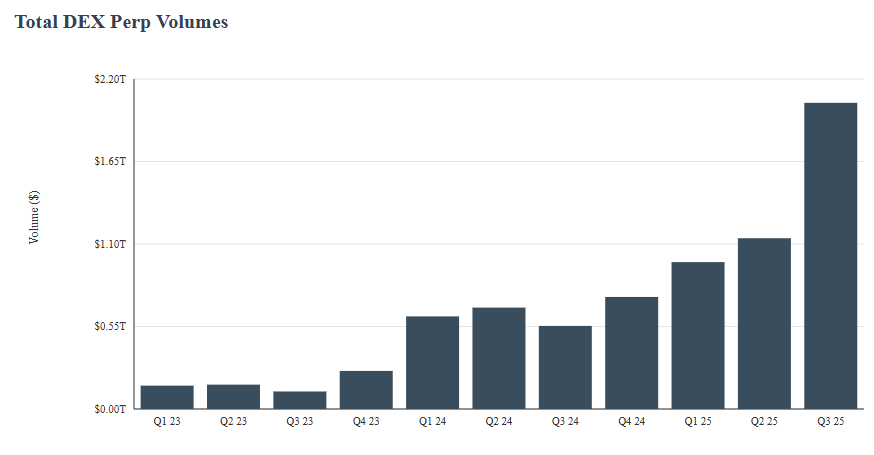
We expect this trend to continue, and despite numerous competitors emerging in recent weeks, we believe Hyperliquid will maintain 40% market share in perpetual activity. Below is a scenario analysis of total decentralized perpetual exchange volume growth by end of 2026, along with our expectations for Hyperliquid’s market share. These projections are based on organic platform growth, excluding volume from HIP-3 and Builder Codes:
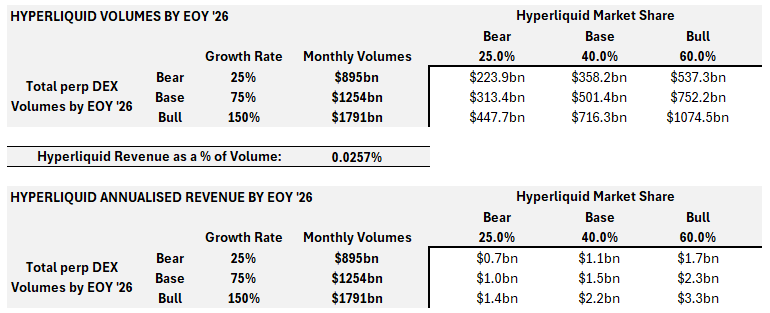
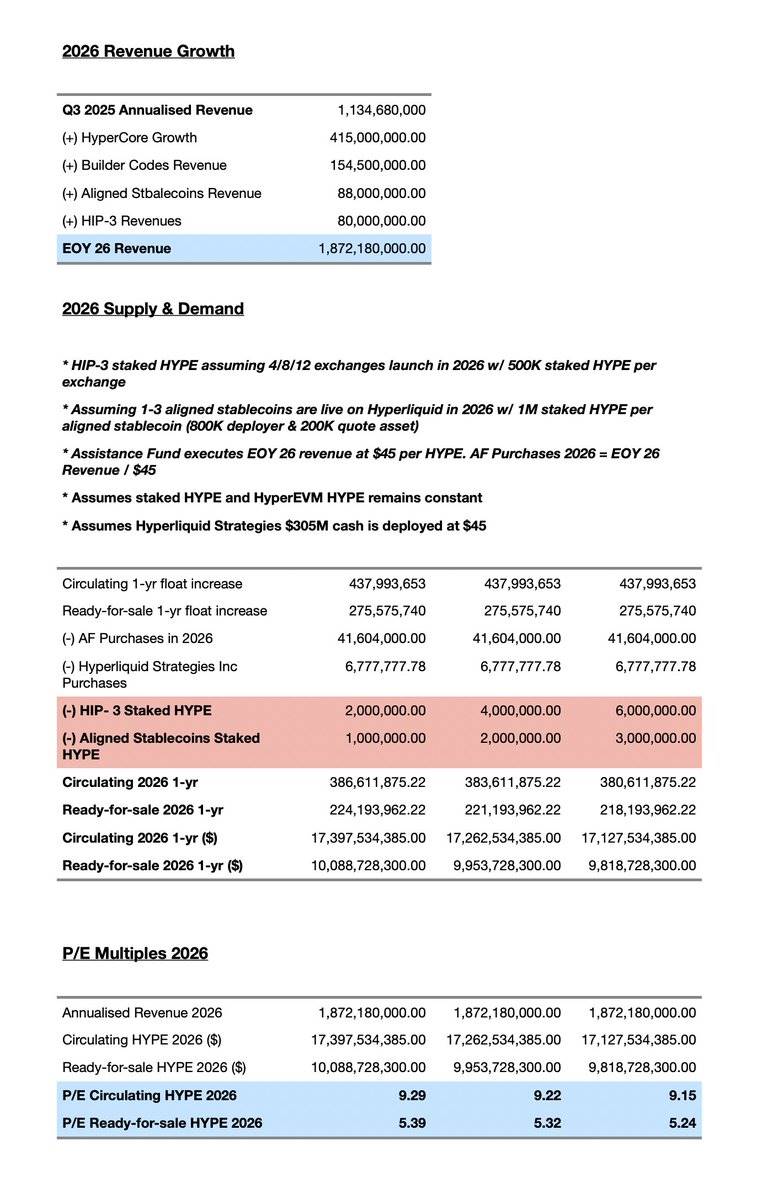
We believe the base case is that Hyperliquid will reach $1.9 billion in annualized revenue by end of 2026, representing a 70% increase from Q3 2025 annualized revenue.
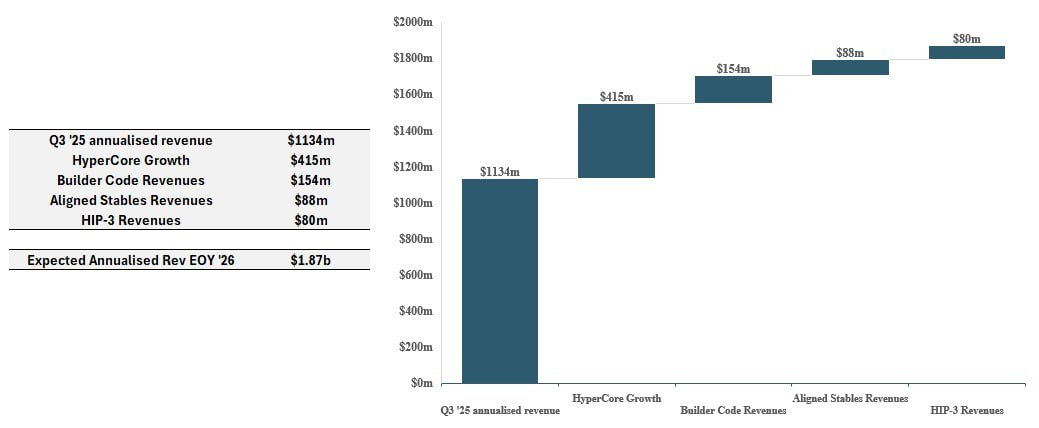
Hyperliquid Q3 2025 Annualized Revenue and One-Year Core Contributor Float Growth Analysis
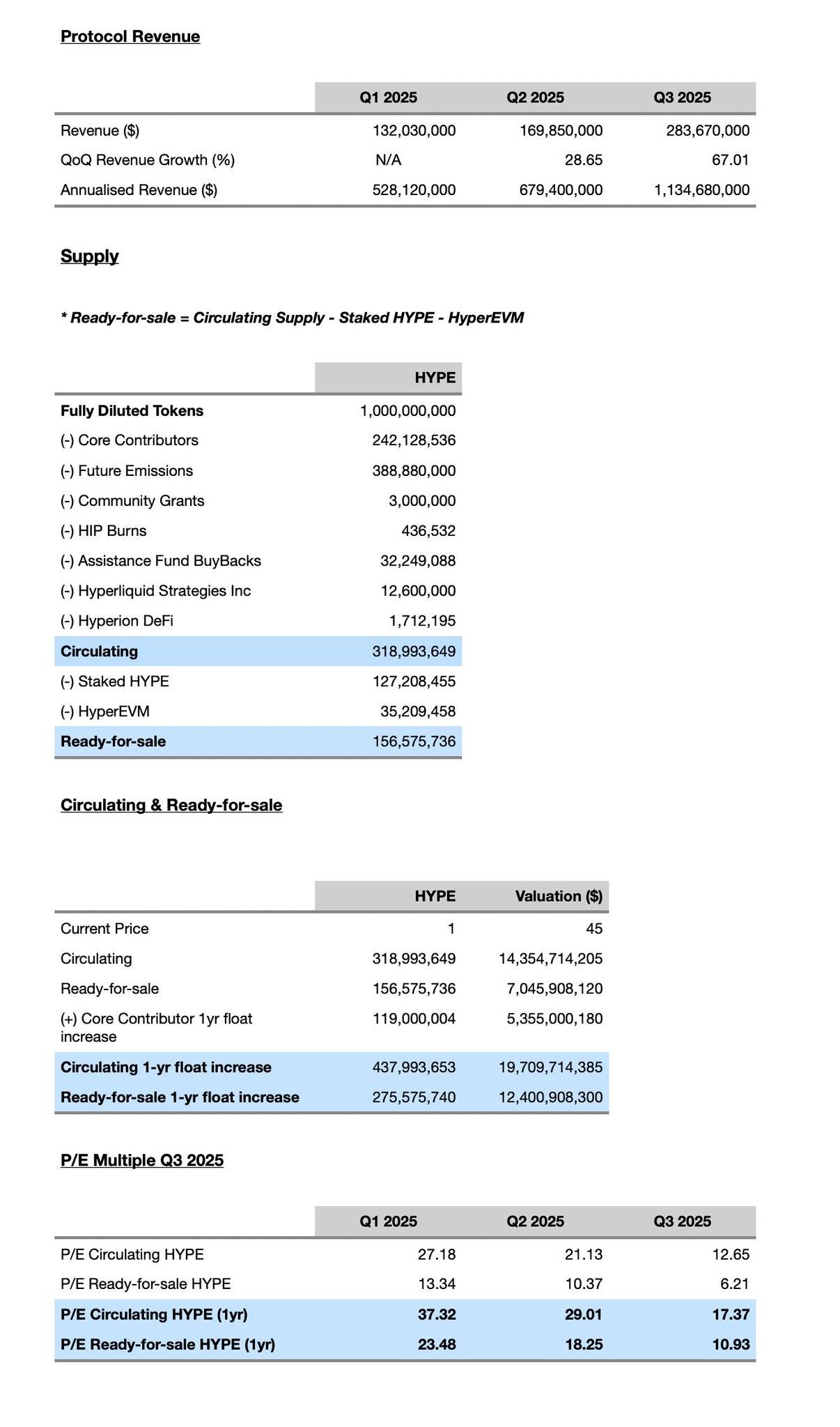
Hyperliquid 2026 Revenue Forecast and One-Year Core Contributor Float Growth Analysis
2026 Outlook
-
Hyperliquid will continue to take market share from centralized exchanges (CEXs) in perpetual trading, driven by its liquidity flywheel and accelerated by traffic enhancements from Builder Codes. We project that by end of 2026, Hyperliquid will capture 15%-25% of Binance’s perpetual market share and 7.5%-15% of the global perpetual trading market.
-
Prominent fintechs and brokers will begin offering perpetual trading to users through direct integration of Builder Codes. These integrations will significantly boost protocol revenue.
-
Hyperliquid will launch multiple fiat-backed stablecoins, driving 50% of treasury yield back to the Assistance Fund. Additionally, we expect many participants from the USDH proposal to move forward with plans to launch fiat-backed stablecoins on Hyperliquid. By end of 2026, we expect USDH issuance to exceed $5 billion, and total issuance of other Hyperliquid-aligned stablecoins to exceed $2 billion.
-
HIP-3 will support multiple active perpetual markets, focusing on indices, equities, FX, and commodities. Most deployed HIP-3 markets will use USDH as the quote asset, further solidifying USDH’s position and accelerating the migration from USDC to USDH on HyperCore.
-
Hyperliquid will expand into real-world assets (RWA), enabling 1:1 backed tokenized stocks to trade on spot order books. This will go beyond accessing traditional markets via HIP-3 perpetuals, becoming the deepest on-chain liquidity platform for traditional market access.
-
DATs centered on Hyperliquid will perform exceptionally well and naturally drive HYPE value appreciation. We also expect numerous additional DATs to be announced and launched in 2026, employing differentiated strategies, particularly focused on HIP-3 and HyperEVM.
-
Multiple Hyperliquid spot ETF filings may emerge in 2026 to improve accessibility for qualified investors. Given Hyperliquid is the highest-revenue protocol in digital assets, we expect significant institutional interest. At that point, Hyperliquid’s annual revenue could exceed $2 billion.
Conclusion
We believe that as institutions gradually accept digital assets as an asset class, public markets are entering a golden age for growth investing. Previous market cycles left deep psychological imprints on participants, but we are approaching a turning point where multiple key businesses are scaling massively, generating meaningful cash flow, attracting top talent, and expanding consumer-facing product offerings. Within this context, investing in elite teams with exceptional execution capability and riding their growth story over the coming years is our core philosophy.
Arete Capital’s approach to liquidity investing is not active public market trading, but rather identifying a select few extraordinary investment opportunities with deep value and realizing returns through a long-term horizon. Hyperliquid remains our core liquidity investment choice, perfectly embodying our growth investment methodology outlined above. With the arrival of HIP-3, bringing traditional markets on-chain via perpetuals, and its role in the stablecoin growth narrative (e.g., USDH), we can clearly see key parts of the financial system being brought into HyperCore and HyperEVM. The grand vision of unifying the entire financial landscape on Hyperliquid has never been clearer.
Join TechFlow official community to stay tuned
Telegram:https://t.me/TechFlowDaily
X (Twitter):https://x.com/TechFlowPost
X (Twitter) EN:https://x.com/BlockFlow_News
 @Arete_xyz