








On-chain payments are the future trend—Star shares OKX Pay vision in first comprehensive look
TechFlow Selected TechFlow Selected
On-chain payments are the future trend—Star shares OKX Pay vision in first comprehensive look
OKX announced the launch of its self-custodial crypto payment product, OKX Pay, on the eve of Token2049. Initially rolling out in Singapore, the service enables users to enjoy features such as stablecoin payments, 4% annualized yield, and cashback rewards. The initiative aims to build a global, low-cost, and efficient on-chain payment infrastructure, integrating crypto payments seamlessly into everyday life.
 Navigating Web3 tides with focused insights
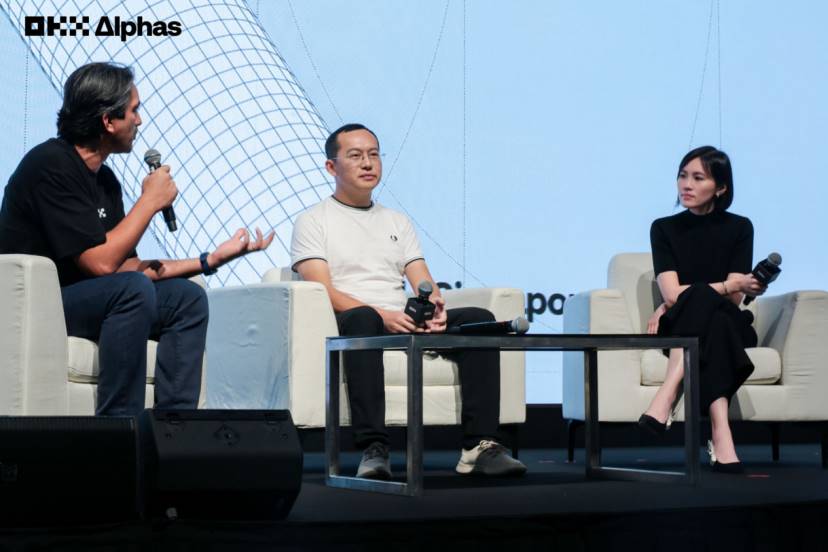
On the eve of Token2049 on September 30, OKX's Alphas Summit "The New Money Era" became one of the industry's most talked-about events. OKX founder and CEO Star Xu, OKX CMO Haider Rafique, and OKX SG CEO Gracie Lin took the stage together to discuss the future of on-chain payments. This marked the first time Star publicly focused on the payment topic that users care about most, sharing deep insights into "OKX Pay".
Below is the roundtable discussion (edited):
Vision for the Future of Crypto Payments
Haider Rafique: I'd like to kick off today's roundtable with a concept that's been on my mind. Let's temporarily set aside trading, exchanges, and markets. Consider this: the entire industry now handles trillions of dollars in transaction volume daily—moving billions in liquidity within just an hour or even less. That's an astonishing scale. But here's the irony—most of you still can't directly use cryptocurrency to buy a hamburger. Yes, something as simple as everyday spending.
I have multiple credit cards in my pocket and my phone is filled with various fintech apps. Yet despite being in the crypto space for so many years, the reality is I don't use crypto apps to buy pizza, Blue Bottle coffee, book a Grab ride, or make routine daily payments. Why is that? Partly because our existing fintech solutions—including credit and debit cards—are already "good enough." Of course, we all know there are gaps in the market, and these are precisely where crypto payments can step in. But the truth remains: even though most of you likely have crypto apps on your phones, very few actually use them for daily transactions.
So given this context, I'd like to ask Star a question: As an industry pioneer who has witnessed the evolution of crypto payments and seen many companies try to compete with traditional fintech players, could you summarize your vision for the future of crypto payments? How do you see it truly becoming part of our daily lives?
Star Xu: I believe one of the biggest achievements of the crypto industry over the past 12 to 13 years was first Bitcoin. We successfully made Bitcoin a global asset—its market cap now exceeds not only Bitcoin ETFs but even gold ETFs. The second major achievement is stablecoins. Today, we see over $300 billion worth of stablecoins circulating on-chain. I believe within the next one to two years, that figure will reach $1 to $2 trillion.
Prior to the internet, human societies relied on peer-to-peer payment methods for thousands of years. For example, you held gold, silver, or currency in hand, kept money at home, and paid merchants directly—giving you full control over your funds. But in the digital age, most of our money is held by financial institutions. If those institutions face risks, we can only recover a portion through insurance. That’s far from ideal. I believe blockchain and stablecoins offer us a new opportunity—to return to that original peer-to-peer model of payments.
At the same time, this method is both cheaper and more efficient. For instance, using a credit card domestically usually incurs very low fees. But cross-border payments can cost 1%, 2%, or even 3%. Stablecoins, by nature, are global, and peer-to-peer transfers don’t compromise security or compliance. I believe they will inevitably become the infrastructure of future payments.
Technology is also advancing rapidly. For example, multi-signature setups can make your crypto wallet as secure as a bank account. And numerous on-chain monitoring tools allow crypto firms to conduct anti-money laundering operations faster and more efficiently than traditional banks. Therefore, I believe stablecoin payments will quickly integrate into our daily lives in the coming years.
Applications of OKX Pay in Daily Life
Haider Rafique: Let me ask you this: I arrived in Singapore three days ago. When I landed, I booked a Grab ride to the office. But here’s what puzzled me—why couldn’t I pay for that Grab ride with my crypto stablecoins?
Gracie Lin: We’re actively working on that. Unfortunately, you still can’t pay for Grab rides with stablecoins yet. But we can already do many other things—and I’m thrilled because today we’ve just announced OKX Pay in Singapore. This project has been months in the making, and we’ve worked closely with our friends at Grab, so I’m glad you brought up Grab. We want to bring OKX Pay to Singaporean users and visitors alike. So next time you're in Singapore, you’ll be able to use stablecoins in the OKX App to buy a hamburger or coffee, experiencing true peer-to-peer payments. What I love most is that this product combines all the advantages—stablecoins, self-custody, multi-sig, compliance—while seamlessly integrating into everyday life, making payments simple and natural.
Next time, I’ll buy you a cup of Blue Bottle coffee using my OKX Pay app. It’s entirely powered by stablecoins—a stablecoin-backed payment system. We’re incredibly excited. The future is already here—the New Money Era has arrived, and so has our New Money app.
Haider Rafique: Thank you, Gracie. Now tell me, I have the OKX Pay app—what happens next? Let’s explain to everyone here: what happens when you go to a store that accepts OKX Pay? How does it work?
Gracie Lin: Let’s take a merchant that supports GrabPay as an example. When you walk into a store, you’ll see a QR code. If you see that the merchant accepts GrabPay, all you need to do is take out your phone, open the OKX Pay app, switch to the "Pay" tab, and scan the QR code to complete the payment. At checkout, simply select your preferred stablecoin—like USDC or USDT—and the transaction is done. That’s it.
We’ve also discussed the convenience of cross-border payments. This is where it shines—you avoid high fees. Paying with stablecoins in Singapore will feel vastly different from using credit cards. We hope that one day, you won’t need a credit card at all and can instead use OKX Pay for all your transactions.
Haider Rafique: While traveling around the world, I've noticed something—whether you go to Europe or Asia, when using traditional credit or debit cards, at the point of sale, you're often asked: in which currency should the transaction settle? In my experience, sometimes it's USD, sometimes local currency like SGD. So when I use OKX Pay, do I still need to make that choice? How does it work?
Gracie Lin: You don’t need to make that choice at all. You simply use a stablecoin, such as the USD-pegged USDC or USDT. And using it abroad feels exactly the same as using it at home. That’s the beauty of it. Whether or not the merchant side is ready for crypto payments doesn’t matter—the backend handles everything automatically, and merchants receive the currency they prefer.
This highlights a key factor in technology adoption: if a solution doesn’t require significant changes in user behavior, it’s much more likely to succeed. That’s exactly our design philosophy behind OKX Pay—centered on real-life usage, ensuring the payment process is as simple and natural as possible. In fact, OKX Pay is Singapore’s first-of-its-kind solution—the first service enabling direct stablecoin payments via QR code scanning, and the first company to offer such an on-ramp in the domestic market. This underscores Singapore’s strategic importance to OKX.
Will On-Chain Payments Become the Future Trend?
Haider Rafique: We work closely together, and I’m very familiar with your vision and passion for bringing everything on-chain. Could you explain in the simplest terms possible—for the audience here and watching online—why you believe on-chain payments will become the trend of the future?
Star Xu: Starting today, we’re launching our on-chain payment service in the Singapore market, with plans to expand gradually over the coming months. For Singapore users who hold their assets as stablecoins in OKX Pay, they’ll earn approximately 4% annualized yield. Additionally, when users make offline payments, about 80% of Singapore merchants support PayNow QR payments, and they can also enjoy 3% to 4% cashback. We’ll also launch a co-branded debit card with the McLaren F1 team, which users can use for payments in Singapore and even globally. Going forward, we plan to roll out this service as quickly as possible to more markets including Brazil, Europe, and the U.S. Our vision is that in a few years, users will be able to travel freely around the world using just their stablecoins and the OKX app, earning higher yields than banks while enjoying greater cashback on every transaction.
Haider Rafique: That’s a fantastic start. Because in my case, with my U.S. accounts, keeping money in a bank earns almost nothing. Even if I put it in a fixed deposit, I might get 4%—but then my funds are locked up and unusable. So what you're saying is, your vision is for people to convert their funds into stablecoins and keep them in OKX Pay, where they’ll automatically earn yield with almost zero effort, right?
Star Xu: Exactly. Especially after the new U.S. "Genius Act," I believe earning interest on your own assets should be a fundamental right. No one should be allowed to steal our yield.
Why Did OKX Pay Adopt a Self-Custodial Model?
Haider Rafique: Absolutely—well said. OKX Pay currently supports several stablecoins, but nearly every week brings new stablecoin launches. How do you approach adding new stablecoins to OKX Pay?
Star Xu: I think OKX itself isn’t a stablecoin issuer, but we aim to become the liquidity hub for all stablecoins. That’s why we launched our stablecoin strategy. Today, users can already seamlessly use various stablecoins—such as USDT, USDC, PYUSD—within the OKX app, integrating on-chain stablecoin payments with yield in one place.
Haider Rafique: There are many crypto payment apps in the market today. Most of them are custodial services. But OKX Pay is purely self-custodial—you’ve designed this product differently. Can you explain your vision? Why did you choose a self-custodial model for OKX Pay while still maintaining usability?
Star Xu: If stablecoin payments are to truly enter everyday retail and daily life, we must obtain licenses worldwide and work closely with regulators everywhere. Self-custody remains a challenging topic for regulators, but we firmly believe it’s the user’s right—no one should access their assets without permission. So we’ve created a balanced solution: first, users must pass OKX’s due diligence and comply with regulations; second, users hold their own private keys, meaning OKX cannot access their funds without explicit consent. All of this is built on X Layer, our Ethereum L2 network. X Layer serves as the infrastructure for OKX Pay, ensuring true self-custody while meeting regulatory requirements. With X Layer, our payments become global, peer-to-peer, consistently low-cost, and highly efficient.
Haider Rafique: Thank you! I know most of us are gathered here to talk about trading. But if you think about traditional brokerage platforms in the U.S.—like opening an account with Fidelity or Charles Schwab—you often get a debit card, allowing you to spend your settled USD or fiat in daily life. So for OKX, offering a similar product to our traders is a natural next step. This way, when you trade and settle positions, you can easily spend your stablecoin assets. I hope you found this useful, and enjoyed Star’s vision and Gracie’s important announcement for Singapore. Thank you very much—I’m also really looking forward to the next session.
Disclaimer
This article is for informational purposes only. The views expressed herein are those of the author and do not reflect the position of OKX. This article does not constitute (i) investment advice or recommendation; (ii) an offer or solicitation to buy, sell, or hold digital assets; or (iii) financial, accounting, legal, or tax advice. We make no guarantees regarding the accuracy, completeness, or usefulness of the information provided. Holding digital assets (including stablecoins and NFTs) involves high risk and may experience significant price volatility. Past performance is not indicative of future results. You should carefully consider whether trading or holding digital assets is suitable for you based on your financial situation. Please consult your legal/tax/investment professionals for your specific circumstances. You are solely responsible for understanding and complying with applicable local laws and regulations.
Join TechFlow official community to stay tuned
Telegram:https://t.me/TechFlowDaily
X (Twitter):https://x.com/TechFlowPost
X (Twitter) EN:https://x.com/BlockFlow_News
 OKX
OKX






