MetaMask's mUSD: An Ambitious Play to Leverage Hundreds of Millions of Users to Disrupt the Stablecoin Market
TechFlow Selected TechFlow Selected
MetaMask's mUSD: An Ambitious Play to Leverage Hundreds of Millions of Users to Disrupt the Stablecoin Market
What does MetaMask want mUSD to become?
 Navigating Web3 tides with focused insights
Author: Prathik Desai
Translation: Block unicorn
Every week lately feels familiar—a new stablecoin launch, another attempt to shift the direction of value. First, we saw Hyperliquid's bidding war with the issuance of USDH; then we discussed the verticalization trend aimed at capturing U.S. Treasury yields. Now comes MetaMask’s native mUSD. What ties all these strategies together? Distribution power.
Distribution has become a cheat code—not just in crypto but across industries—for building a thriving business model. If your community already has millions of users, why not leverage that and directly put tokens into their hands? Yet this doesn’t always work. Telegram tried it with TON, boasting 500 million messaging users, but those users never migrated on-chain. Facebook attempted the same with Libra, convinced that its billions of social media accounts could form the foundation of a new currency. Theoretically, both projects seemed destined for success—but failed in practice.
That’s perhaps why MetaMask’s mUSD (with the fox ears and a "$" on top) caught my attention. At first glance, it looks no different from other stablecoins—backed by regulated short-term U.S. Treasuries and issued via Bridge.xyz using the framework developed by M0 Protocol.
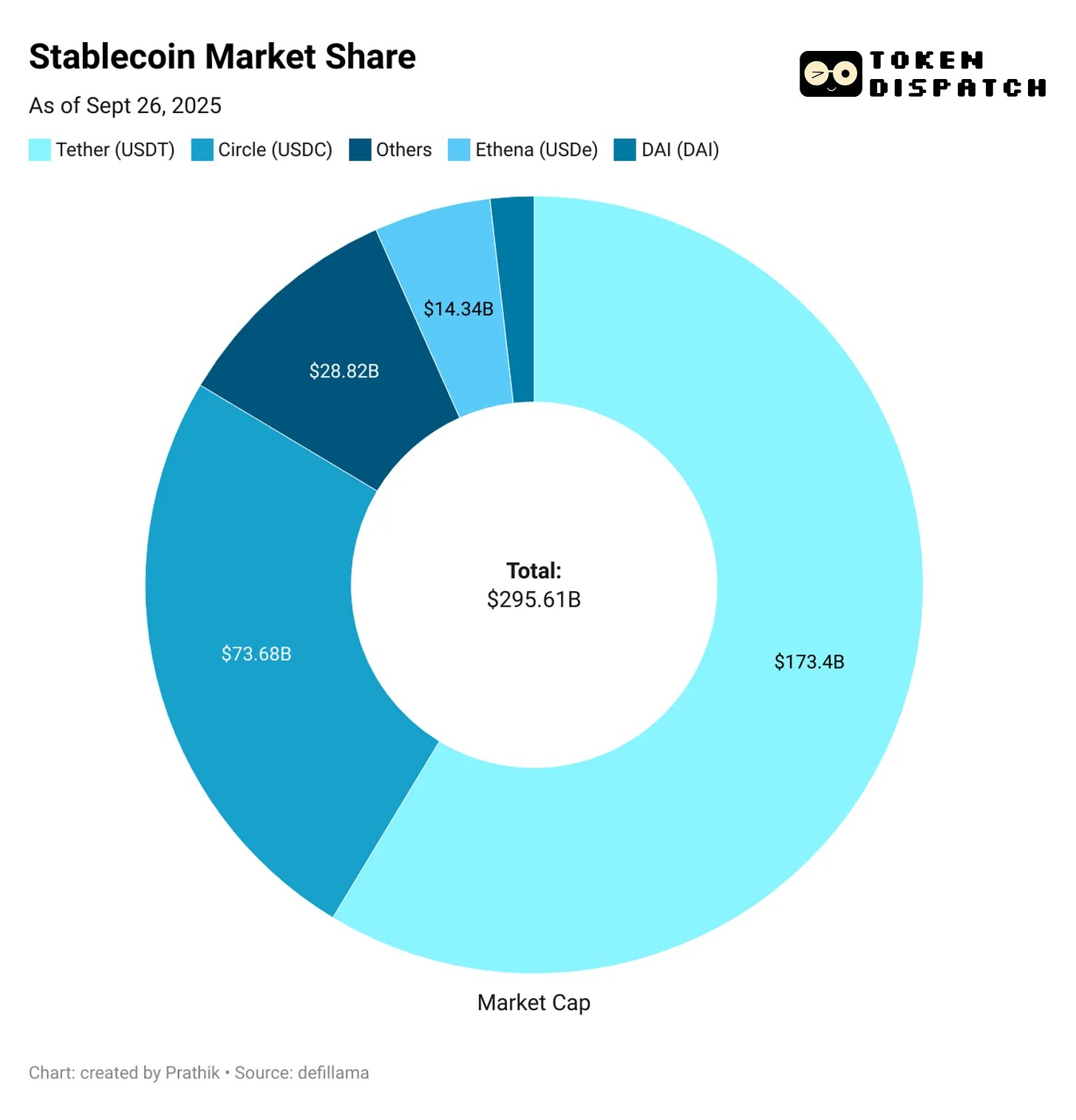
But what sets MetaMask’s mUSD apart in today’s duopolized $300 billion stablecoin market?
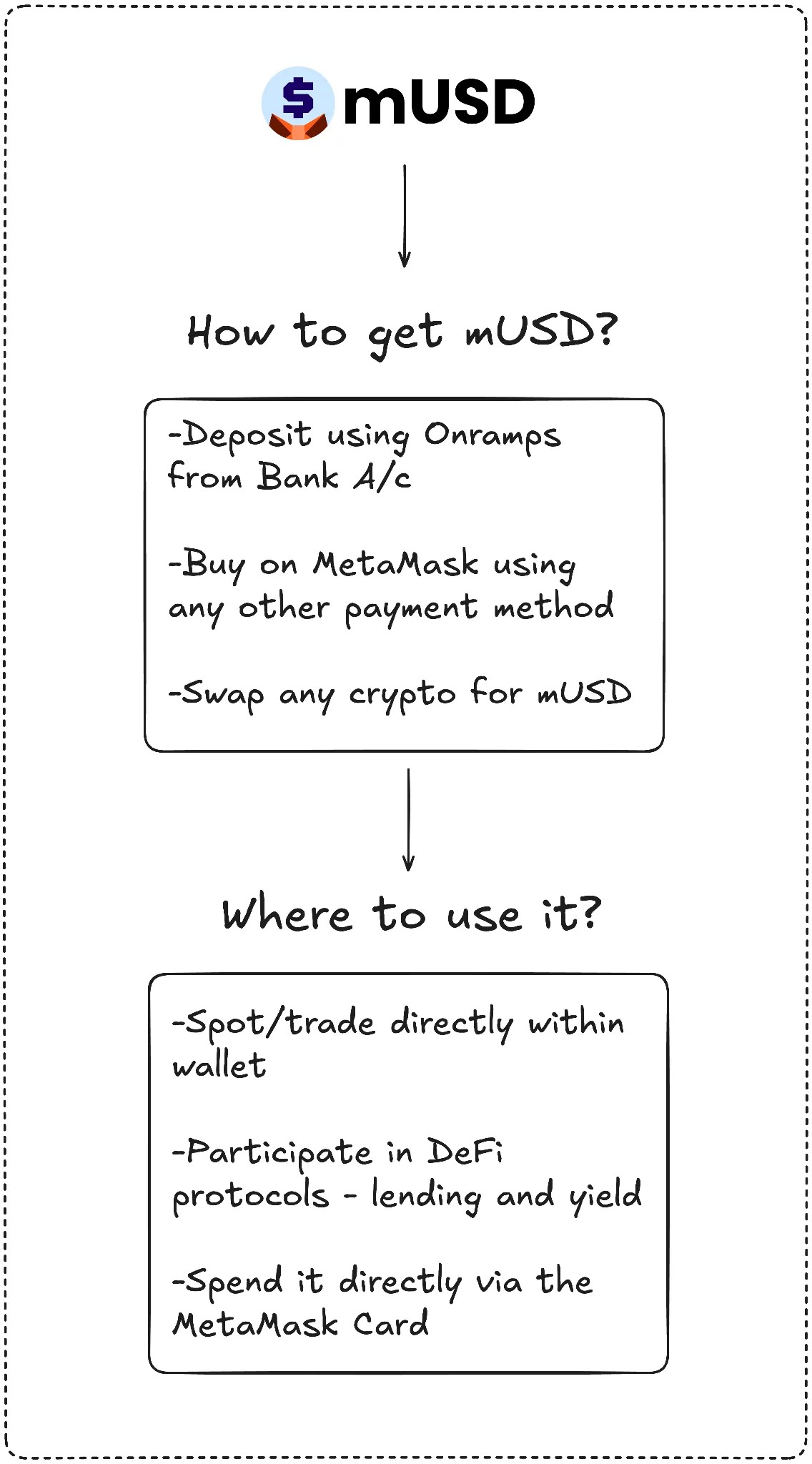
MetaMask may be entering a fiercely competitive space, but it has a unique selling point unmatched by any rival: distribution. With nearly 100 million annual active users worldwide, MetaMask’s user base is almost unrivaled in scale. mUSD will also be the first stablecoin natively issued within a self-custodial wallet, allowing users to buy with fiat, swap, or even spend via the MetaMask card at stores. Users no longer need to hunt across exchanges, bridge across chains, or deal with the hassle of adding custom tokens.
Telegram lacked this product-user behavior fit—MetaMask has it. Telegram tried moving its messaging users onto blockchains for decentralized finance applications. MetaMask instead enhances user experience by integrating a native stablecoin directly into the app.
Data shows adoption has been rapid.
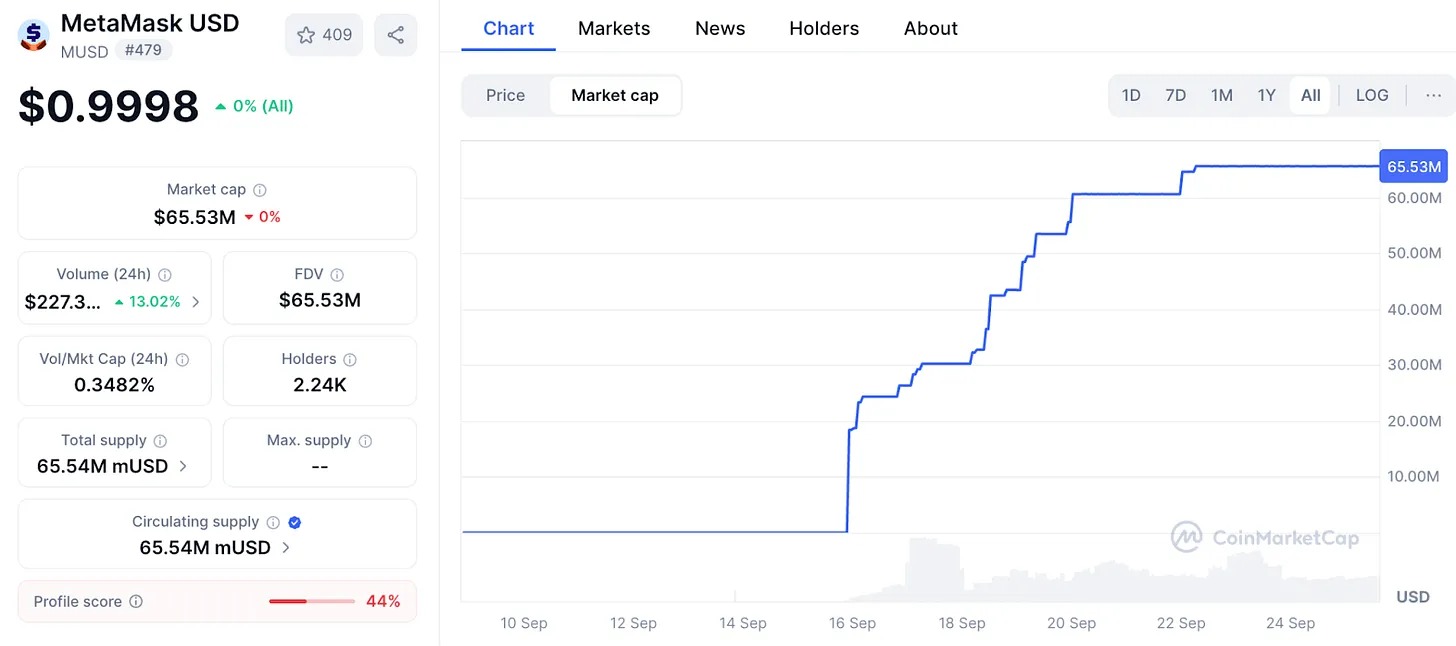
MetaMask’s mUSD market cap surged from $25 million to $65 million in less than a week. Nearly 90% of that volume came through Linea, ConsenSys’ Layer 2 platform, indicating MetaMask’s interface can effectively direct liquidity. This leverage mirrors past exchange tactics: in 2022, Binance automatically converted deposits into BUSD, causing circulation to spike overnight. Whoever controls the user, controls the token. With over 30 million monthly active users, MetaMask holds the largest user base in Web3.
This distribution power is what separates MetaMask from earlier players who attempted sustainable stablecoins but failed.
Telegram’s grand vision partly collapsed due to regulatory issues. MetaMask sidesteps this by partnering with Bridge, a Stripe-backed issuer, and backing each token with short-term Treasuries. This satisfies regulatory requirements, and the newly passed U.S. GENIUS Act provides it with a legal framework from day one. Liquidity will also be key. MetaMask is injecting mUSD trading pairs into DeFi on Linea, betting its internal network can solidify the token’s utility.
Yet distribution alone doesn’t guarantee success. MetaMask’s biggest challenge will come from existing giants in a market already dominated by a few.
Tether’s USDT and Circle’s USDC together hold nearly 85% of all stablecoin market share. In third place is Ethena’s USDe, with issuance reaching $14 billion, attracting users through yield. Hyperliquid’s USDH has just launched, aiming to recycle exchange deposits back into its ecosystem.
This brings me back to the question: what does MetaMask actually want mUSD to become?
Direct challengers to USDT and USDC seem unlikely. Liquidity, exchange listings, and user habits all favor the incumbents. mUSD may not need to compete head-on. Just as I expect Hyperliquid’s USDH to benefit its ecosystem by delivering more value to its community, mUSD is likely designed to extract more value from existing users.
Every time a new user deposits via Transak, every time someone swaps ETH into the new stablecoin inside MetaMask, and every time they swipe the MetaMask card at a store, mUSD will be the default. It integrates the stablecoin as the network’s built-in option.
I recall the days of bridging USDC between Ethereum, Solana, Arbitrum, and Polygon, depending on what I needed to do with my stablecoin.
mUSD ends all that cumbersome bridging and swapping.
Then there’s another crucial takeaway: yield.
With mUSD, MetaMask earns yield from the U.S. Treasuries backing the token. Every $1 billion in circulation means tens of millions in annual interest flowing back to ConsenSys. This transforms the wallet from a cost center into a profit engine.
If just $1 billion in mUSD is backed by equivalent U.S. Treasuries, it could generate $40 million annually in interest income. By comparison, MetaMask earned $67 million last year from fees.
This opens another significant, passive revenue stream for MetaMask.
Yet one factor unsettles me. For years, I’ve viewed wallets as neutral tools for signing and sending. mUSD blurs that line, turning a once-trusted neutral infrastructure tool into a business division profiting from my deposits.
Thus, distribution is both an advantage and a risk. It could make mUSD the default sticky choice—or raise concerns about bias and lock-in. If MetaMask tweaks its swap flow to make its own token cheaper or prioritized, it could make the world of open finance a little less open.
Then there’s fragmentation.
If every decentralized wallet starts issuing its own dollar, it could create multiple closed-loop currencies instead of the interchangeable USDT/USDC duopoly we have today.
I don’t know where this will lead. MetaMask neatly closes the financial loop of buying, investing, and spending by integrating mUSD with its card. First-week growth shows it can overcome early launch hurdles. Yet the dominance of existing giants illustrates how challenging the climb from millions to billions truly is.
I don’t know where this will lead. MetaMask completes the financial cycle of buying, investing, and spending mUSD by integrating it with its card. The first week’s growth indicates it can overcome initial launch barriers. However, the dominance of existing giants highlights how difficult the leap from millions to billions really is.
Between these realities may lie the fate of MetaMask’s mUSD.
Join TechFlow official community to stay tuned
Telegram:https://t.me/TechFlowDaily
X (Twitter):https://x.com/TechFlowPost
X (Twitter) EN:https://x.com/BlockFlow_News