Why Stock Tokenization Might Be a False Proposition?
TechFlow Selected TechFlow Selected
Why Stock Tokenization Might Be a False Proposition?
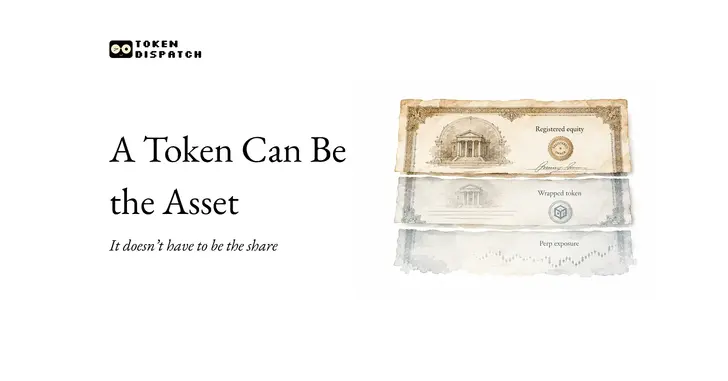
Tokenization of stocks might be a false proposition; the real proposition is the blockchainization of exchange systems.
 Navigating Web3 tides with focused insights
Author: Liu Honglin
The term "stock tokenization" keeps appearing in market news. Whether it's initiatives like Robinhood and xStocks, or Nasdaq studying the feasibility of stock tokenization, a wave of turning stocks into tokens seems to be coming.
Many view this as a revolutionary breakthrough for the stock market, even calling it the best entry point for combining blockchain with traditional finance.
But in my view, stock tokenization is more of a transitional product rather than an end-state solution. Its popularity stems from regulatory arbitrage and market imagination, not genuine business logic. To put it simply: stock tokenization may be a false premise—the real opportunity lies in the blockchain transformation of exchange systems.
The Essence and Transitional Value of Tokenization
To understand stock tokenization, we must first return to the essence of a token. A token is a credential that records "what I own and what rights I am entitled to." It can represent currency, points, tickets, or even stocks.
However, when a stock is "tokenized," its legal status and shareholder rights do not fundamentally change just because it's placed on a blockchain. Tokenized stocks are still subject to corporate law, securities regulations, and exchange rules. They carry no more rights than traditional stocks, nor do they bear fewer responsibilities. In other words, the essence of stock tokenization is merely moving a certificate from System A to System B.
Here arises the question: if tokenization doesn't alter the rights and obligations of stocks or solve core issues, why are so many companies and platforms pushing for it?
The reason lies in the gap between reality and ideals.
The ideal scenario—exchanges migrating onto blockchains—is still years away, but market demand and arbitrage incentives won't wait. Therefore, before regulatory frameworks are fully updated, tokenized stocks become a "patchwork" solution. Their existence isn't due to changing the nature of stocks, but rather filling the void between outdated systems and new technologies.
This model is attractive mainly in three ways:
1. Lowering barriers: Investors don't need cross-border accounts; all they need is a wallet to access U.S. stocks or other securities;
2. Enhancing liquidity: Tokenized stocks can trade 7x24 hours, bypassing time restrictions of traditional markets;
3. Creating arbitrage opportunities: Price differences across markets attract capital flows between them.
Yet these advantages, while seemingly novel, are essentially transitional. They exist only because institutional gaps remain between securities markets and crypto markets—such as geographic restrictions, account-opening barriers, and inconsistent clearing processes. Tokenized stocks exploit these imbalances to carve out space in the cracks.
If we look for a clearer analogy, their role resembles early offshore intermediary accounts—Mainland investors wanting to buy U.S. stocks without compliant channels had to rely on intermediaries. But once cross-border trading opens up and official compliant pathways emerge, such models naturally disappear. The fate of stock tokenization will be the same.
More importantly, tokenized stocks cannot address the core pain points of capital markets. Whether it's settlement efficiency, lack of transparency, or inconsistent global regulations, they offer no fundamental solutions. They are products born in the cracks, justified more by misalignment between old systems and new demands than by defining the future.
The Future Vision: Exchanges Going On-Chain
Imagine a scenario ten years from now: NYSE, Nasdaq, HKEX, and even SSE (admittedly, this one sounds bold) gradually migrate to blockchain architectures. At that point, every stock is natively a token from the moment it's issued. Its registration, transfer, dividend distribution, rights offerings, and voting are all executed via smart contracts. Stocks are inherently tokens, making the concept of "tokenization" obsolete.
What does this shift mean? Today, stock issuance, registration, clearing, and settlement involve multiple layers—depositories, custodian banks, clearing houses, exchanges—requiring T+2 settlement at best. In a blockchain-based system, registration equals settlement and trading equals clearing. Ownership and transaction records update in real time on-chain, drastically reducing intermediary costs. For investors, this isn't just about improved efficiency—it's a revolution in financial market transparency and security.
Once exchanges undergo this blockchain transformation, the boundary between traditional brokerages and crypto exchanges will blur. You could buy Bitcoin directly through your brokerage account, or purchase Apple and Tesla stocks seamlessly on a crypto exchange. With converging underlying infrastructures, the line between traditional and emerging markets dissolves completely. Financial product design would also evolve. For instance, on-chain stocks could combine with stablecoins and RWAs (real-world assets) to automatically generate structured wealth products, enabling instant settlements or on-chain staking.
To grasp this evolution, consider the past 30 years of music formats. From cassette tapes to Walkmans, then MP3s and MP4s—each generation enjoyed temporary popularity, but the ultimate winner was the smartphone, which integrated everything and quickly made predecessors obsolete. Stock tokenization today is like the Walkman—trendy on the surface, yet fundamentally transitional. The true disruptor will be the "smartphone moment" that redefines the entire ecosystem: the blockchain transformation of exchanges.
This transformation, to some extent, is also a global competition among capital markets.
America's strength lies in its mature stock market institutions and unmatched liquidity. If it leads in blockchain adoption, it can extend dollar-based financial dominance into the blockchain layer, upgrading "dollar settlement" to "dollar chain settlement." Imagine Apple and Tesla stock transactions and dividends settled entirely in dollar-pegged stablecoins on-chain—then the dollar’s dominance wouldn’t just be monetary, but foundational to the global capital market protocol itself.
Hong Kong's experiments can be seen as a vanguard effort linking China's capital markets with blockchain. Leveraging its "first-mover" regulatory advantage, it has drawn global Web3 entrepreneurs and capital. Especially after launching pilot programs for compliant exchanges and stablecoin legislation, Hong Kong is building a hybrid "East-meets-West" capital market model. If it successfully pioneers the path toward on-chain exchanges, it could become a new gateway for international capital—not only connecting Wall Street and Silicon Valley funds but also offering Mainland Chinese investors and enterprises a fresh channel to go global.
Conclusion
The buzz around tokenized stocks is essentially a transitional phenomenon thriving in regulatory gaps. It offers investors short-term convenience and arbitrage chances, but cannot truly alter the DNA of stocks. The real revolution lies in exchanges going on-chain.
This is an upgrade both technologically and institutionally—an emerging strategic race in global capital markets.
Join TechFlow official community to stay tuned
Telegram:https://t.me/TechFlowDaily
X (Twitter):https://x.com/TechFlowPost
X (Twitter) EN:https://x.com/BlockFlow_News