Tokenization of Equity in Private Companies: Is It Possible, How to Do It, and What It Will Look Like?
TechFlow Selected TechFlow Selected
Tokenization of Equity in Private Companies: Is It Possible, How to Do It, and What It Will Look Like?
The real challenge lies in encoding three "old-world" elements: ownership, transferability, and transaction infrastructure.
 Navigating Web3 tides with focused insights
Author: Manqin
In recent months, the topic of tokenized U.S. equities has surged in popularity, with a wave of "stock token" platforms targeting overseas users launching one after another. Major platforms like Robinhood continue to make moves, while Jarsy, Republic and others are discussing bringing equity interests in high-quality private companies such as SpaceX / xAI / Stripe on-chain. Many entrepreneurs and investors are thus becoming increasingly eager:
-
Can private company equity actually be tokenized?
-
How can it be done compliantly? How much do regulations differ across jurisdictions?
-
What implementation paths exist? Where do rights and risks differ across each path?
-
As an issuer / sponsor / investor / platform, how should I execute this?
This article clarifies these questions: whether it's possible, how to do it, and what the outcome looks like.
Can private company equity be tokenized?
The answer is: yes. Securities laws across jurisdictions do not prohibit using tokens—more efficient digital instruments—to represent equity or its economic rights. Regulators care about what rights you're selling, how transfers occur, and where trading takes place—not whether you use blockchain.
Why is it possible? (Core logic)
-
Technology neutrality: Equity can be represented via paper certificates, electronic registries, or on-chain tokens; as long as disclosure, investor suitability, and ongoing compliance requirements under securities law are met, the technical form won't be inherently rejected.
-
Efficiency is verifiable: On-chain systems streamline registration, transfer, and clearing & settlement into a single auditable workflow, reducing manual steps and counterparty risk, enabling cross-border collaboration and automated execution.
-
Real market demand: Pre-IPO assets are high quality but illiquid. Tokenization enables better allocation, pricing, and exit design within qualified investor circles.
To what extent is it feasible? (Practical boundaries)
-
Start with qualified investors: Most jurisdictions currently support participation only by professional/qualified investors (e.g., PI/AI/QIB). Retail access remains limited in the short term due to information asymmetry and suitability requirements.
-
Secondary liquidity operates in "layers": Tokenization doesn't change the nature of restricted securities. Whitelists (compliant ledgers) and lock-up periods still apply. Real liquidity mostly occurs within regulated venues.
-
Issuer cooperation is key: Without issuer consent or proper handling of ROFR (right of first refusal), full shareholder rights cannot be implemented—even if tradeable, only economic rights may be conveyed.
When should you NOT proceed? (Red lines)
-
Unclear ownership: Underlying shares lack proof of 1:1 backing, custody/transfer records, or verifiable provenance.
-
Unenforceable promises: Claiming "1:1 share conversion" without transfer agent or issuer cooperation clauses.
-
Cross-border marketing overreach: Using "globally tradable" as a slogan while ignoring local securities laws and prohibitions on active solicitation.
Therefore, private company equity can be tokenized—legally assessed by "rights and rules," technologically executed through "verifiability and control." By clearly defining ownership, transferability, and compliant venues, tokenization becomes not only feasible but also sustainable.
Three Types of Tokenization Approaches
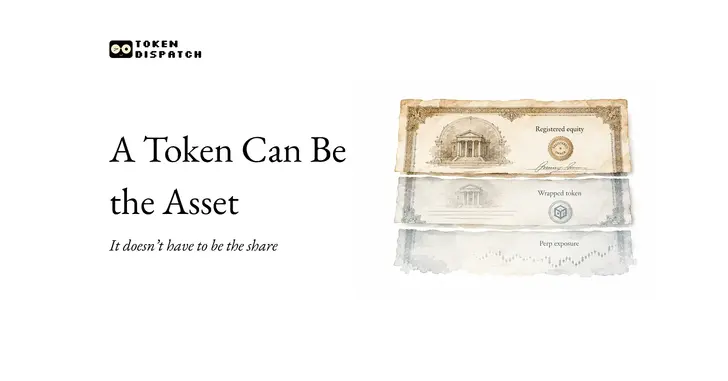
1. True Shares On-Chain (Directly moving "the actual equity" onto the blockchain)
Definition: The token represents the stock itself, with token transfers synchronized with updates to the shareholder register.
When to choose this: When the issuer agrees to governance changes and seeks the most complete rights and best secondary market integration over the long term.
Execution priorities (focus on three things):
-
Charter and registry: Company charter permits on-chain registration; integrated with a transfer agent (third party responsible for registration and transfers).
-
Venue and settlement: Identify regulated secondary markets (e.g., ATS (U.S. Alternative Trading System, SEC-regulated secondary market facility), MTF (EU Multilateral Trading Facility, MiFID-regulated matching venue)) and settlement pathways.
-
12(g) management (Section 12(g) of the U.S. Securities Exchange Act sets thresholds for record holder count and asset size triggering public company registration): Control reporting scope and holder counts to avoid turning a private placement into a "quasi-public company."
Signals not to choose this: Issuer unwilling to amend charter, refuses transfer cooperation, or cannot bear disclosure, audit, and shareholder management costs.
2. Economic Rights / Contractual Exposure (Stock-like, but not stock)
Definition: Tokens deliver economic outcomes such as profit sharing, buyback, or event-based settlement. Legally, you typically aren't a shareholder.
When to choose this: For fast launch and market testing when the issuer does not open its shareholder register, but strong market demand exists.
Execution priorities (focus on three things):
-
Enforceable payout terms: Clearly define redemption/conversion triggers, timelines, responsible parties, and fallback mechanisms upon failure.
-
Dual-track compliance: Use Reg D 506(c) (U.S. Regulation D allowing general solicitation to accredited investors only) + Reg S (offshore safe harbor requiring offshore transactions and no U.S.-directed offers); separate channels geographically to avoid integration.
-
Programmable transferability: Encode whitelists, lock-ups, and restrictive legends (resale restrictions) into smart contracts rather than leaving them in static PDF documents.
Signals not to choose this: Marketing implies "you are a shareholder" or promises "1:1 share conversion" without transfer agent or issuer cooperation clauses.
Note: Identically named assets across platforms are non-interchangeable; differing price references (latest funding round / offer / NAV) and redemption paths may cause shadow market price discrepancies.
3. Fund / SPV Share Tokenization (Indirect exposure to multiple assets)
Definition: Tokenizing fund / LP / SPV shares that hold stakes in multiple Pre-IPO companies at the underlying level.
When to choose this: Targeting institutions, family offices, HNWIs seeking institutional governance, auditable NAVs, and stable secondary market linkages.
Execution priorities (focus on three things):
-
Contracts and disclosures: Fund agreements must fully explain redemption windows, side pockets; valuation methods and revaluation upon major events must be explicit.
-
Fee transparency: Disclose fund fees, platform fees, and conduit fees layer by layer so investors can understand total cost.
-
Secondary market access: Prioritize connection to regulated venues (e.g., ATS/MTF/RMO), with primary circulation within closed circles.
Signals not to choose this: Desire to bet on a single hot asset, high sensitivity to lock-up and liquidity windows, or low tolerance for multi-layer fee structures.
How to choose among these three?
-
For strongest rights: Choose 1 (True Shares On-Chain), provided the issuer truly cooperates.
-
For speed and flexibility: Choose 2 (Economic Rights), but embed "redemption logic" and "restricted transfer rules" into code.
-
For institutional robustness: Choose 3 (Fund / SPV Shares), relying on disclosures and NAV credibility, with secondary trading on regulated venues.
How to Do It Compliantly: "Baselines and Pathways" Across Four Jurisdictions
(1) United States
Regulatory stance: Focuses on "what security you're selling, to whom, and how it transfers"—not whether blockchain is used.
Available issuance pathways (choose one or combine):
-
Reg D 506(b): No general solicitation allowed; may include limited non-accredited but financially sophisticated investors; no cap on fundraising amount; requires Form D filing with the SEC within 15 days of first sale.
-
Reg D 506(c): General solicitation permitted, but only to accredited investors; requires substantive verification of accreditation status (via third-party verification letters, tax returns, etc.).
-
Reg S: Offshore transaction with no directed selling efforts toward U.S. markets. Often combined with Reg D to cover both U.S. domestic and international investors.
How secondary liquidity works
Rule 144 / 144A (resale rules for restricted securities; 144A applies to QIBs - Qualified Institutional Buyers): Determines who can transfer to whom and when. ATS (Alternative Trading System, a FINRA/SEC-regulated alternative trading system): To achieve real secondary trading, connect to an ATS; otherwise, liquidity is limited to internal redemptions or internal matching.
Embed restrictions into code: Whitelists (only KYC-verified/accredited addresses can hold/transfer), lock-up periods, and Legends (restrictive resale notices) must be enforced on-chain, not just stated in PPMs.
Pitfalls to avoid
Integration risk: Any public marketing during a 506(b) offering, or using the same domain name/sales funnel for 506(c)/Reg S offerings, may result in loss of exemption due to deemed integration.
12(g): Be consistent in counting record holders—whether nominal holders or on-chain multiple addresses—to avoid being treated as exceeding the threshold for mandatory public company registration (e.g., don’t treat multiple wallets as multiple individuals).
Bottom line: Dual-track Reg D 506(c) + Reg S is most common; restricted security status remains unchanged—first secure whitelist + ATS integration before discussing "liquidity."
(2) Hong Kong
Regulatory stance: Equity tokens = securities; not the type of "non-security VA" that general VATPs (Virtual Asset Trading Platforms) can handle.
Available issuance / distribution channels
Private placements only to PI (Professional Investors); public solicitation/advertising easily triggers licensing or approval obligations.
To enable trading, activities typically involve Type 1 (Dealing in Securities) and/or Type 7 (Providing Automated Trading Services), where ATS (Automated Trading Services, Hong Kong term) requires SFC approval. Do not attempt to list security tokens on VATPs.
How secondary liquidity works
Liquidity should primarily occur on regulated securities venues (operated by licensed corporations providing matching and settlement). Currently focused on PI; retail access is limited.
Pitfalls to avoid
Active marketing vs. passive access: Chinese-language websites, HKD pricing, advertising in Hong Kong media, or having a local customer service number may be considered active solicitation to the Hong Kong public.
Bottom line: Issuing security tokens in Hong Kong = securities licensing route + PI-only access; VATP pathway does not apply.
(3) Singapore
Regulatory stance: Security tokens fall under SFA (Securities and Futures Act) as capital market products; distinct from DPTs (Digital Payment Tokens) regulated under PSA (Payment Services Act).
Available issuance / venue options
-
Private offers to AI/II (Accredited/Institutional Investors) can rely on prospectus exemptions, but face advertising and transfer restrictions.
-
RMO/AE (Recognised Market Operator / Approved Exchange): Required for trading/matching; must connect to or operate under RMO/AE framework.
-
VCC (Variable Capital Company): A flexible corporate structure ideal for funds/portfolios, suitable for approach ③ (Fund / SPV Shares).
How secondary liquidity works
Primarily through RMO-mandated matching, limited to AI/II circles; cross-venue settlement with overseas regulated venues is possible.
Pitfalls to avoid
Substance requirement: Having a team or operations in Singapore—even with servers overseas—may lead to being deemed as conducting regulated activities in Singapore.
Bottom line: For reliable execution, SFA private placement + RMO is the main path; PSA/DPT does not address security token needs.
(4) European Union
Regulatory stance: Security tokens remain subject to MiFID II (Markets in Financial Instruments Directive II) and CSDR (Central Securities Depositories Regulation); MiCA (Markets in Crypto-Assets) does not govern security tokens.
Available issuance / venue options
Standard Prospectus Regulation or exempted private placements;
DLT Pilot (Regulation 2022/858): Authorizes DLT-based MTF/SS/TSS (DLT Multilateral Trading Facilities / Settlement Systems / Integrated Trading & Settlement Systems) to pilot on-chain trading and settlement under size and product limitations.
How secondary liquidity works
Connect to MTF or DLT MTF for compliant matching and settlement; otherwise, only internal redemption or negotiated transfers are possible.
Pitfalls to avoid
Treating MiCA as a gateway for security tokens; or replacing prospectus / key information document standards with "whitepaper-style" disclosures.
Bottom line: For true equity/debt tokenization, DLT Pilot + MTF is the correct path; otherwise follow traditional MiFID routes—technology is merely the medium.
Summary:
Issuance strategy: U.S. Reg D 506(c) + Reg S is the most universal combo; Hong Kong, Singapore, and EU follow their respective private placement/exemption frameworks.
Solving secondary liquidity: Restricted securities remain restricted; whitelists, lock-ups, and legends must be codified and traded on regulated venues (ATS in U.S., MTF/DLT MTF in EU, RMO in Singapore).
Marketing approach: Design channel segmentation and anti-integration strategies by jurisdiction—avoid using "one funnel for global sales."
Risk mitigation: First secure clear ownership and issuer consent; then encode transferability into code; only then consider valuation and liquidity.
What We Offer
We specialize in transforming a "plausible story" into a legally issuable, compliantly tradable, and contractually redeemable product. I’ll first eliminate foundational risks for you (clarity of equity source, target company consent, existence of transfer restrictions), then provide a one-page decision: whether to proceed, which path saves time and cost, and what resources and timeline are required. Then I’ll embed issuance, transfer, disclosure, and risk controls into contracts and systems (not just PowerPoint slides), and connect your product to regulated secondary markets to ensure "tradability" and "settling capability."
What you ultimately receive isn’t a pile of legal jargon, but a set of actionable deliverables: a clear roadmap with key milestones, externally usable legal opinions, complete issuance documents, compliance rules coded into the system, secondary liquidity plans, contingency protocols, and operational standards acceptable to banks and regulators. In short—turning uncertainty into certainty, making risks visible, processes controllable, and outcomes verifiable.
Conclusion
Tokenization is not simply "turning equity into tokens." The real challenge lies in encoding three "legacy world" elements—ownership, transferability, and trading infrastructure—so they operate stably across multiple jurisdictions. My recommendation: consistently prioritize law before code—first confirm issuer consent / ROFR, 12(g) thresholds, distribution periods and whitelists, settlement pathways—then discuss valuation, liquidity, and market education. Only then does private company equity tokenization become a real product, not just a narrative.
Join TechFlow official community to stay tuned
Telegram:https://t.me/TechFlowDaily
X (Twitter):https://x.com/TechFlowPost
X (Twitter) EN:https://x.com/BlockFlow_News