The internet service you use every day just launched its own stablecoin
TechFlow Selected TechFlow Selected
The internet service you use every day just launched its own stablecoin
Not just Cloudflare, every big tech company needs to launch its own stablecoin.
 Navigating Web3 tides with focused insights
By Sleepy.txt
You may not have heard of Cloudflare, but if you're online, it's nearly impossible to avoid its services.
The company is an "invisible giant" in the internet world. Whether you're ordering food, scrolling through short videos, checking your email, or logging into a corporate system, there's a high chance your traffic is flowing through its network. It acts like a massive digital shield and accelerator, providing security protection and content delivery services for nearly one-fifth of websites worldwide.
When web pages load instantly and your favorite apps withstand hacker attacks, Cloudflare is often behind the scenes. It has become the de facto "water, electricity, and coal" of the internet—the foundational infrastructure enabling efficient and secure global data flow.
On September 25, Cloudflare made a landmark strategic move, extending its infrastructure into a completely new dimension by announcing its own stablecoin—NET Dollar.
Why issue its own stablecoin?
Cloudflare CEO Matthew Prince provided the answer: "For decades, the internet's business model has relied on advertising platforms and bank transfers. The next era of the internet will be driven by pay-per-use, fragmented payments, and micropayments."
With annual revenue exceeding $1.6 billion and handling trillions of requests daily, Cloudflare is truly the underlying "utility" of the internet. Yet within this vast digital network, payment remains the only环节 outside its control. This sense of losing control is increasingly troubling large enterprises.
Apple settles tens of billions of dollars annually with App Store developers, Amazon manages massive cash flows from third-party sellers, and Tesla conducts payment operations with over three thousand global suppliers. All these giants face the same friction: long settlement cycles, high transaction fees, complex cross-border compliance, and most critically, loss of autonomy at the core of their business loops.
As commerce becomes increasingly digital and automated, this outdated financial infrastructure has become a bottleneck. In response, large companies are choosing a more direct path: if they can't change the old system, they'll build a new one themselves.
Why Big Tech Needs Its Own Stablecoin
The emergence of NET Dollar prompts a reevaluation of stablecoin issuance motives. Unlike USDT or USDC, which aim for broad circulation, Cloudflare’s approach is more pragmatic—it aims first to solve payment issues within its own business ecosystem.
The difference is significant.
USDT and USDC initially targeted the entire crypto market, growing scale through wide acceptance; NET Dollar, by contrast, currently resembles an "internal currency," custom-built for Cloudflare’s commercial network.
Of course, boundaries aren't fixed. PayPal's PYUSD is a typical example: launched in 2023 solely within PayPal’s own payment system, it now supports exchanges with over a hundred cryptocurrencies, far exceeding its original scope.
Enterprise stablecoins may follow a similar path, evolving from internal efficiency tools into broader circulation systems.
The key difference lies in motivation. Traditional stablecoin issuers primarily profit from investing reserves, while enterprises issue stablecoins to optimize processes and regain control. These differing starting points shape their design, application, and future trajectories.
For big tech, payment has always been the "last mile" of the commercial loop—but this final stretch is controlled by banks and payment institutions, plagued by the very problems mentioned earlier. Thus, bringing payments in-house and rebuilding a controllable loop via stablecoins becomes a strategic choice.
The real value of enterprise stablecoins isn’t in grand narratives, but in surgically targeting inefficiencies to dramatically improve operational efficiency.
This value is especially evident in supply chain finance.
Global supply chain finance itself is a highly friction-prone system. A payment from the U.S. to Vietnam must traverse multiple time zones, currencies, and banks. According to World Bank data, the global average remittance cost remains above 6%.
Average transaction costs for remittances to specific countries/regions (%)|Source: WORLD BANK GROUP
Enterprise stablecoins can compress this process to minutes. A U.S. company can send payment directly to a Vietnamese supplier in minutes, reducing costs below 1%. Transit time plummets, significantly boosting supply chain turnover efficiency.
More importantly, the locus of settlement power shifts.
In the past, banks acted as intermediaries controlling speed and cost; in a stablecoin network, enterprises themselves can dominate this critical link.
Beyond efficiency, cost is another burden businesses cannot ignore. Exchange rate losses, bank processing fees, and card network charges may seem minor individually, but cumulatively erode competitiveness.
This is where enterprise stablecoins make a difference—they bypass traditional financial intermediaries and reconstruct cost structures. The change isn't just about lower absolute amounts, but also simpler, more transparent structures. In traditional models, businesses face complex fee systems: fixed fees, percentage-based fees, exchange spreads, intermediary charges—all opaque and hard to predict.
In a stablecoin network, costs are reduced to essentially one component: on-chain transaction fees. These are public, predictable, and relatively stable, allowing businesses to calculate expenses and profits more accurately and make decisions with greater confidence.
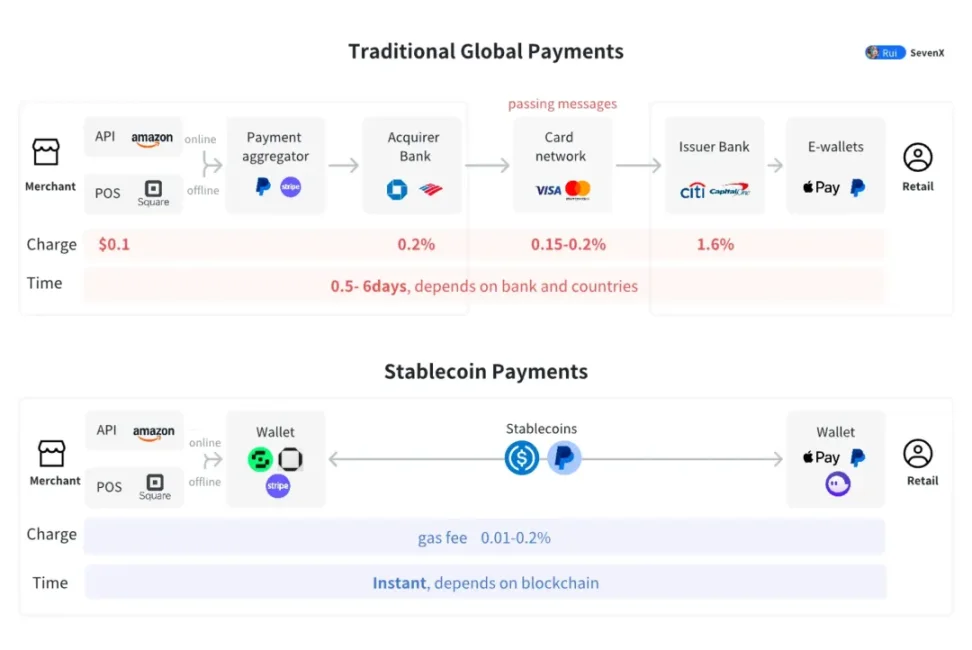
Comparison of traditional financial global payment steps vs. stablecoin payments|Source: SevenX Ventures
Further, even cash flow management itself can be transformed. Traditional methods rely on manual operations and banking systems—complex, inefficient, and error-prone.
When enterprise stablecoins integrate with smart contracts, fund flows can execute automatically based on predefined conditions. Upon delivery and inspection confirmation, payments are released instantly; upon project milestones, funds are disbursed immediately. Businesses no longer need to manually monitor accounts—they encode rules into contracts.
This mechanism brings more than just efficiency gains. Transparent, immutable payment logic reduces trust costs between partners and preempts potential disputes.
And as more partners join the same payment system, network effects emerge. Suppliers, distributors, partners, and even end users all settle in the same stablecoin, causing the network’s value to grow exponentially.
This value isn't just in scale, but in creating a lock-in effect. Once deeply integrated into a company’s stablecoin ecosystem, switching to another system becomes costly—not just technically, but in terms of learning, relationships, and opportunity costs.
This stickiness becomes the firm’s strongest moat. In fierce competition, companies with stablecoin ecosystems gain better control over costs and cash flow, and leverage network effects to solidify long-term advantages.
How Enterprise Stablecoins Enter Every Industry
Different industries face unique pain points, and enterprise stablecoins are emerging as potential solutions. While not yet widely deployed, they already show real-world applicability.
E-commerce Platforms: Automating Deposits, Commissions, and Refunds
For e-commerce platforms, stablecoins are becoming experimental tools for building next-generation payment infrastructures. Shopify’s collaboration with Coinbase enables merchants in 34 countries to accept USDC settlements—but this is just the beginning.
Security deposits paid by merchants upon registration can be encoded into smart contracts, automatically deducted upon violations and refunded at contract end. Platform commissions can also be settled in real-time: every completed transaction triggers an automatic transfer from the merchant’s stablecoin account to the platform.
The refund process is similarly transformed. Cross-border refunds that once took weeks and passed through multiple banks can now settle in minutes, offering a completely different user experience.
Moreover, stablecoins enable micropayment scenarios. Consumers can pay per page view, for personalized recommendations, or priority customer service—small transactions nearly impossible under traditional payment systems become feasible in a stablecoin environment.
Manufacturing Giants: Unified Networks for Supplier Payments and Inventory Financing
Manufacturing is among the most globalized industries, with supply chains spanning dozens of countries. For companies like Apple and Tesla, coordinating payments, financing, and deposits across thousands of suppliers is a massive operational challenge.
If these firms issued their own stablecoins, they could establish an efficient, low-cost internal payment network. Paying upstream suppliers, arranging inventory financing, and managing quality assurance deposits—processes previously dependent on multiple banks, currencies, and manual work—could be completed instantly within a single network.
Even more importantly, this digital payment system could integrate seamlessly with existing enterprise management systems. When ERP detects insufficient parts, it could automatically trigger orders and payments; when quality inspection systems flag defective batches, deductions could be made instantly from supplier deposits.
Take Tesla as an example: with over 3,000 suppliers across more than 30 countries, unifying settlements via stablecoin would allow suppliers to use "Tesla Coin," with Tesla handling USD conversion. This not only reduces costs but also strengthens control over critical operations.
Content Platforms: New Paths for Revenue Sharing and Micropayments
The content industry is undergoing a creator-driven transformation. Whether it’s video platforms like YouTube and TikTok or text platforms like Substack and Medium, the biggest challenge is efficiently and fairly distributing earnings to global creators.
Enterprise stablecoins are seen as a potential solution. They enable platforms to instantly settle payouts with creators worldwide, eliminating reliance on complex cross-border banking systems and avoiding high fees. Further, micropayment mechanisms allow for finer-grained revenue distribution.
YouTube pays out tens of billions annually to creators, but payment methods vary by country, exchange rate fluctuations affect real income, and tax procedures are extremely cumbersome. A self-built stablecoin network could enable truly unified global settlements.
This mechanism could also spawn new business models: readers pay per article, viewers pay per video clip, listeners pay per song. More granular value distribution not only gives creators more direct rewards but also incentivizes higher-quality content production.
Cloud Providers: Payment Testbeds for the Machine Economy
Cloudflare’s NET Dollar exemplifies how cloud providers are experimenting with stablecoins. With advances in AI and IoT, machine-to-machine communication and transactions are becoming increasingly common. These interactions are characterized by high frequency, small amounts, and full automation—beyond the capacity of traditional payment systems.
In such scenarios, an AI model might pay for calling another model’s API, an IoT device might settle its computing usage, and an autonomous vehicle might pay for map services. These payments might be fractions of a cent, yet triggered thousands of times per second.
Stablecoins—especially those like NET Dollar designed for programmatic transactions—can support these high-frequency, low-value automated payments. Machines can autonomously determine when, how much, and to whom to pay, based on preset rules, without human intervention.
To this end, Cloudflare partnered with Coinbase to launch the x402 Foundation, developing a protocol enabling direct machine-to-machine payments. When one AI model uses another’s service, fees are settled instantly. Such explorations are laying the payment foundation for the future machine economy.
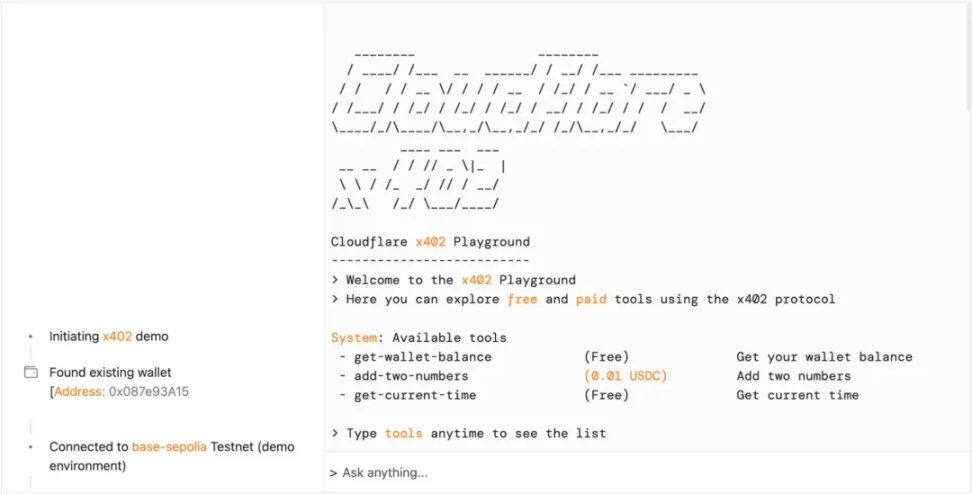
Real-time demo interface of Cloudflare's x402 testnet|Source: Cloudflare
Stablecoin Swaps and the Emergence of New B2B Payment Networks
Once every major enterprise issues its own stablecoin, the next question arises: how do these "corporate currencies" interoperate? The answer points to a new B2B payment network.
In such a network, different enterprise stablecoins could be seamlessly converted via swap agreements, potentially leveraging liquidity pools from decentralized exchanges. A supplier receiving payment in "Tesla Coin" could instantly convert it to "Apple Coin" or USD without going through traditional banks.
For this system to function, several hurdles remain.
First is exchange rate pricing. How are exchange rates between different enterprise stablecoins determined? This may require a supply-demand pricing mechanism akin to foreign exchange markets.
Second is liquidity sourcing. Who provides sufficient liquidity? Will it rely on professional market makers, or will enterprises set up mutual channels? There's no consensus yet, requiring further industry exploration.
Finally, risk management. How are credit and operational risks mitigated during conversions? This is not just a technical issue but requires clear regulatory guidance.
Stripe has already begun testing this direction. In May 2025, it launched the world’s first AI-powered payment model and introduced a stablecoin payment suite. Businesses can simply toggle a switch to use USDC for settlements across multiple public blockchains including Ethereum, Solana, and Polygon.
Stripe’s strategy is clear: rather than issuing its own coin, it empowers more businesses to easily adopt stablecoin settlements, positioning itself as the foundational infrastructure for stablecoin payments.
More interestingly, "industry alliance stablecoins" may emerge within specific sectors. For instance, major automakers could jointly issue an "Auto Coin" covering everything from parts procurement to vehicle sales. Such a unified currency system could drastically reduce transaction costs and promote industrial collaboration.
The automotive supply chain, with its complexity, is ideal for experimentation. A single car involves tens of thousands of components and global suppliers. If the entire chain settles in one stablecoin, redundant multi-currency, multi-bank processes can be bypassed, greatly simplifying payments.
The advantages of alliance stablecoins are clear: industry scale ensures liquidity, transaction models are standardized, and closed-loop circulation minimizes disruption to traditional finance. But challenges remain—how to balance interests among different firms, whether dominant players will exploit control, and whether governance can stay transparent—all questions to be answered in practice.
All visions for enterprise stablecoins ultimately depend on regulatory compliance. Whether individual firms or industry alliances, gaining real market adoption requires transparent reserve custody, regular third-party audits, and full disclosure to regulators.
In July 2025, the U.S. GENIUS Act took effect, establishing the first clear legal framework for stablecoin issuance. Stablecoins exceeding $10 billion in circulation must come under federal oversight, with reserves limited to USD, bank deposits, or short-term U.S. Treasuries, and fully segregated from the issuer’s other assets.
In August of the same year, Hong Kong’s Stablecoin Ordinance was implemented. It requires issuers to hold at least HK$25 million in paid-up capital, submit to ongoing supervision and annual audits by the Monetary Authority, and establish comprehensive anti-money laundering and customer identification systems.
For enterprises, compliance is not just a requirement but a prerequisite for trust. Without transparent and credible reserve management, even the strongest business case will fail to convince suppliers, partners, and customers to join.
Stablecoins and the New Commercial Order
The rise of enterprise stablecoins signifies not just a shift in payment tools, but a precursor to the restructuring of future commercial order.
They deeply couple payments with systems, granting devices and programs independent economic agency. Autonomous vehicles can independently complete charging and payment when low on power; industrial robots can automatically order replacement parts when worn. Machines thus evolve from mere "tools" into genuine economic actors.
Micropayments offer new distribution logic for the content industry: videos charged by the second, novels by chapter, software by feature. Income becomes more granular, reshaping incentive structures.
Combined with AI, the possibilities expand further. Once AI agents have stablecoin budgets, they can autonomously purchase data, computing power, or other services to accomplish complex tasks.
In September 2025, Google launched the Agent Payments Protocol (AP2), partnering with sixty institutions to build payment channels for AI agents, enabling direct settlements during task execution. This means AI will no longer be just tools, but economically capable "digital employees," forming new collaborative relationships with humans.
For banks and payment companies, this presents a structural challenge. If enterprises can build their own payment and clearing systems, traditional financial institutions’ roles in cross-border settlement and treasury management will diminish. In the future, banks may focus more on reserve custody, compliance, and auditing, while payment firms must evolve into stablecoin infrastructure providers.
From a macro perspective, enterprise stablecoins may signal the emergence of a new commercial order. In this system, value creation and distribution will occur with unprecedented efficiency, and business relationships will become more transparent and effective.
From medieval Venetian bills to today’s stablecoins, the underlying logic has always been the pursuit of more efficient mediums of exchange. In this technology-driven transformation, no enterprise aiming to thrive in the future digital economy can afford to stand aside.
Join TechFlow official community to stay tuned
Telegram:https://t.me/TechFlowDaily
X (Twitter):https://x.com/TechFlowPost
X (Twitter) EN:https://x.com/BlockFlow_News
 BlockBeats