The Era of AI Agent Payments: Google's AP2 Protocol Ignites the Battle, Ten Major Crypto Projects Rush to Claim the New Frontier
TechFlow Selected TechFlow Selected
The Era of AI Agent Payments: Google's AP2 Protocol Ignites the Battle, Ten Major Crypto Projects Rush to Claim the New Frontier
AP2 heralds the dawn of a new AI-driven commercial era connecting traditional finance with the crypto world.
 Navigating Web3 tides with focused insights
By Yuliya, PANews
September 16, an otherwise ordinary day, could become a pivotal turning point in the history of AI. On this day, Google officially launched the Agent Payments Protocol (AP2), an open standard designed to enable AI agents to securely conduct financial transactions on behalf of users.
AP2 is not a solo act by Google. It is more than just a technical protocol—it serves as a rallying call, signaling the dawn of a new commercial era driven by AI and bridging traditional finance with the crypto world.
Payment giants such as Mastercard, American Express, PayPal, and UnionPay International; tech/AI companies like Salesforce, Adobe, and ServiceNow; and key players from the crypto space including Coinbase, MetaMask, Ethereum Foundation, and Mysten Labs are all on board. This means that equipping AI agents with the ability to "spend money" has become an industry-wide consensus.
Why Does the World Need AP2? The Three Trust Challenges of AI Payments
The rise of AI agents breaks a fundamental assumption: previously, all payment systems assumed a "human" behind the screen clicking the "buy" button. But when AI begins autonomously booking flights, purchasing goods, or even managing investments, three core issues emerge:
-
Authorization: How do we prove that the user truly authorized the AI to spend?
-
Authenticity: How can merchants confirm that the AI's request genuinely reflects the user’s intent?
-
Accountability: If the AI makes a wrong purchase or falls victim to fraud, who is responsible?
AP2 aims to solve these problems through "digital mandates"—cryptographically signed, tamper-proof contracts that convert each user intention (e.g., "help me buy concert tickets") and final approval (e.g., confirming items and price in cart) into a verifiable chain of evidence. Whether for real-time purchases or pre-set tasks, the entire process—from intent, to cart, to payment—is fully recorded, creating a clear, indisputable audit trail that forms a solid foundation for resolving the three trust challenges.
The Trilogy: From MCP, A2A to AP2
AP2 is not an isolated development but a critical component in Google’s broader AI agent protocol ecosystem, forming a “trilogy” alongside the earlier A2A (Agent2Agent Protocol) and the industry-driven MCP (Model Context Protocol), which together define how AI agents interact with the external world:
-
MCP: Spearheaded by companies like Anthropic, it addresses how AI interacts with external data and tools (e.g., databases, software, blockchains). It acts like a "universal adapter," enabling AI to read and write the external world using a unified language—forming the basis for accessing real-time information and executing actions.
-
A2A: Launched by Google in April 2025, it enables secure communication and collaboration between AI agents from different companies and platforms. If MCP allows AI to "see" and "touch," then A2A enables them to "talk" and "cooperate."
-
AP2: After acquiring connectivity and collaboration capabilities, AP2 grants AI agents their most crucial function—“transacting.” It extends the A2A protocol, allowing agent collaboration to close the loop through value exchange.
Together, they outline a grand vision: future AI agents will no longer be isolated chatbots, but intelligent economic participants capable of accessing real-time data, collaborating with other agents, and ultimately completing complex commercial tasks—including payments.
The Crypto World’s “Tipping Point”: How Ten Projects Are Positioning Themselves in AI Payments
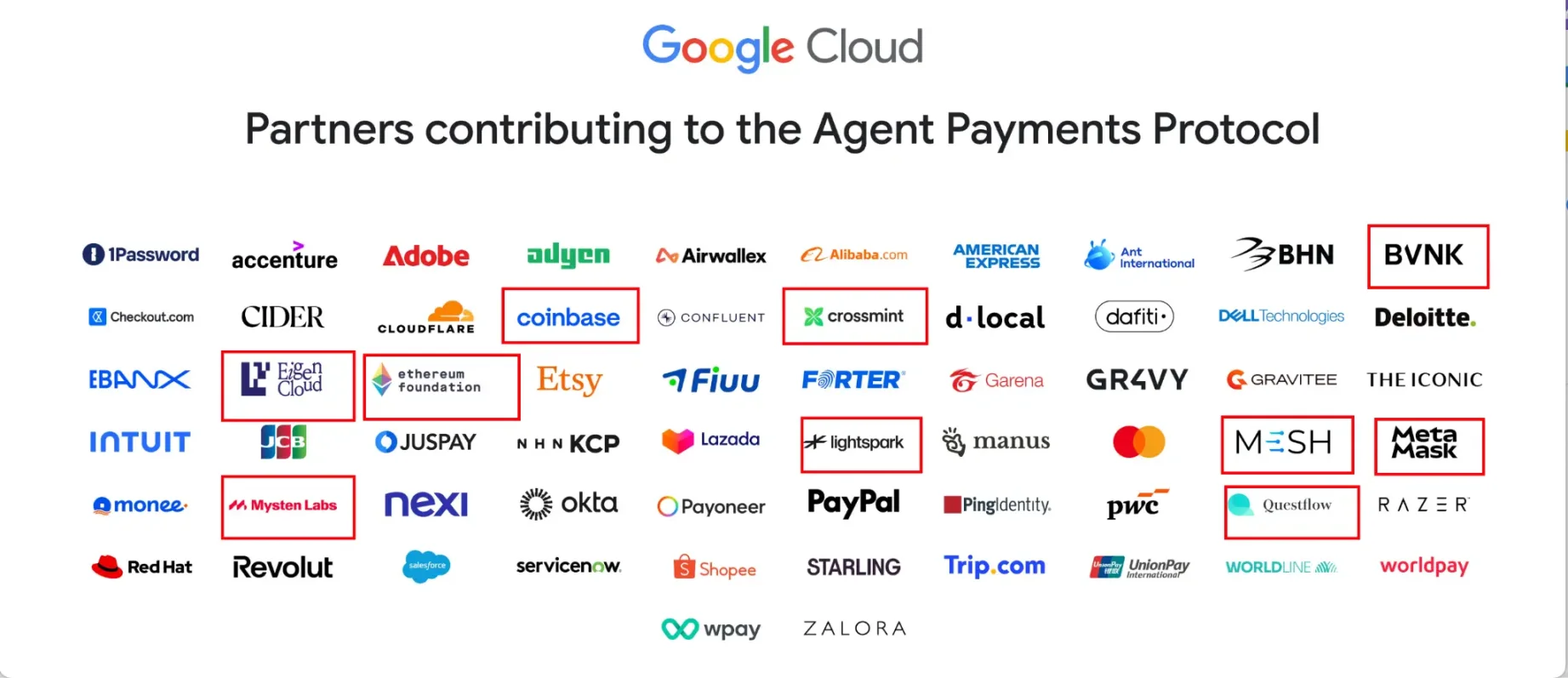
From the outset, AP2 was designed to be universal—not only supporting traditional payment methods like credit cards and bank transfers but also natively integrating stablecoins and cryptocurrencies. Google, together with Coinbase, Ethereum Foundation, and MetaMask, introduced the A2A x402 extension, delivering production-ready solutions specifically for crypto payments. This creates unprecedented opportunities for crypto projects deeply embedded in the AI agent economy. Here are ten projects playing key roles:
1. Coinbase: Champion and Practitioner of AI Payment Standards
As Google’s most important strategic ally in the crypto space, Coinbase plays a role far beyond that of a simple partner. It is not only the original proposer of the x402 payment standard but also actively driving its implementation.
Designed specifically for stablecoin payments, x402 supports micropayments and instant settlement between AI agents. Erik Reppel, Engineering Lead at Coinbase, described it as “a natural testing ground where agents begin transacting and exploring cryptographic rails.” In collaboration with Google, Coinbase demonstrated a shopping use case for Lowe’s, where a single user prompt enabled an AI agent to seamlessly research products, verify inventory, build a cart, and complete payment using x402 and stablecoins.
Internally, Coinbase has long used AI to improve operational efficiency. For example, its NodeSmith system uses AI to automate node upgrades across over 60 blockchains, reducing engineers’ repetitive work by 30%. Additionally, Coinbase is exploring cutting-edge areas such as integrating Bitcoin’s Lightning Network to lower payment costs.
In external expansion, Coinbase acquired the DeFi consumer app team Sensible and partnered with the U.S. Department of Commerce as the crypto infrastructure provider for its “GDP Data on Chain” project, deeply linking its business with the broader on-chain economy and AI applications. Its goal is to become a “one-stop trading platform” for the future AI agent economy.
2. MetaMask: Building Self-Custodial AI Agent Wallets
As a crypto wallet used by hundreds of millions globally, MetaMask’s core mission is ensuring users retain full control over their assets and data while enjoying the convenience of AI. Its vision is “self-custody in the age of agents.” Marco De Rossi, Head of MetaMask AI, emphasized: “Blockchain is the natural payment layer for agents, and Ethereum will be its backbone.”
To this end, MetaMask actively embraces the x402 standard and AP2 protocol, partnering with Stripe’s Bridge platform and M0 to launch MetaMask USD (mUSD), a stablecoin deeply integrated with its ecosystem.
On security, MetaMask introduced the Delegation Toolkit, enabling users to set granular permissions for AI agents—such as budget caps, allowable asset ranges, and time windows—achieving secure automation through “delegated authority without surrendering private keys.” Meanwhile, MetaMask collaborates with the Ethereum Foundation to advance ERC-8004, a trust agent standard establishing an open, verifiable agent registry and reputation system, allowing anyone to check an agent’s capabilities and credibility.
On August 26, MetaMask launched social login, allowing users to quickly create, back up, and recover wallets using Google or Apple accounts while preserving self-custody. This not only improves user experience but also solidifies MetaMask’s position as a secure and convenient gateway into the AI agent economy.
3. Ethereum Foundation: Building the Foundational Trust Network for the AI Economy
Leveraging strong network effects and liquidity, Ethereum serves as a neutral, trusted settlement and coordination network for the global AI agent economy. Currently, stablecoins on Ethereum exceed $171 billion in circulation, with $152.8 billion on the mainnet—a 78% year-on-year increase—solidifying its status as the world’s leading hub for stablecoin liquidity.
To seize the historic opportunity presented by AI, its mission is to “make Ethereum the preferred settlement and coordination layer for AI and machine economies.” The team is working in two directions: first, building an “AI economy on Ethereum” that provides AI agents with intermediary-free mechanisms for payment and coordination; second, advancing a “decentralized AI stack” to ensure AI does not depend on a few tech giants.
In this effort, the Foundation is actively promoting protocols like ERC-8004 (Trust Agent Standard) and collaborating closely with ecosystem projects to enable AI agents to securely pay, coordinate, and follow rules on Ethereum—freeing them from reliance on centralized platforms and building an open, censorship-resistant decentralized AI ecosystem.
4. Mysten Labs (Sui): High-Performance Infrastructure for AI Commerce
The AI agent economy demands extremely high speed and programmability for payments and transactions—areas where Mysten Labs and its Sui blockchain excel. As a launch partner of AP2, Sui leverages its unique architecture to achieve transaction finality in under 400 milliseconds, providing performance assurance for real-time AI agent interactions.
Its signature feature is Programmable Transaction Blocks (PTB), which bundle multiple complex operations into a single atomic transaction. For instance, a shopping agent can initiate six separate purchases from three different merchant agents and settle them all in one transaction, greatly improving efficiency.
Additionally, Mysten Labs has built a comprehensive tech stack to support the future of AI agents: Walrus for decentralized data storage with provenance tracking, Seal for programmable data access control, and zkLogin, which allows users to interact with blockchains privately using traditional Web2 accounts (e.g., Google). These innovations offer novel solutions to identity and data privacy challenges in AI agents.
5. EigenCloud: The Foundation of “Verifiability” in the AI Agent Economy
In environments where AI agents autonomously execute high-risk tasks, “trust” becomes paramount. EigenCloud aims to provide verifiability for all AI agent behaviors, thereby establishing a globally verifiable economy. Founder Sreeram Kannan noted that the AP2 protocol creates a “globally verifiable economy where agents can coordinate, transact, and prove their actions to humans and each other,” while EigenCloud provides the underlying infrastructure to ensure accountability.
EigenCloud’s core is its “crypto cloud” concept, which uses re-staking of the EIGEN token to extend Ethereum’s security to services such as AI computation, data availability (EigenDA), and dispute resolution (EigenVerify). This vision has attracted strong backing from top-tier investors: after a16z invested $100 million, it further purchased $70 million worth of EIGEN tokens.
To accelerate ecosystem growth, Eigen Labs released a suite of developer tools—DevKit, Hourglass, and Multichain—that reduce the time needed to build an AVS (Active Verification Service) from weeks to minutes, laying a solid foundation for the trust layer of the AI agent economy.
6. Crossmint: The “Universal Socket” Connecting Enterprises to the AI Economy
For most traditional enterprises, the barrier to adopting complex blockchain technology is prohibitively high. Crossmint acts as an enterprise-grade “translator” and “adapter,” wrapping complex blockchain backends into simple APIs so businesses can rapidly embrace the AI agent economy.
As a Google AP2 partner, Crossmint offers turnkey solutions like wallet-as-a-service and stablecoin payments, supporting both credit card and cryptocurrency payments—significantly lowering entry barriers for businesses and users alike.
Its capabilities have been proven in real-world cases: it helped global remittance giant MoneyGram launch a USDC-based cross-border payout service in Colombia, where users receive stablecoins directly in their wallets via SMS; it also built a Solana-based AI-powered loyalty program for popular boba tea brand Boba Guys, resulting in loyal customers spending 3.5x more and visiting stores 244% more often. With clients including Adidas, Red Bull, and Coinbase among its 40,000 enterprise and developer users, its stablecoin API and AI bot payment features are highly sought-after—subscriptions surged 1100% in 2024. Crossmint is emerging as a key enabler of AI agent commercialization.
7. BVNK: Full-Stack Provider for Enterprise Stablecoin Payments
BVNK focuses on delivering end-to-end stablecoin payment solutions for global enterprises, serving as a mature, intelligent financial infrastructure for corporate receivables, payments, and treasury management. As a Google AP2 partner and backed by Visa, BVNK has seen rapid growth, processing over $15 billion in annual transaction volume and serving global enterprises like Deel, Worldpay, and LianLian Global. Through collaboration with Paxos, BVNK is expanding its services to all 50 U.S. states.
Going further, BVNK integrates AI into its core offerings, launching an AI assistant and Smart Treasury. The AI assistant uses natural language processing to help customers check balances and generate addresses, while the Smart Treasury uses machine learning to predict liquidity needs, automatically rebalancing funds and managing gas fees—transforming traditional, passive financial management into proactive, intelligent automation perfectly suited to the 24/7 nature of stablecoins.
8. Mesh: The “Universal Payment Connector” for AI Agents
In a complex network of countless AI agents, wallets, and exchanges, how can payments always be completed in the most efficient and cost-effective way? Mesh aims to solve the fragmentation of the crypto payment ecosystem by providing a unified entry point for AI agents. CEO Bam Azizi says Mesh’s technology “abstracts away the complexity of the crypto ecosystem.”
As a supporter of the AP2 protocol, Mesh’s API seamlessly connects over 300 wallets and exchanges, supporting hundreds of tokens. When an AI agent needs to make a payment, Mesh’s technology automatically analyzes and identifies the optimal payment path, ensuring high success rates and speed. It functions like an “intelligent payment GPS” for the AI economy, navigating every transaction.
In August, Mesh secured a new round of funding from PayPal Ventures, Coinbase Ventures, and others, bringing total funding past $130 million. Additionally, it launched Wallet-as-a-Service, further cementing its role as foundational infrastructure for AI agent payments.
9. Questflow: The “Orchestration and Distribution Hub” for the AI Agent Economy
If other projects provide the “components,” Questflow is building the “assembly line” and “app store.” As a launch partner of AP2, Questflow positions itself as the orchestration layer for a multi-agent economy. It allows users to describe needs in natural language, then automatically coordinates multiple specialized AI agents (e.g., content generation, data analysis, transaction execution) to complete complex tasks. Since AP2’s launch, Questflow’s transaction volume has doubled weekly, showing explosive growth.
Its core is the Multi-Agent Orchestration Protocol (MAOP) and the TARS platform, which allow users to describe requests naturally (e.g., “summarize the latest developments in AI+Crypto”), prompting the platform to coordinate various AI agents (like news aggregation and on-chain analytics agents) to collaboratively fulfill complex tasks.
Questflow has built-in micro-payment via Coinbase’s x402, enabling agents to be paid based on task results and usage (pay-as-you-go), thus creating an open, composable AI labor market. Backed by a $6.5 million seed round and deep collaborations with top platforms like Google, Coinbase, and Circle, it launched the A2A.build portal—the central hub for discovering and using all AP2- and x402-compatible agents. The platform already hosts 40 active AI agents, 106 A2A integrations, and 66 developers, aiming to become the “App Store” of the AI era, controlling traffic and economic distribution for AI agents.
10. Lightspark: Empowering Real-Time AI Payments with Bitcoin’s Lightning Network
Amidst numerous Ethereum-based solutions, Lightspark stands out by bringing the near-instant, ultra-low-cost payment capabilities of Bitcoin’s Lightning Network into the AI agent economy. As a collaborator on the AP2 protocol, this company founded by former PayPal President David Marcus focuses on building an open, interoperable global payment network.
It has partnered with fintech giants SoFi and digital bank Revolut, integrating its technology into mainstream financial apps. By promoting its Universal Money Address (UMA) standard and aligning with Lightning Network integrations at exchanges like Coinbase, Lightspark offers AI agent payments a new, highly efficient, and cost-effective option powered by Bitcoin.
Building the Technical Foundation for AI Crypto Payments
The launch of Google’s AP2 protocol is far more than a technical update. In the future, AP2 may become the foundational infrastructure for AI + e-commerce + crypto payments. It sends a clear signal: AI is evolving from an information-processing tool into a true economic participant.
This transformation unfolds along two intertwined tracks:
-
Web2 Power: Giants like Google, Mastercard, and Salesforce provide massive application scenarios, user bases, and commercial networks.
-
Web3 DNA: Crypto-native forces like Ethereum, Coinbase, and MetaMask contribute the underlying philosophy and technical implementations of decentralization, trustlessness, and user sovereignty (stablecoins, smart contracts, non-custodial wallets).
The AP2 alliance represents the first large-scale convergence of these two forces. What emerges will be a new autonomous economy, driven by AI agents and transcending boundaries between traditional and crypto finance. For the ten crypto projects above, they are not merely participants—they are architects shaping this economic transformation.
Join TechFlow official community to stay tuned
Telegram:https://t.me/TechFlowDaily
X (Twitter):https://x.com/TechFlowPost
X (Twitter) EN:https://x.com/BlockFlow_News
 PANews