Forbes Exclusive Interview with Coinbase's First Chief Business Officer: The Crypto Giant's Ambition to Break Into the Mainstream
TechFlow Selected TechFlow Selected
Forbes Exclusive Interview with Coinbase's First Chief Business Officer: The Crypto Giant's Ambition to Break Into the Mainstream
Coinbase aims to be both a "full-category exchange" in the digital asset space and the "AWS" of crypto infrastructure.
 Navigating Web3 tides with focused insights
Interviewee: Shan Aggarwal, CBO of Coinbase
Original article: Sandy Carter, Forbes
Translation: Saoirse, Foresight News
Editor's Note: This article compiles an interview by Forbes with Shan Aggarwal, Coinbase’s first Chief Business Officer. Previously leading Coinbase Ventures for seven years while also serving as Vice President of Corporate and Business Development, Shan shares insights on Coinbase’s core strategy, including product expansion, institutional partnerships, global initiatives, stablecoin outlook, and market cycle strategies. His perspective offers a clear view into Coinbase’s real thinking and strategic planning on product innovation, market growth, and regulatory navigation—providing key insights into not only Coinbase but the broader cryptocurrency industry’s trajectory. Below is the full interview.

In September 2024, Coinbase’s inaugural Chief Business Officer, Shan Aggarwal, hosted a fireside chat with Coinbase co-founders Brian Armstrong and Fred Ehrsam III at the Coinbase Ventures annual summit.
In recent weeks, I’ve had the privilege of in-depth conversations with Shan Aggarwal, Coinbase’s newly appointed Chief Business Officer (CBO)—a role newly created at the crypto exchange. Shan’s background defies the traditional tech executive mold: he began in medicine, earning a bachelor’s degree in neuroscience from UCLA, before transitioning into the cryptocurrency industry and rising to become a leader in corporate strategy, M&A, and partnerships.
From overseeing fundraising and capital markets during Coinbase’s Series E round in 2018 through its public listing in 2021, to now being one of the youngest executives at a Fortune 500 company, Shan is stepping into leadership at a pivotal moment for Coinbase. With surging institutional demand for crypto and increasingly clear regulatory landscapes, his mission is clear: propel Coinbase into its next phase of growth, moving beyond its identity as a retail trading platform.
Below are his insights on the company’s strategy, market outlook, and vision for crypto’s mainstream future.
Q1: As Chief Business Officer of Coinbase, what are your core responsibilities?
As CBO, my primary responsibility is to tightly integrate all components of Coinbase’s growth engine. I oversee ecosystem partnerships, business operations and strategic planning, data and analytics, mergers and acquisitions (M&A), and investment activities. My role essentially serves as a “bridge” between the product team and market opportunities—defining not just what we should do, but how we execute it.

In September 2024, at the annual Coinbase Ventures summit, Shan Aggarwal posed for a photo with Brian Armstrong, Jesse Pollak, and members of the Coinbase Ventures team.
My focus is advancing Coinbase—not just as a trading platform, but as foundational infrastructure powering the entire crypto economy. This means partnering with institutions, retail partners, and emerging projects to deeply embed crypto into the core of global financial infrastructure.
Q2: What are the three core priorities under your leadership at Coinbase?
First, we’re focused on building best-in-class trading products by expanding support beyond cryptocurrencies to meet trader demand—such as stocks, futures, perpetuals, crypto-native assets, and prediction markets.
Second, we’re leveraging our existing platform to drive institutional adoption of crypto. Enterprise demand for crypto services is extremely strong, and our platform is “plug-and-play” for partners, enabling them to quickly offer crypto trading, staking, and other services to end users.
Third, we’re prioritizing payments and driving stablecoin adoption. We’re developing first-party payment products and building a crypto payments platform that other businesses can use. Throughout these priorities, international expansion remains a key focus—expanding our global footprint to fulfill our mission of “expanding economic freedom for people and businesses around the world.”
Q3: How will Coinbase’s growth evolve in the current market cycle?
Growth today is about quality over quantity. We’re not chasing vanity metrics—we’re deepening relationships with high-value customers and increasing our share of their crypto needs. This means expanding beyond trading into savings, spending, and financing, thereby enhancing engagement.
We also see massive growth potential in B2B—moving beyond direct-to-consumer to enabling other companies’ crypto strategies. We call this model “Crypto-as-a-Service.” As regulations clarify, we can offer white-label solutions and infrastructure APIs that allow enterprises to integrate crypto instantly, without building systems from scratch.
The builder ecosystem is vast. Consider fintech firms, payment processors, and traditional companies that want crypto functionality but don’t want to handle compliance, custody, or technical complexity—we can be their “crypto backbone.” This is evident in partnerships like BlackRock and PNC using our infrastructure for institutional crypto services, and companies like Perplexity integrating crypto data into their platforms.
These collaborations are transformative because they bring crypto to users who have “never downloaded a crypto app.” We’re not just growing our direct user base—we’re driving crypto adoption across the digital economy. This model expands our end-user reach and accelerates real-world crypto usage.
Q4: From Coinbase’s standpoint, what is your outlook on stablecoins and their regulatory future?
Stablecoins are a “platform-level shift” in payments. We believe all global asset classes will eventually move on-chain, and stablecoins are among the first and most critical categories. The increasingly clear regulatory landscape not only legitimizes stablecoins but establishes a solid foundation—setting unified frameworks for reserve requirements, transparency, and more.
I foresee a divergence: compliant, transparent stablecoins will clearly differentiate themselves from others. The winners will be those who work closely with regulators, not against them. We’re already seeing stablecoins integrate deeper into traditional finance—and this trend will continue, as stablecoins offer a more efficient, global, and lower-cost channel for dollar circulation.
In short, the digital economy needs digital currency, and stablecoins are the “missing piece.” Following the GENIUS Act, Coinbase holds a unique advantage in the stablecoin space, thanks to its broad USDC distribution network and ability to deliver industry-leading rewards.
Q5: How is Coinbase positioning itself for the next bull and bear cycles in crypto?
We take a long-term view and plan strategically across market cycles. During bear markets, we scale infrastructure to support the next wave of crypto applications and invest in long-term projects and teams. In bull markets, we focus on optimizing customer experience and launching innovative new products.
We’re heavily investing in the Coinbase platform because we believe that as regulations clarify, more enterprises will enter crypto. At the same time, we’re developing new revenue streams less tied to trading volume—such as stablecoin yield, custody fees, and staking rewards. Our goal is to build a company that is “antifragile,” capable of thriving regardless of market price fluctuations.
Q6: What is Coinbase’s acceleration strategy? What role will traditional finance play in mainstreaming crypto?
Traditional finance will serve as the “critical bridge” connecting legacy systems with decentralized finance. As CBO, I believe partnerships with institutions like JPMorgan Chase and American Express are vital to accelerating crypto adoption. These collaborations expand accessibility, lower consumer barriers, and embed crypto into everyday financial activities like payments and rewards programs.
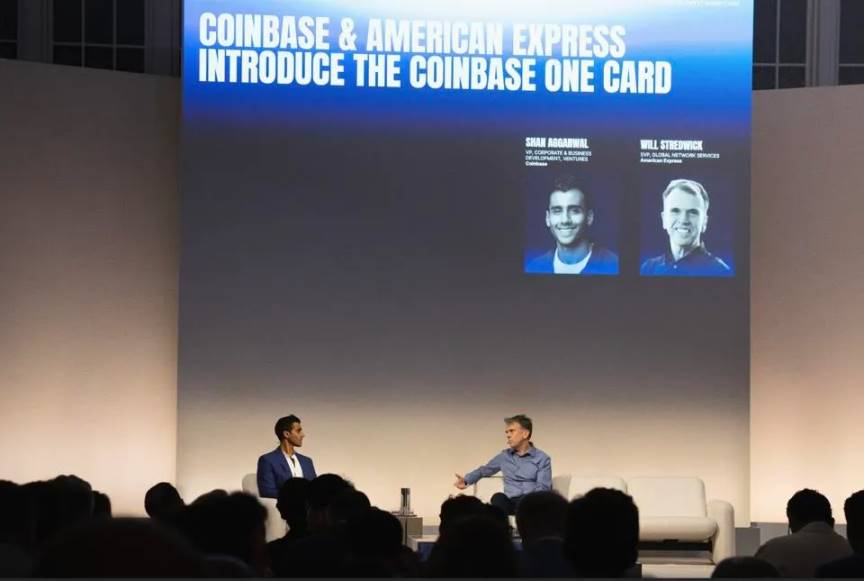
In June 2025, Shan took the stage at the Coinbase Crypto Summit alongside Will Stredwick, Senior Vice President at American Express, to discuss the new Coinbase One credit card—a card issued by American Express.
Leveraging traditional finance’s trust and infrastructure, we can attract the next wave of users into crypto and help millions worldwide achieve “economic freedom.”
This trend is already unfolding: institutions once skeptical of crypto are now exploring Bitcoin custody for clients; asset managers want to launch crypto ETFs and index products; payment firms are seeking stablecoin distribution channels. Our role is to provide secure, compliant infrastructure to empower their participation. In essence, traditional finance and crypto are moving toward each other—and Coinbase is the “bridge” between them.
Q7: Among emerging crypto areas like DeFi, NFTs, and RWAs, which present the greatest opportunities for Coinbase?
Currently, RWAs hold the most significant potential.
Tokenizing assets—from real estate to commodities—not only unlocks new markets but creates liquidity in areas previously starved of it. DeFi is also maturing—evolving beyond “yield farming” to become core infrastructure for a new generation of legitimate financial systems. At Coinbase, we believe the future of all asset classes lies on-chain, so we’re concentrating resources on building the infrastructure to make this vision a reality.
The key is identifying use cases that “solve real problems at scale,” not just driving speculative activity within crypto-native circles (though speculation has its place).
Q8: How will Coinbase balance international expansion with regulatory challenges in the U.S.?
We’re encouraged by efforts in the U.S. to improve regulatory clarity, but we also see enormous global opportunities—many markets have clearer rules and faster paths to implementation.
Regions like Europe, APAC, and Latin America are advancing rapidly in crypto regulation and adoption, and we’re actively matching that pace—building local partnerships and developing region-specific compliance capabilities to meet diverse market needs. The U.S. remains a critical market, but we won’t let an “incomplete domestic framework” limit our global ambitions. Crypto is a global phenomenon, and we’re committed to making Coinbase a global leader in this space.
Q9: What is Coinbase’s M&A strategy? When building core capabilities, does the company prefer “building in-house” or “acquiring and integrating”?
We’ve remained active in M&A and will continue to be. We view M&A as a core component of our growth engine—a capability we’ve cultivated over many years. Once a strategic direction is set, we evaluate execution paths across three dimensions: build, buy, or partner.
Core platform capabilities are primarily built in-house—this is our “foundation” and must be deeply integrated with our existing platform.
Acquisitions focus on opportunities that “accelerate our strategy,” such as acquiring differentiated technology, expertise, licenses, or established businesses. Recent examples include the acquisition of Deribit, a leading crypto options exchange, and Spindl, an on-chain advertising protocol and exchange.
These acquisitions enhance our product offerings and create new revenue streams. We also value talent, sometimes conducting small-scale “acqui-hires” to bring in specialized teams. The key to successful M&A is integration—only when an acquired business strengthens our core platform, rather than becoming an isolated “silos,” does the acquisition truly add value.
Q10: Five years from now, what do you want Coinbase to represent?
I want Coinbase to be the go-to platform where users, institutions, and their end customers “store and grow wealth.” Customers should know clearly that through our trusted, easy-to-use products, they gain access to unique opportunities. That’s our goal: to build a “full-suite exchange” and a mature financial platform where users can “trade every asset they want in one place,” easily grow wealth, and manage daily finances—all powered by crypto.
Beyond that, I want Coinbase to become synonymous with “crypto infrastructure”—just as AWS is in cloud computing. Base, Coinbase’s blockchain network, is building the future on-chain economy, supporting crypto applications across finance, social, and more. Whether you’re a startup issuing tokens, a bank offering crypto services, or a nation exploring digital currencies, Coinbase can be your trusted infrastructure partner. We aim to be essential, not optional—enabling innovation across every industry connected to crypto.
My New Understanding of Coinbase from Shan Aggarwal’s Insights
Through my conversation with Shan Aggarwal, I’ve gained a deeper understanding: Coinbase isn’t just preparing for the next crypto bull run—it’s building infrastructure for crypto’s long-term future. The company’s strategy isn’t about chasing short-term trends, but embedding crypto into everyday finance—from institutional adoption and stablecoin expansion to global market development. Shan makes clear that the key growth levers today are: high-quality growth, deeper customer relationships, and becoming the “crypto backbone” for enterprises.
I now also see Coinbase’s ambition more clearly: to be both the “full-suite exchange” in digital assets and the “AWS of crypto infrastructure.” Whether it’s tokenizing real-world assets, building compliant and trustworthy stablecoins, or bridging traditional finance and Web3, Shan’s vision is consistent: Coinbase won’t just “participate in the future of money”—it aims to “define the future of money.”
It’s a bold mission, and I’ll be watching every step of Coinbase’s journey ahead.
Join TechFlow official community to stay tuned
Telegram:https://t.me/TechFlowDaily
X (Twitter):https://x.com/TechFlowPost
X (Twitter) EN:https://x.com/BlockFlow_News
 Forbes