Not just wallets, MetaMask has also launched a stablecoin
TechFlow Selected TechFlow Selected
Not just wallets, MetaMask has also launched a stablecoin
Waiting nine years, and MetaMask delivers a stablecoin?
 Navigating Web3 tides with focused insights
Author: angelilu, Foresight News
When you ask friends in the space what their first on-chain application was, the answer is undoubtedly MetaMask—a plugin wallet featuring a cute fox logo and backed by Consensys, a company with strong technical capabilities within the Ethereum ecosystem.
In 2016, under the leadership of MetaMask founder Aaron Davis, this now-iconic fox in the blockchain world was born. Nine years later, despite long-standing community anticipation for MetaMask to launch a native token, the platform has unexpectedly made its first major move in the stablecoin arena.
Against the backdrop of the U.S. GENIUS Act bringing unprecedented clarity to stablecoin regulation, MetaMask seized the moment and announced yesterday (September 15) the official launch of its native stablecoin, MetaMask USD (mUSD).
Technical Architecture and Partners of mUSD
MetaMask first revealed plans to launch a stablecoin in an early August governance proposal. Less than a month and a half later, mUSD has already gone live—an accelerated rollout made possible by key partners.
mUSD’s issuance follows a tripartite collaboration model: Bridge, a subsidiary of Stripe, acts as the issuer; M0 provides the on-chain technical infrastructure; and MetaMask integrates the stablecoin deeply into its wallet ecosystem.
M0 plays a crucial role in this architecture by decoupling stablecoin reserve management from programmability. This allows regulated entities to connect to the platform to hold and manage reserves, while developers use it to control how their stablecoins operate—defining who can mint, hold, and transfer them, while also customizing new revenue streams and loyalty opportunities.
In late August this year, M0 announced a $40 million funding round, bringing its total funding to $100 million. Beyond supporting MetaMask’s mUSD, M0 has also participated in issuing Noble’s RWA blockchain stablecoin USDN and Usual’s stablecoin protocol USD0. Additionally, the neobanking platform KAST and gaming OS Playtron are building their own stablecoins using M0.
Who is the regulated entity responsible for actually issuing mUSD? That would be Bridge, which provides compliance licensing, monitoring, and strict reserve management for mUSD. Bridge was acquired last October by payments giant Stripe for $1.1 billion and offers comprehensive support and solutions for enterprises looking to issue customized stablecoins.
Zach Abrams, co-founder and CEO of Bridge, said regarding the mUSD launch: "Issuing custom stablecoins used to take over a year and complex integrations. With our issuance technology, we’ve reduced that to just weeks."
Positioning and On-chain Ecosystem Strategy of mUSD
mUSD is positioned as a “wallet-native, self-custodial, high-utility” stablecoin. Its key differentiator from traditional stablecoins lies in seamless integration with the wallet. mUSD will serve two core use cases:
-
On-chain applications: enabling frictionless deposits, exchanges, transfers, and cross-chain functionality;
-
Real-world usage: expected to be spendable at millions of Mastercard-accepting merchants worldwide via the MetaMask card by end of 2025.
Gal Eldar, MetaMask’s product lead, stated: "mUSD is a critical step in bringing the world onchain. It will help us overcome some of the most persistent barriers in web3, reducing user onboarding friction and cost. We’re not just getting people onchain—we’re building reasons they’ll never want to leave."
mUSD is initially deployed on Ethereum and Linea, the latter being an EVM-compatible Layer 2 network developed by Consensys. On Linea, mUSD will serve as foundational infrastructure, integrated across core DeFi protocols including lending markets, decentralized exchanges, and custodial platforms, offering deep liquidity. The team also noted that mUSD’s introduction is expected to drive continued growth in Linea’s TVL and protocol activity.
Stablecoins have long been the backbone of DeFi, yet they’ve always existed outside wallets. This strategic move signals Consensys’ ambition—not just to build wallets, but to create a complete on-chain financial ecosystem.
Moreover, although mUSD currently discloses no yield features, MetaMask previously launched Earn, a savings and yield product for stablecoins, suggesting future yield potential for mUSD could be significant.
Cross-chain expansion is another key direction for mUSD. Wormhole has confirmed its role as an interoperability partner, supporting future multi-chain extensions of mUSD to enhance its liquidity and utility across different blockchain ecosystems.
Reserve Mechanism and Data for mUSD
For any stablecoin, reserve composition is critical. While MetaMask has not explicitly disclosed mUSD’s reserves, M0, as the technical provider, implements an on-chain proof-of-reserves mechanism allowing users to verify in real-time the correspondence between mUSD’s supply and its reserve assets.
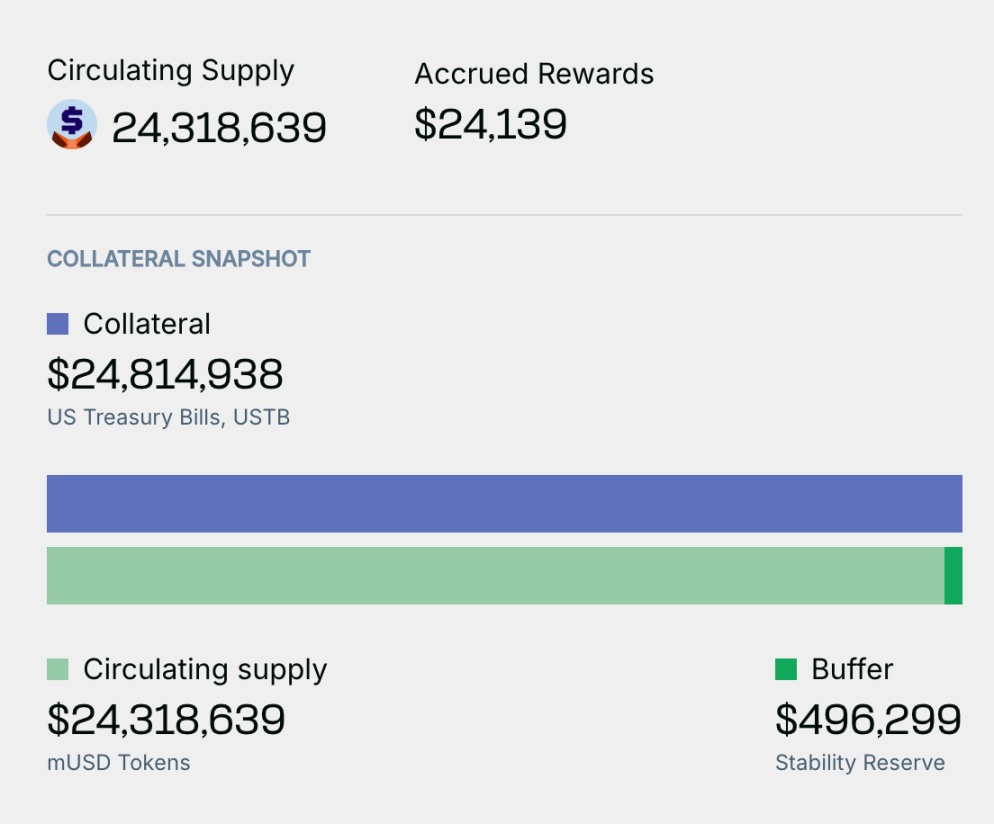
According to data disclosed by M0, mUSD uses an overcollateralization model. The collateral value ($24,814,938) exceeds the circulating supply ($24,318,639), resulting in an overcollateralization rate of approximately 102%. The system includes a nearly $500,000 stability reserve as an additional buffer against market volatility. mUSD’s collateral consists entirely of highly liquid, low-risk assets such as U.S. Treasuries.
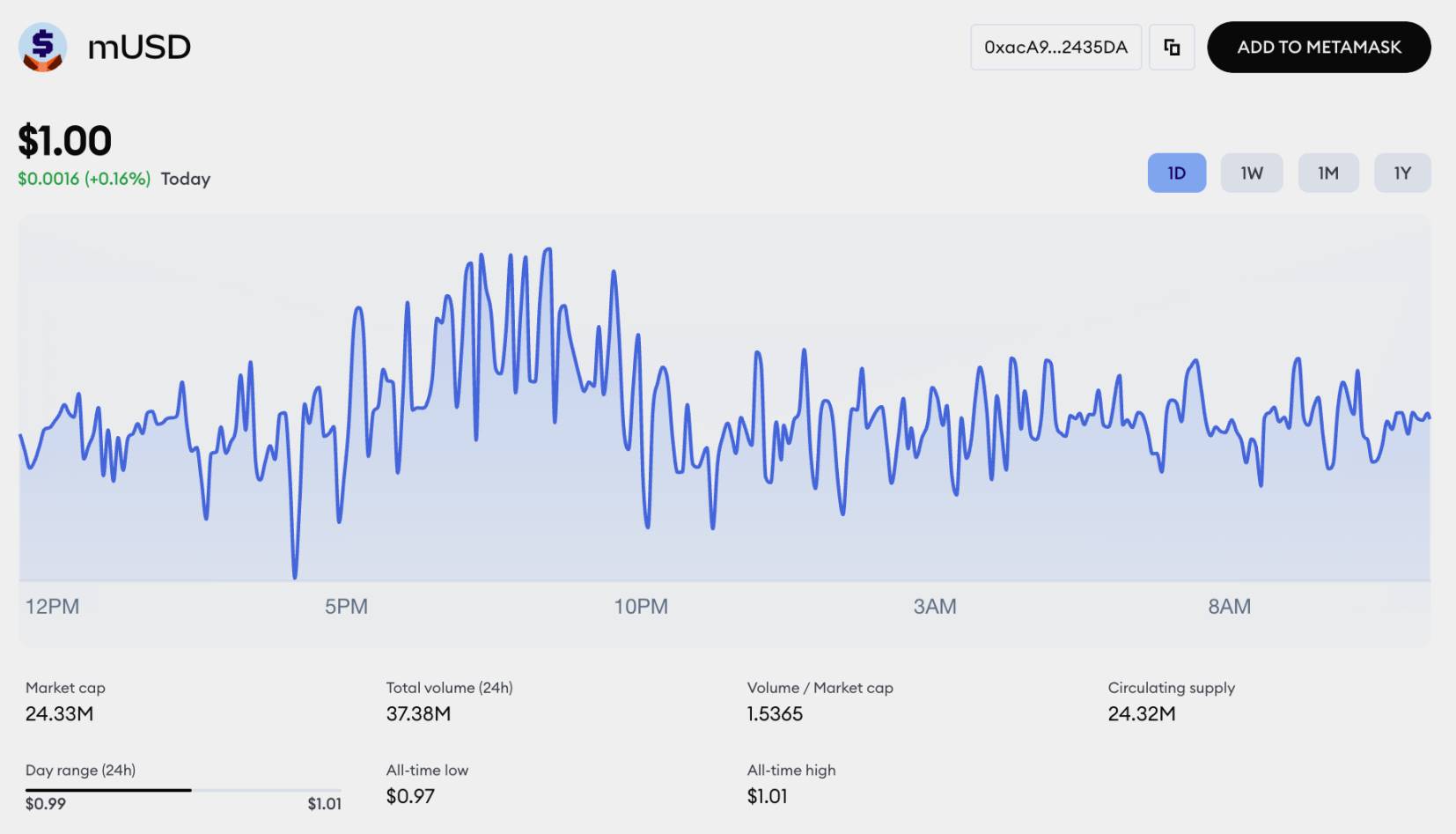
MetaMask’s official website now features an interface for purchasing and exchanging mUSD. Less than 24 hours after launch, according to Etherscan data, mUSD’s circulating supply stands at 24.36 million tokens, held by 179 addresses, with 1,539 transactions recorded.
Consensys has not yet disclosed mUSD’s specific business model or revenue sources. Based on industry norms, stablecoin issuers typically earn income through interest on reserve assets, transaction fee sharing, or capturing ecosystem value.
Toward a DeFi Super App
MetaMask was once the undisputed leader in the wallet space, reaching a peak of 30 million monthly active users during the 2021 bull run and again in January 2024. However, according to Token Terminal data, recent months have seen its monthly active users drop to around 250,000, with market share falling to 14.8%, placing it third among similar products.
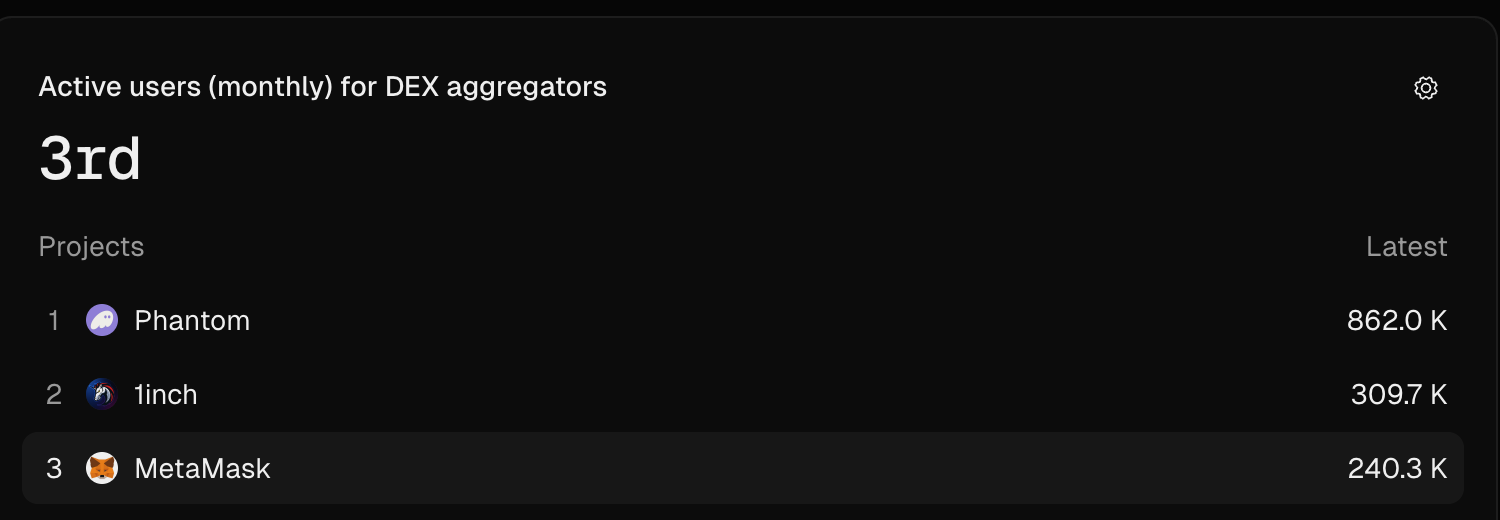
In contrast, leading DeFi applications like Uniswap and Aave are evolving from single-function tools into comprehensive platforms: Uniswap is becoming a trading super app with its own wallet, cross-chain standard, and routing logic; Aave has launched its own stablecoin and integrated lending, governance, and credit functionalities. The market trend is clear—single-purpose products are giving way to ecosystem-level super apps.
Against this backdrop, MetaMask’s launch of mUSD—as one of the most iconic wallets in the Ethereum ecosystem—carries strategic significance far beyond a simple product update. It represents not only a systematic exploration into tokenomics but also a pivotal step in Consensys’ vision to build a full-stack DeFi service matrix.
The “little fox” is transforming from a standalone wallet tool into a comprehensive financial services platform. As Web3 experiences mature, MetaMask no longer aims merely to be a gateway—it aspires to become the “super app” accompanying users throughout their entire on-chain journey.
Join TechFlow official community to stay tuned
Telegram:https://t.me/TechFlowDaily
X (Twitter):https://x.com/TechFlowPost
X (Twitter) EN:https://x.com/BlockFlow_News
 Foresight News