








Besides stablecoins, what will drive RWA asset value to $30 trillion?
TechFlow Selected TechFlow Selected
Besides stablecoins, what will drive RWA asset value to $30 trillion?
Tokenization has evolved from proof-of-concept pilots into a global infrastructure, with billions of dollars flowing into diversified real-world assets across continents.
 Navigating Web3 tides with focused insights
By: Blockchain Knight
In 2025, the tokenized real-world asset (RWA) market has approached $300 billion, with some forecasts suggesting it could reach $30 trillion by 2034.
This momentum is largely driven by stablecoins, which this week alone hit a record high of $165 billion in supply on Ethereum.
But can blockchain infrastructure sustain such massive demand amid high fees, high friction, and clunky user experiences?
Despite significant progress in tokenized RWA, crypto innovators recognize that a truly seamless system remains a moving target.
"It's still evolving," admits Aishwary Gupta, Head of Global Payments at Polygon Labs.
With a Web2 payments and treasury management background at American Express—where he oversaw "cross-border fund flows"—Aishwary believes the issue isn't technology itself, as the underlying tech is rapidly advancing.
Aishwary emphasizes that old scalability challenges are quickly fading, only to be replaced by new barriers such as regulatory hurdles and liquidity bottlenecks.
Four-Year Transformation: From Struggle to Breakthrough
Aishwary joined in 2021 as the first full-time employee dedicated to Polygon’s DeFi business. Comparing the current state of tokenized payments to the past, he says the difference is night and day. He recalls that four years ago, fees were higher and onboarding was far worse.
"Four years ago, users had to pay 5% or even 10% just to get onto the chain. You might try five on-ramps before one worked. From that situation to today, completing transactions and funding your account has become much easier. We haven’t fully evolved yet, but looking back over four years, the process is significantly smoother."
Aishwary points out that the core issue lies in fee structures shaped by fragmented market conditions and regional regulations: "In specific markets, only one or two institutions may be licensed or inside a liquidity sandbox. The number of actual authorized participants for on/off-ramping is extremely limited, so you see all kinds of arbitrage... Transferring ten billion dollars on-chain costs just one cent—the real bottleneck is regulatory arbitrage."
Regulatory Clarity: Who’s Leading the Tokenization Race?
If stablecoin issuers and RWA providers are leveraging regulatory arbitrage, where are they going? Which regions are laying the groundwork for a multi-trillion-dollar explosion, genuinely embracing the technology and pushing forward aggressively?
Aishwary identifies four key regions: the United States, Singapore, Europe, and the Middle East. "These are the markets we see with high levels of adoption."
He notes that the U.S. is shifting from long-term lagging to leadership, thanks to increased regulatory transparency.
As BitMEX CEO Stephan Lutz noted weeks ago, the Trump administration flipped the script overnight with the GENIUS Act, which sets clear standards for stablecoin issuance and delivers long-awaited regulatory certainty for U.S. issuers.
Singapore is another pioneer in tokenized RWAs, especially stablecoins.
Its Payment Services Act and Financial Services and Markets Act have established a clear licensing regime for digital token service providers, strictly regulated by the Monetary Authority of Singapore and aligned with international financial standards.
Major players like Nium, Zodia Custody, and Crypto.com have chosen Singapore for its innovative payment corridors and regulatory framework.
"Beyond dollar payments, Singapore dollar transaction volume ranks second," Aishwary shares.
Europe, according to Aishwary, is a classic case of "solid but slow." While MiCA (Markets in Crypto-Assets Regulation) still requires adjustments, he believes it has done "extensive due diligence" for stablecoin issuers, with established firms like Bitstamp and Fireblocks already offering regulated digital asset payment services under MiCA.
The Middle East isn't trailing either. Take Abu Dhabi, where regulators have clearly defined requirements for banks issuing stablecoins, establishing clear guidelines for reserve management and compliance.
Idle Capital Always Chases Yield
Given Aishwary’s mention of the GENIUS Act, we asked about his view on its clause prohibiting stablecoin issuers from paying any interest or yield to holders.
He responded: "The problem is that idle capital in banks earns at least some interest—even if low, there’s still yield. If on-chain dollars can offer higher returns than off-chain, users will naturally keep their funds on-chain, which actually disrupts the entire banking cash flow."
In fact, traditional financial institutions and crypto-native asset managers are increasingly seeking yield from on-chain products such as tokenized U.S. Treasuries, private credit, and regulated money market funds.
By mid-2025, assets under management (AUM) in tokenized Treasuries surpassed $7.4 billion, with major institutions like Goldman Sachs, BNY Mellon, and Securitize actively allocating capital into these products to capture higher yields, instant settlement, and flexible collateralization—often outperforming traditional off-chain banking instruments.
RWA Trends Beyond Stablecoins
We shifted the conversation from stablecoins to other trends in tokenized RWAs. While tokenized stocks are gaining buzz on centralized exchanges like Kraken and Coinbase, and DeFi platforms like Synthetix and Mirror Protocol, Aishwary remains analytically cautious:
"Everyone is chasing tokenized stocks, thinking it’s the best path forward, but Polygon tried tokenizing stocks a year and a half ago—it didn’t work, because there wasn’t enough demand."
Why the lack of interest? He explains: "Unless you’re from certain regions where you can’t access Apple stock, users anywhere—from India to Dubai—already hold Apple shares through their bank accounts. Tokenization hasn’t reached those who truly lack access."
Besides, liquidity remains an unsolved challenge. "On-chain liquidity is still a major issue—thin liquidity often leads to poor pricing or exchange rates for users." This isn’t the breakthrough many expected.
Commodities and Non-Dollar Stablecoins
The two trends Aishwary sees real potential in within the tokenized monetary world are non-dollar stablecoins and tokenized commodities—areas still underappreciated.
Polygon captures 50–60% of the total market share in non-dollar stablecoins and continues to grow rapidly. We're heavily expanding in this space. Tokenized commodities like gold and silver are also crucial, aiming to improve accessibility and trading ease.
Globally, non-dollar stablecoins now account for around 30% of active cross-border transaction volumes outside the U.S.
The global market size for tokenized commodities reached approximately $25 billion in 2024, with gold tokens valued at around $1.7 billion, while oil, silver, and agricultural commodity tokens steadily gain share.
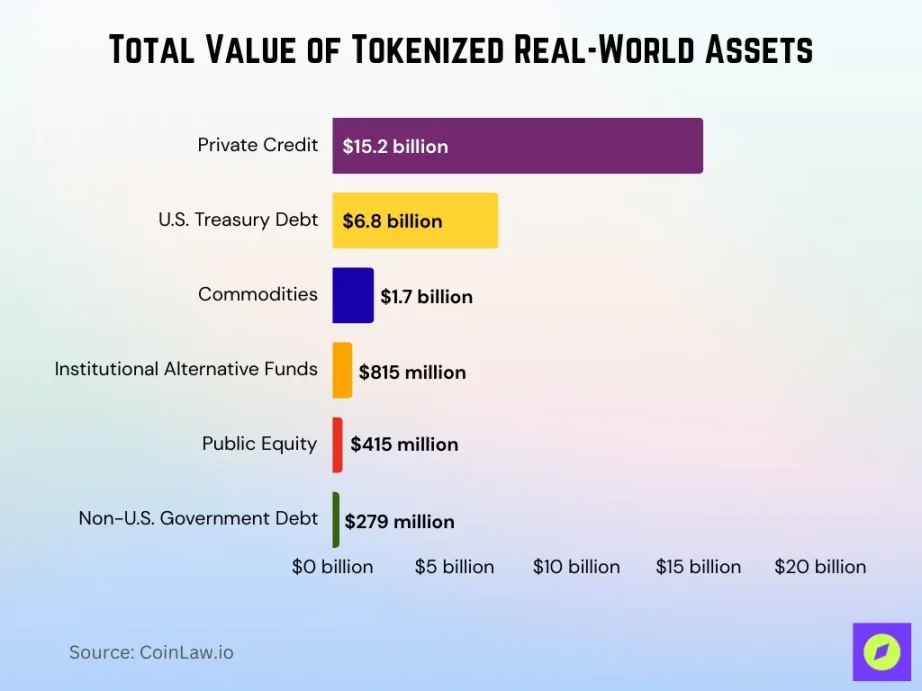
Aishwary adds: These commodities or assets may be on-chain, but they haven’t yet developed into independent ecosystems. That’s the missing piece today.
The Road to $30 Trillion
As tokenized RWAs move toward the trillion-dollar scale, how the market landscape evolves will be critical. Against the backdrop of governments globally accelerating hard asset accumulation—with gold prices hitting record highs for strategic reserves—the growth of tokenized gold follows logically.
In just a few years, tokenization has evolved from proof-of-concept pilots to global infrastructure, with billions of dollars flowing into diversified real-world assets across continents.
The future will depend not only on scaling and removing regulatory barriers but also on how the industry unlocks new forms of value and utility beyond the transformation already initiated by stablecoins.
Join TechFlow official community to stay tuned
Telegram:https://t.me/TechFlowDaily
X (Twitter):https://x.com/TechFlowPost
X (Twitter) EN:https://x.com/BlockFlow_News






