Can Plume become a compliant liquidity engine for Ant Chain RWA to "bring fresh water into the market"?
TechFlow Selected TechFlow Selected
Can Plume become a compliant liquidity engine for Ant Chain RWA to "bring fresh water into the market"?
The difficulty of RWA has never been in "writing the contract," but in "bringing the institution on-chain."
 Navigating Web3 tides with focused insights
Author: Sanqing
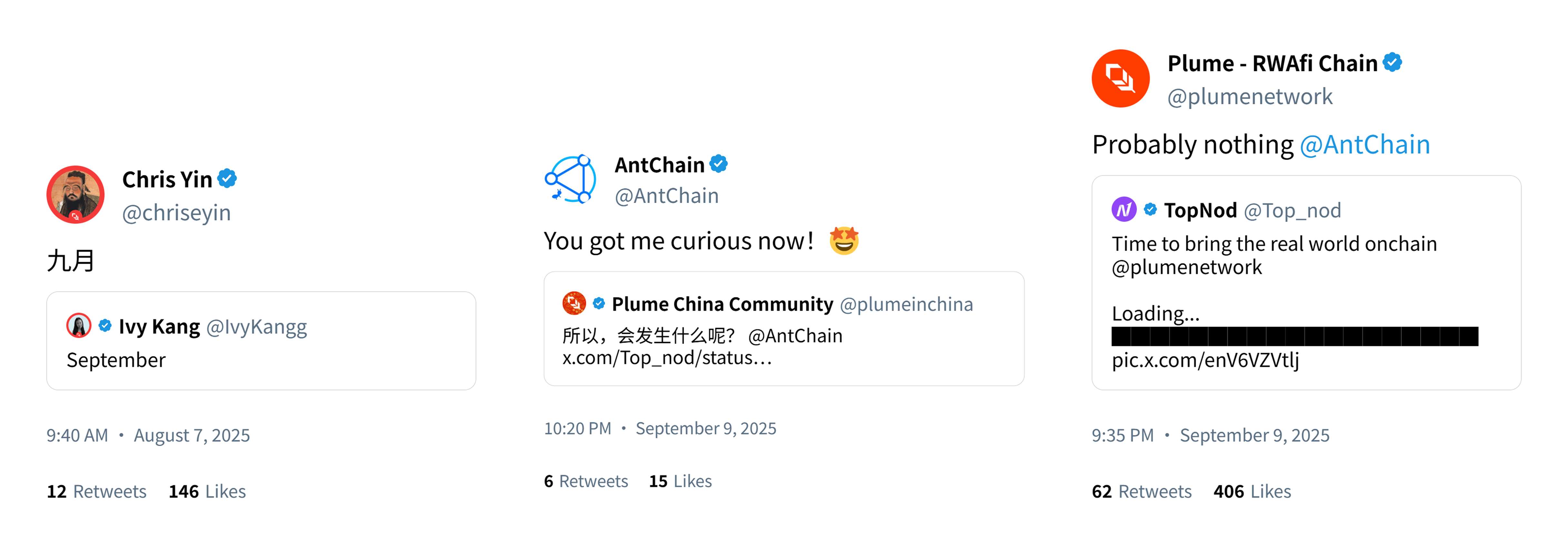
In early August, the Plume team sparked speculation with a teaser labeled "September," and CEO Chris Yin communicated in Chinese, leading the community to speculate that September might bring partnership developments. Recent public interactions between Plume and AntChain have further amplified these expectations.
The Foundations and Strengths of Two Chains
AntChain
Positioning: A leading domestic permissioned consortium blockchain, serving government, enterprise, and industrial internet scenarios.
Technical Characteristics:
-
Permissioned System and Identity Framework: Institutional-grade CA, real-name mapping for enterprises/individuals, fine-grained access control.
-
Auditable Compliance: On-chain traceability, multi-node consensus, integration with off-chain audit and risk control systems.
-
High Performance and Deterministic Finality: Designed for stable business needs such as reconciliation, settlement, and judicial evidence collection.
-
Privacy and Data Governance: Mature capabilities including Multi-Party Computation (MPC) and Trusted Execution Environment (TEE).
Strengths in Applications: Supply chain finance, cross-border trade compliance, digital certificates/evidence storage, industrial collaboration—“digitizing real-world assets within institutional frameworks.”
Plume
Positioning: EVM-compatible chain focused on RWA, emphasizing composability and developer ecosystem for RWA ✖ DeFi.
Technical Characteristics:
-
EVM / Account System: Deep compatibility with Ethereum ecosystem, low migration cost for contracts and toolchains.
-
Compliance Modules: Chain-level AML, supporting modular compliance logic such as whitelisting, transfer restrictions, and secondary verification.
-
Natively DeFi-Friendly: Lego-style composability via AMM/lending/LP/yield distribution, adaptable to various market-making and derivative strategies.
-
Open Visibility: Assets gain easier access to global developers and market-making networks, enhancing secondary liquidity.
Strengths in Applications: Market making, LP, stable vaults, leverage/looping, yield tokenization—“bringing compliant assets to life.”
Practical Constraints in Linking Permissioned and Public Chains
While linking permissioned chains (e.g., AntChain) and public chains (e.g., Plume) holds great potential, it faces multiple practical challenges stemming from regulatory, technical, and operational barriers—especially evident in the 2025 RWA landscape:
-
Legal Anchor: Onshore asset issuance and investor registries are strictly regulated locally (e.g., by mainland China or Hong Kong SFC), making it impossible to simply “move the chain” to a public chain environment without risking non-compliance.
-
Suitability and Transfer Restrictions: Only qualified investors (e.g., institutions or accredited individuals) may hold/trade; registries must remain consistent with original systems in real time, limiting retail participation and raising KYC thresholds.
-
Bridge Trust Model: Permissioned chains often lack light-client verification available on public chains, relying instead on operators, custodians, and periodic audits as core security mechanisms—making them vulnerable to centralization risks.
-
Cash Flow and Redemption: Payouts of coupons, rents, and maturity redemptions require compliant cross-border fund flows while ensuring full traceability and audibility across the entire chain—posing high technical integration complexity.
Simple technical bridging is insufficient. Solutions must also satisfy compliance and regulatory requirements, integrate multi-chain interoperability, bridge the strengths of both chains, minimize risks, and lay the foundation for future collaboration models.
However, on August 26, news emerged that Guotai Junan International (GTJAI) partnered with Ant Digital Technologies to complete the first cross-chain issuance of structured product tokens from AntChain to Ethereum, including fixed-income redeemable tokens and principal-guaranteed products linked to U.S. equity ETFs. This achieved T+0 settlement and transparent auditing, demonstrating a compliant flow mechanism similar to a custody bridge. It provides a successful case reference for AntChain RWA assets to be bridged to Plume. Additionally, Plume has previously successfully onboarded a USD money market fund issued by CMBI under the Singapore-Hong Kong mutual recognition framework.
Three Possible Collaboration Models
Model A: One-Way “Issuance Gateway”
Process
-
Assets are issued, custodied, and investor KYC completed on AntChain;
-
A gateway institution locks the asset and mints mirrored tokens (ERC-20/1155 + compliance hooks) on Plume;
-
Mirrored tokens can only be transferred among whitelisted wallets;
-
Upon redemption, Plume burns the mirror token, and the gateway unlocks the original asset rights on AntChain.
Characteristics:
-
Simple, clear, and easily auditable;
-
Suitable for standardized, short-duration, cash-flow-stable assets (e.g., rent, receivables/factoring).
-
Risk: Limited liquidity, reliance on gateway trust.
Model B: Two-Way “Custody Bridge”
Built upon Model A, adding:
-
Proof of Reserves (PoR): Regular disclosure of on-chain and off-chain reconciliation;
-
Multi-sig / Custodian System: Distribute operational risk;
-
Tranched Shares: Senior/subordinated structures matching different risk profiles.
Enhances market confidence and supports richer income-generating and term-managed products. Risk: Collusion among custodians could amplify systemic issues.
Model C: ZK-KYC and Programmatic Compliance
-
Investors complete qualification checks on the AntChain side and receive anonymous credentials (ZK proofs);
-
On Plume, they prove only “I meet the criteria” without revealing identity details;
-
Combines compliance with privacy, suitable for more open secondary markets and market-making networks.
Conclusion
The challenge of RWA has never been about “writing the smart contract,” but about “migrating institutional frameworks.” AntChain provides the anchor of regulation and trust, while Plume offers the engine of market access and composability. With a “trusted gateway + mirrored tokens” framework, augmented by PoR, custody, and auditing safeguards, AntChain’s RWA assets can maintain compliance while embracing liquidity. However, actual collaboration requires regulatory approval and carries technical and geopolitical risks. Monitor official updates closely—when stability and dynamism truly coexist, that will be the most valuable moment for this bridge.
Join TechFlow official community to stay tuned
Telegram:https://t.me/TechFlowDaily
X (Twitter):https://x.com/TechFlowPost
X (Twitter) EN:https://x.com/BlockFlow_News