Nasdaq to welcome first "European Web3 concept" stock
TechFlow Selected TechFlow Selected
Nasdaq to welcome first "European Web3 concept" stock
What gives CoinShares the edge to list on U.S. markets at over 30% premium?
 Navigating Web3 tides with focused insights
By Eric, Foresight News
Following Coinbase, Galaxy Digital, Circle, Bullish, and Gemini, another Web3 company is set to enter the U.S. stock market.
On September 8, European crypto asset management firm CoinShares will merge with Vine Hill Capital Investment Corp, a special purpose acquisition company (SPAC) listed on Nasdaq in the United States, and the newly formed Jersey-based entity Odysseus Holdings Limited. Following the merger, CoinShares will be listed on Nasdaq (or another U.S. exchange) and delist from Nasdaq Stockholm. After several U.S.-based Web3 companies have successively gone public, the first Europe-based Web3 firm will also enter the U.S. capital market.
CoinShares originated from Global Advisors, a commodities investment firm founded in 1998 by Russell Newton and Danny Masters. Russell Newton worked for eight years in crude oil trading at companies including Shell starting from 1986, then joined JPMorgan Chase in July 1994 as a commodities strategist. The other co-founder, Danny Masters—now also chairman of CoinShares—previously served as global head of energy trading at JPMorgan before founding Global Advisors with Russell Newton.
JM Mognetti, an economist and current CEO of CoinShares, joined Global Advisors in 2012. Just one year after his arrival, global macro investors began withdrawing heavily from commodities into equities and fixed income. For the three executives, it became urgent to find new investment directions—and at that moment, Bitcoin, then priced only a few hundred dollars, caught their attention.
With almost no hesitation, Global Advisors fully pivoted to digital assets in 2014, later rebranded as CoinShares in 2016, and gradually evolved into today’s integrated crypto asset management firm encompassing asset management, capital markets operations, and proprietary investments.
In 2014, Global Advisors launched Europe’s first regulated Bitcoin investment fund. After the rebranding, CoinShares acquired XBT Provider—the issuer behind the first Bitcoin-based security listed on a regulated exchange. Its product, Bitcoin Tracker One ETP, debuted on the Swedish exchange in 2015.
In early 2021, CoinShares began launching physically backed ETPs (exchange-traded products), which now cover not only Bitcoin and Ethereum but also tokens such as LTC, XRP, LINK, and UNI. In March of the same year, CoinShares listed in Sweden, becoming the second publicly traded Web3 company globally after Galaxy Digital (which had already been listed on Canada’s Toronto Stock Exchange). According to data provided by CoinShares, as of February 19, 2021, its assets under management (AUM) reached $4.56 billion, including 70,185 BTC and 655,211 ETH, making it at the time the largest crypto asset manager in Europe and the second-largest globally (after Grayscale).
In comparison, as of February 24, 2021, Grayscale’s total AUM stood at $39.3 billion, Bitwise surpassed $1 billion in AUM, and Galaxy Digital reported $834.7 million in AUM as of January 31, 2021.
In early 2024, following the SEC's approval of multiple spot Bitcoin ETF applications, CoinShares acquired Valkyrie, one of the issuers of spot Bitcoin ETFs. At the time of writing, Valkyrie’s spot Bitcoin ETF has over $650 million in AUM.
Besides asset management, investments are also a key business for CoinShares. At the time of its 2021 listing, CoinShares disclosed its late-2020 investments in Canadian crypto asset manager 3IQ Corp and the parent company of U.S. qualified custodian Kingdom Trust. In both 2021 and 2022, CoinShares invested twice in Swiss online bank FlowBank, reaching nearly 30% ownership at its peak, though FlowBank eventually went bankrupt and liquidated in 2022 due to insolvency.
Having reviewed CoinShares’ development history, let’s now examine its financial situation.
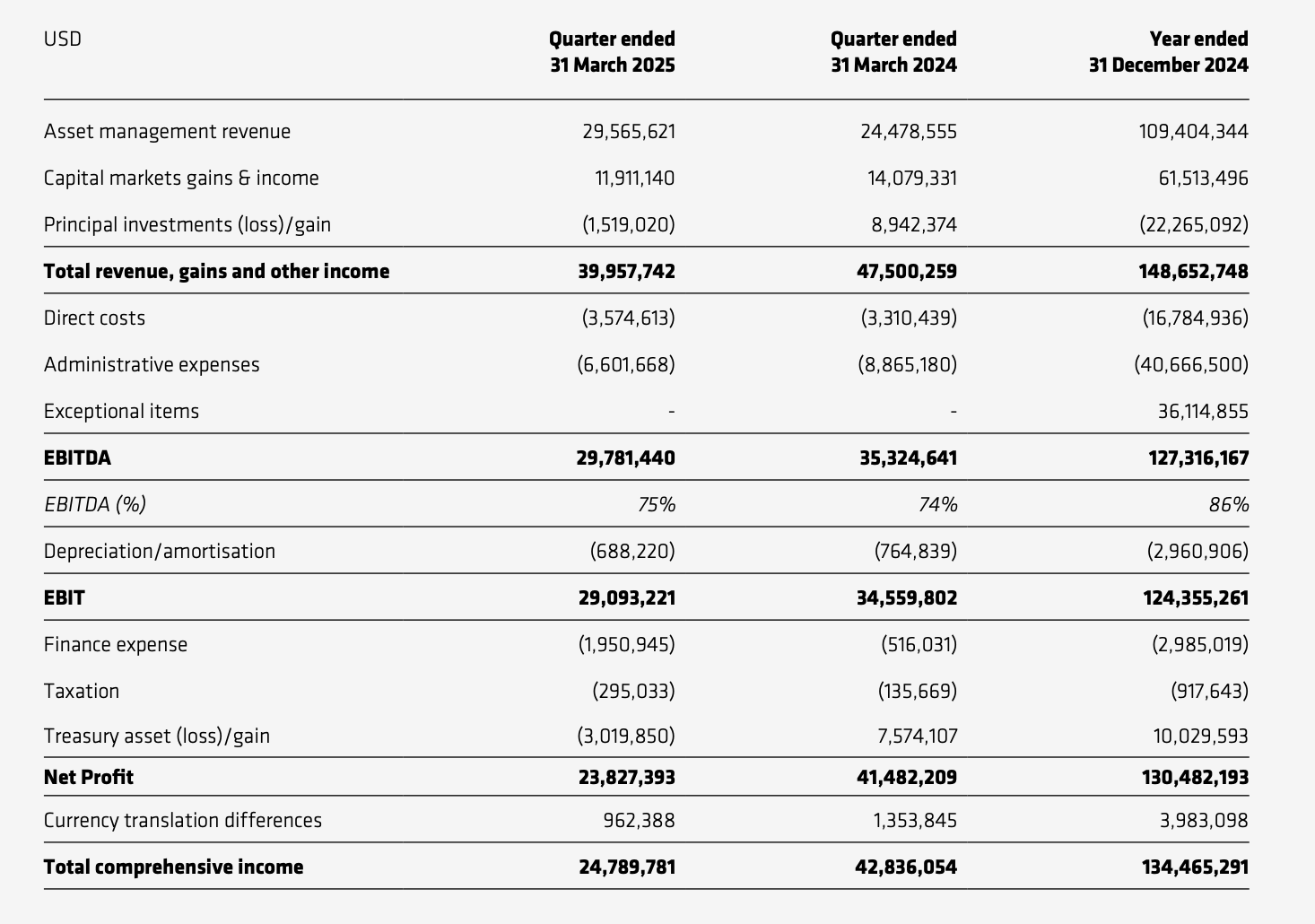
Comparing CoinShares’ Q1 and Q2 financial reports released this year, the company recorded $39.958 million in revenue in Q1, down approximately 15.88% year-on-year. EBITDA (earnings before interest, taxes, depreciation, and amortization) was $29.781 million, down about 15.7% year-on-year, yet profit margin reached 75%, slightly up year-on-year. Including changes in the value of self-held crypto assets, taxes, and other factors, CoinShares' comprehensive income for Q1 totaled approximately $24.79 million, down 42.1% year-on-year.
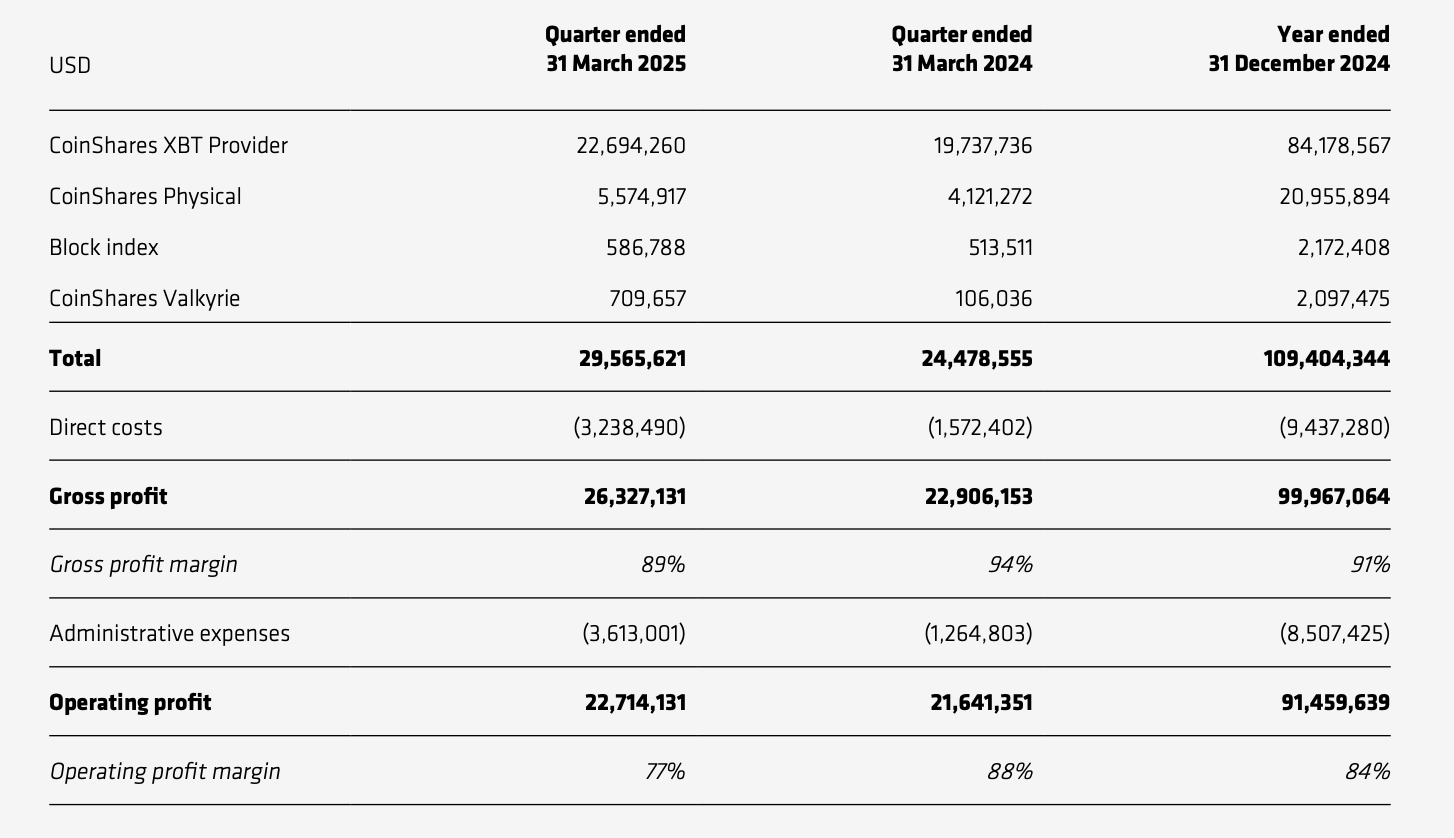
In asset management—the highest-revenue segment—CoinShares generated $29.566 million in Q1, accounting for roughly 74% of total revenue, up about 20.8% year-on-year. After deducting direct costs and administrative expenses, profit was approximately $22.714 million, up modestly by around 5% year-on-year.
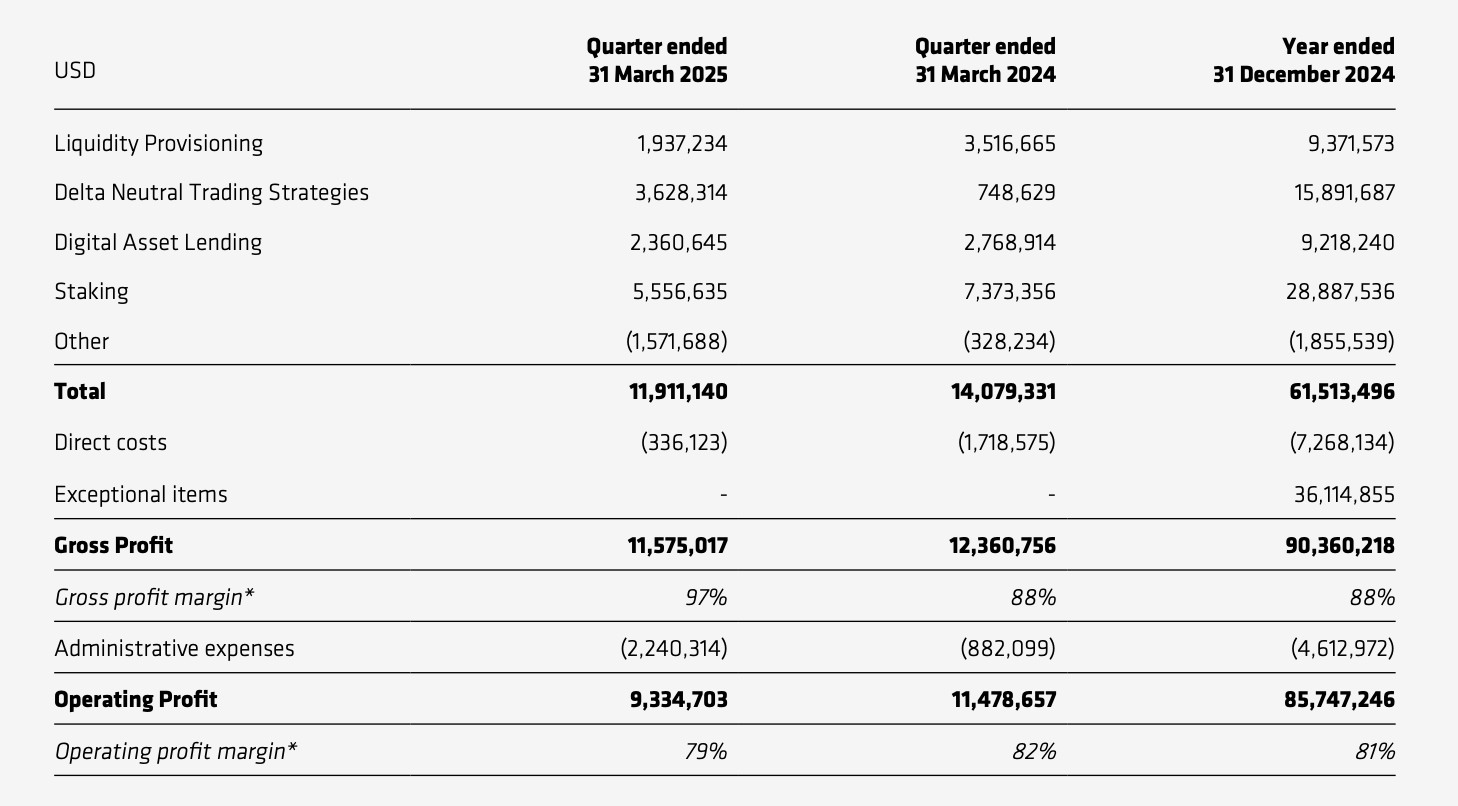
In capital markets infrastructure, CoinShares generated approximately $11.911 million in Q1, down about 15.4% year-on-year. This segment includes liquidity provision revenue, delta-neutral trading strategy revenue, digital asset lending, and staking income. After removing direct costs and administrative expenses, profit was about $9.335 million, down approximately 18.7% year-on-year.
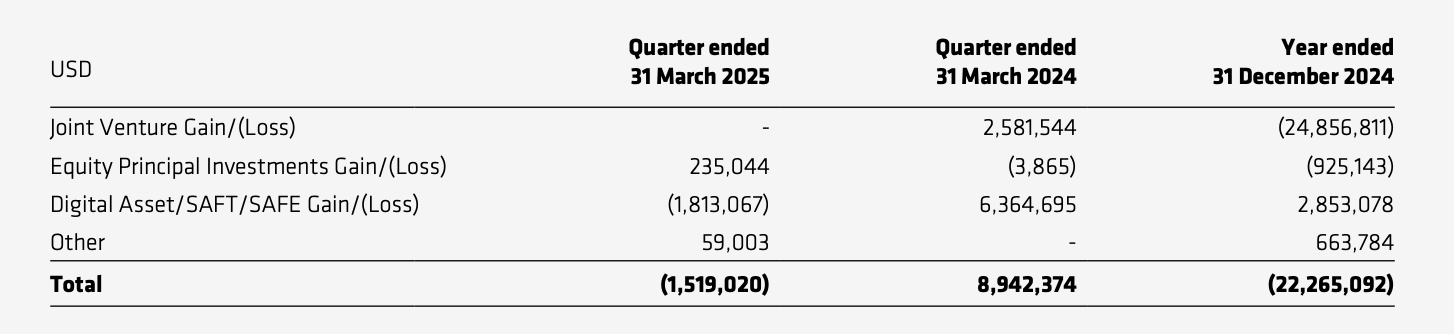
In proprietary investments, CoinShares incurred a loss of approximately $1.519 million in Q1, compared to a profit of about $8.942 million in the same period last year—a year-on-year decline of roughly 117%.
Due to an overall decline in cryptocurrency prices in Q1, all segments except asset management—which is less affected by price fluctuations—experienced declines. Looking deeper into the report, capital markets infrastructure revenues from liquidity provision, lending, and staking were significantly impacted by falling prices and low trading activity, although delta-neutral trading strategies partially offset these losses. The investment segment suffered primarily from broad market price declines. Overall, there is no sign of deterioration in core operations, and strategic adjustments are actively being made in investments.
In Q2, overall cryptocurrency prices rose, but CoinShares did not see a significant increase in business performance.
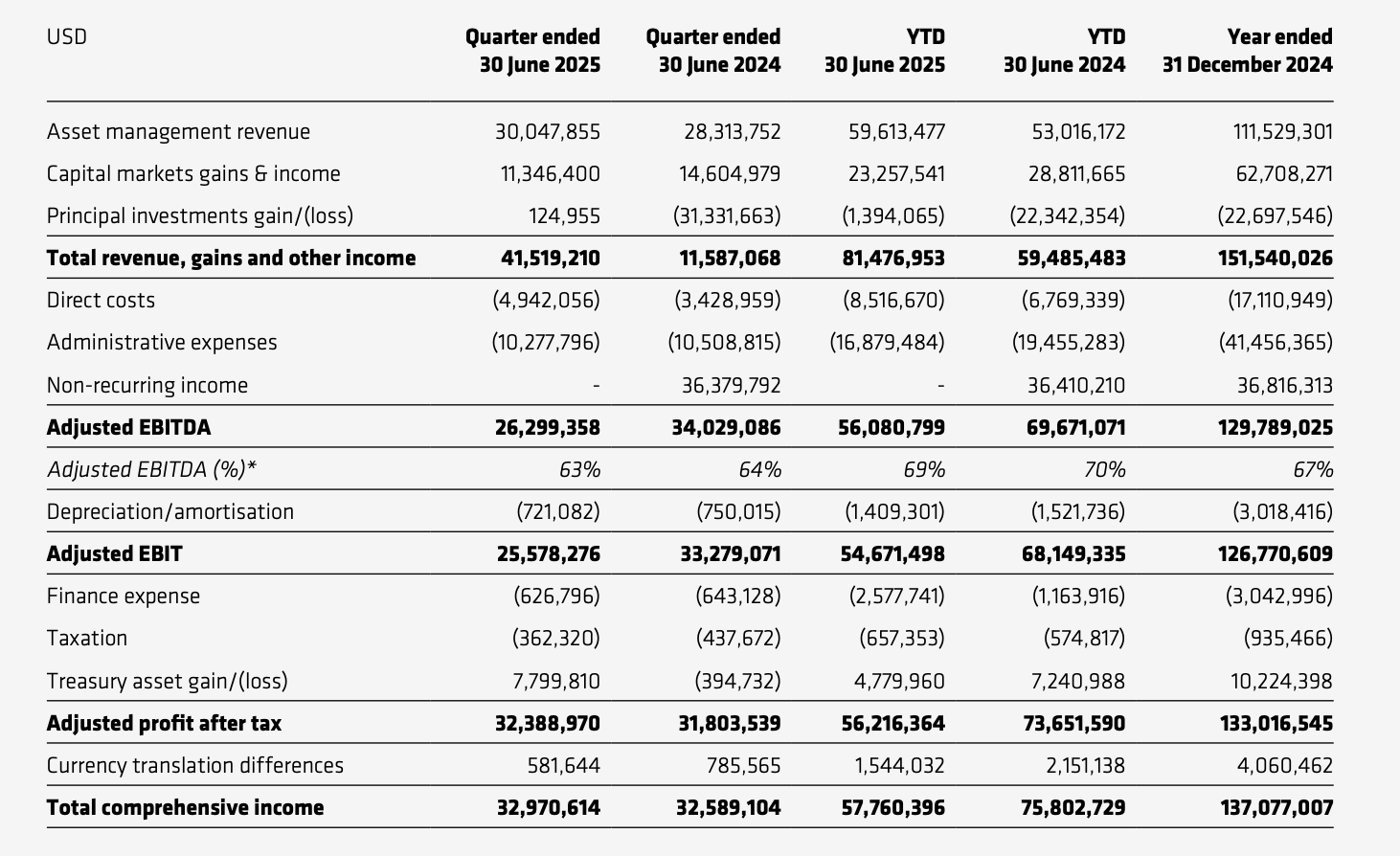
CoinShares recorded $41.519 million in revenue in Q2, up approximately 3.8% quarter-on-quarter and surging 258.3% year-on-year. EBITDA was $26.299 million, down 11.7% quarter-on-quarter and about 22.7% year-on-year, with profit margin declining to 63%. Comprehensive income for Q2 was approximately $25.578 million, up slightly by 3.2% quarter-on-quarter and 1.1% year-on-year.
For the first half of the year, 2024 figures include losses from FlowBank’s bankruptcy and gains from selling FTX claims, distorting comparisons (the abnormally high year-on-year revenue growth stems from this). Excluding these items, CoinShares’ performance in the first half of this year shows little change compared to the same period last year.
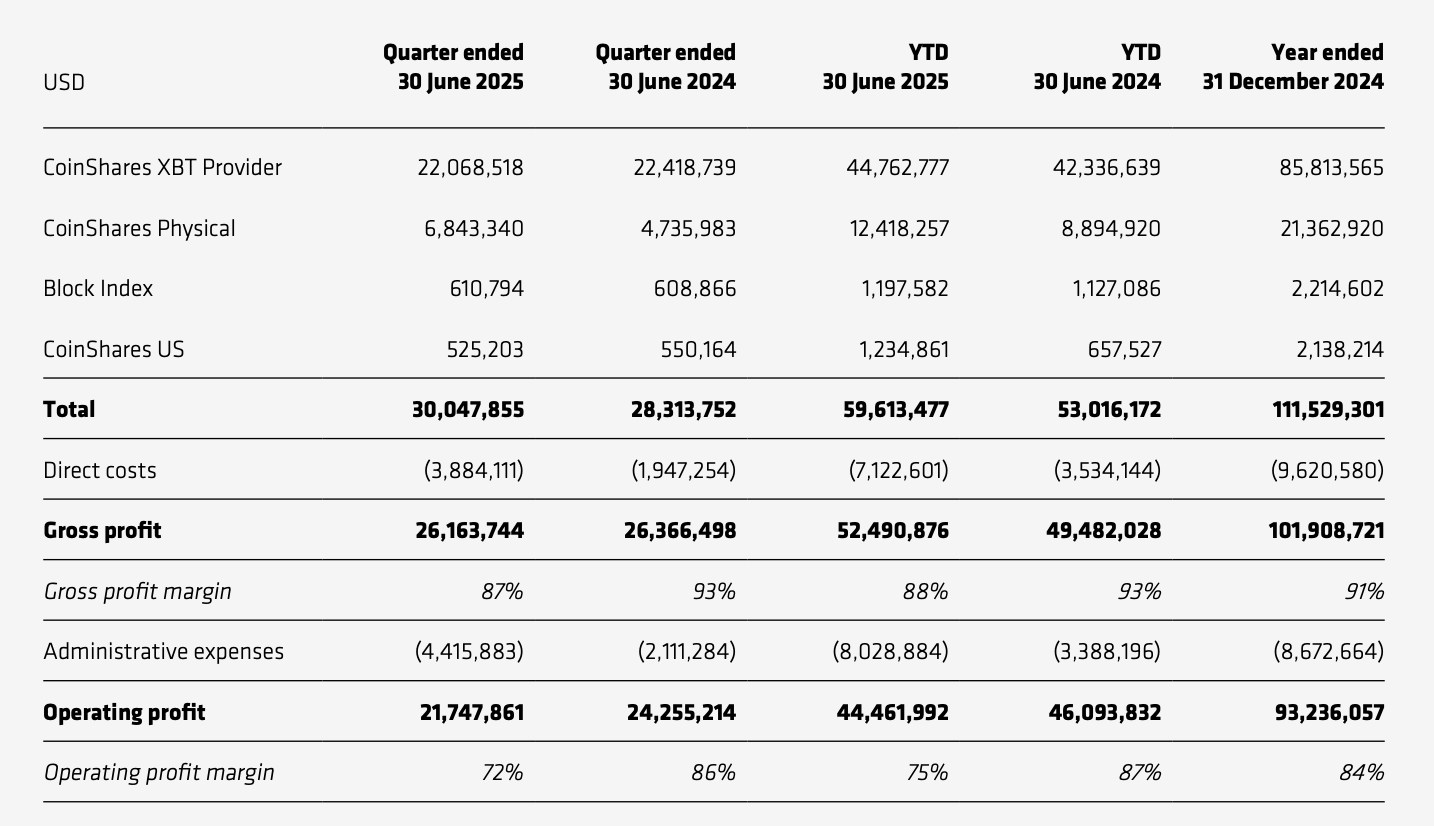
In asset management, CoinShares generated just over $30 million in Q2, up 1.6% quarter-on-quarter and 6.1% year-on-year. Operating profit was $21.748 million, down about 4.3% quarter-on-quarter and 10.3% year-on-year. For the first half of the year, total asset management revenue was approximately $59.613 million, up 12.4% year-on-year, while operating profit was $44.462 million, down 3.5% year-on-year.
CoinShares stated that in Q2, products under its XBT brand experienced $126 million in net outflows, and increased cost allocations to the asset management division led to declining profits despite rising revenues.
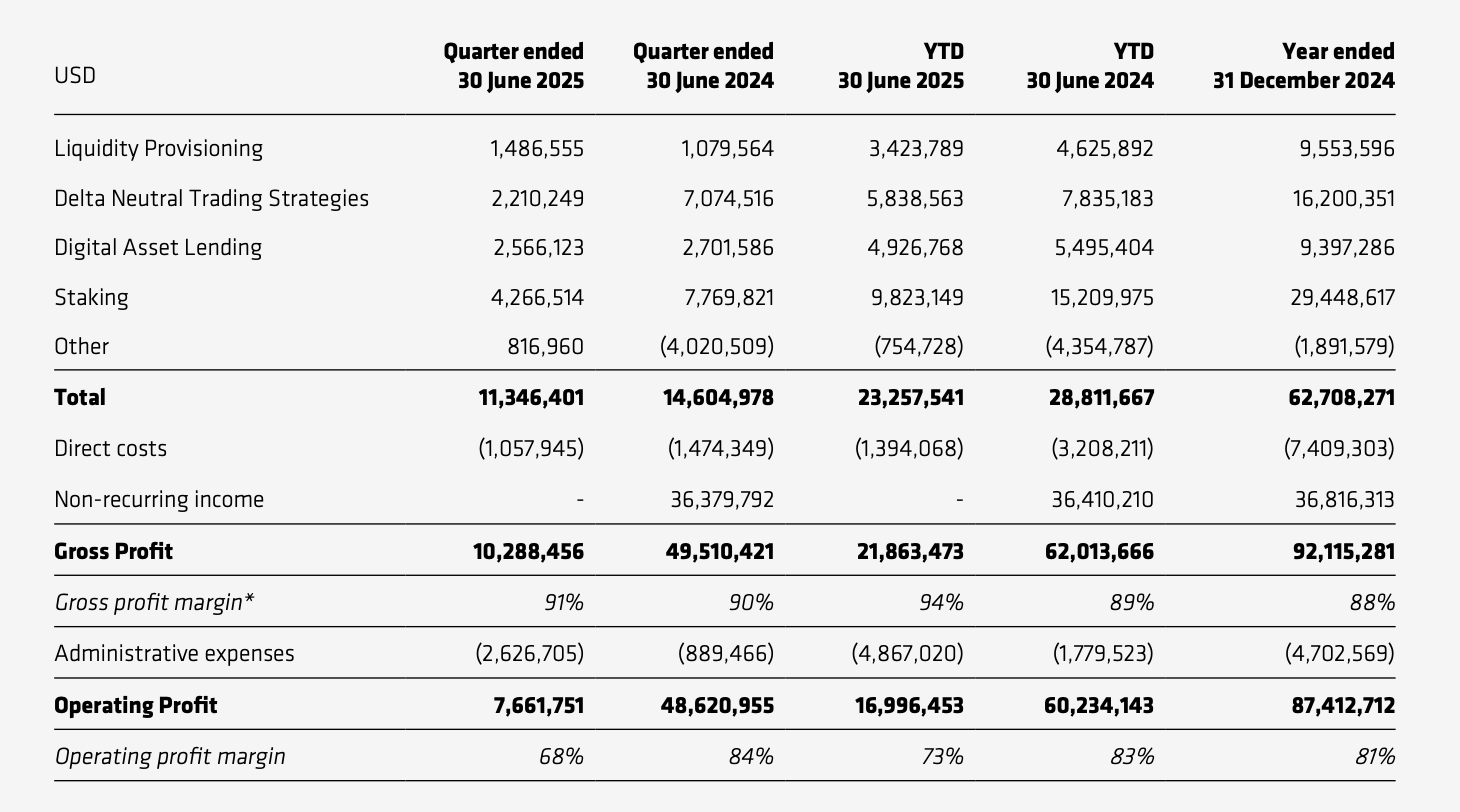
In capital markets infrastructure, CoinShares generated approximately $11.346 million in Q2, down 2% quarter-on-quarter and 22.3% year-on-year. Profit and profit margins also declined after excluding the one-time gain from selling FTX claims.
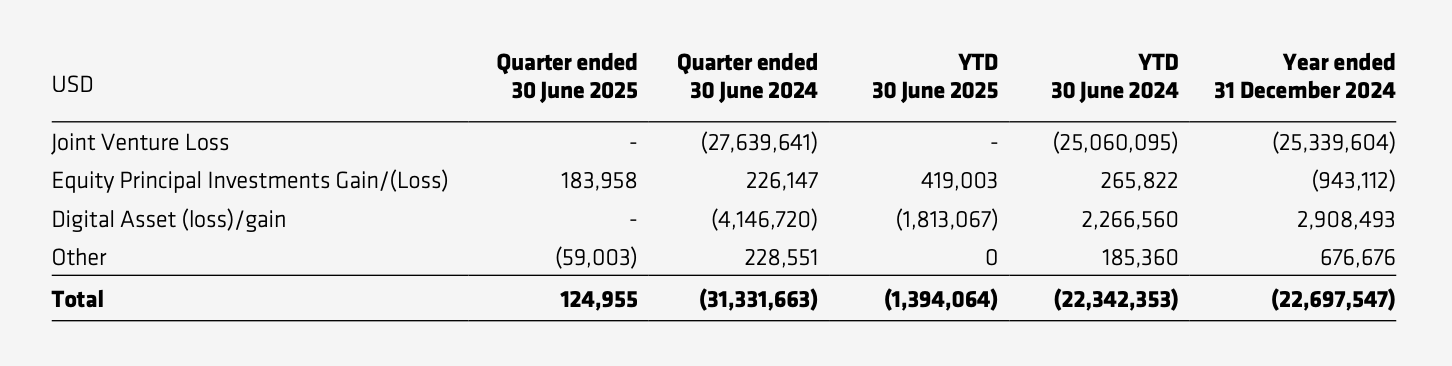
In proprietary investments, CoinShares earned only about $125,000 in profit in Q2—while improved from the $1.519 million loss in Q1, investment gains and losses exhibit some randomness over time and thus have limited reference value. Notably, CoinShares has remained in a losing position in investments throughout 2024 and so far in 2025, whereas in 2023 it achieved nearly $3.7 million in investment profits.
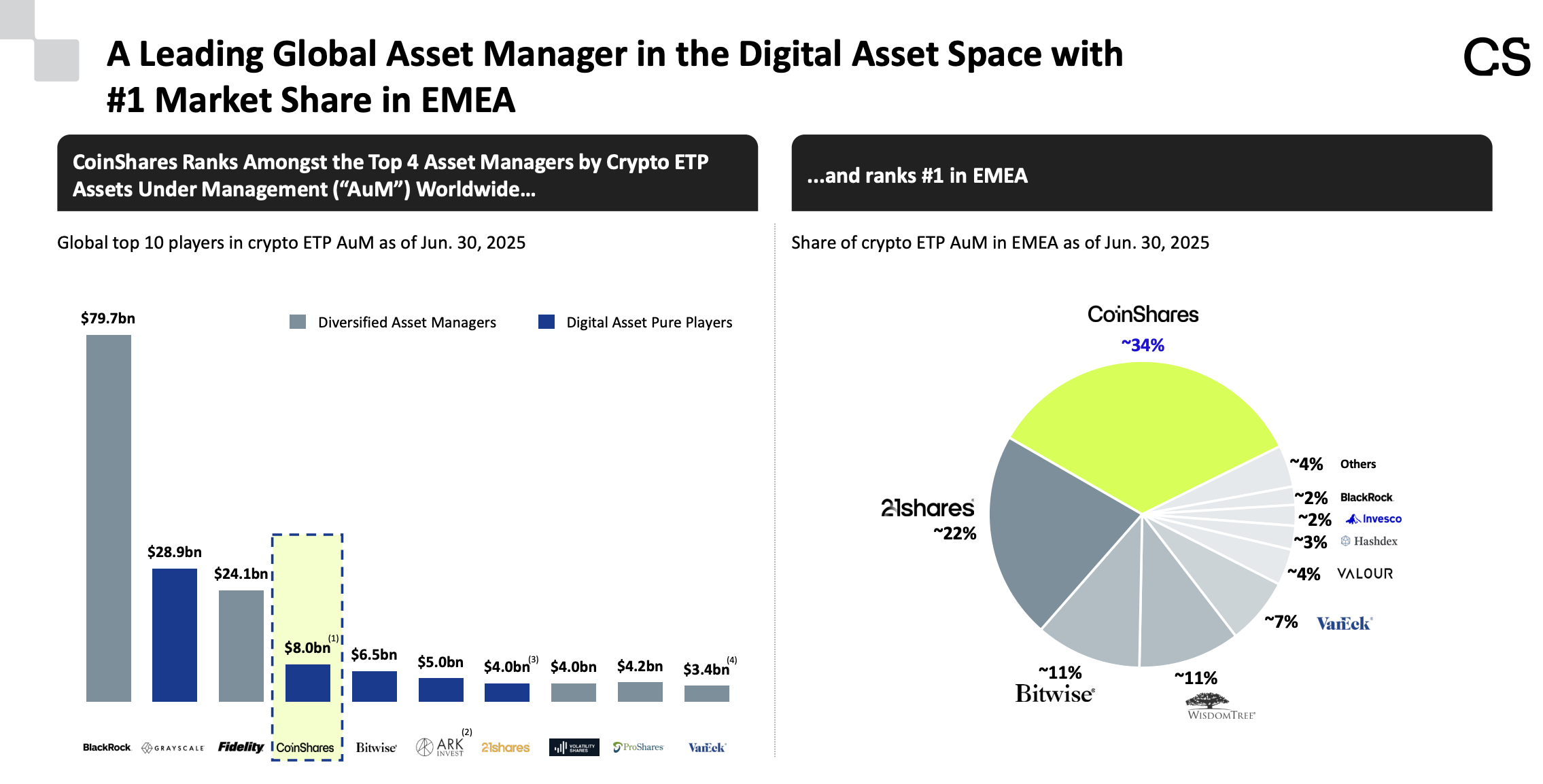
Although CoinShares claims in its roadshow materials that its total AUM has exceeded $8 billion, positioning it as the world’s fourth-largest crypto asset manager after BlackRock, Grayscale, and Fidelity, and the largest in the EMEA (Europe, Middle East, and Africa) region with approximately 34% market share, the above data suggest relatively slow growth. Aside from steady, modest expansion in asset management, other segments show significant volatility. CoinShares’ acquisition of Valkyrie and its U.S. listing are essentially strategic moves aimed at expanding its presence in the American market, but its home base appears to lack a distinctive competitive moat.
According to ISS Market Intelligence, as of the end of May this year, U.S. fund managers’ AUM in Europe has grown from $2.2 trillion ten years ago to $4.9 trillion. If major U.S. asset managers decide to expand their crypto asset management services into Europe, CoinShares will face formidable competition.
If the SEC approves ETFs for more cryptocurrencies in the future, CoinShares’ current advantages could gradually erode. Based on yesterday’s closing price in European markets, CoinShares’ market cap is approximately 8.228 billion Swedish kronor, or about $877 million, with a P/E ratio of around 7.97. However, its valuation via the SPAC merger reached $1.2 billion, implying a premium of nearly 37%.
Compared to the world’s largest asset manager, BlackRock—whose AUM reached $12.5 trillion by the end of Q2 this year—CoinShares’ AUM-to-market-cap ratio is far higher than BlackRock’s, yet its P/E ratio is significantly lower than BlackRock’s near-27 figure. This results in a somewhat contradictory valuation profile for CoinShares. While crypto asset management will likely remain attractive for the foreseeable future, whether CoinShares can achieve significant market cap growth depends rationally on whether its asset management business can exceed expectations, establish defensible positions outside the U.S., and capture a meaningful share of the domestic U.S. market.
Join TechFlow official community to stay tuned
Telegram:https://t.me/TechFlowDaily
X (Twitter):https://x.com/TechFlowPost
X (Twitter) EN:https://x.com/BlockFlow_News
 Foresight News