Breaking Down the Walled Garden: How Ondo Global Market Brings 100+ U.S. Stocks On-Chain?
TechFlow Selected TechFlow Selected
Breaking Down the Walled Garden: How Ondo Global Market Brings 100+ U.S. Stocks On-Chain?
Make financial markets truly global, democratized, and programmable.
 Navigating Web3 tides with focused insights
This year, the stock tokenization sector has suddenly become active.
Projects such as Robinhood, xStocks, Backed, and Swarm have entered the space, each exploring different approaches.
Why are giants turning their attention to stock tokenization?
The market size is indeed attractive. The U.S. stock market is worth $60 trillion, yet global crypto users—especially non-U.S. investors—have never had convenient access to invest in U.S. equities.
The opportunity is large, and there are many players. But persistent problems remain: tokens are either locked within platforms and cannot be withdrawn, suffer from severe illiquidity causing massive slippage, or cover too few assets to achieve scale.
"Free circulation" and "liquidity depth" remain key challenges that the sector must urgently address.
On September 3, Ondo Finance, a leading project in the RWA sector, launched Global Markets, which may serve as a strong solution to these issues and a challenger to the current market landscape.
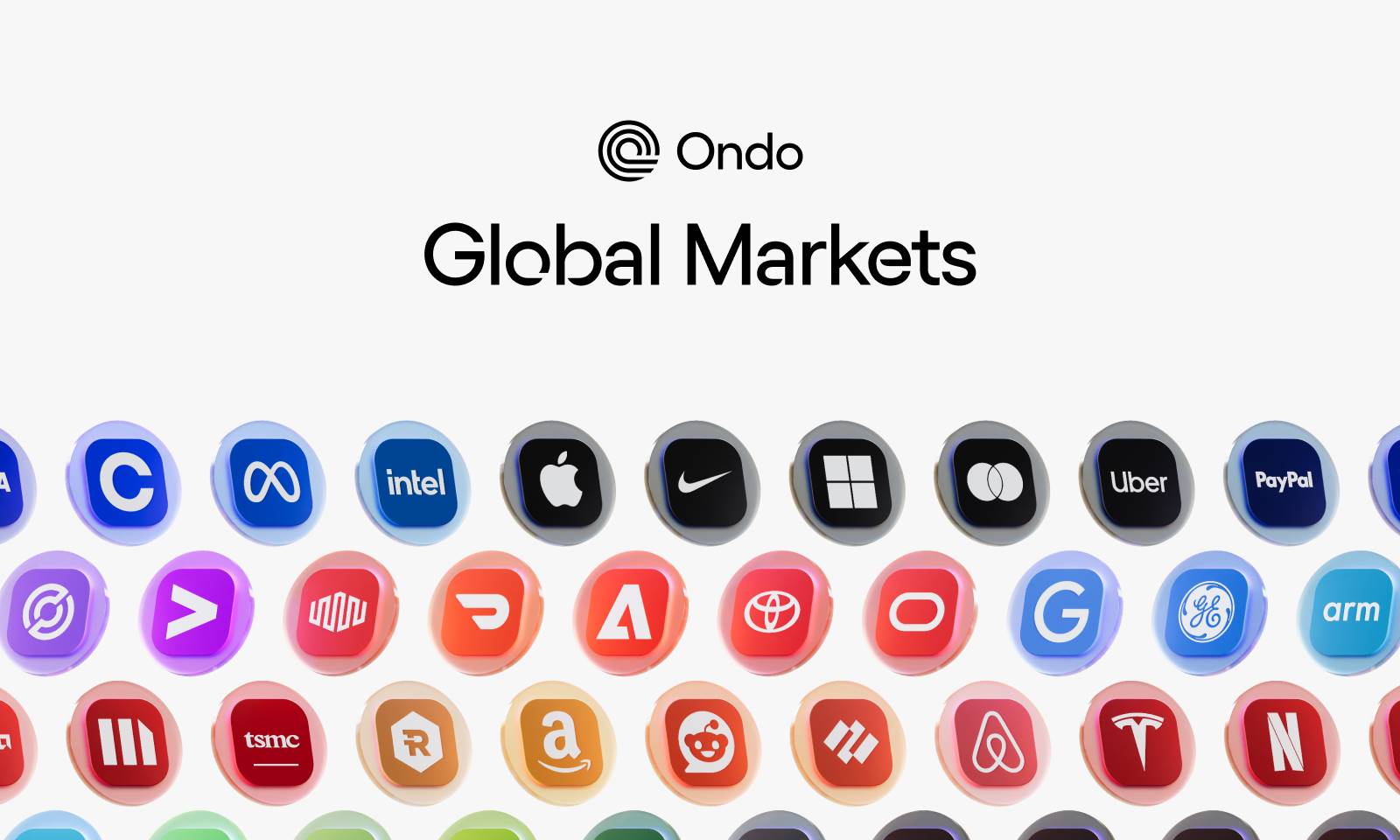
When introducing this new product on its official X account, it made a thought-provoking statement:
"Not all tokenized stocks are born equal."
This clearly pays homage to the famous phrase "all men are created equal" from the U.S. Declaration of Independence, but also implies another kind of equality:
Enabling global investors equal access to U.S. capital markets, no longer constrained by the high transaction costs and flaws of existing products.
On its first day of launch, Ondo demonstrated an extraordinary scale.
Over 100 stocks and ETFs were opened for trading simultaneously—from Apple and Tesla to the S&P 500 index, even crypto-related names like MicroStrategy—covering nearly all major U.S. equity assets of interest to investors.
More striking are its near-zero transaction fees, 24/5 trading availability, and deep liquidity enabled by its "instant minting" technology.
This inevitably brings stablecoins to mind.
USDC and USDT freed the U.S. dollar from bank accounts, enabling free 24/7 circulation on-chain; now, Ondo aims to do the same for U.S. equities, turning Tesla, Apple, and the S&P 500 into easy-to-use native on-chain assets just like stablecoins.
Although currently available only to institutional investors, we can still gain insights from the publicly disclosed product details.
The "stablecoin moment" for stock tokenization may truly be arriving.
Buying Stocks Like Buying Crypto
Opening the Ondo Global Markets interface gives an immediate sense of familiarity and simplicity.
It looks more like a stock market version of CoinMarketCap. Even if you’ve never traded U.S. stocks before, the familiar UI layout and navigation make it easy to feel at home.
The top section displays real-time rolling updates of major U.S. indices: DJIA, Nasdaq, and S&P 500. Below are three sections: Top Gainers, Trending, and Newly Added.
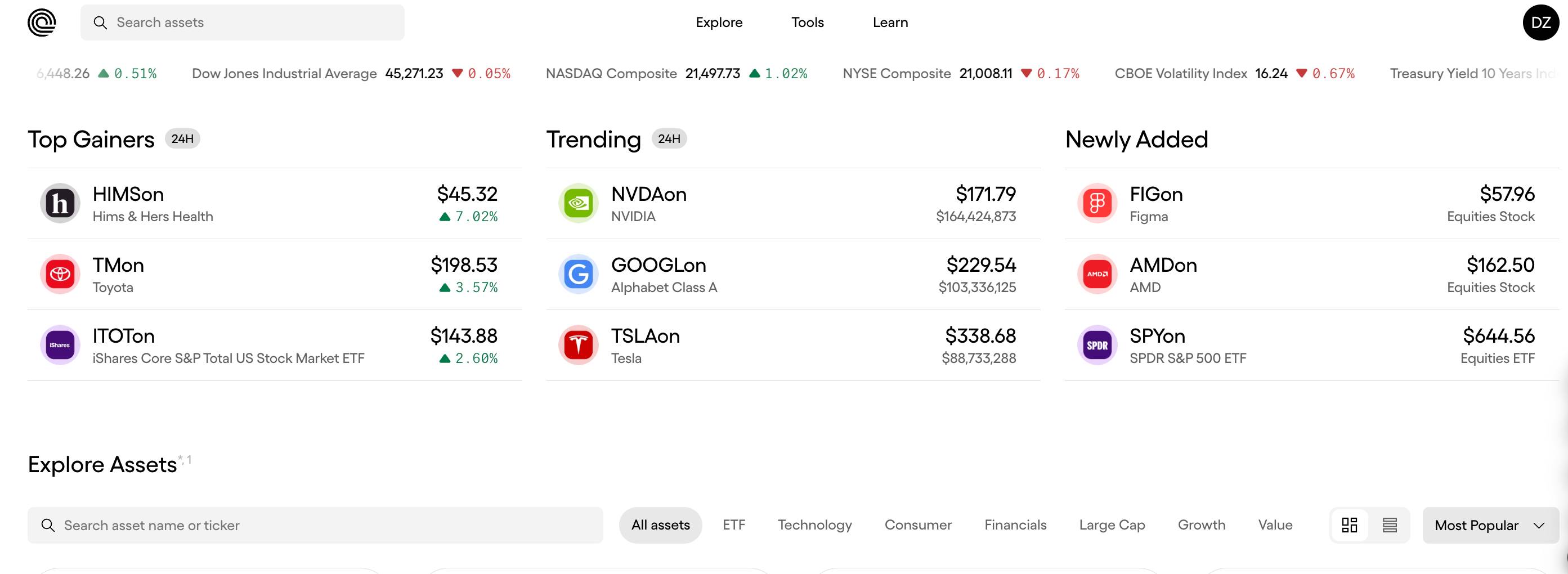
Scrolling down, "Explore Assets" feels like browsing a well-organized supermarket of U.S. equities.
All assets are neatly categorized—ETFs, tech stocks, consumer stocks, financial stocks—and clicking into each reveals real-time prices and 24-hour candlestick charts, very similar to what you'd see on typical crypto market aggregators.
However, each stock name carries an "on" suffix, reminding you this is Ondo’s tokenized version.
In terms of volume, tech stocks dominate Ondo’s tokenized equities. At the time of writing, Nvidia had a 24-hour trading volume of $164 million; Google, $103 million; and Tesla, $88 million.
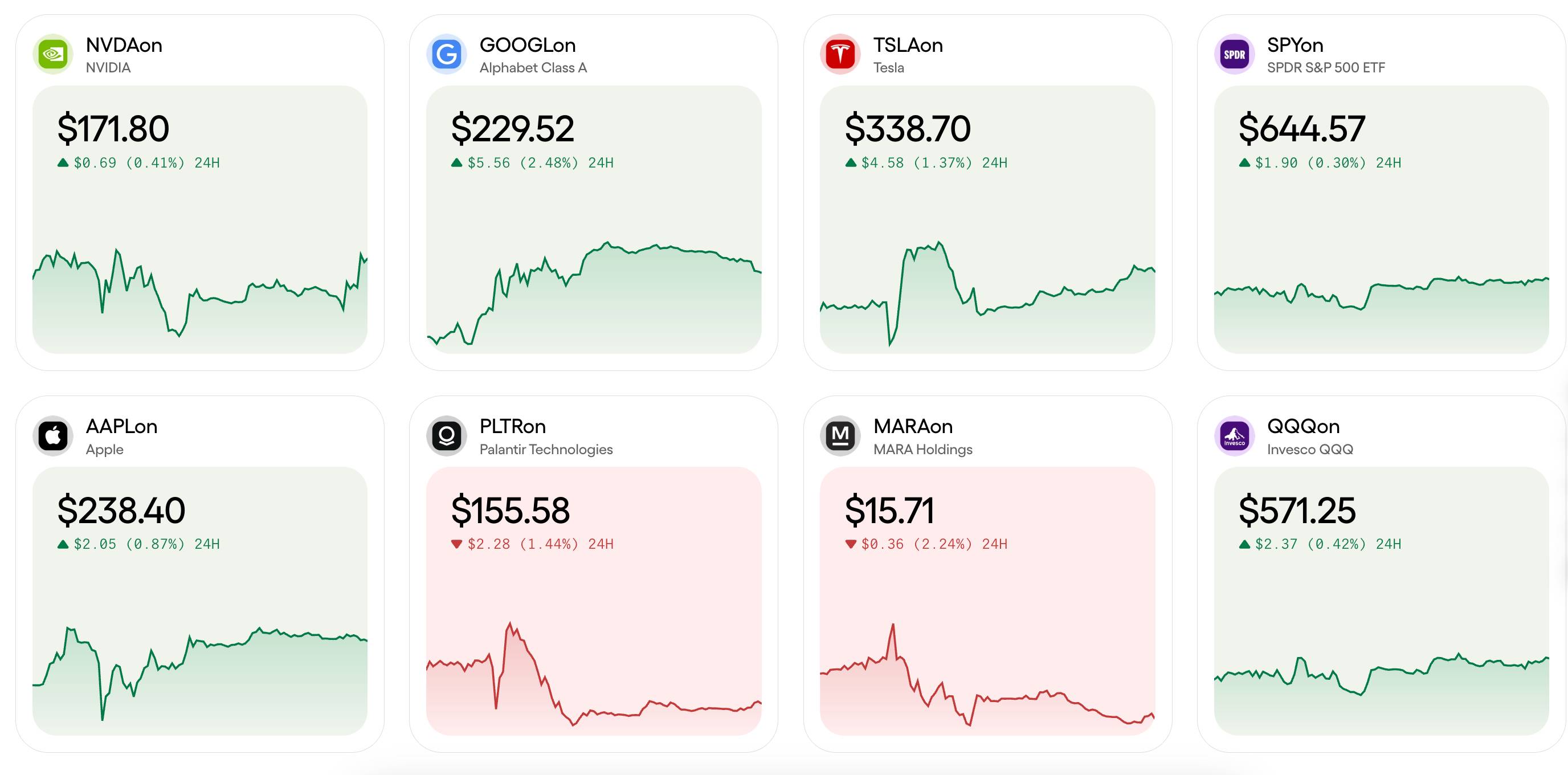
Out of curiosity, we compared the prices of U.S. stocks on Ondo with those in the real stock market during the same period. Interestingly, these prices are not exactly identical to Nasdaq's real-time quotes.
According to Ondo Finance's official documentation, Ondo tokens track not only stock prices but also dividends.
In simple terms, if Apple pays a $1 dividend, the system automatically uses that $1 (after tax) to buy more Apple shares. Over time, one AAPLon might represent 1.05 actual Apple shares, hence a slightly higher price. This is akin to having "dividend reinvestment" automatically enabled.
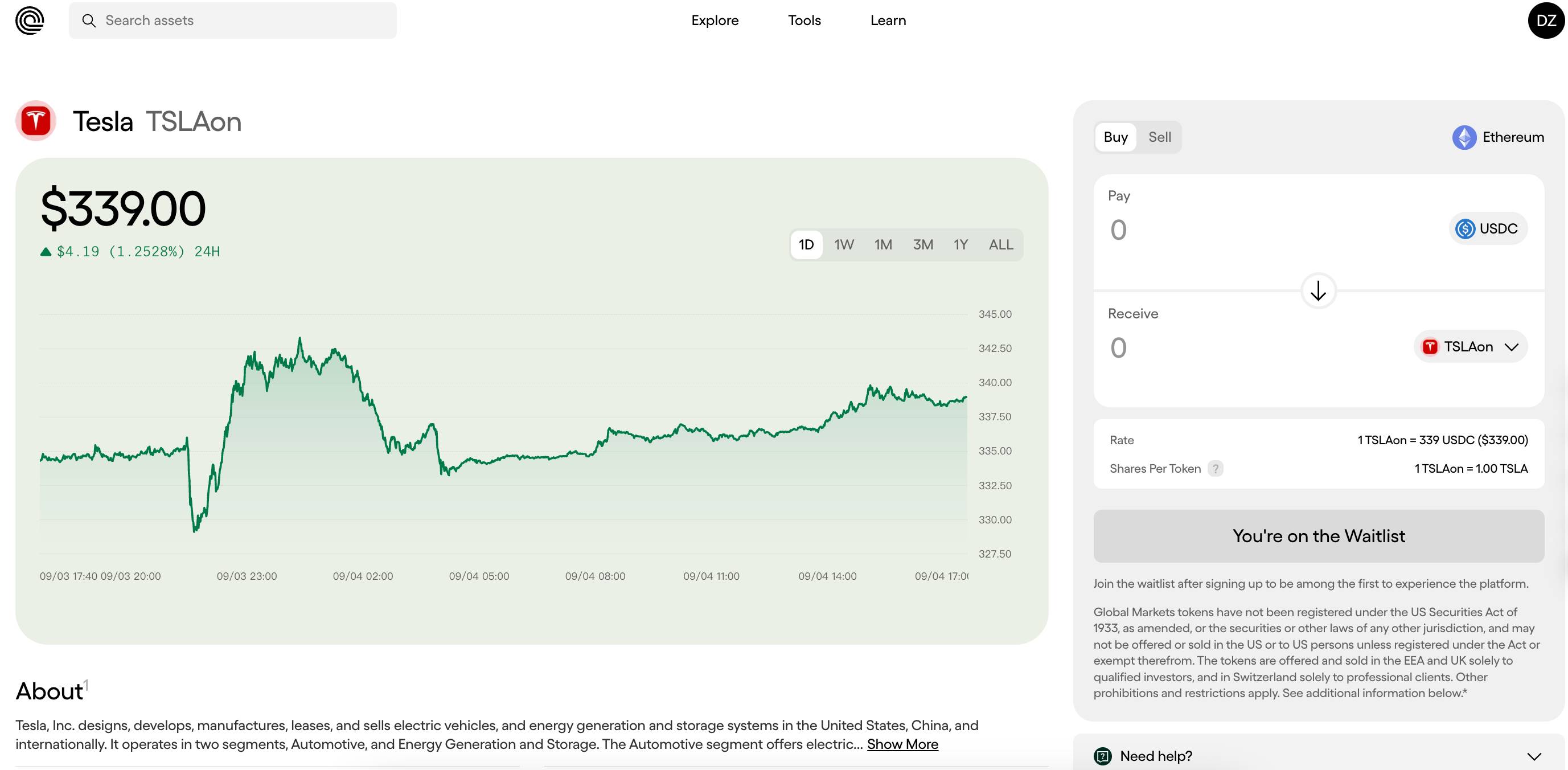
For example, in the image above, you can directly select Tesla’s token TSLAon on Ondo, enter the amount you wish to exchange in a DeFi-like Swap interface, and pay using USDC stablecoin.
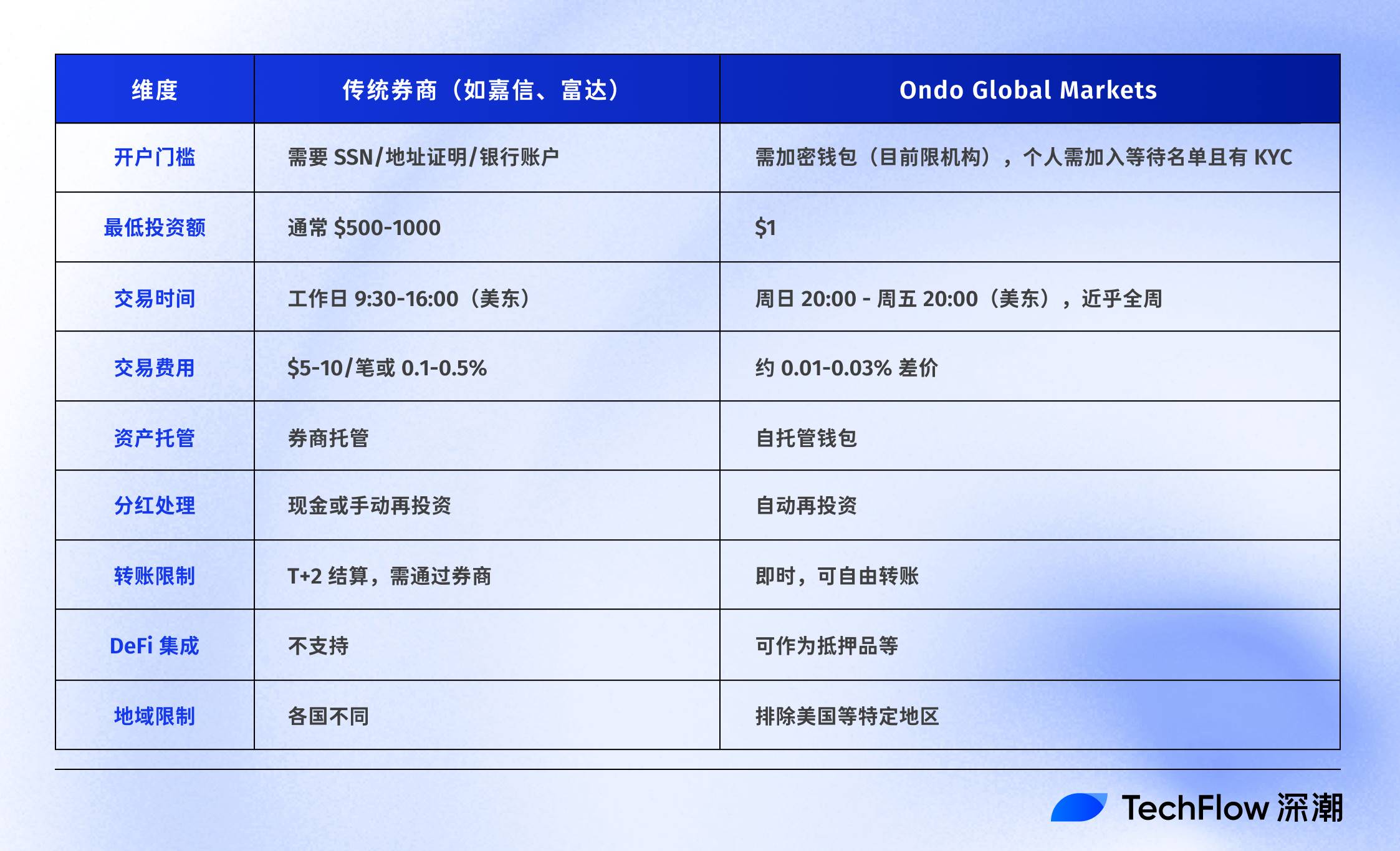
The current minimum purchase threshold is just $1, meaning any crypto user with a wallet could theoretically participate in U.S. stock investing. However, note that Ondo’s market currently operates on Ethereum, so gas fees must be considered. The team has publicly stated plans to expand to BNB Chain, Solana, and its own Ondo Chain.
Excluding blockchain gas costs, Ondo does not charge traditional brokerage fees—no account opening, management, or platform usage fees. Its revenue comes from a transaction fee of approximately 0.01–0.03% per trade.
In short, a $1,000 trade costs around $1 total, far below traditional brokers’ standard fees of $5–$10 or 0.1–0.5%.
Trading hours are “24/5”—from Sunday 8 PM to Friday 8 PM Eastern Time.
This flexibility is especially friendly to Asian investors, eliminating the need to stay up late for U.S. market openings. How continuous trading after U.S. market close is achieved involves its unique technical architecture, which we’ll detail later.
Of course, this is currently available only to institutional investors. Individual users are still on a waitlist. Yet from a product design perspective, Ondo is clearly building a more accessible U.S. equity investment platform.
How Are Deep Liquidity and 24x5 Trading Achieved?
After experiencing Ondo’s interface and workflow, three questions naturally arise:
Does Ondo offer better liquidity than other platforms? How can trading continue after U.S. market hours? And if there are no visible fees, how does Ondo make money?
Instant Minting: Leveraging Nasdaq’s Liquidity Depth
Let’s start with liquidity.
A recent post on X shared comparison screenshots that visually highlight differences in liquidity. For a $50,000 USDC purchase of Amazon stock tokens: on Ondo, you get 218.67 AMZNon tokens worth $49,834; on xStocks, only 38.97 AMZNx tokens worth $8,833—a displayed slippage of -82.33%.
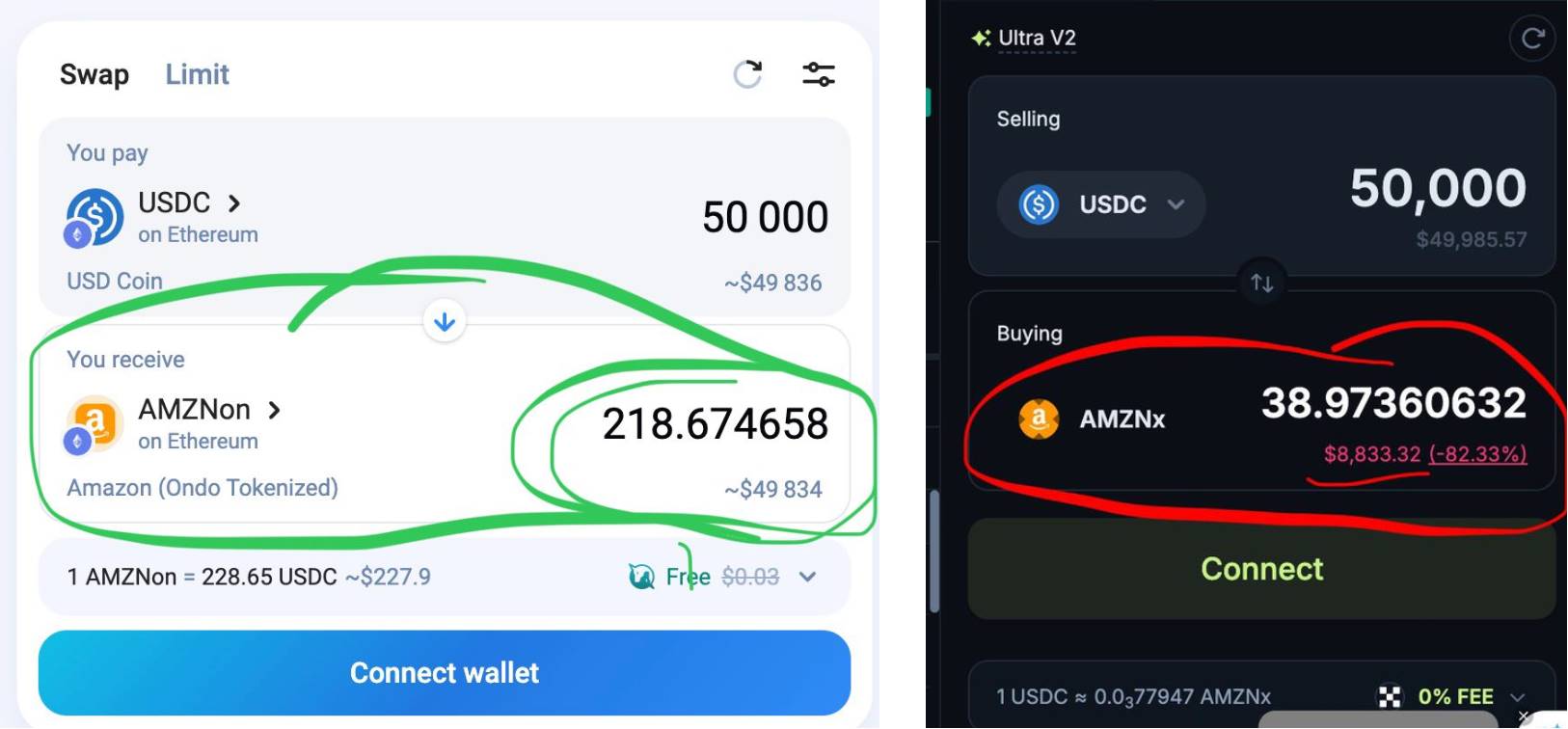
The same amount buys 218 shares on one platform, only 39 on the other. Why such a huge gap?
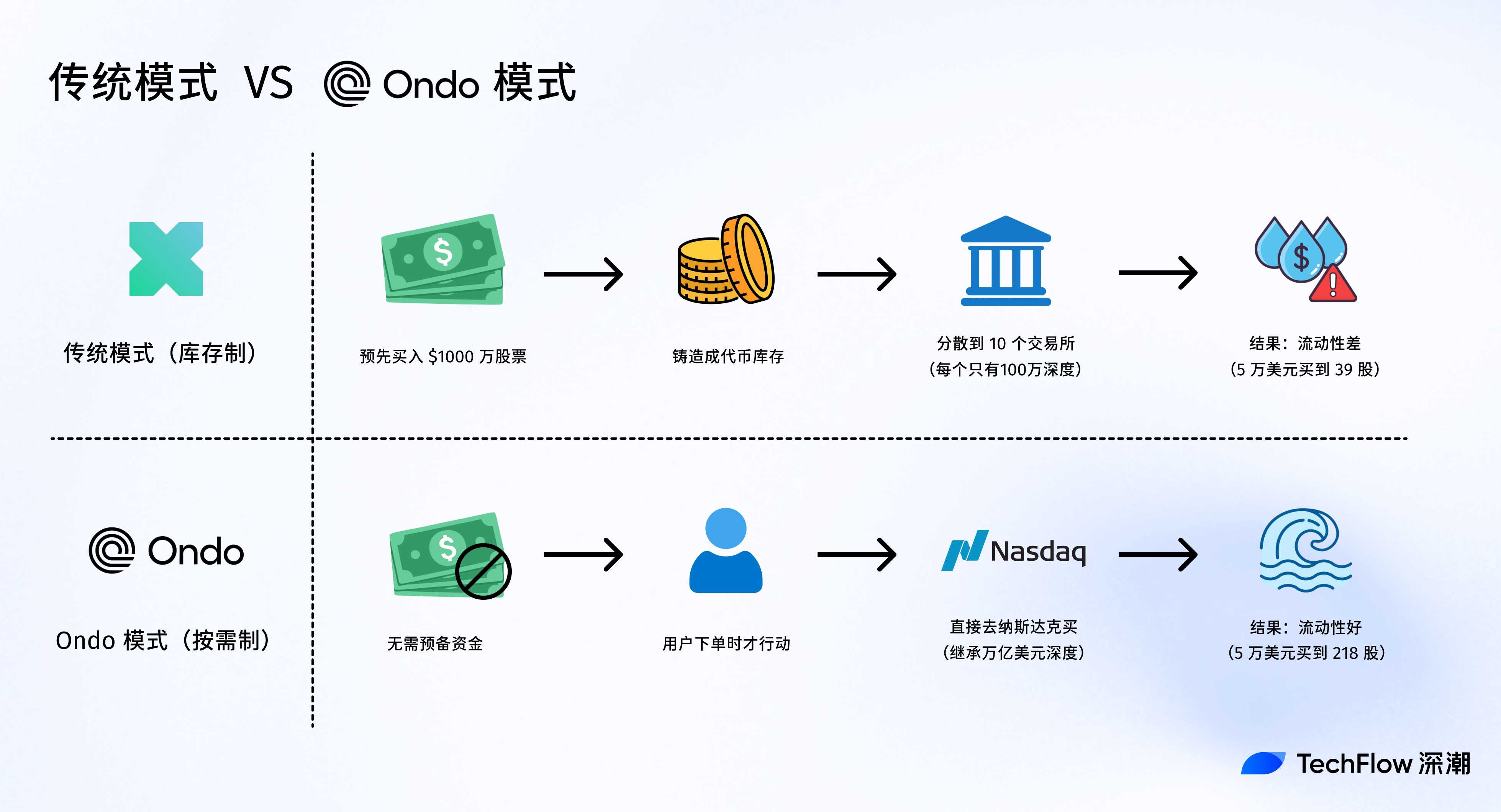
Ondo CEO Nathan Allman explained this well in his launch tweet, highlighting two fundamentally different tokenization models.
-
Existing platforms, like supermarkets: They must stock inventory first—market makers pre-purchase stocks, mint tokens, then distribute them across exchanges. But shelf space and capital are limited. If someone wants to buy $50,000 worth of Amazon but only $10,000 is in stock, they either can't complete the purchase or face wildly inflated prices.
-
Ondo Global Markets, like food delivery: When a user orders Amazon stock, the platform procures the real stock from Nasdaq and mints the token instantly. When selling, it immediately burns the token and sells the underlying stock on Nasdaq. No inventory limits, no shelf constraints—directly inheriting Nasdaq’s daily trading volume of thousands of billions.
Nathan calls this model "instant, atomic minting and burning." More importantly, it can easily scale to hundreds or even thousands of stocks without needing pre-funded pools for each.
24/5 Trading, 24/7 Transferability
According to the official documentation, trading runs from Sunday 8:05 PM to Friday 7:59 PM (ET), covering almost the entire week. How is this possible?
The answer lies in a two-layer mechanism. The first layer is minting and redemption, relying on traditional markets.
Ondo connects not only to NYSE and Nasdaq regular trading hours (9:30–16:00), but also pre-market (4:00–9:30), after-hours (16:00–20:00), and overnight sessions via alternative trading systems like Blue Ocean (20:00–4:00). Combined, this achieves 24-hour coverage on weekdays.
The second layer is token transfer. Once minted, tokenized versions like TSLAon become standard ERC-20 tokens, freely transferable 24/7 between users like USDT. Even when traditional markets are fully closed on weekends, users can still trade among themselves.
The documentation notes, however, that overnight liquidity is relatively lower, and large orders may need to be split.
Spread: A Transparent Revenue Model
"We do not charge any minting, redemption, or management fees."
This FAQ statement confirms Ondo doesn’t profit from these steps, but the next sentence is equally important: "Prices may differ slightly from the prices at which we buy or sell the underlying stocks."
This "slight difference" is Ondo’s source of revenue.
In financial markets, there is always a small spread between buying and selling prices—the cost and return for providing liquidity. Traditional brokers also have spreads, but additionally charge $5–$10 commissions. Ondo charges only the spread, no extra fees.
For example, when Tesla trades at $100, you might pay $100.01 to buy through Ondo and receive $99.99 when selling. This $0.02 (0.02%) spread is far below the total cost (spread + commission) of traditional brokers, typically 0.5–1%.
This pricing model is common in forex and gold markets. Ondo has minimized the spread while eliminating all other fees.
For users, this means a $1,000 stock trade costs about $1 total—an unimaginable figure in the traditional brokerage era.
Comparison with Current Competitors
Stock tokenization is not new. From early 2021 projects like Mirror Protocol to today’s Ondo Global Markets, the sector has undergone clear evolution.
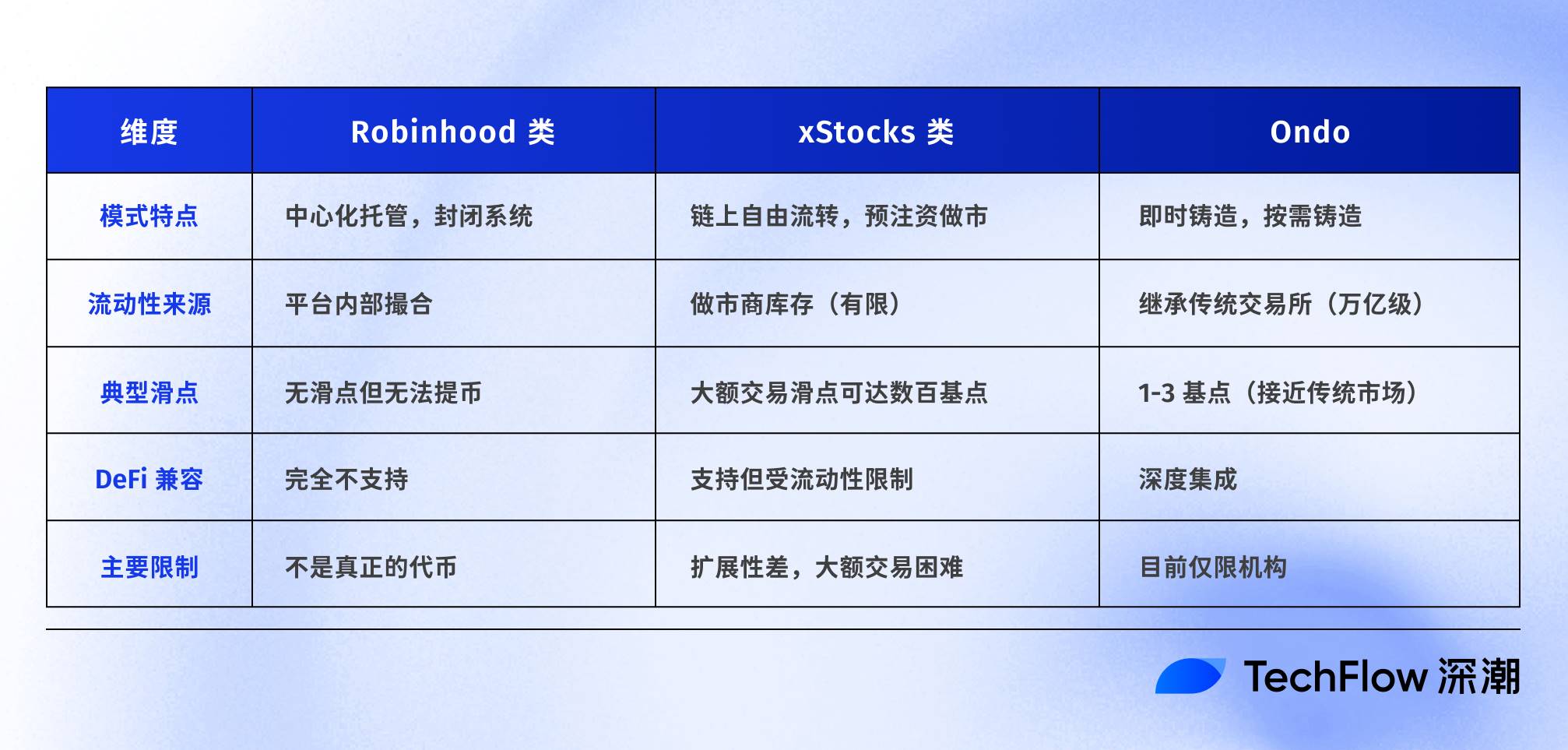
The most conservative approach builds a walled garden where tokens circulate only within the platform and cannot be withdrawn to personal wallets—Robinhood being a classic example.
This model essentially moves traditional brokerages onto blockchains. Beyond potential cost reductions, it fails to leverage blockchain’s true advantages. The user experience resembles trading on a brokerage app, with only the backend possibly using blockchain tech.
The second type, like xStocks, allows on-chain transfer of tokenized U.S. stocks but suffers from poor liquidity, making large trades problematic due to high slippage.
Ondo represents perhaps a third-generation approach: not just building a trading platform, but creating infrastructure.
Through instant minting, Ondo solves the core issue of liquidity. More importantly, it was designed from the start for deep integration with DeFi—for instance, Morpho accepts these tokens as collateral, and 1inch aggregates their trades.
In short,
-
Robinhood-type: Prioritizes compliance at the expense of openness
-
xStocks-type: Prioritizes openness but struggles with liquidity
-
Ondo: Attempts to achieve both openness and liquidity through technological innovation, while maintaining compliance
This doesn’t mean Ondo will necessarily win. Robinhood has a vast user base, and xStocks enjoys first-mover advantage and ecosystem positioning. But Ondo has indeed found a differentiated path.
Participation Eligibility in the Asia-Pacific Region
For Asia-Pacific investors, Ondo Global Markets offers opportunities alongside barriers. Participation rules vary significantly by country and region, as summarized in the chart below.
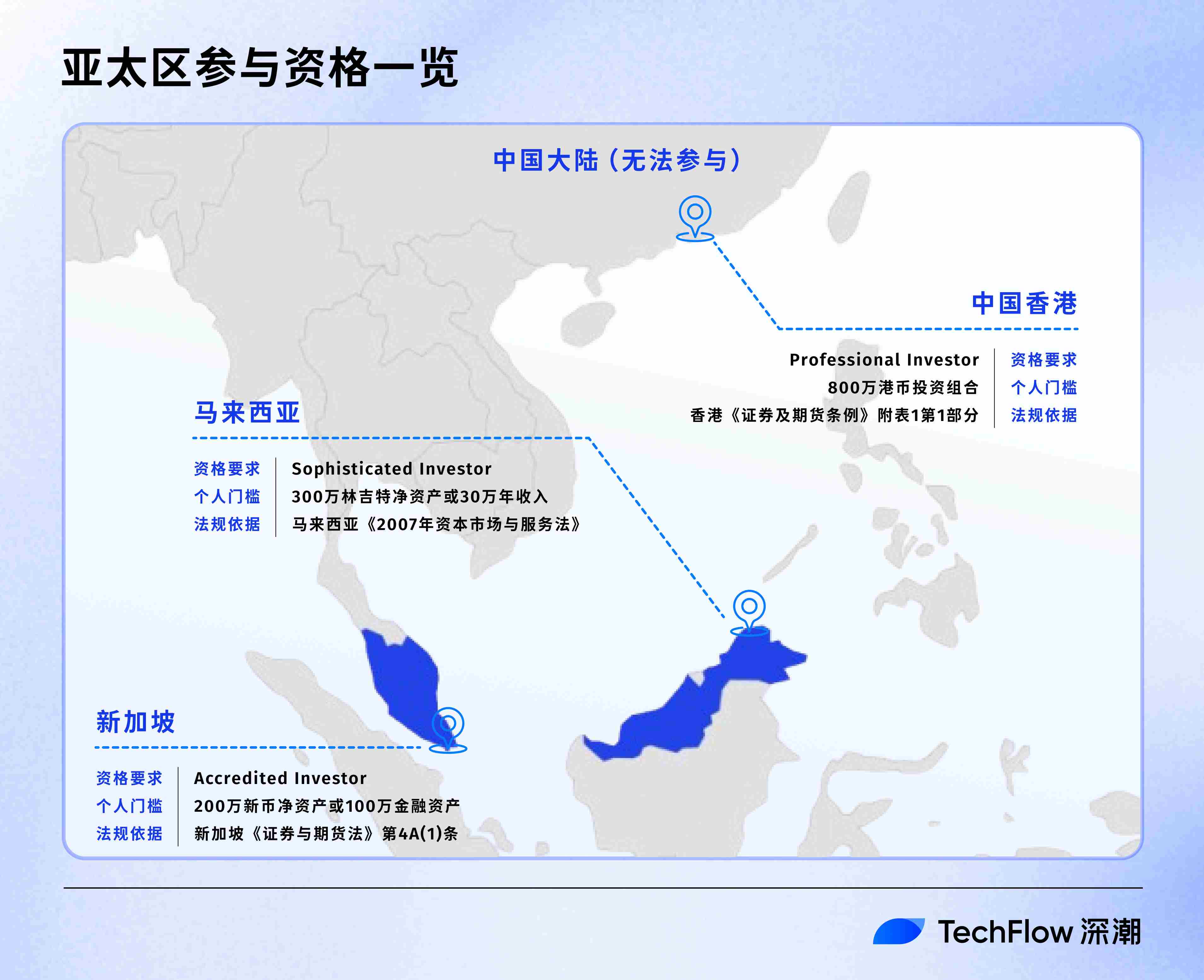
Besides explicitly banned or restricted regions, other non-U.S. areas can theoretically participate. This means users from Japan, South Korea, Thailand, Indonesia, the Philippines, and Vietnam can join after basic KYC verification.
However, note that Ondo Global Markets is currently open only to institutional investors. Individual investors, regardless of location, must still wait.
An On-Chain Revolution Underway
If you examine Ondo Global Markets’ list of partners, you’ll see even greater ambition.
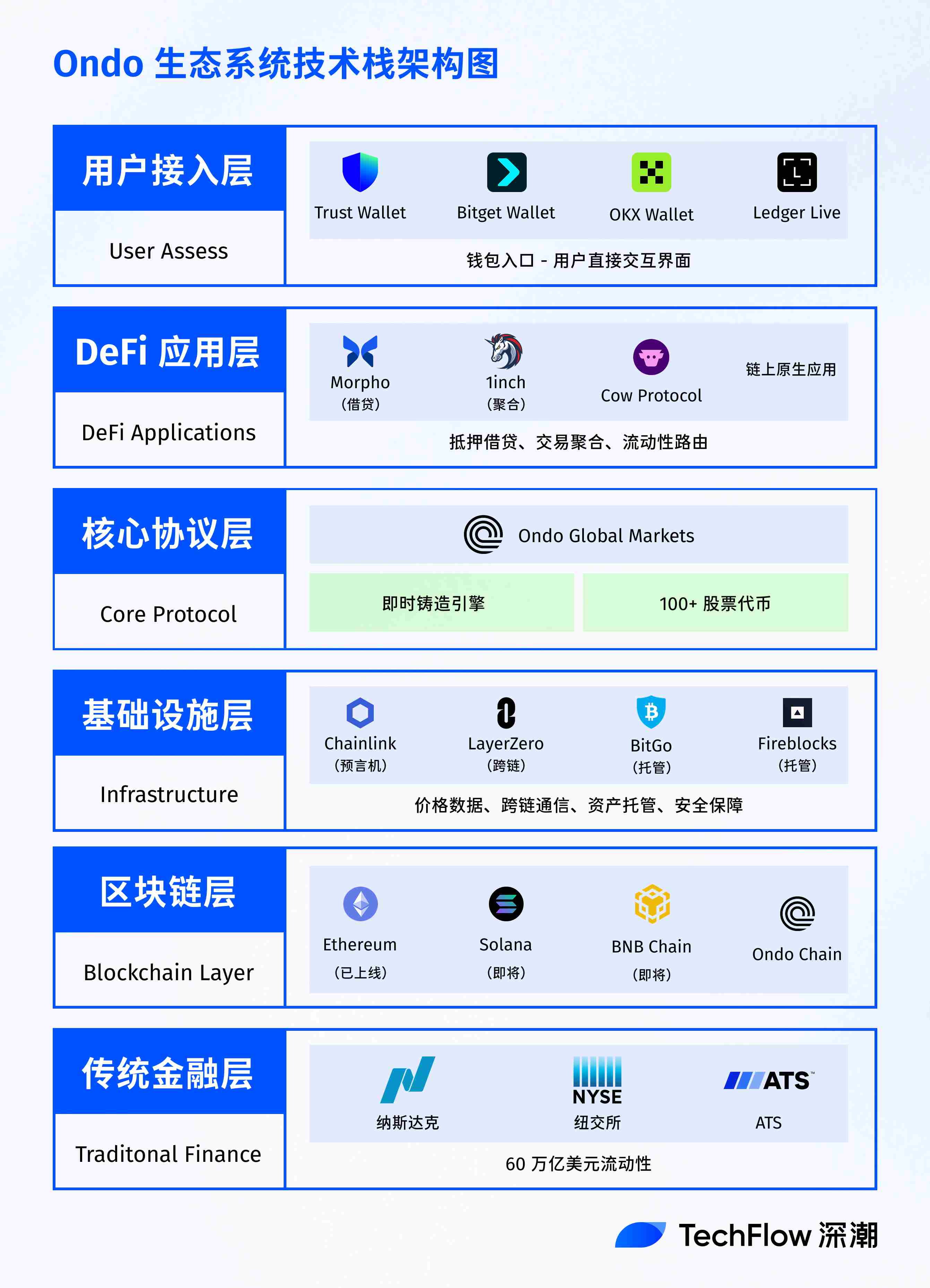
Under its broader vision of merging crypto and stocks, it aims to build a DeFi stock infrastructure, revealing a clear technology stack:
-
Technical Foundation: Chainlink provides price oracles and proof of reserves; LayerZero enables cross-chain functionality; BitGo and Fireblocks offer institutional-grade custody, allowing traditional finance institutions to participate with confidence.
-
DeFi Protocol Integration: Morpho has confirmed support for Ondo stock tokens as collateral. This means you could use Tesla stock to borrow in DeFi. Aggregation features from 1inch and CoW Protocol allow liquidity to flow freely across platforms.
-
User Access Expansion: Integrations with major wallets like Trust Wallet, Bitget Wallet, and OKX Wallet lower entry barriers. Support from centralized exchanges like Gate and MEXC provides alternative channels.
Returning to the opening question: has the "stablecoin moment" for stock tokenization truly arrived?
Technically, Ondo has indeed solved core challenges. Instant minting delivers deep liquidity, zero fees lower participation barriers, and DeFi integration unlocks new possibilities.
From a market perspective, timing also seems ripe. The RWA market is growing explosively, institutions are beginning to accept it, and infrastructure is maturing.
But realistically, the revolution has just begun. Institutional-first rollout, geographic restrictions, and regulatory uncertainty remain significant hurdles.
Ondo Global Markets may not be the final answer, but it points in the right direction: making financial markets truly global, democratized, and programmable. This journey may take years, but the first step has been taken.
For investors, now may not yet be the time to fully participate—but it is certainly a moment to watch closely.
Join TechFlow official community to stay tuned
Telegram:https://t.me/TechFlowDaily
X (Twitter):https://x.com/TechFlowPost
X (Twitter) EN:https://x.com/BlockFlow_News
 深潮TechFlow