Comprehensive Comparison of 4 Major RWA Protocols: Ondo, OpenEden, Plume, and Ethena
TechFlow Selected TechFlow Selected
Comprehensive Comparison of 4 Major RWA Protocols: Ondo, OpenEden, Plume, and Ethena
RWA is a key growth vector in the crypto space, with the potential to bring trillions of dollars in traditional financial assets on-chain.
 Navigating Web3 tides with focused insights
Author: Ash
Translation: TechFlow
Like stablecoins and payments, RWA (real-world asset tokenization) is a key growth vector in crypto, with the potential to bring trillions of dollars in traditional financial assets on-chain.
Recent institutional developments:
-
@BlackRock launched BUIDL (tokenized U.S. Treasury fund)
-
@FTI_Global launched FOBXX (on-chain money market fund)
-
@PayPal expanded its PYUSD stablecoin to the @solana network
-
@stripe acquired @Stablecoin for $1.1 billion to strengthen stablecoin infrastructure
Comparative Analysis
a) Core Value Proposition
-
$990 million in total value locked (TVL), offering institutional-grade tokenized U.S. Treasury products across eight blockchains
-
Over 10,500 USDY holders; adopts a regulation-first strategy to compliantly bridge TradFi and DeFi
-
Strong institutional relationships
-
Multi-chain strategy with plans to launch a dedicated L1 to solidify leadership in the tokenized U.S. Treasuries market
-
$ONDO has a $2.6B market cap and $8.2B fully diluted valuation. Limited utility beyond governance; more value accrual to the token is desired
b) Challenges
-
Geographic restrictions (USDY not available to U.S. investors)
-
High entry barrier for OUSG (limited to qualified purchasers and accredited investors)
-
Limited asset diversity and availability—currently only U.S. Treasuries
-
Competition from traditional financial institutions launching their own solutions
c) Effective Market Strategy
-
Top-down approach via partnerships with major financial institutions, initially focusing on institutional users before expanding to retail
a) Core Value Proposition
-
Offers investment-grade tokenized T-bills backed by formal credit ratings from Moody’s
-
Regulation-first strategy focused on qualified investors
-
Focus on U.S. T-bills ensures yield directly reflects performance of underlying U.S. Treasury portfolio
-
$USDO is a yield-bearing stablecoin fully collateralized by U.S. T-bills
-
Currently running T-bill incentive campaigns as part of market strategy
b) Challenges
-
Smaller ecosystem and lower market influence compared to competitors
-
Limited chain diversity (primarily on Ethereum)
-
Less mature community development
c) Effective Market Strategy
-
First establishing regulatory credibility (Moody’s investment-grade rating)
a) Core Value Proposition
-
Built a purpose-built L1 chain specifically for RWAFi (Real-World Asset Finance), defining the category
-
Full-stack ecosystem approach: RWA AA wallet + Arc (onboarding any asset on-chain) + pUSD stablecoin + Nexus Oracle (data superhighway)
-
Community-first strategy with strong emphasis on composability and programmability
-
$PLUME has a $320M market cap and $1.6B fully diluted valuation. Used for governance, gas fees, staking, and ecosystem liquidity
b) Challenges
-
New tech stack and RWAFi ecosystem remain unproven
-
Lower institutional recognition compared to Ondo
-
Success of the L1 ecosystem is critical amid competitive blockspace landscape
c) Effective Market Strategy
-
Community-first approach: building a large ecosystem of RWA-focused protocols and dApps prior to mainnet launch. Initially targeting crypto-native users, then expanding to institutions.
a) Core Value Proposition
-
Leading hybrid player with ~$10B TVL and AUM: $6.4B from Ethena products and $4B from Securitize tokenized assets
-
Diverse product suite: USDe stablecoin + Ethereal perpetual DEX + Derive options + Converge L1 development
-
$ENA has a $1.5B market cap and $4.3B fully diluted valuation. Used for governance, staking, validator security, and ecosystem growth
b) Challenges
-
Synthetic dollar model relies on centralized exchanges (CEXs) for perpetual futures trading (counterparty risk)
-
Converge L1 offers limited infrastructure differentiation
-
Profitability dependent on positive funding rates
c) Effective Market Strategy
-
Dual-pronged strategy: serving both on-chain DeFi whales and institutional users, scaling through high yields, integrating USDe into dApps and CEXs, and building institutional credibility via strategic partnerships
Each protocol is carving out its own niche while building infrastructure that could fundamentally reshape global capital markets.
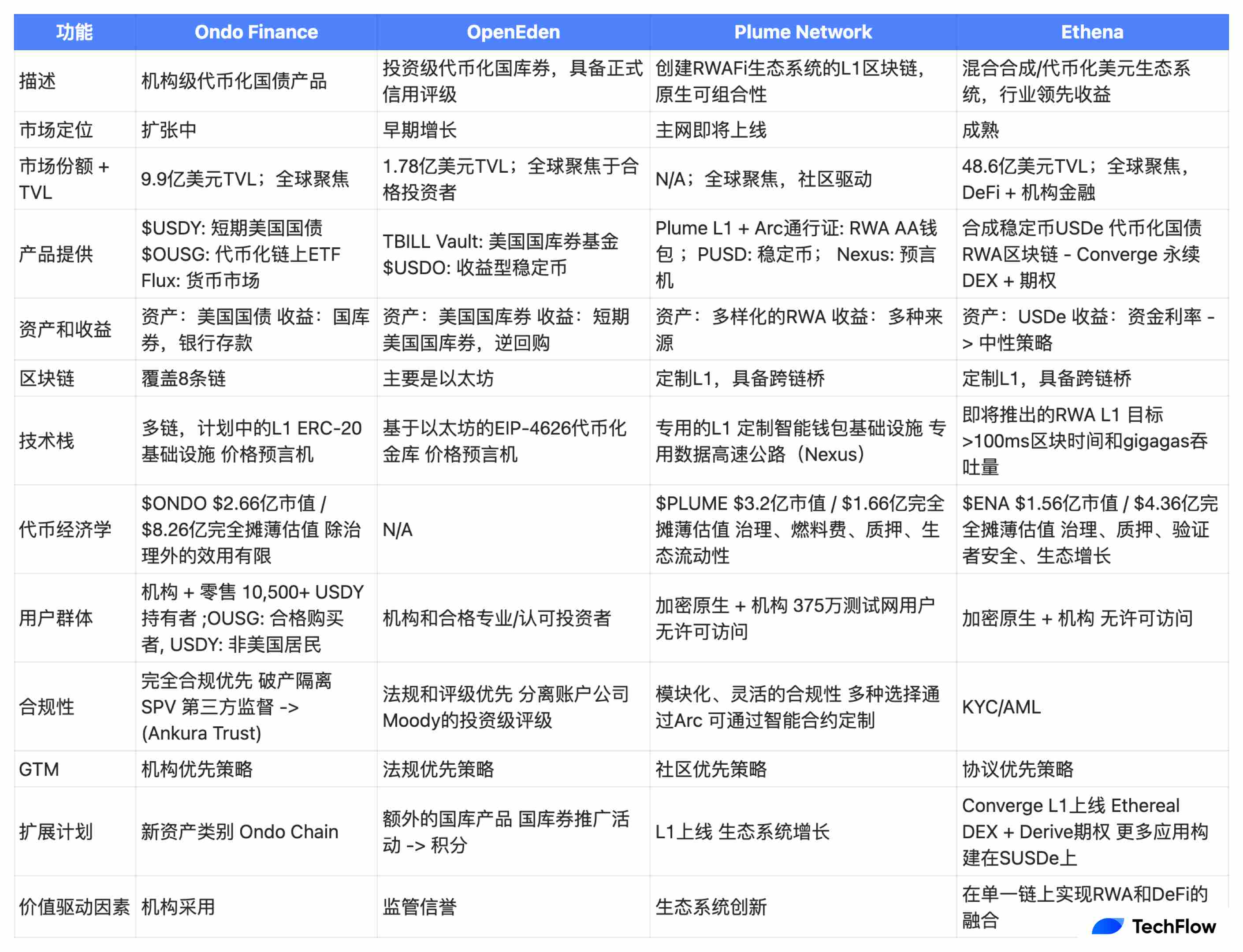
Image source: @ahboyash, translated by TechFlow
Join TechFlow official community to stay tuned
Telegram:https://t.me/TechFlowDaily
X (Twitter):https://x.com/TechFlowPost
X (Twitter) EN:https://x.com/BlockFlow_News
 @ahboyash