








Hayden Adams and the Story of Uniswap
TechFlow Selected TechFlow Selected
Hayden Adams and the Story of Uniswap
A cryptocurrency visionary transforming the way the world trades digital assets.
 Navigating Web3 tides with focused insights
Author: Thejaswini M A
Translation: Block unicorn
Prologue
July 6, 2017. A phone call from Human Resources.
Hayden Adams had been laid off after one year working as a mechanical engineer at Siemens. He had never quite fit into thermal flow simulation work. His performance had been underwhelming. The company was downsizing.
But the 24-year-old Adams felt only relief.
He had long questioned whether engineering was the right career path. The layoff forced a decision he had been avoiding.
One day, his phone buzzed. A text message from his college roommate.
Karl Floersch worked at the Ethereum Foundation. For years, he had preached about blockchain technology—smart contracts, decentralized applications—revolutionary stuff.
Adams had always tuned it out. Too abstract. Too strange.
Now unemployed and adrift, he decided to listen.
The call lasted three hours. Floersch painted a vision of the future: code without human oversight, money moving without banks, applications serving millions without corporate control.
This conversation planted the seed for Uniswap.
But first, he needed to convince himself that shifting from mechanical engineering to cryptocurrency made sense.
Ethereum's Evangelist
Adams saw uncertainty; Floersch saw opportunity.
Ethereum was still young—young enough that a motivated person could become an expert within months. The barrier to entry was low because few people understood the technology.
Adams had concerns. Beyond basic courses, he had no programming background. He had never built a website or written a smart contract. The prospect of switching from mechanical engineering to software development was daunting.
Floersch offered a framework: learn by building real projects. Instead of just taking online courses, Adams should pick a concrete project and see it through. Learning would happen naturally through creation.
Floersch explained how Ethereum worked, the importance of decentralized applications, and the problems that needed solving. He described an emerging ecosystem where small teams could build applications serving millions without traditional corporate infrastructure.
Despite skepticism, Adams found himself growing interested.
He made a decision. He would spend the next year learning to code and building something meaningful on Ethereum. By the end of the call, Adams was cautiously optimistic.
The Underground Lab
Adams moved back into his childhood bedroom in the New York suburbs.
His parents tried their best to support him. Their son studied mechanical engineering at Stony Brook University. He worked at a reputable company. Now he wanted to learn programming and build apps on something called blockchain.
The learning curve was steep. Adams watched JavaScript tutorials on YouTube. He read documentation for Solidity, Ethereum’s programming language. Concepts intuitive to computer science graduates required deep study for someone from a mechanical engineering background. He approached programming like any engineering problem: every function served a purpose in a larger system, every variable had meaning. Smart contracts were machines that transformed inputs into outputs according to predefined rules.
Progress was slow. Adams built simple contracts to store and retrieve data. He learned to deploy code to Ethereum’s test network. Each small success narrowed the gap between abstract concepts and practical implementation.
Floersch visited regularly, offering guidance and encouragement. During a visit in late 2017, he presented Adams with a specific challenge.
Vitalik Buterin, co-founder of Ethereum, had written a blog post about automated market makers (AMMs). The concept described a way to trade without traditional order books. Instead of matching buy and sell orders, traders would interact with liquidity pools managed by mathematical formulas.
No one had yet built a functional implementation.
Adams studied the idea. Market making involved complex systems with multiple participants, precise calculations, and real-time responses. The blend of mathematical theory and practical engineering intrigued him.
Floersch made a proposal: build a working prototype with a user interface within one month, and he would showcase it at the upcoming flagship Ethereum conference, Devcon.
Adams accepted the challenge. He had thirty days to learn web development, implement AMM logic, and create something worthy of presentation to the global Ethereum community.
The Protocol That Changed Everything
November 2, 2018. Adams prepared to deploy his smart contract onto Ethereum’s mainnet.
It had taken over a year to go from prototype to production-ready. What began as a one-month challenge proposed by Floersch had evolved into a comprehensive protocol refined through multiple iterations. The initial demo at Devcon 2 proved the concept’s feasibility. But Adams wanted to build a system robust enough for real users risking real money. The process included rewriting smart contracts, conducting security audits, and refining the user interface. Each improvement brought the system closer to launch.
Vitalik Buterin suggested rewriting the contracts in the Vyper language and recommended applying for funding from the Ethereum Foundation. The grant application process forced Adams to clearly articulate his vision.
A $65,000 grant provided funds for full-time development. Adams used the money to audit the smart contracts, build a production-grade interface, and prepare for mainnet deployment. Every detail mattered—users would be trusting the system with real money.
The core mathematical formula behind Uniswap is x * y = k.
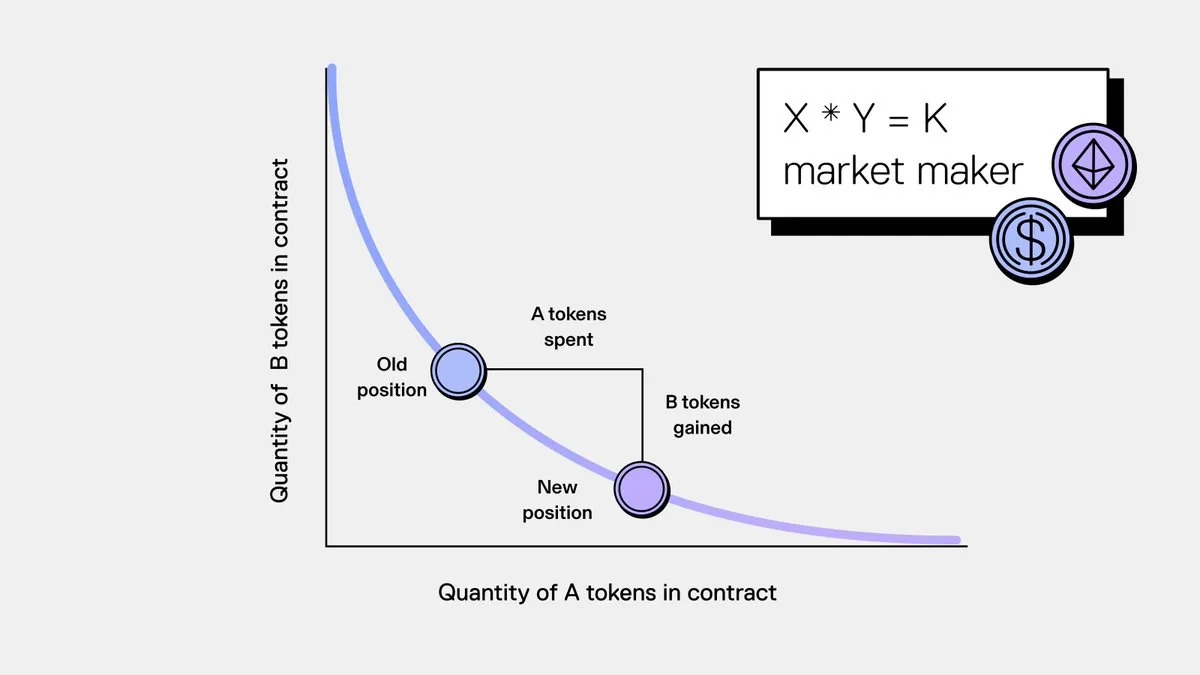
This constant product formula ensures that the product of the quantities of two tokens in a liquidity pool remains constant during trades. As one token becomes scarcer, its price rises proportionally.
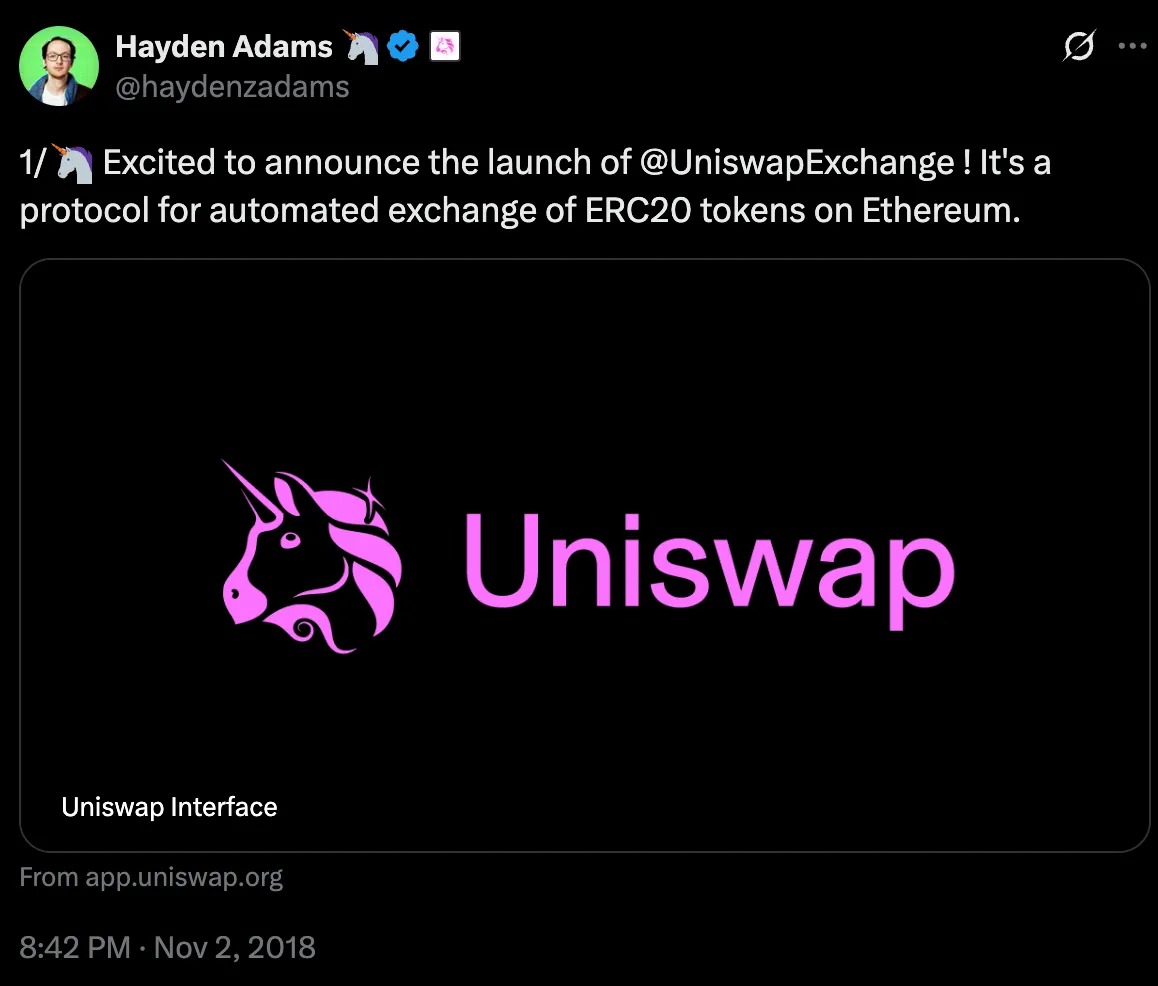
Adams deployed the contract during Devcon 4 in Prague. Launching at Ethereum’s largest conference would maximize visibility among developers and early adopters. He announced the deployment on Twitter to his roughly 200 followers.
Initial reactions were mixed. Some developers praised its elegant design and permissionless architecture. Others questioned whether automated market makers could compete with traditional centralized exchanges. Early trading volume was limited, confined mostly to curious developers and DeFi enthusiasts.
Adams anticipated such skepticism. Uniswap wasn’t designed to be more efficient than centralized exchanges but to offer trustless trading without intermediaries, permissionless token listings, and composable liquidity that other applications could build upon. Centralized exchanges rely on active market makers who constantly adjust liquidity amid price fluctuations. AMMs inverted this model by automating market making—eliminating the need for human market makers. Once a liquidity pool is deployed, the pool’s logic handles all market-making functions.
Tokens could be created without anyone’s permission. Therefore, there should also be permissionless ways to trade them, especially as new tokens launched on Ethereum. Centralized exchanges charged high listing fees and required lengthy approval processes. Uniswap allowed anyone to create a market by depositing tokens and earn fees from subsequent trades.
By early 2019, daily trading volume steadily grew. The protocol processed millions of dollars in transactions—without employees, offices, or traditional business operations. Adams had built a system that operated according to mathematical rules rather than human decisions.
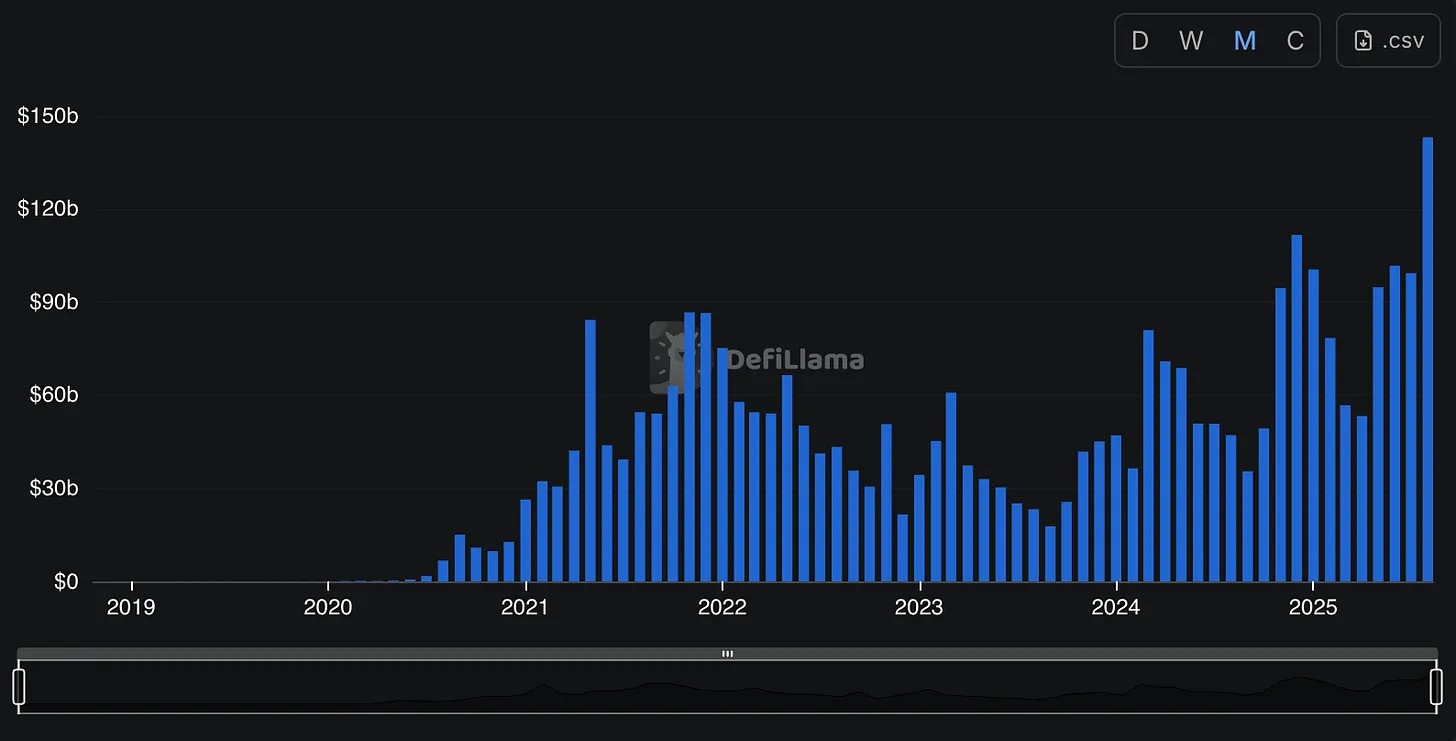
In the summer of 2020, DeFi (decentralized finance) reached a turning point.
DeFi Summer brought explosive growth to blockchain-based financial applications. Uniswap sat at the heart of this movement, providing infrastructure for a new generation of programmable money.
Adams watched trading volume surge from millions to billions of dollars per month. The protocol handled volumes exceeding many traditional financial institutions, all while remaining decentralized and permissionless.
Success attracted venture capital. Adams founded Uniswap Labs to formally assemble a team and accept institutional investment. The company raised $11 million in an A round led by Andreessen Horowitz, providing resources to accelerate development.
The second version, launched in May 2020, brought major improvements. The new contracts supported direct trades between any ERC-20 tokens, not just pairs involving Ether. They included price oracles usable by other protocols. Flash loans enabled users to temporarily borrow tokens within a single transaction.
These innovations unlocked use cases Adams hadn’t foreseen. Other developers built lending protocols, derivatives platforms, and yield farming strategies atop Uniswap’s infrastructure. The protocol became composable infrastructure that amplified innovation across the entire DeFi ecosystem.
The September 2020 launch of the UNI governance token marked another milestone. Adams and his team distributed 400 tokens to every address that had ever used Uniswap, creating one of the largest airdrops in crypto history. This retroactive distribution rewarded early users and aligned their interests with the protocol’s long-term success.
The third version, launched in May 2021, introduced concentrated liquidity. Liquidity providers could concentrate their capital within specific price ranges, increasing capital efficiency by up to 4000x for certain strategies. This innovation attracted professional market makers while maintaining accessibility for individual users.
Concentrated liquidity fundamentally changed how market making worked on Uniswap. Previously, liquidity was spread across all possible price ranges, leading to inefficiency. V3 allowed providers to define precise liquidity positions within expected trading ranges. This enabled more strategic positioning and better risk management. Liquidity providers could mitigate impermanent loss by concentrating positions and setting stop-loss mechanisms, making the market more sophisticated and professional.
Uniswap V3 attracted both professional market makers seeking advanced strategies and individual users benefiting from greater accessibility and capital efficiency.
Each iteration expanded Uniswap’s capabilities while preserving its core principles. The protocol remained permissionless, trustless, and censorship-resistant. Anyone could trade any token without sharing personal information or seeking intermediary approval.
Adams had built what traditional finance deemed impossible: a fully automated exchange processing billions of dollars in daily volume without human oversight.
On October 10, 2024, Uniswap Labs announced Unichain, an Ethereum Layer 2 network specifically designed for DeFi applications.
This blockchain marked Adams’ evolution from protocol developer to infrastructure provider. Building a dedicated network allowed Uniswap to optimize the entire tech stack for automated market making.
Launched on February 11, 2025, Unichain adopted Rollup-Boost technology. Trusted execution environments enabled private mempools and fair transaction ordering. This technical innovation addressed a long-standing problem in decentralized trading: Maximum Extractable Value (MEV).
In traditional blockchain networks, sophisticated traders could observe pending transactions and front-run regular users by paying higher gas fees. This practice extracted value from ordinary traders, increasing their transaction costs. Unichain’s private mempool hides transaction details before processing, while the trusted execution environment ensures transactions are ordered fairly by arrival time—not by how much the user paid.
The network processes transactions in 200-millisecond sub-blocks. This speed boost enables Uniswap to compete with centralized exchanges in latency-sensitive trading strategies. These technological advances reduce the amount of value extracted by sophisticated actors from ordinary users, creating a fairer trading environment.
Today, Uniswap processes over $20–30 billion in daily trading volume across multiple blockchain networks. The fourth version, launched in 2025, introduced hooks, allowing developers to customize pool behavior for specific use cases. The protocol continues to evolve while maintaining simplicity and accessibility.
Adams has remained focused on his original mission: making value exchange as simple and accessible as information exchange.
From a childhood bedroom to billions in daily trading volume, Uniswap has proven that decentralized systems can compete with traditional institutions.
This is the story of Uniswap. See you in the next article.
Join TechFlow official community to stay tuned
Telegram:https://t.me/TechFlowDaily
X (Twitter):https://x.com/TechFlowPost
X (Twitter) EN:https://x.com/BlockFlow_News






