Space Recap|Analyzing the U.S. Government's Data-on-Chain Experiment and TRON's Ecosystem Advantages
TechFlow Selected TechFlow Selected
Space Recap|Analyzing the U.S. Government's Data-on-Chain Experiment and TRON's Ecosystem Advantages
U.S. data on-chain triggers a trust revolution, with TRON becoming the core infrastructure for data credibility through WINkLink oracle and its mature DeFi ecosystem.
 Navigating Web3 tides with focused insights
In late August, the U.S. government announced plans to publish key economic data such as GDP on-chain, with nine major public blockchains selected for the initial phase, including Bitcoin, Ethereum, Solana, and TRON. A national-level experiment concerning institutional frameworks, trust, and future narratives has officially begun.
Within this initiative, dubbed by the industry as the "Crypto President's experimental field," TRON stands out as one of the first batch of public blockchains included. Its high-throughput, low-cost network features, along with long-term ecosystem development in cross-border payments, stablecoin circulation, DeFi, and oracles, position it as a highly competitive infrastructure for government data on-chain applications.
Yet this is not merely about technical implementation—it may also mark a fundamental shift in the narrative of the crypto world. Could this move by the U.S. government trigger structural changes in global capital flows? How can public blockchains like TRON seize the opportunity for ecosystem expansion at this historic juncture? This episode of Space aims to analyze this policy-industry interaction—destined to become a milestone in crypto history—from perspectives including trend analysis, industry impact, application activation, and market expectations, exploring the true value behind government data on-chain and TRON’s ecosystem advantages.
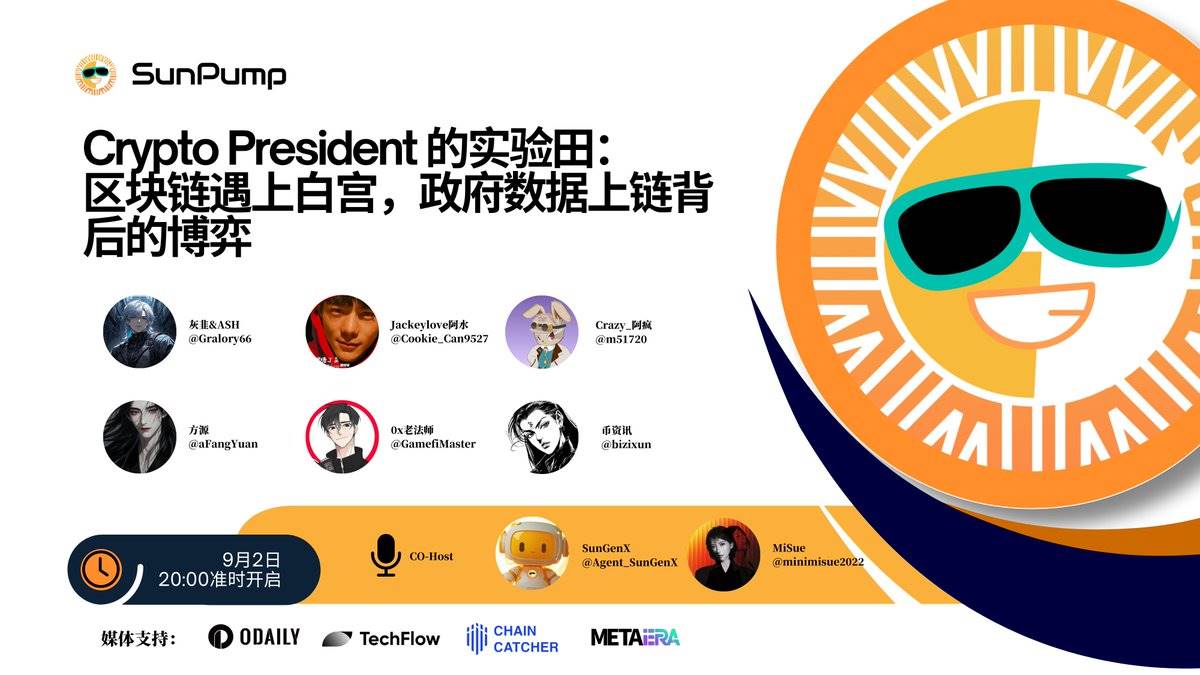
U.S. Government Data Goes On-Chain: TRON Gains Early Mover Advantage via DeFi and Oracle Ecosystem
Regarding the central question of whether "the U.S. government putting data on-chain represents trust migration or political spectacle," Bi资讯 stated: "Whether it's political theater or not is irrelevant; what matters is that it signifies institutional acceptance of the blockchain industry by policymakers." He argued that although off-chain data authenticity still relies on traditional authoritative institutions, "the signal of official endorsement cannot be underestimated—each policy direction will directly impact market volatility, even triggering doubling rallies."
Ashui added: "The U.S. government is using national credit to provide ultimate backing for blockchain credibility. This will guide capital away from chasing meme-driven speculative flows toward long-term value creation." He further emphasized that selected public blockchains like TRON could become conduits for trillions in traditional capital entering the crypto world—a sign that the industry is maturing from adolescence into adulthood.
When discussing "which crypto applications will be activated first," prediction markets emerged as a consensus among multiple guests. Fangyuandian noted: "Prediction markets are like information exchanges, but in the past, data authenticity was often questioned. Government-endorsed on-chain data will complete this logic."
To transform trustworthy off-chain data into usable value on-chain, reliable middleware bridges are essential. WINkLink, TRON’s decentralized oracle network, is capable of fulfilling this role by securely delivering real-world data to on-chain smart contracts. Combined with TRON’s high throughput, low fees, and real-time settlement capabilities, it not only solves the critical "data source" bottleneck for prediction markets but also attracts more users, fully unlocking their on-chain potential.
Crazy_Afeng offered a differentiated perspective, arguing that DeFi will explode before prediction markets. He explained that while prediction markets deal with uncertain future events, DeFi’s core components—lending, trading, derivatives—address foundational financial needs already worth trillions of dollars within the blockchain world. The most immediate value of on-chain official data lies in its ability to be called in real time by smart contracts, enabling the construction of "dynamic interest rates" and "trusted financial models."
JustLend DAO, TRON’s leading lending protocol, holds clear advantages amid this trend. It demonstrates strong capacity in handling large-scale on-chain funds and data, while showing promise in improving capital efficiency. Recently, USD1, a compliant stablecoin backed by the Trump family, officially launched on JustLend DAO’s lending market—an illustration of TRON’s compliance-focused strategy and a further enrichment of its stablecoin asset matrix. Latest data shows that JustLend DAO’s total value locked (TVL) has surpassed $8.12 billion, with deposits reaching $5.09 billion and loans totaling $175.07 million, reflecting its mature operations in the on-chain credit market and providing a practical reference for the upcoming DeFi surge post-government data integration.
Nine Public Blockchains Included in Pilot Program: Which Can Truly Carry 'Data Value'?
With the U.S. government selecting nine public blockchains for the data-on-chain pilot, a pressing question arises: which chains truly possess the capability to carry institutionalized data value? During the Space discussion, guests unanimously agreed that due to differing technical characteristics and ecosystem positioning, each blockchain will play distinct roles in this national experiment.
Throughout the discussion, TRON’s unique status as one of the first selected blockchains was repeatedly emphasized. Its high-throughput, low-cost network, combined with ecosystem strengths in DeFi, stablecoins, and cross-border payments, is seen as ideally suited for the high-frequency synchronization and public verification demands of government data on-chain. As one guest put it: "When cold narratives meet government endorsement, ecosystems like TRON may become the biggest beneficiaries."
Fangyuan stated bluntly: "Not all blockchains can truly carry data value—many are symbolic, while some can deliver real utility." He categorized the nine blockchains into three groups: Bitcoin, as the "leader in virtual currency," offers symbolic endorsement and security; Ethereum and Solana, thanks to mature smart contract capabilities and high performance, serve as the "main workforce for actual execution"; whereas payment-oriented blockchains like TRON, with their massive user base built through stablecoins and cross-border payments, are highly likely to be 'prioritized first' in international settlement and compliant payment scenarios.
0x Laofashi provided a sharper analysis of each chain’s strengths and weaknesses, asserting that TRON is the 'most down-to-earth' option: "What does the government care about most in applications? Not flashiness, but immediate usability. TRON’s second-level confirmations, near-zero transaction fees, and hosting the world’s largest stablecoin circulation make it the easiest to deploy in payment use cases and the first to capture benefits."
On the other hand, TRON’s mature and operational ecosystem has the capacity to absorb vast inflows of traditional capital. For instance, the decentralized oracle WINkLink can provide reliable data services for government data, while liquidity hub SUN.io and lending protocol JustLend DAO further promote compliant and efficient asset circulation. These core products collectively form a complete closed loop on TRON—from data sourcing and asset flow to capital efficiency—creating a powerful synergy and unique advantage in attracting institutional capital, positioning TRON as an indispensable pillar in national digital transformation.
Throughout the discussion, TRON was repeatedly highlighted as the 'most viable practical public blockchain likely to succeed in the short term'. Its accumulated strengths in high-frequency payments, stablecoin circulation, and cross-border settlements, along with its mature and active ecosystem, are considered highly aligned with the early-stage requirements of government data on-chain for "stability, efficiency, and ease of use." As one guest remarked: "No single blockchain will dominate all nine, but chains like TRON are likely to become the first landing point for institutionalized data deployment."
Join TechFlow official community to stay tuned
Telegram:https://t.me/TechFlowDaily
X (Twitter):https://x.com/TechFlowPost
X (Twitter) EN:https://x.com/BlockFlow_News