After farming for 3 months, only receiving $10: Should we cancel airdrops?
TechFlow Selected TechFlow Selected
After farming for 3 months, only receiving $10: Should we cancel airdrops?
The current state of airdrops is utterly terrible.
 Navigating Web3 tides with focused insights
Author: OxTochi
Translation: Chopper, Foresight News
I still remember the moment I received my first crypto airdrop—it felt like yesterday. It was 2020, and I was busy completing bounty tasks on Bitcointalk. One morning, I woke up to a WhatsApp notification. A friend had messaged me.
"Have you used Uniswap?" he asked. I replied, "Yes." Then he said, "You should be eligible to claim 400 UNI tokens—worth over $1,000 now." I immediately checked Uniswap's Twitter for the claim link, claimed it, and sold it right away.
That simple. Free money from the sky. No forms to fill, no Discord grinding, no nonsense about “contributions required.”
Looking back, that moment defined what airdrops were supposed to be: a surprising reward for users who genuinely love and use a product—not the worthless grind-fest they've become today.
The Golden Age of Airdrops
Later, I also claimed the 1Inch airdrop—any wallet eligible for UNI could claim it. But what truly reshaped my view of airdrops was the dYdX airdrop.
To participate, I had to bridge ETH into the dYdX protocol. At that time, most Layer2s were still just whitepapers, and cross-chain fees were insane. I made a few trades to generate some volume—not much—and then bridged my assets back out. Just one day of activity, and I ended up with a five-digit dollar airdrop. Even now, it feels unreal.
At its peak, the total value of airdrops I’d claimed exceeded $20,000. Honestly, I sold half along the way—after all, it’s “free money,” and cashing out is the natural instinct.
The dYdX airdrop gave me my first real capital, which I directly put into DeFi. During the “DeFi Summer,” I provided liquidity on Juldswap, earning roughly $250 per day. I really miss those days.
The Decline of Airdrops
Of course, such good times couldn’t last. After dYdX, I participated in airdrops from Scroll, Arbitrum, Optimism, and zkSync—the latter marking the beginning of my “terrible airdrop experiences.”
Yet, I’ll never forget the Scroll airdrop. Everyone had sky-high expectations, even though co-founder Sandy had famously tweeted to “lower your expectations”—but that didn’t dampen the hype.
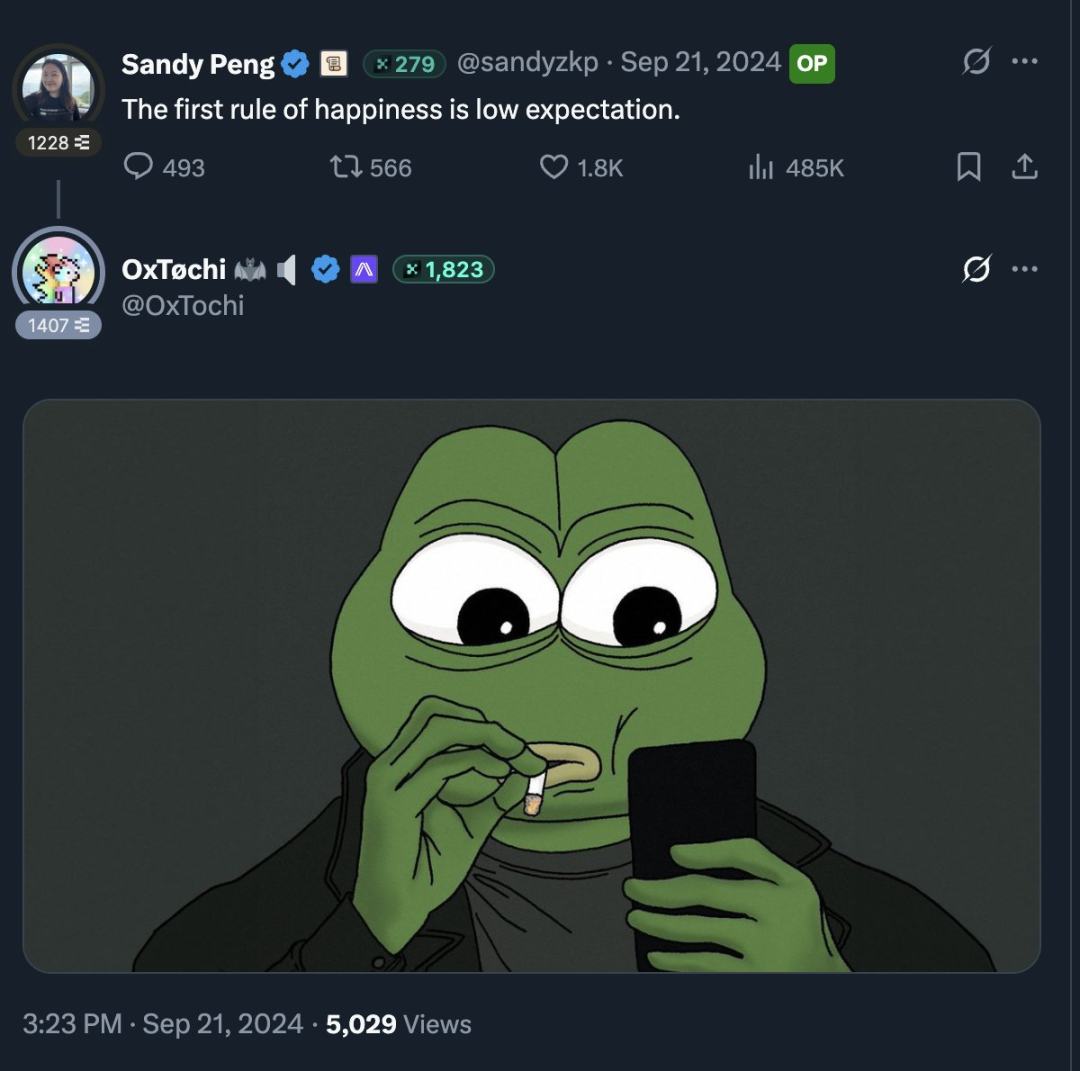
Expectations kept rising until disappointment finally hit. The Scroll airdrop allocation was absurdly low—downright laughable. The crypto community’s mood instantly crashed from anticipation to despair. Honestly, that airdrop left a scar. I swore then and there I’d never farm another Layer2 airdrop again.
If it had been just Scroll, maybe I could’ve accepted it. But what truly upset me was realizing: this kind of low-quality airdrop would become the norm.
The Current State of Airdrop Chaos
Fast forward to today, and the airdrop scene is a complete disaster. What was once a “surprise reward” has turned into industrial-scale witch hunting and farming operations.
You’re expected to spend months—or even years—interacting with protocols: bridging, providing liquidity, burning gas, building so-called “user loyalty”—and even then, receiving an airdrop depends on luck, and if you do get one, the amount is pitiful. Worse yet, we now see cases where “airdrop claims are only open for 48 hours.” Sunrise was probably the first to do this.
Even when you finally reach claim day, the allocation rarely justifies the time and cost invested. On top of that, many come with absurdly strict vesting schedules. Take 0G Labs’ airdrop: unlocked quarterly over 48 months—48 months! That’s four full years!
There’s so much garbage now that when I see tweets about “airdrop alpha,” my first thought is: “Oh great, another measly crumb.”
The Game Between Projects and Users
Here’s the truth: in recent years, user mentality has become purely “transactional”—no need to sugarcoat it. People now use products solely for rewards. Nobody spends hours clicking and contributing to a community just for some vague sense of ecosystem culture.
And projects? They say they want loyal users, but what they really want are impressive metrics for VCs—high user counts, large communities. These numbers let them inflate valuations in their fundraising pitch decks. So what emerges is a game of data farming versus anti-farming measures.
The result? Everyone ends up unhappy. Users feel cheated; projects struggle with user retention.
What Airdrops Should Be
If I were to redesign airdrops, I’d go back to the Uniswap model: no hype, no leaderboards—just one day, surprise loyal users with a genuine reward. Doing so alone would reduce industrial farming and temper unrealistic expectations.
Alternatively, take inspiration from Sui’s “pre-sale airdrop” model: set a reasonable fully diluted valuation (FDV), allowing early contributors and users to buy tokens under favorable terms.
The closest examples today are Cysic and Boundless. They use a tiered system, offering presale discounts based on users’ contribution levels within the ecosystem.
Or better yet, ditch airdrops altogether and focus energy on building truly useful products: create something with real product-market fit, establish solid revenue models—instead of copying and pasting the same thing 200 times. Honestly, that’s what truly serves the long-term interests of the crypto community.
Conclusion
The current state of airdrops is utterly broken. It fails both users who spend time grinding and projects trying to build real communities.
The end result? Everyone feels exploited. Maybe canceling airdrops and instead building products that let everyone profit is the better path forward?
Join TechFlow official community to stay tuned
Telegram:https://t.me/TechFlowDaily
X (Twitter):https://x.com/TechFlowPost
X (Twitter) EN:https://x.com/BlockFlow_News
 @OxTochi