Pantera Partner: Why the 2025 Crypto VC Landscape Is Different From Previous Cycles?
TechFlow Selected TechFlow Selected
Pantera Partner: Why the 2025 Crypto VC Landscape Is Different From Previous Cycles?
Strategic mergers and acquisitions and the IPO wave will continue into the next cycle.
 Navigating Web3 tides with focused insights
Author: Paul Veradittakit, Partner at Pantera Capital
Translation: Luffy, Foresight News
Summary
-
From the beginning of 2025 through present, cryptocurrency companies have raised over $16 billion and completed more than 100 M&A deals. The industry is on track to set new records, with transaction volumes already surpassing the full-year total of 2024.
-
This cycle is underpinned by clearer U.S. regulations and global growth momentum, making its foundation stronger than previous cycles.
-
Strategic mergers and acquisitions, along with a wave of IPOs, will extend into the next market cycle.
In 2025, record-level M&A and IPO activity are reshaping and accelerating the crypto industry, attracting new capital, institutions, developers, and users, fueling innovation and real-world applications on blockchain. This pattern has appeared during other major technological shifts: after decades of infrastructure development, explosive growth often follows. The rise of artificial intelligence benefited from decades of infrastructure investment, while the crypto industry is maturing far faster—leveraging more advanced technology stacks and superior tools to achieve compounding growth. As a result, the current market's internal dynamics are fundamentally different from past cycles: driven less by speculation and more by strategic integration.
Accelerating Momentum: What Makes This Cycle Different
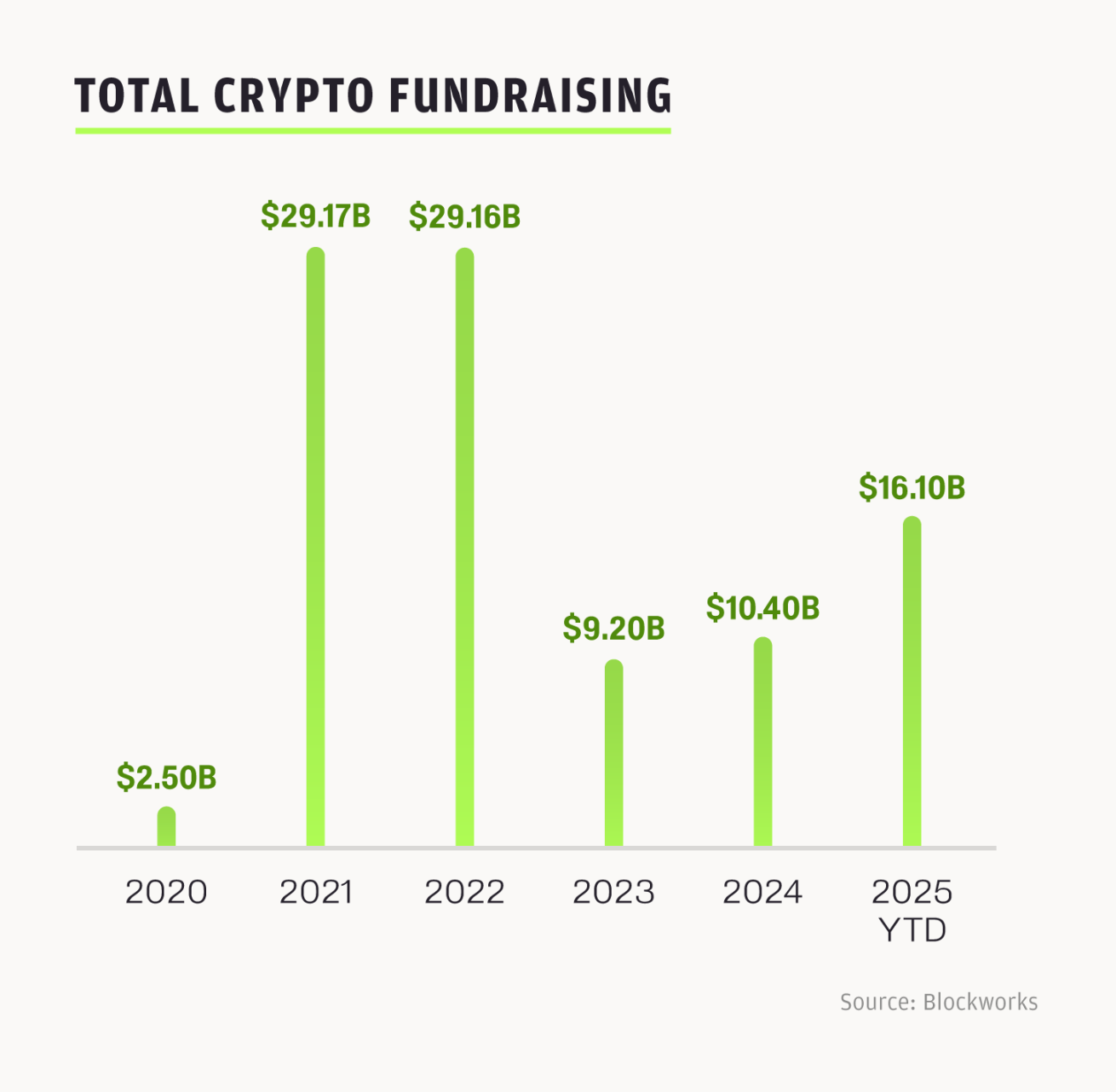
The trajectory of the crypto market fluctuates like a sine wave. Despite a slowdown in venture capital funding, deeper industry activity is actually bullish, driven by regulatory tailwinds, government support for crypto, strong deal flows, increased investments in crypto services by firms like Robinhood, and growing convergence between crypto and adjacent sectors.
After peaking in 2022, capital inflows dropped sharply in 2023, began recovering in 2024, and accelerated notably in 2025: in Q2 2025 alone, there were 31 deals exceeding $50 million each. Late-stage financings—including IPOs, M&As, and debt financing—have become the main drivers of growth. So far in 2025, the crypto market has attracted $16.1 billion in capital. However, crypto venture capital is following traditional VC trends: capital is concentrating among fewer funds. This concentration typically leads to larger individual investments but fewer overall deals, reflecting that many crypto companies are transitioning into growth stages and indicating that both founders and investors now face a more competitive fundraising environment than ever before.
A confluence of factors makes this cycle unique: recovering token prices, continuous product launches, increasing founder confidence, and favorable regulation providing clarity for stablecoins and digital assets—all unlocking additional capital. For years, regulatory ambiguity created friction between innovators and the Web3 space due to fears of potential penalties. The Trump administration’s pro-crypto stance, supported by initiatives like the Genius Act and the Clarity Act, has laid legislative groundwork for on-chain application deployment. While we cannot predict the long-term impact of these acts, it is certain that such discussions and actions will reduce hesitation around crypto investments at both cognitive and financial levels. Additionally, the Federal Reserve is expected to cut interest rates in November, which could drive more capital into risk assets, while Digital Asset Transaction Systems (DATS) will lock capital into long-tail assets. Investor risk aversion is gradually decreasing, and capital inflow enthusiasm continues to rise.
Investment allocation is shifting: one-third of capital is flowing into “bottom-up” opportunities such as perpetual contracts, token issuance platforms, prediction markets, and novel DeFi infrastructure protocols; the remaining two-thirds focus on “top-down” areas including DATS, tokenization of real-world assets (RWAs), exchange-traded funds (ETFs), and companies preparing for public listings. In this cycle, publicly traded assets dominate, enabling broader public access to crypto assets—a healthy signal for the industry. This balanced trend indicates that the market is maturing, valuing both innovation and integration with traditional finance.
The window for shaping a crypto legislative framework is narrow and currently open due to governmental support, likely lasting until the 2026 midterm elections. The DeFi Education Fund is actively protecting software developers—not only submitting feedback to the Senate Banking Committee’s Request for Information on Digital Asset Market Structure but also recently releasing a discussion draft of the Responsible Financial Innovation Act of 2025. Last week’s 2025 Wyoming Blockchain Symposium focused on digital asset regulation, emphasizing the urgency of establishing a clear U.S. crypto regulatory framework and building balanced market structures. Current government officials attended the event, whose agenda included advancing forward-looking regulation. Looking ahead to Q1 2026, we expect the regulatory foundation to be stronger than in any prior cycle, especially given the time constraints.
Token Listings and the IPO Market Rebound
In 2025, the number of new token listings has declined, and fewer newly issued tokens sustain price gains, dragging down downstream trading activity. Projects reliant on token issuance will find fundraising harder if they lack market appeal.
In contrast, the IPO window has reopened. In 2025, 95 companies have listed on U.S. exchanges, raising $15.6 billion by mid-June—an increase of 30% compared to 2024. IPOs by crypto-related firms like Circle and BitGo are setting trends, prompting investors to shift allocations from tokens to crypto equities. Circle’s listing on June 5, 2025, was a pivotal moment: priced at $31 per share, it rose to $233 by mid-July, delivering over 5x returns and reaching a market cap of $44.98 billion. Recently, Figure and Bullish also completed IPOs, with Bullish becoming the first company to raise $1.15 billion partially via stablecoins. BitGo plans to pursue an IPO and had already raised $100 million during the 2023 bear market, highlighting sustained investor interest. Today, crypto companies prioritize optimizing revenue and growth over speculative token launches.
The surge in crypto IPOs and other “top-down” sectors is attracting traditional investors through stable, revenue-driven business models rather than volatile cryptocurrencies. The IPO wave has only just begun, with many more companies expected to join in the coming months.
Mergers & Acquisitions and Industry Maturation
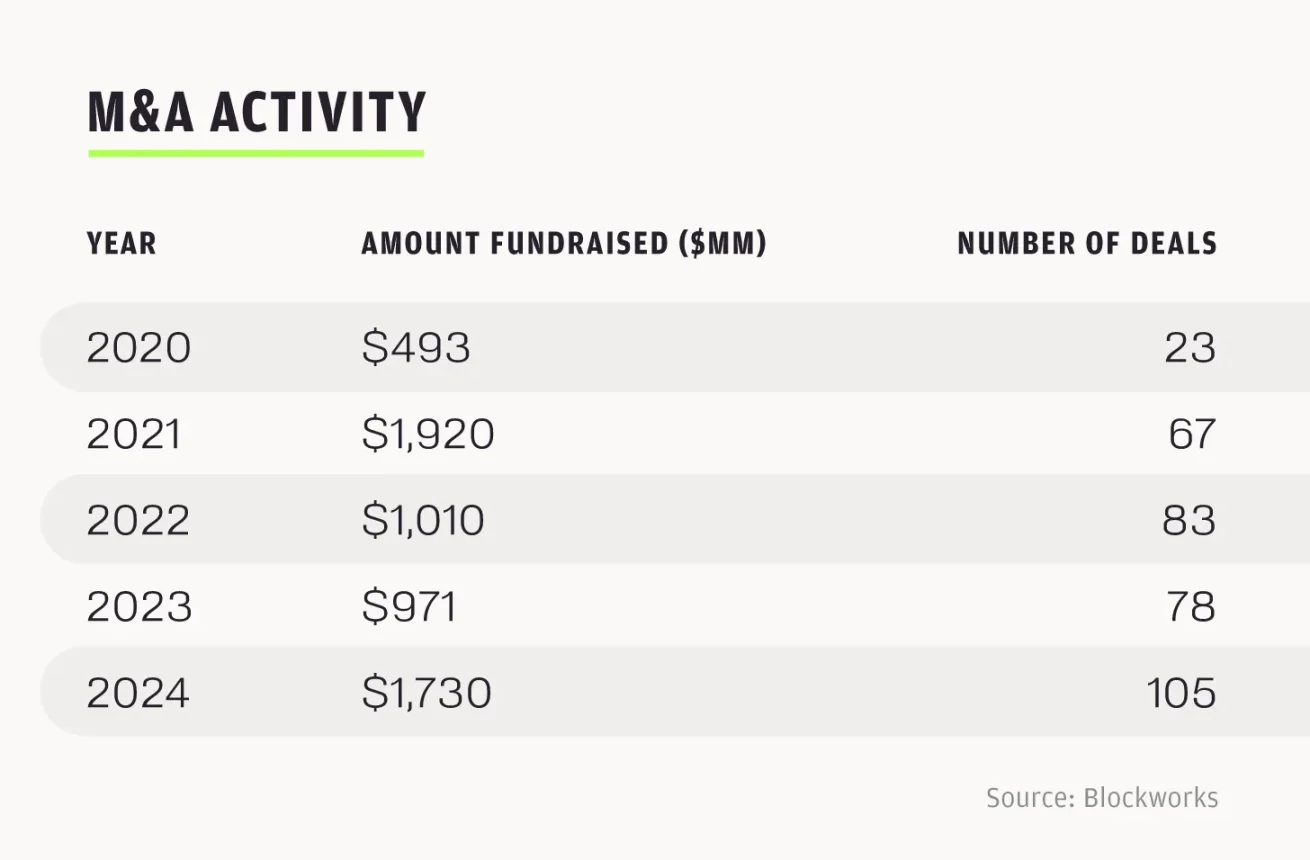
2024 was a record year for M&A, with over 100 deals totaling $1.73 billion. 2025 is on pace to exceed that number. From January to July 2025 alone, 76 deals worth $6.23 billion have been completed—3.6 times the full-year 2024 volume. At this rate, 2025 could see around 130 M&A transactions.
The M&A momentum in 2025 reflects organic industry maturation rather than pent-up demand. Strategic deals like Robinhood’s acquisition of Bitstamp show established players building integrated platforms. Robinhood’s multi-billion dollar bet on crypto adds credibility to the ecosystem. In Q2 2025, Robinhood’s crypto revenue surged 98% year-over-year to $160 million; total company revenue grew 45% to $989 million, with profits reaching $386 million. As a retail-focused stock trading platform embracing blockchain infrastructure, Robinhood underscores the industry’s shift toward mainstream adoption and compliant infrastructure.
Likewise, late-stage financing deals reflect a focus on “revenue-driven, compliant models.” For example, in Q2 2025, Securitize raised $400 million from Mantle for RWA tokenization; prediction market platform Kalshi raised $185 million at a $2 billion valuation. These moves indicate that the crypto industry is shifting toward collaboration with traditional financial institutions rather than chasing pure speculation.
Cross-Sector Convergence with Crypto
The crypto industry is no longer isolated—it is deeply integrating with cutting-edge technologies and the global financial system.
In artificial intelligence, OpenMind’s OM1 + FABRIC tech stack fills the “missing layer” in robotics by enabling decentralized coordination across robots; Worldcoin’s iris-scanning identity verification system, built on blockchain identity layers, may allow AI agents to autonomously authenticate and transact, solving key security challenges for AI agent interactions in crypto; decentralized AI platforms like Sahara AI (a decentralized version of Scale AI) and Sentient (a decentralized version of Hugging Face) are disrupting traditional AI infrastructure. While the application layer of crypto AI remains nascent, its potential could spawn entirely new market structures through on-chain agents and transaction systems.
In payments, stablecoins—especially Circle’s USDC—have become integral to the global payment system, and the Genius Act further accelerates USDC adoption. In Q1 2025, Circle’s revenue rose 58.6% to $579 million. Analysts project daily stablecoin transaction volume could reach $250 billion within three years; if growth continues, stablecoins may even surpass traditional payment networks like Visa within a decade. PayPal and Visa are exploring stablecoin integration, embedding them into mainstream payment channels. Robinhood’s collaboration with Arbitrum allows users to directly trade USDC on Arbitrum, lowering barriers for retail users. This partnership is just the beginning—Arbitrum plays a crucial role in expanding stablecoin use and demonstrates the value of Layer 2 solutions in bridging crypto and traditional finance.
This convergence across key industries brings together experts from AI, fintech, and consumer tech, blurring sector boundaries. As infrastructure for decentralized systems, crypto is increasingly becoming a critical layer in the global technology stack.
Looking Ahead
We anticipate that the market cycle from Q4 2025 through Q1 2026 will be structurally stronger. Unprecedented regulatory clarity, anticipated rate cuts, and substantial capital inflows from strategic M&As and IPOs are collectively building a solid industry foundation. This new momentum centered on “real-world utility” sets the stage for accelerated growth. Our strategy is to seize this opportunity by focusing high-conviction investments on Series A companies poised to define their respective fields.
From the start of 2025 through present, the U.S. IPO market has seen 224 IPOs. In H1 2024, there were 94 IPOs; in H1 2025, that number reached 165—an increase of 76%. In the first half of 2025 alone, there were 185 crypto-related M&A deals, projected to surpass 2024’s annual total of 248. Successful IPOs by prominent firms like Circle and acquisitions of crypto companies by traditional financial giants highlight the strength of the upcoming cycle.
The convergence of crypto with AI, payments, and infrastructure—combined with favorable regulation and strong investor interest—will propel the industry into an era of accelerated growth. Leveraging this momentum, we will continue strengthening crypto’s position as a pillar of global finance and technology.
Join TechFlow official community to stay tuned
Telegram:https://t.me/TechFlowDaily
X (Twitter):https://x.com/TechFlowPost
X (Twitter) EN:https://x.com/BlockFlow_News
 Pantera Capital