HTX Ventures Latest Research Report | Understanding Stock Tokenization: Opportunity or Trap?
TechFlow Selected TechFlow Selected
HTX Ventures Latest Research Report | Understanding Stock Tokenization: Opportunity or Trap?
Stock tokenization: the golden gateway to RWA or a gray trap in capital markets?
 Navigating Web3 tides with focused insights
Introduction
Stock tokenization is becoming the latest focal point where crypto intersects with traditional finance. With platforms like Kraken and Robinhood entering the space, the market is attempting to bring real-world assets such as U.S. stocks and ETFs on-chain, creating a global 7×24-hour on-chain capital market. As a leading industry exchange, this trend is not isolated but rather driven by the convergence of stablecoin popularity, the shadow dollar system, and the logic of real-world asset (RWA) tokenization.
The core logic is this: stablecoins have already built a global shadow dollar system, and stock tokenization is its natural extension—allowing non-U.S. users to directly access "shadow U.S. equities" via USDT, bypassing account opening, wire transfers, and cross-border settlements, forming an on-chain version of "Gray-scale Wall Street." This model unlocks new liquidity opportunities while simultaneously bringing regulatory and compliance risks to the forefront.
At the same time, another reverse path is emerging: on-chain assets are being restructured through compliant frameworks to enter traditional markets. Recently, a Nasdaq-listed company renamed itself Tron Inc., incorporating the public blockchain ecosystem and TRX into its core strategy—a signal that the integration of crypto assets with mainstream finance is no longer conceptual but gradually materializing within institutional frameworks.
Pie or trap? The answer depends on whether a closed loop can be achieved:
● Can real equity backing and transparent custody be delivered?
● Can liquidity and market-making be sustained long-term?
● Can regional compliance mechanisms keep pace with innovation speed?
This article, written by HTX Ventures, will analyze the models, key players, regulatory landscape, typical risks, and future evolution to help you determine: Is stock tokenization the golden gateway to RWA, or a gray-scale trap in capital markets?
1. Why Is Crypto Eyeing Stocks?
Since the inception of blockchain technology, nearly every asset that can be tokenized has already been or is currently being moved onto the chain. From early stablecoins to real estate, bonds, funds, and now increasingly popular tokenized stocks, each innovation aims to use blockchain to eliminate barriers and frictions inherent in traditional financial systems.
The core idea behind stock tokenization is converting traditional stock assets into digital tokens on a blockchain, enabling 24/7 global trading, fractional share purchases, and more efficient cross-border transactions. This model has gained attention because it directly addresses pain points faced by retail investors worldwide—especially those in emerging markets—such as difficulty opening U.S. brokerage accounts, remittance challenges, and mismatched trading hours.
However, stock tokenization is not a new concept. It briefly emerged in 2020 when exchanges like FTX and Binance attempted it, only to fail under strong regulatory pressure.
2. Lessons from Past Attempts: FTX and Binance
In 2020, FTX—one of the earliest exchanges to experiment with stock tokenization—partnered with German securities firm CM-Equity to purchase real stocks for custody, then issued tokenized versions as ERC-20 tokens (e.g., Tesla, Apple, Coinbase stocks) and sold them globally on its platform.
FTX’s initial trial was successful, attracting many retail investors from emerging markets. However, this model quickly drew scrutiny from European and U.S. securities regulators. Germany's Federal Financial Supervisory Authority (BaFin) and the U.S. Securities and Exchange Commission (SEC) issued strong warnings, stating that such activities constituted public securities offerings and required compliance with securities regulations and proper licensing. Unable to meet these requirements, FTX was forced to delist its stock tokens.
In 2021, Binance also launched a similar product, tokenizing Tesla, Coinbase, and Apple stocks using the same approach. But Binance’s effort was similarly short-lived, halting services under regulatory pressure from multiple jurisdictions.
The failures of FTX and Binance sent a clear message: the main challenge for stock tokenization lies not in technology, but in compliance and regulation.
3. Why Is Stock Tokenization Back in Focus?
Despite previous regulatory resistance, stock tokenization has re-emerged as a hot topic in 2024–2025. There are four primary reasons:
● Policy and political factors: In 2024, Donald Trump publicly supported cryptocurrency development, reigniting market hopes for moderate regulatory relaxation. SEC official Hester Peirce also expressed interest in regulatory sandboxes, creating policy flexibility.
● Entry of traditional financial institutions: Giants like BlackRock and Franklin Templeton have begun tokenizing funds and bonds, setting precedents and encouraging wider institutional participation.
● Matured technical infrastructure: Unlike in 2020, rapid advancements in blockchains like Solana, Base, and Arbitrum have significantly reduced on-chain transaction costs, improved speed, and enhanced liquidity.
● Strong ongoing retail demand: Retail investors in Southeast Asia, South Asia, and the Middle East still have high demand for U.S. stocks. Many hold large amounts of USDT but face barriers accessing traditional U.S. markets—stock tokenization fills this gap.
4. How Is Stock Tokenization Linked to the Shadow Dollar System and Stablecoin Trends?
Stock tokenization is the “second-layer evolution” of stablecoin-based on-chain dollars, transforming retail-held shadow dollars into shadow U.S. equities, turning RWA from “static custody” into “composable, dynamic assets.” The hotter stablecoins become, the more viable this path appears—but so does regulatory concern over the shadow dollar system.
Stablecoins Are the Global “Gray Channel” of the Shadow Dollar System
● Dollar-pegged stablecoins (USDT, USDC) are no longer just “crypto payment tools,” but rather “dollar replicas” bypassing traditional cross-border clearing networks.
● In many emerging markets, stablecoins represent local residents’ shadow claims on dollars. In countries like the Philippines, Pakistan, Argentina, and Vietnam, users may lack local currency but possess “dollars” through stablecoins.
● From a retail perspective: “Holding USDT ≈ holding dollar deposits,” but more flexible—they can easily enter and exit crypto trades or directly swap for stock tokens.
● Once stock tokenization emerges, it naturally becomes a new destination for stablecoins: USDT/USDC can directly track on-chain shadow prices of Apple/TSLA instead of first converting to fiat and opening accounts with U.S. brokers.
The Hotter Stablecoins Get, the More Runway for RWA (Real-World Assets)
● USDT’s circulation surpassed $115 billion in 2024, making it the world’s largest “dollar alternative”, with transaction velocity far exceeding traditional wire transfers.
● With highly liquid stablecoins available, on-chain RWA (bonds, funds, real estate, stocks) naturally needs new “reservoirs”; otherwise, USDT remains confined to CEX contract trading without connecting to real-world assets.
● Tokenized stocks are among the most intuitive and globally liquid RWAs—retailers understand the underlying assets, and market makers can quote based on real secondary markets, making them easier to trade than real estate, art, or receivables.
Shadow Dollar System + Stock Tokenization = “U.S. Stocks” as a Second-Layer On-Chain Dollar Asset
● From a regulatory standpoint, the combination of stablecoins and stock tokenization forms a “shadow dollar capital market”:
○ Stablecoins provide a shadow substitute for dollar currency;
○ Stock tokenization shadows the equity returns of U.S. corporations;
○ Together, they allow non-U.S. residents to trade “shadow equities” with “shadow dollars” 24/7.
● This setup bypasses U.S. broker systems, SWIFT settlement, and direct tax reporting (theoretically).
● Precisely for this reason, regulators remain highly sensitive—they’re watching “dollar influence spillover,” not just token mechanics.
This logic explains why Kraken, Bybit, Robinhood, and Backed dare to return in 2024–2025
● Stablecoins have been validated by global users (fast, convenient cross-border payments), and on-chain RWA now has backing from major players (BlackRock, Franklin Templeton).
● Kraken and others see an opportunity to bring retail users from the gray zone into the formal system via the shadow dollar framework.
● Robinhood’s pilot of tokenized stocks in the EU targets non-U.S. USDT traffic, capturing user segments previously unreachable via on-chain instruments.
5. Three Main Models of Stock Tokenization
Although “stock tokenization” sounds simple, it involves multiple implementation paths.
Depending on whether real stocks are held in custody and how tokens are issued and traded on-chain, current market practices can be categorized into three main models:
One is real stock custody + on-chain token issuance, two is Contract for Difference (CFD) model, and three is pure DeFi synthetic assets.
Each model has distinct advantages and drawbacks, with significant differences in regulatory exposure, liquidity design, and target user scenarios. Understanding these distinctions is fundamental to grasping the entire stock tokenization landscape.
Model 1|Real Stock Custody + On-Chain Issuance
This is the dominant model used by Kraken and Bybit today—and from a compliance standpoint, the most robust approach.
Operating Mechanism
● A licensed issuer or broker (e.g., Backed Finance, Dinari) purchases real stocks (e.g., Apple, Tesla) on traditional secondary markets.
● The stock assets are held by compliant custodians (e.g., BitGo, Anchorage) to ensure verifiable, auditable holdings.
● The issuer mints tokens on-chain at a 1:1 ratio (e.g., 1 Apple share = 1 AAPLx or bAAPL), deployable on networks like Solana or Base.
● Users on platforms like Kraken can buy these tokens with USDT, gaining indirect exposure to real-equity-linked on-chain assets.
Key Characteristics of the Model
While seemingly ideal, this model faces several limitations:
● Although linked to real shares, most tokens do not automatically confer voting rights or dividends. Robinhood, Kraken, and others explicitly state on their websites: "This is not shareholder rights."
● To redeem tokens for real shares, users typically must complete full KYC and follow redemption procedures, possibly paying additional fees. Some issuers don’t even support retail fractional redemptions.
● Therefore, the vast majority of users buy these tokens solely to capture price movements; very few exercise shareholder rights.
Why Are Kraken and Bybit Still Actively Pursuing This?
● Compliance buffer: Backed by real stocks and transparent custody, if regulatory pressure arises, responsibility largely shifts to the issuer (e.g., Backed).
● DeFi composability: Tokens are transferable on-chain and can be integrated across protocols—for example, Kraken’s AAPLx can be transferred to a Solana wallet and used as LP on Jupiter or for liquidity mining on Kamino.
● Greater appeal to retail: Compared to pure CFDs or synthetic assets, real-stock backing provides psychological reassurance, easing user education and adoption.
Special Case|Robinhood’s “Fully On-Chain Integration” Approach
Robinhood takes a more aggressive path, leveraging its own U.S. broker-dealer license, which already allows real stock trading and custody.
Currently, Robinhood is developing its proprietary Robinhood Chain, linking stock accounts directly on-chain to achieve integrated custody, issuance, and matching, while connecting with Bitstamp for global liquidity.
This model is akin to a “brokerage version of Binance Chain,” giving Robinhood full control over issuance, market-making, and data flow—all revenue, users, and traffic retained within its ecosystem.
However, such a highly closed-loop compliance architecture and technical barrier cannot be easily replicated by ordinary exchanges or wallet providers, whose cost structures cannot support such self-built ecosystems.
Model 2|Contracts for Difference (CFD): Simple Wrapper, Legacy Play
Compared to real stock custody, CFDs appear simpler and are currently one of the most widely adopted methods among exchanges.
Operating Mechanism
● Typical players include Bybit CFD, PrimeXBT, and others using similar structures.
● Users select instruments like “Apple CFD” via MT5, MT4, or Bybit’s built-in CFD interface to take positions on price movements.
● The platform—or external liquidity providers (LPs)—acts as counterparty, with no need to hold real stocks or physical custody.
● Spreads, slippage, and leverage parameters are set by the platform. The essence of trading is a price bet between users and the platform or LP, with no actual stock delivery or shareholder registration.
Why Is the CFD Model So Prevalent?
● Fast deployment: Only requires integration with mature LPs and real-time stock pricing feeds to go live.
● Lower compliance burden: Most jurisdictions classify CFDs as derivatives. As long as there’s no physical equity settlement, they fall outside the strictest scope of securities laws.
● High user acceptance: Crypto users are familiar with BTC/ETH futures; transitioning to stock CFDs involves no learning curve.
Bybit’s Dual-Track Strategy
Bybit’s recent strategy is particularly illustrative:
● On one hand, it partners with Backed to offer xStocks (e.g., AAPLx, TSLAx), targeting users who prefer “real stock backing,” directly competing with Kraken and Robinhood.
● On the other, it maintains its traditional CFD product line to serve speculative users seeking high leverage and 24/7 arbitrage opportunities.
This dual-track hybrid model enables Bybit to simultaneously serve conservative users wanting psychological assurance of real equity backing and high-frequency speculators chasing leverage—all within one trading system—maximizing both liquidity sources and user reach.
Risks: Common Issues Users Should Watch Out For
Despite ease of use, CFDs carry hidden risks:
● No shareholder rights whatsoever: CFDs grant no voting or dividend rights and aren’t tied to any shareholder registry.
● Counterparty is the platform or LP: User profits equal platform losses. If users trade too profitably, some platforms may adjust slippage or force liquidations to mitigate risk, increasing chances of blow-ups or widened spreads.
● Inherently a regulated “betting market”: Thus, CFDs are better suited for short-term volatility plays rather than long-term value holding.
Model 3|Pure On-Chain DeFi Synthetic Assets
Compared to the first two models, pure on-chain DeFi synthetics represent the most “fundamentalist” decentralized approach. Key examples include the early Mirror Protocol and the still-operational Synthetix.
Operating Mechanism
● Users deposit stablecoins (e.g., UST, sUSD) as collateral into smart contracts to mint synthetic assets.
● The protocol uses oracles to fetch real-time stock prices (e.g., Apple at $180).
● Smart contracts automatically mint corresponding synthetic stock tokens (e.g., “mAAPL”, “sTSLA”), which track price movements but don’t represent real ownership.
● Users can trade these tokens on DEXs (e.g., Terraswap, Uniswap, Curve), provide liquidity (LP), or combine them into indices or leveraged products.
Advantages
● Fully on-chain: No reliance on centralized matching or custody—issuance, transfer, and redemption are all automated via smart contracts.
● Flexible composability: Can integrate with other DeFi modules to enable collateralized lending, options, structured products, etc.
Limits and Risks
● No real equity backing: Synthetics rely entirely on oracle price feeds, lacking real stock ownership.
● High systemic risk: If oracles are attacked or fail, price pegs break, and contracts may become insolvent.
● Liquidity drought risk: Unlike centralized market makers, on-chain LP depth depends on continuous order placement and incentives. Without sustained rewards, liquidity can vanish overnight.
Mirror Protocol’s collapse is a classic case: after the Terra ecosystem imploded and UST lost its peg, Mirror’s synthetic stocks mAAPL and mTSLA became worthless.
Synthetix continues operating, with some sAAPL and sTSLA still usable on Optimism and its main protocol for collateral or synthetic debt pools. However, user base and TVL have shrunk dramatically compared to peak levels. Pure DeFi-style stock tokenization remains far less popular than stablecoins or ETH leverage use cases.
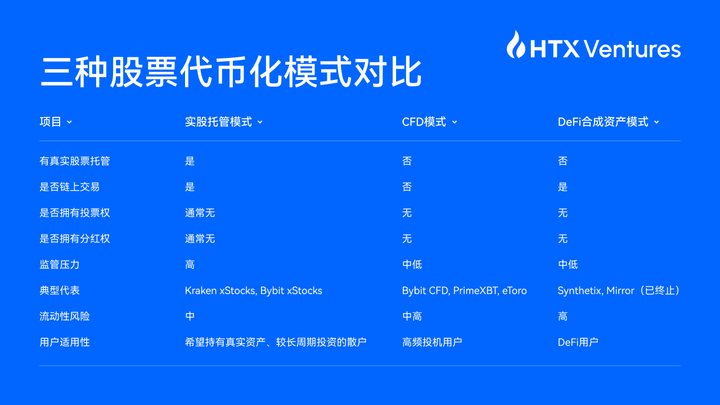
Comparison of Three Stock Tokenization Models
6. Key Players: Who’s Building This Ecosystem?
Behind this wave of stock tokenization, a clear supply chain has emerged: upstream issuance – custody – platform liquidity – end-user distribution.
Backed Finance: The Core Issuer Behind the Scenes
● Based in Switzerland, it is one of the most representative stock token issuers in the industry, purchasing real stocks through traditional brokers and using Chainlink’s Proof of Reserve (PoR) to disclose custody details in real time on-chain.
● Key clients include Kraken, Bybit, and Ondo. Backed’s stock tokens are seen as “compliant spot listings,” allowing CEXs to quickly launch them for retail investors.
● The key logic: the issuer assumes responsibility for securities compliance and custody, while CEXs only handle front-end KYC/AML, minimizing direct liability for securities issuance.
Ondo & Securitize: Alliance-Builders and Traditional Digital Securities Providers
● Ondo leads the “Global Market Alliance,” partnering with Solana Foundation, BitGo, Fireblocks, Jupiter, and others to build standardized solutions for cross-chain operations, custody, and liquidity.
● Securitize is an early player in the digital securities space, primarily helping traditional firms tokenize shares and connect with qualified investors—focused on B2B, not retail.
Dinari: Attempting Direct Compliance in the U.S.
● A U.S.-based team trying to obtain Reg D, Reg CF, and ATS (Alternative Trading System) licenses to directly comply with U.S. securities regulations, aiming to launch truly compliant tokenized stocks called “dShares.”
● Unlike Backed, Dinari hopes to eventually offer optional shareholder benefits (e.g., dividends), but faces immense U.S. compliance costs—broker licenses, custody, and legal teams require long-term investment.
● Currently, Dinari focuses on B2B partnerships, offering white-labeled stock token products to wallets or exchanges.
Kraken: A Veteran Compliant CEX Leading the Charge
● Kraken positions itself as a compliant CEX, emphasizing trust from users in Europe and North America regarding licensing and compliance.
● Its xStocks module integrates with Backed: Backed handles real stock custody, while Kraken provides matching, listing, wallets, and API connectivity. PoR is publicly verifiable, tokens are transferable to Solana, and can be used in LP/DEX for secondary liquidity.
● Kraken strictly observes compliance boundaries—blocking U.S. IPs and applying timezone-based KYC restrictions to avoid crossing SEC red lines.
Bybit: Dual-Track Hybrid, Balancing Spot and Derivatives
● Unlike Kraken, Bybit runs both real stock tokenization and CFD (Contract for Difference) product lines simultaneously.
● The CFD side connects with external LPs (e.g., IS Prime, Finalto) via MT5 to serve high-frequency speculators, earning spreads and fees.
● The real stock path partners with Backed to list xStocks (e.g., AAPLx, TSLAx), serving users who want “real stock backing,” enabling dual customer conversion on-platform.
Robinhood: Integrated Broker-Chain Model
● Robinhood holds a U.S. Broker-Dealer license, already enabling real stock trading and custody.
● It is building its own Robinhood Chain to move stock accounts on-chain, with proprietary wallets and matching systems. It first pilots in the EU (Robinhood Europe), tokenizing over 200 stocks and ETFs for EU users—bypassing U.S. regulation.
● Bitstamp provides liquidity bridging, allowing future use of tokens as collateral or in structured DeFi products.
● This “broker-on-chain” model creates a closed loop from issuance to custody, matching, and liquidity—greatly enhancing retention and data control—but requires massive compliance and capital investment, making it hard for smaller players to replicate.
Republic: Focused on Scarce Private Equity
● Unlike others focusing on public stocks, Republic emphasizes tokenizing scarce private company equity (e.g., SpaceX, OpenAI), often using SPV (Special Purpose Vehicle) notes to let retail investors access otherwise inaccessible private shares.
● Risks include potential authorization issues—OpenAI has stated Robinhood Europe’s related product launch was unauthorized, and the SEC has opened an investigation.
7. Global Regulatory Overview
United States: Securities Law Is the Hard Constraint
● Core principle: Stock tokenization ≠ non-securities. Mapping stocks to tokens and offering them to U.S. users triggers SEC securities regulations.
● Compliance requirements: To issue or sell stock tokens, entities need a Broker-Dealer license, ATS license, compliant custody, and disclosure frameworks—often requiring legal review.
● Regulatory stance: SEC’s position is clear: “Tokenization doesn’t change the nature of the underlying asset.”
● Historical precedent: FTX and Binance’s 2020–2021 attempts failed due to lack of full compliance, facing pressure from SEC, FINRA, and Germany’s BaFin, ultimately forcing delisting.
European Union: Dual Applicability of MiFID II and MiCA
● MiFID II: Any product involving securities sales to retail or institutional investors must strictly follow the Markets in Financial Instruments Directive—cannot evade obligations by calling something a “token.”
● MiCA: Though primarily targeting crypto and stablecoin licensing, if tokenized stocks have real equity backing, they may fall under MiCA oversight.
● Regional practice: Robinhood Europe has piloted in the EU using SPV structures; once securities characteristics are evident, exemptions or full disclosures must be filed per local rules.
Asia/Middle East: Gray-Zone Pilots Are Relatively Active
● Singapore’s MAS, Switzerland’s FINMA, UAE’s ADGM/DFSA have established RWA-focused regulatory sandboxes, allowing small-scale tokenization pilots—provided they target non-U.S. clients and qualified investors.
● Hong Kong takes a cautious view on security-like tokens; current RWA efforts focus on bonds, funds, structured notes—not yet open to stock tokenization at scale.
8. Real-World Use Cases | How Retail and Institutions Are Engaging
Stock tokenization isn’t just for retail investors.
From individual retail traders to high-frequency speculators, from mid-tier CEXs and regional wallets to traditional brokers and DeFi protocols—each finds their own entry point in this ecosystem.
1. General Retail Investors
● Direct use: Buy small amounts of xStocks with USDT to gain exposure to Apple, Tesla, etc., tracking price moves.
● Primary need: Solve the pain point of “wanting to try U.S. stocks but lacking a brokerage account.”
● Key awareness: Understand that holding the token does not make you a shareholder—it confers no dividends or voting rights.
2. High-Frequency Speculators
● Main goal: Capture short-term price swings and volatility arbitrage.
● CFDs are best suited: offer leverage, flexible hedging, T+0 closing.
● Key awareness: Understand slippage, leverage risks, and counterparty betting dynamics—avoid forced liquidation or blow-ups.
3. Mid-Sized Exchanges / Regional CEXs
● Without full broker licenses, adopt a “CFD + partnered tokenization” hybrid model.
● Offer front-end spot/CFD matching, partner with issuers like Backed or Dinari to bring in real-backed tokens, capturing gray-zone traffic and earning fee shares.
● Key awareness: Carefully define service regions to avoid high-regulation markets like the U.S.
4. Traditional Brokers
● Legally and financially capable brokers prefer the “build own chain + own license” model.
● Robinhood and Bitstamp are exploring this in Europe and the U.S.—using on-chain accounts and internal custody to capture both matching and custody revenue.
● Key awareness: Requires mature licensing, compliant custody, and multi-jurisdictional legal support.
5. Wallets / Agents
● In emerging markets, some wallets or OTC teams use white-labeled tokenized products, embedding tokens from Kraken or Backed into their own apps or mini-programs to earn traffic and commission.
● Especially effective in regions like Pakistan and the Philippines, where retail account access is difficult and gray-zone demand is high.
● Key awareness: Must partner with reliable issuers and ensure compliance integration to reduce regional regulatory risks.
6. DeFi Protocols
● Tokenized stocks can combine with on-chain bonds and stablecoins as key components in DeFi derivative strategies.
● Examples: Provide bilateral liquidity in LP pools, or use as collateral in lending protocols like Aave or Compound to increase leverage.
● Key awareness: Must ensure oracle and liquidation mechanism security to avoid risks like those faced by Mirror (oracle attacks, price failure).
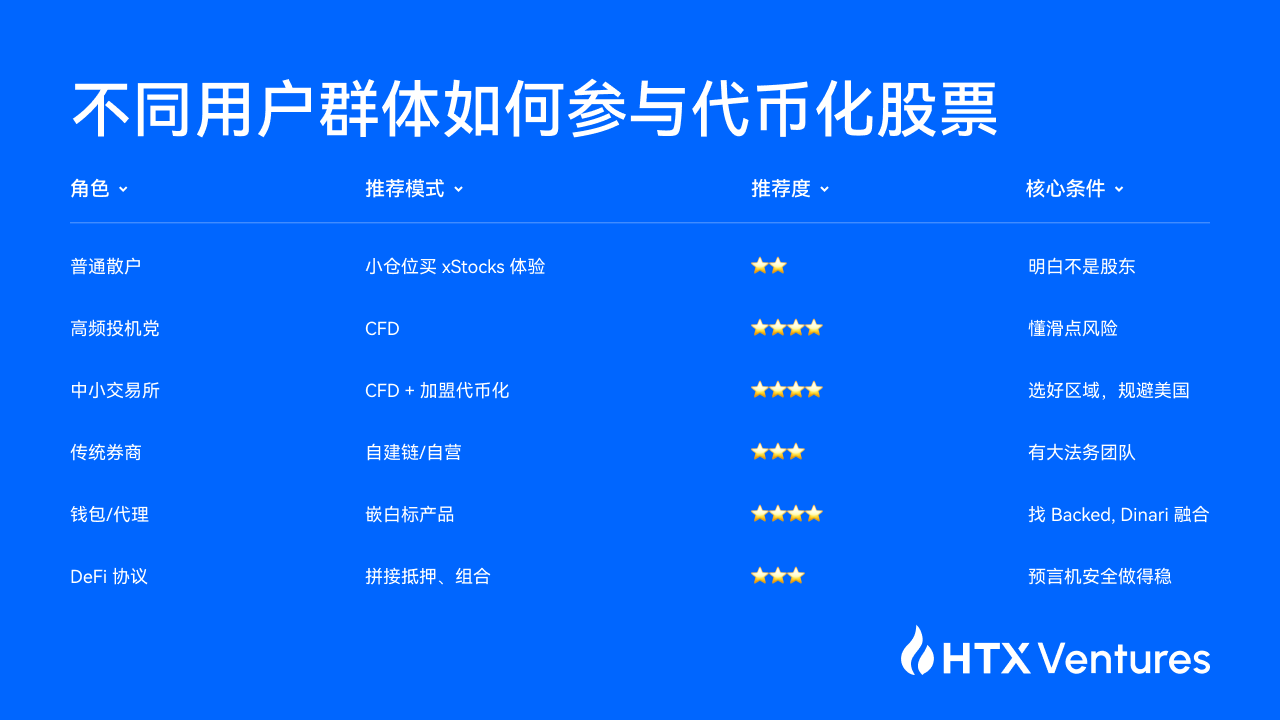
How Different User Groups Participate in Tokenized Stocks
9. Risk Factors | Truths and Common Pitfalls
Stock tokenization appears to offer a convenient channel for global users to trade U.S. stocks, but the hidden risks and operational hurdles are often underestimated. Below are five critical risks:
Risk 1|Most Tokens Don’t Include Shareholder Rights
Platforms like Robinhood, Backed, and Kraken clearly state in their FAQs:
“This token does not represent actual shareholder rights.”
That is, users hold only on-chain price-tracking instruments—not equivalent to traditional shareholders.
● Cannot automatically receive annual reports, attend AGMs, or vote;
● Dividends are usually excluded unless the issuer proactively implements profit-sharing—which is extremely rare.
Thus, most users hold only price shadows, not real shareholder status.
Risk 2|Real Stock Redemption Is Much More Complex Than Expected
Though theoretically 1:1 redeemable, practical redemption barriers are high:
● Often has minimum thresholds (e.g., at least 1 share, some require 100+);
● Includes cooling-off periods lasting 30–90 days;
● Requires full KYC again, including proof of address;
● Usually incurs fees (0.5%–2% of face value).
Therefore, most retail users rarely attempt redemption in practice.
Risk 3|Insufficient Liquidity Can Lead to “Empty Pools”
Though listed on-chain pools or CEXs, actual order depth is often limited:
● For example, Backed’s AAPL and TSLA LP pools on Solana typically hold only a few million dollars;
● Day-to-day market-making relies heavily on a few players like Kraken and Bitstamp;
● If major market makers exit or exchanges delist tokens, users may only trade via OTC—significantly increasing liquidity risk.
Risk 4|Oracle Failure Is the Core Risk for On-Chain Synthetics
Pure DeFi synthetics depend on Chainlink, Pyth, or other oracles to sync real-time prices. If fake prices, API distortions, or oracle manipulation occur, synthetic tokens lose accuracy:
● Classic case: Terra’s Mirror Protocol—after UST de-pegged and LUNA collapsed, oracle failure caused mAAPL and mTSLA to drop to zero.
Risk 5|Cross-Border Compliance and Regulatory Blocks Could Trigger Anytime
If a stock tokenization project serves U.S. residents or conducts cross-border securities sales, it may trigger SEC, FINRA, or other regulators:
● Robinhood Europe’s launch of unauthorized OpenAI and SpaceX tokenized equities led to OpenAI issuing a statement denying authorization and triggering regulatory investigations;
● Precedents like Binance and FTX show the risks—forced delisting in the former, bankruptcy in the latter due to compliance failure.
10. Future Scenarios | Possible Evolution Paths
As part of real-world asset (RWA) tokenization, stock tokenization is only at the beginning. Over the next three years, it may evolve along three main paths:
Scenario A|Brokerage On-Chain, Self-Contained Closed Loop
Robinhood is likely to double down on its all-in strategy: building its own blockchain, holding compliant licenses, managing real stock custody, issuing tokens on-chain, and integrating matching and settlement.
If the SEC offers more regulatory flexibility, Robinhood could achieve a “brokerage + wallet + chain” trifecta.
If realized, this would be a “compliant version of Binance Smart Chain,” differing in that its underlying assets are real stocks and ETFs, not purely native crypto assets.
Scenario B|Regional Gray Markets, Early Breakthroughs
Abu Dhabi, Singapore, and Switzerland have incorporated RWA into official innovation pilots, allowing early exploration of gray-market assets like tokenized stocks.
In the future, more “region-specific models” may emerge:
● Americas and EU dominated by local licenses and homegrown brokers;
● Middle East, Southeast Asia, Africa may become major global hubs for gray-market stock tokenization.
Platforms like Kraken, Bybit, and Ondo are expected to aggressively expand into these gray zones, targeting non-U.S. user flows and regulatory flexibility.
Scenario C|DeFi Assembly and Composability Path
If DeFi rebounds in the next cycle, tokenized stocks could become modular “financial Lego” components in on-chain RWA strategies.
● For example, tokenized bonds (Ondo T-bills), stock tokens (Backed AAPLx), and stablecoins (USDC) could be bundled into on-chain structured notes or index products.
● Stock tokens could enter LP pools for bilateral market-making, deepening on-chain capital efficiency.
● Users could collateralize these assets in Aave, Compound, etc., to unlock higher leverage, creating complex DeFi yield scenarios.
Once this DeFi assembly chain works, on-chain RWA will transcend mere token listing or one-way transfer—becoming a closed-loop ecosystem of collateralizable, composable, and reconfigurable liquidity.
Scenario D|Non-Compliant Perpetual Contracts and Gray Matching
Beyond mainstream compliance and DeFi assembly, a gray segment persists:
If global regulatory pressure remains fragmented, small platforms may emerge offering non-compliant stock perpetual contracts.
● These may operate as CEXs or anonymous on-chain derivatives protocols, directly connecting retail capital flows, using USDT to match stock perpetuals.
● Similar to CFDs, but with higher leverage, auto-renewal, no need for real stock custody—pure price betting.
● Some may wrap front-ends on-chain (e.g., cross-chain Dex or anonymous pools), using on-chain liquidity and anonymous accounts to attract high-risk users while reducing compliance traceability.
If demand for leveraged, short-term stock token trading remains high, these non-compliant matching and perpetual models could temporarily thrive in niche markets as gray supplements to circumvent regulation and serve speculative demand.
Yet, risks are high:
Any involvement with cross-border flows or U.S. users could trigger enforcement by SEC, CFTC, or other regulators. Users face risks of sudden liquidity cuts, platform exit scams, or extreme slippage.
11. Reverse Convergence: When On-Chain Assets Enter Stock Markets
If “stock tokenization” represents traditional assets going on-chain, then recent events suggest the reverse trend is starting: on-chain assets are now attempting to enter traditional finance, seeking legitimacy in mainstream capital markets through compliant, structured approaches.
On July 25, SRM Entertainment, a Nasdaq-listed company, officially changed its name to Tron Inc. and adopted the new ticker TRON. The company announced it would divest its toy business and restructure its core assets around the TRX treasury strategy of the TRON DAO ecosystem, adopting TRON’s native token TRX as its primary strategic reserve. It currently holds over 365 million TRX, managing staking and yield generation via on-chain protocols like JustLend.
On the announcement day, Tron Inc.’s stock surged over 55%, becoming a market sensation. This isn’t just a flashy crypto backdoor listing—it marks native on-chain assets exploring new compliant financial structures.
Note: This isn’t the first time a public company disclosed crypto holdings. As early as 2020, MicroStrategy became known for buying BTC and including it in financial statements; Tesla, Block, Coinbase have also listed BTC, ETH, or stablecoins in their filings. But Tron Inc. differs:
● It’s one of the few listed companies making a public chain token (TRX) its core asset and incorporating on-chain ecosystem development into corporate strategy;
● The project isn’t directly controlled but uses DAO governance and advisory structures for “shadow control,” experimenting with integrating on-chain governance and traditional equity frameworks;
● Its asset operations rely more on on-chain protocols (e.g., JustLend), with earnings mechanisms leaning toward Web3.
This goes beyond capital play—it’s active narrative reconstruction: turning token assets into financial units recognizable, valuably measurable, and compliant within traditional finance. After stablecoins and crypto treasuries, this may be the next testbed for public chains to connect with TradFi.
Thus, we see stock tokenization and asset tokenization forming a “two-way nesting”:
● One side: U.S. stocks, bonds, and other real-world assets go on-chain, enriching on-chain finance with real-world anchors;
● The other: Native crypto assets enter mainstream capital markets via compliant paths, gaining incremental liquidity and institutional credibility.
This trend is no longer theoretical—it’s taking shape through Kraken, Bybit pushing real stocks on-chain, and Tron Inc. backdoor listing. Together, they sketch a nascent “on-chain Wall Street”—a bridge between decentralized asset structures and traditional market frameworks.
Whether a true closed loop can form depends on market-making strength, regulatory flexibility, and institutional design. But one thing is certain: the boundary between crypto and stocks is being rewritten.
12. Conclusion | Pie or Trap? Depends on Closure and Structural Design
From Kraken, Bybit, and Robinhood pushing real stocks on-chain, to Backed, Dinari, and Ondo playing compliant issuance roles, to Tron Inc. representing “on-chain assets entering traditional markets”—the core competitiveness of this round of structural transformation has never been just about smart contracts or product formats, but about whether a complete on-chain financial closed loop can be built.
Macroscopically, this model is a second-layer extension of the stablecoin system:
Stablecoins let global retail bypass traditional banking settlements; stock tokenization connects shadow dollars to “shadow U.S. equities”; together, they form an on-chain “gray-scale Wall Street,” breaking down closed real-world capital markets into 7×24-hour, composable, modular on-chain markets.
But for this model to truly work, it needs clear accountability and stable compliance backing:
Real equity backing prevents empty speculation; transparent custody and issuance build user trust; sustained market-making ensures on-chain depth; regional licenses and cross-border compliance hedge against SEC, EU, or local regulator constraints.
If any link breaks, user-held tokens could lose real value, becoming isolated assets with no rights and no redemption.
For retail, stock tokenization might just be a speculative gray-zone testing ground—the real shareholder identity and long-term returns still reside in traditional brokerage systems.
For mid-tier CEXs, wallets, OTCs, and DeFi protocols, it may be the fastest way to activate stablecoin liquidity trapped in wallets and rapidly connect to the RWA赛道.
And in reverse, Tron Inc. offers a bold yet realistic possibility: bringing crypto into traditional capital markets, shaking hands with stocks at the institutional level.
Pie or trap—ultimately depends on who can build a two-way, composable, implementable closed-loop structure. Only those who truly run this path to completion will catch the next wave of asset and liquidity dominance.
About HTX Ventures
HTX Ventures is Huobi HTX’s global investment arm, integrating investment, incubation, and research to identify the world’s most talented and visionary teams. As an industry pioneer, HTX Ventures has over 12 years of blockchain-building experience, excelling at identifying cutting-edge technologies and emerging business models in the space. To drive growth within the blockchain ecosystem, we offer comprehensive support to projects, including fundraising, resources, and strategic guidance.
HTX Ventures currently supports over 300 projects across multiple blockchain sectors, with select high-quality projects already listed on Huobi HTX. Additionally, as one of the most active FOF funds, HTX Ventures invests in 30 top global funds and collaborates with leading blockchain funds such as Polychain, Dragonfly, Bankless, Gitcoin, Figment, Nomad, Animoca, and Hack VC to co-build the blockchain ecosystem. Visit us.
For investment and collaboration inquiries, please contact [email protected]
Join TechFlow official community to stay tuned
Telegram:https://t.me/TechFlowDaily
X (Twitter):https://x.com/TechFlowPost
X (Twitter) EN:https://x.com/BlockFlow_News
 @Ventures_HTX